AI Agents for Oil and Gas: Transforming Operations with Fluid AI

TL;DR
AI agents for oil and gas go beyond answering questions. Fluid AI’s AI agents for oil and gas can understand a task, read SOPs and manuals, connect to SAP, SCADA and ERP, create work orders, track suppliers, flag safety risks and complete full workflows. But real deployment in oil and gas needs more than an AI model. It needs system connections, safety rules, human approval, audit trails and on-premise deployment. Fluid AI brings all of this together in one enterprise agentic AI platform built for oil and gas.
Introduction: Why AI Agents for Oil and Gas Matter Now
Most AI in oil and gas started with a simple idea: ask a question, get an answer.
That was useful. But it did not solve the real problem.
Someone still had to do the work.
An engineer could ask AI why a pump stopped. But someone still had to check the data, open the maintenance system and raise a work order.
A safety officer could ask AI to summarise incident reports. But someone still had to file the report, inform the team and track the follow-up.
A procurement team could ask AI about a delayed order. But someone still had to call the vendor, check SAP and update the plant.
AI agents for oil and gas change this.
Instead of stopping at an answer, an AI agent in oil and gas can understand the goal, break it into steps, pull the right data, use the right systems, take action and ask a human when needed.
This is what Fluid AI’s AI agents for oil and gas are built to do.
For oil and gas companies, the question is no longer “What can AI tell us?”
The better question is:
How do we use AI agents for oil and gas to finish real work, safely and at scale?
This guide explains what AI agents for oil and gas are, how they work, where they help, how to set them up and how Fluid AI makes them production-ready.
What Are AI Agents for Oil and Gas?
AI agents for oil and gas are AI systems that can understand goals, plan tasks, use oil and gas systems and tools, and complete multi-step work with the right level of control.
Normal AI gives you an output.
An AI agent for oil and gas gives you an outcome.
Take this example. A shift engineer asks:
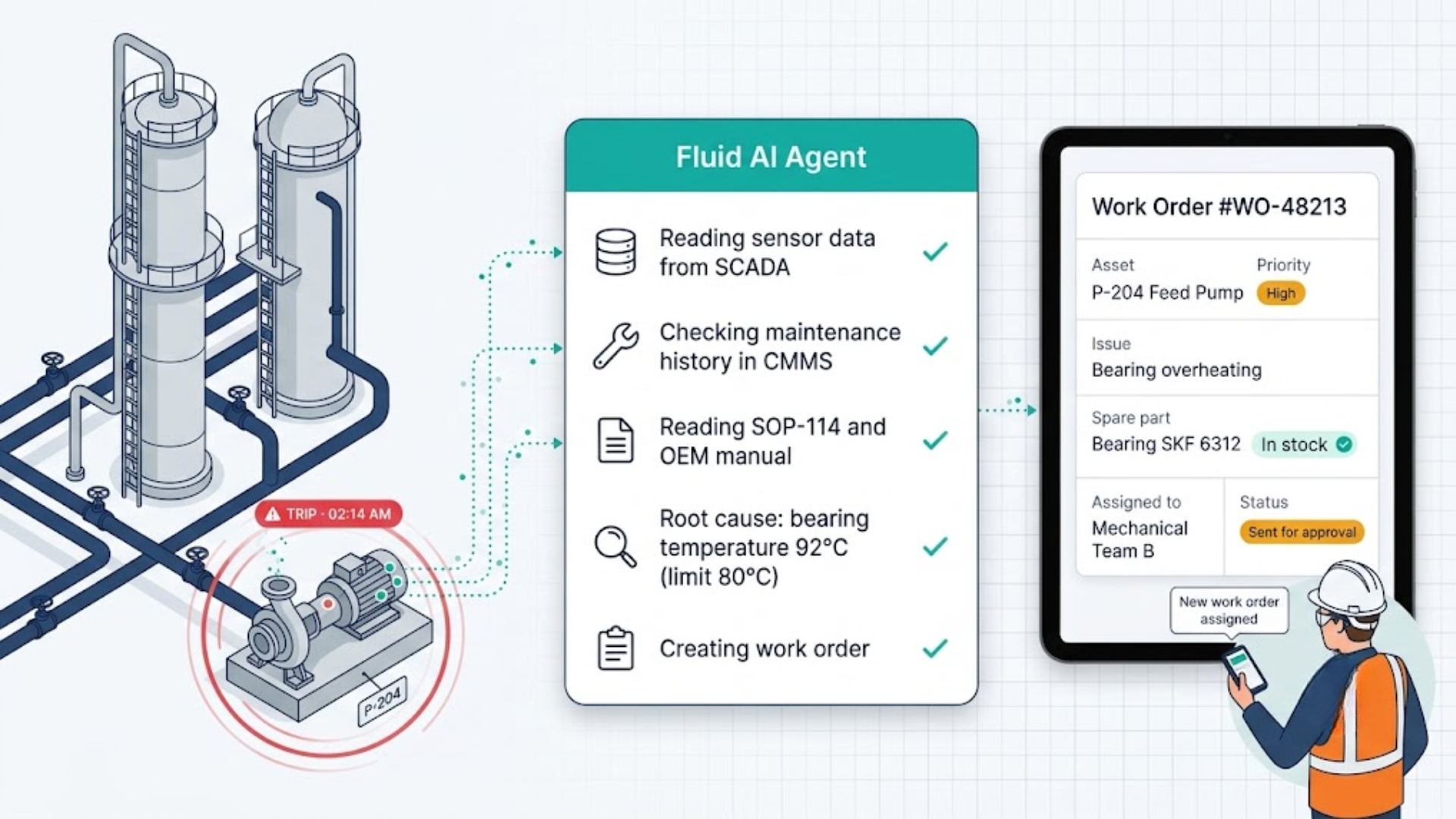
“Pump P-204 tripped last night. Find out why and fix it.”
A normal AI assistant might list common reasons a pump trips.
Fluid AI’s AI agent for oil and gas can:
Understand the request
Pull the trip data from the plant system
Check past maintenance records
Read the right SOP and OEM manual
Compare readings with safe operating limits
Find the most likely cause
Create a work order
Check if spare parts are in stock
Send the work order for approval
Inform the shift supervisor
Record every step
The difference is action.
Fluid AI describes this as AI agents that can plan, reason and execute multi-step workflows across oil and gas systems, while following company safety rules and policies.
This makes AI agents for oil and gas very different from a chatbot that sits outside the plant’s real systems.
AI Agents vs Chatbots vs Automation in Oil and Gas
Many oil and gas companies already use chatbots, dashboards and rule-based automation. These tools are useful, but they solve different problems.
Chatbots answer questions. They help people find information.
Dashboards show data. People still need to read them and decide what to do.
Rule-based automation (RPA) follows fixed steps. It breaks when something unexpected happens.
AI agents for oil and gas understand context, make decisions within rules, use many systems and take action. They can handle exceptions and know when to ask a human.
The goal of Fluid AI’s AI agents for oil and gas is not to replace every existing tool.
It is to add a smart layer that connects them and gets work done.
How Do Fluid AI’s AI Agents for Oil and Gas Work?
An AI agent for oil and gas is not just an AI model connected to one system.
It is a full system made of several layers.
Here is a simple view:
Field alert, user request or business event
↓
Fluid AI agent orchestrator
↓
Reasoning and planning
↓
Oil and gas knowledge (SOPs, manuals, records)
↓
Tools, APIs and MCP
↓
SAP / SCADA / ERP / CMMS / databases
↓
Action
↓
Approval and checks
↓
Audit and monitoring
Each layer has a clear job.
1. Interaction Layer
AI agents for oil and gas can receive requests from many places:
Voice
Chat
Email
WhatsApp
Web apps
Internal company apps
Plant and system alerts
This matters because oil and gas work does not start in one place.
A field engineer may call in.
A plant manager may send an email.
A sensor may raise an alarm.
A dealer may send a WhatsApp message.
Fluid AI’s AI agents for oil and gas respond to all of these and keep the context across channels. A field engineer at a remote site can simply speak to the agent in their own language. Fluid AI supports 60+ languages.
2. Reasoning Layer
The reasoning layer understands what the user wants and decides what needs to happen next.
For example:
“Find all delayed spare part orders that could affect next week’s refinery shutdown plan.”
This is not one simple search.
The AI agent for oil and gas may need to:
Find all open purchase orders
Check supplier delivery dates
Compare them with the shutdown plan
Check current stock
Find which parts are critical
Rank the risks
Suggest next steps
This is where AI agents in oil and gas are different from simple question and answer tools.
3. Planning Layer
The AI agent turns a goal into a list of steps.
For example:
Goal: Close a safety incident report.
Plan:
Collect the incident details
Check the work permit
Pull the related SOP
Check past similar incidents
Classify the incident
Draft the report
Assign corrective actions
Send for HSE approval
Notify the site team
Track closure
If new information comes in, the plan can change.
This flexibility is one of the most important features of AI agents for oil and gas.
4. Knowledge Layer
AI agents for oil and gas need context.
That context comes from:
SOPs
OEM manuals
P&IDs
Safety rules
Maintenance history
Inspection reports
Contracts
Vendor records
Training material
Fluid AI uses retrieval-augmented generation (RAG) so that AI agents for oil and gas look up the right information before they act.
But this is not just “chat with your documents.”
In Fluid AI’s platform, the knowledge is connected to the actual work the agent is doing.
5. Tool and Action Layer
This is where the AI agent for oil and gas moves from thinking to doing.
Tools can include:
APIs
Database queries
SAP and Oracle actions
SCADA and historian data
CMMS work orders
Inventory systems
Email and messaging
Ticketing systems
Document processing
Model Context Protocol (MCP) gives AI agents a standard way to find and use these tools.
Fluid AI’s agent platform includes tool use, MCP connectivity, planning, memory and multi-agent orchestration as core parts of its AI agents for oil and gas.
6. Orchestration Layer
Big oil and gas workflows need more than one agent.
A refinery shutdown, for example, could involve:
A maintenance agent
An inventory agent
A procurement agent
A safety agent
A scheduling agent
A reporting agent
Fluid AI’s orchestrator manages all these AI agents for oil and gas. Tasks can run one after another or at the same time, with clear handoffs and escalation rules.
7. Governance Layer
In oil and gas, autonomy without control is not acceptable.
Fluid AI’s AI agents for oil and gas always know:
What they can access
What they can change
What needs approval
When to stop
When to ask a human
What information they can share
How every action is recorded
This is critical in oil and gas, where safety and audit are non-negotiable.
Fluid AI’s Architecture for AI Agents in Oil and Gas
A real AI agent setup for oil and gas needs more than an AI model and a search tool.
The key parts of Fluid AI’s architecture are:
AI models: These give the agent reasoning and language skills. Fluid AI can use one or more models based on cost, speed, privacy and task needs.
Agent runtime: This runs the AI agents for oil and gas, manages steps, memory, retries and tool use.
Orchestration: This connects multiple AI agents and workflows together.
Oil and gas knowledge: SOPs, manuals, databases and records give the agent the context it needs.
Tool layer: This gives AI agents controlled access to oil and gas systems.
Integration layer: Fluid AI connects to your existing systems. You don’t need to replace anything.
This can include:
SAP
Oracle
SCADA
Plant historians
CMMS
Salesforce
Databases
Ticketing systems
Legacy systems
APIs
Governance and security: Access rules, approvals, audit trails and monitoring cover the full system.
Observability: Oil and gas companies can see:
What the agent received
What it looked up
What it decided
Which tools it used
What action it took
Where it failed
When a human stepped in
This is very important when AI agents for oil and gas take real actions in real plants.
AI Agents for Oil and Gas: Top Use Cases with Fluid AI
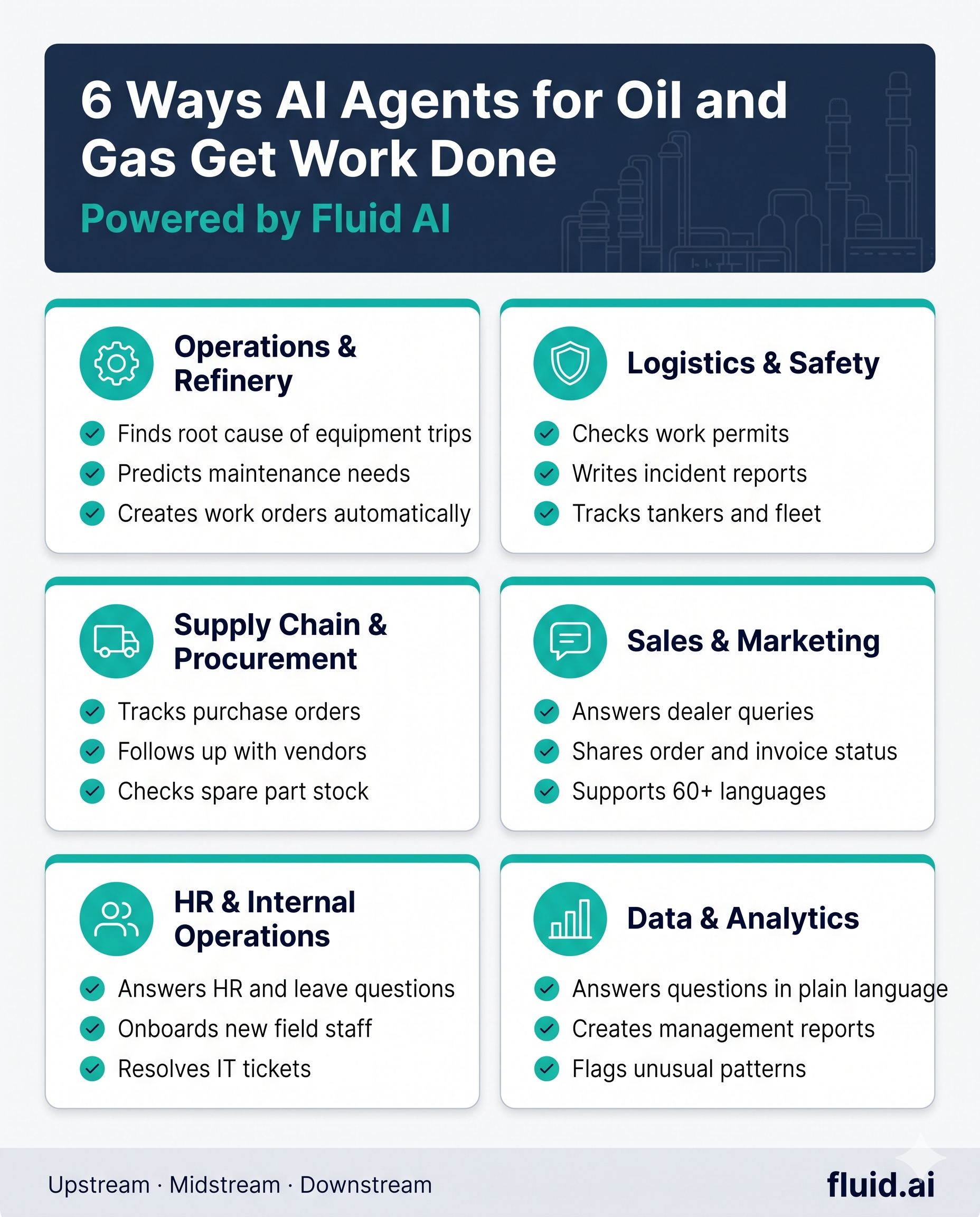
AI agents for oil and gas deliver the most value in high-volume, multi-step work.
Here are the main use cases where Fluid AI’s AI agents help oil and gas companies.
1. Fluid AI for Operations and Refinery
Refineries and plants run 24/7. Every hour of downtime costs money.
AI agents for refinery operations can:
Find the root cause of equipment trips
Guide engineers step by step using SOPs and manuals
Predict maintenance needs from equipment data
Create work orders automatically
Check spare part stock before work starts
Write shift handover reports
Answer operator questions about process limits
Instead of just showing a manual, Fluid AI’s AI agents for oil and gas combine equipment history, sensor data, maintenance records and SOPs to guide teams through the right fix.
2. Fluid AI for Logistics and Safety
Safety is the top priority in oil and gas.
AI agents for oil and gas safety can:
Check work permits against safety rules
Write and classify incident reports
Find patterns in near misses across sites
Track tanker and fleet movement
Alert teams on delays and exceptions
Prepare safety audit reports with evidence
Fluid AI’s AI agents for oil and gas help HSE teams spend less time on paperwork and more time preventing risks.
3. Fluid AI for Supply Chain and Procurement
Oil and gas supply chains are large and complex. One missing spare part can delay a full shutdown.
AI agents for oil and gas supply chain and procurement can:
Search material catalogues
Track purchase orders
Find delayed deliveries
Compare vendors and quotes
Follow up with suppliers
Check stock levels
Update procurement systems
Fluid AI’s AI agents for oil and gas procurement save hours of manual follow-up every week.
4. Fluid AI for Sales and Marketing
For fuel retail, lubricants and B2B oil and gas businesses, customer and dealer support is a big workload.
AI agents for oil and gas sales and marketing can:
Answer dealer and distributor questions
Share order and invoice status
Handle customer queries on WhatsApp, voice and chat
Qualify leads for bulk and industrial buyers
Share product and pricing information
Support customers in 60+ languages
Fluid AI’s AI agents for oil and gas give every dealer and customer a fast answer, any time.
5. Fluid AI for HR and Internal Operations
Oil and gas companies have large workforces spread across plants, offices and remote sites.
AI agents for oil and gas HR and internal operations can:
Answer HR policy, leave and payroll questions
Help onboard new plant and field staff
Solve IT support tickets
Share training content on demand
Help employees find internal information fast
Fluid AI’s AI agents for oil and gas make internal support simple for every employee.
6. Fluid AI for Data and Analytics
Oil and gas leaders need answers from data, fast.
AI agents for oil and gas data and analytics can:
Answer questions in simple language
Pull production, sales and operations numbers
Create management reports
Combine data from SAP, SCADA and finance
Spot unusual patterns early
With Fluid AI, anyone can ask a question and get a clear answer from company data.
AI Agents for Oil and Gas Across Upstream, Midstream and Downstream
Fluid AI’s AI agents for oil and gas work across the full value chain.
Upstream: Drilling reports, well data analysis, field team support, equipment maintenance, remote site help
Midstream: Pipeline alerts, terminal logistics, inspection records, scheduling, transport tracking
Downstream: Refinery operations, fuel retail, dealer support, distribution, procurement, customer service
Wherever there is a process with documents, systems and decisions, AI agents for oil and gas can help.
How Fluid AI Connects AI Agents to Oil and Gas Systems
One big myth about AI agents for oil and gas is that companies need to replace their current software.
They don’t.
The real challenge is making AI work with the systems already running the business.
An AI agent for oil and gas may need access to:
SCADA → Historian → CMMS → SAP → Inventory → Email → Ticketing → Documents → APIs
An AI agent that can only read information is limited.
An AI agent that can safely work with these systems becomes part of the workflow.
For example:
“Find all critical spares below minimum stock and start the approved reorder process.”
Fluid AI’s AI agent for oil and gas might:
Check inventory levels
Find critical parts below minimum
Check approved vendors
Check past prices
Draft purchase requests
Send them for approval
Inform the vendor once approved
Record every step
Escalate any exceptions
Fluid AI works as an orchestration layer that connects AI agents for oil and gas to SAP, Oracle, SCADA, legacy systems, APIs and other company systems.
This system connection is one of the biggest differences between a real AI agent for oil and gas and a simple AI assistant.
Safety, Security and Governance in Fluid AI’s AI Agents for Oil and Gas
The more an AI agent can do, the more control it needs.
An AI agent that reads a manual is one thing.
An AI agent that creates a work order, places a purchase order or sends an alert to a field team is very different.
That is why Fluid AI’s AI agents for oil and gas are built around controlled autonomy.
Role-Based Access
Each AI agent only accesses the systems and data it needs for its job.
Permission Controls
Not every action is open to every agent.
For example:
Read sensor data: allowed
Create a work order: allowed
Approve a large purchase: needs human approval
Change plant settings: not allowed without a human
Human-in-the-Loop
Fluid AI’s AI agents for oil and gas ask for human approval where the process needs it.
This does not mean a human checks every step.
It means humans decide where their judgment is needed.
Audit Trails
Every important action is recorded.
Oil and gas companies can always answer:
What did the agent do?
Why did it do it?
What information did it use?
Which system did it access?
What changed?
Who approved it?
Escalation
If the AI agent is not confident, data is missing, a rule is broken or something unusual happens, it stops and asks a human.
Fluid AI is ISO 27001 and SOC 2 Type II certified, so AI agents for oil and gas run on a secure, trusted platform.
Challenges of Using AI Agents in Oil and Gas
Setting up AI agents for oil and gas is not as simple as plugging in an AI model.
Here are the main challenges, and how Fluid AI solves them.
1. Data Quality
AI agents are only as good as the data they use.
Old, missing or messy maintenance records can lead to poor decisions. Fluid AI helps clean and connect data before agents go live.
2. Legacy Systems
Many oil and gas systems are old and were never built for AI.
Fluid AI connects AI agents for oil and gas to legacy systems using APIs, connectors and middleware.
3. IT and OT Separation
Plant systems (OT) and business systems (IT) are often kept apart for safety.
Fluid AI’s AI agents for oil and gas respect these boundaries and only access what is allowed.
4. Security
AI agents may need access to sensitive plant, asset and business data.
Fluid AI keeps access tightly controlled and offers on-premise deployment.
5. Wrong Answers
A wrong answer is a problem.
A wrong action in a plant can be much worse.
Fluid AI grounds AI agents for oil and gas in approved SOPs, limits their tools and adds approval steps for critical actions.
6. Reliability
Oil and gas operations need predictable systems.
Fluid AI’s AI agents handle failures, retries, timeouts, missing data and unexpected inputs.
7. Cost and Speed
Complex workflows can need many AI calls and system checks.
Fluid AI balances intelligence with speed, cost and model choice.
How to Implement AI Agents for Oil and Gas with Fluid AI
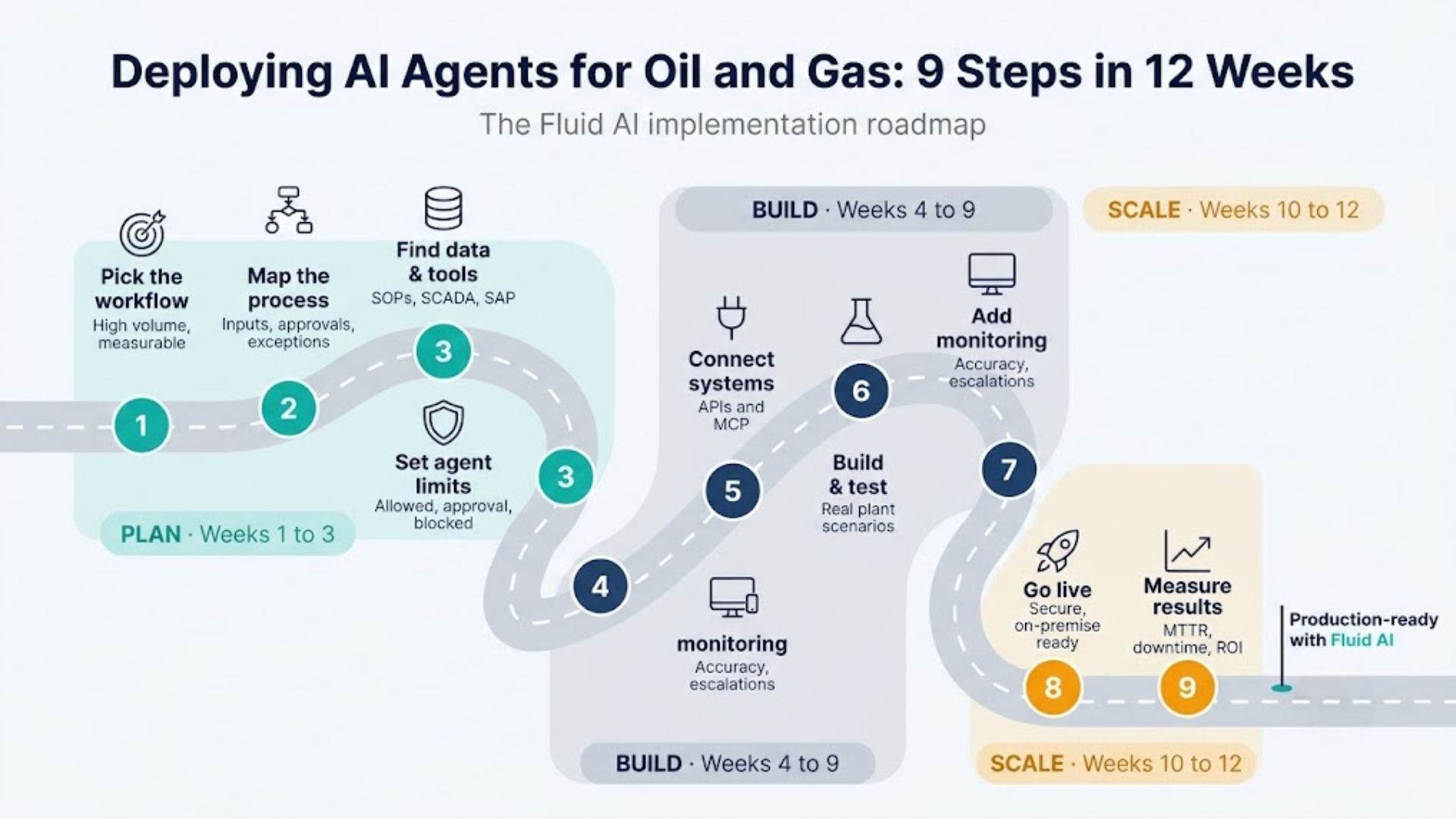
The best AI agent projects in oil and gas start with the work, not the technology.
Step 1: Pick the Right Workflow
Look for oil and gas processes that are:
High volume
Repetitive
Time-consuming
Rule-based
Spread across many systems
Easy to measure
Don’t start with: “Where can we use AI?”
Start with: “Which oil and gas process should run on its own?”
Step 2: Map the Current Process
Write down:
Inputs
Decisions
Systems
People
Exceptions
Approvals
Outputs
Step 3: Find the Data and Tools
Decide what the AI agent for oil and gas needs to:
Read
Look up
Calculate
Decide
Update
Communicate
Step 4: Set the Agent’s Limits
Decide:
What it can do alone
What needs approval
What is not allowed
When it must ask a human
Step 5: Connect Oil and Gas Systems
Fluid AI connects the needed:
SCADA and historians
SAP and ERP
CMMS
Inventory systems
Knowledge bases
Communication channels
Step 6: Build and Test
Test the AI agent for oil and gas with real plant scenarios, including failures.
Don’t just ask: “Did the agent give the right answer?”
Also ask: “Did the agent take the right action?”
Step 7: Add Monitoring
Track:
Accuracy
Completion rate
Failures
Human involvement
Speed
Cost
Escalations
Step 8: Go Live
Once the workflow is reliable, Fluid AI deploys it into your real environment with full security and controls.
Fluid AI’s standard deployment takes 12 weeks.
Step 9: Measure Results
The real test is not how good the demo looks.
It is whether the oil and gas process got better.
How to Measure ROI of AI Agents for Oil and Gas
Measure AI agents for oil and gas by business results, not just AI accuracy.
Productivity
Hours saved
Tasks completed by AI
Work orders handled per engineer
Operations
Downtime hours
Mean time to repair (MTTR)
Work order turnaround
Procurement cycle time
Safety
Incident report time
Permit check time
Audit readiness
Automation
Percentage of workflow done by AI
Human involvement rate
Financial impact
Cost per task
Savings
Avoided downtime cost
ROI
Fluid AI deployments have delivered up to 90% MTTR reduction and up to 8x ROI.
Instead of saying “Our AI is 40% better,” a stronger oil and gas result sounds like:
“The AI agent cut work order turnaround from X hours to Y minutes, with all safety approvals in place.”
On-Premise, Cloud or Hybrid: Where Should AI Agents for Oil and Gas Run?
AI deployment in oil and gas is not one-size-fits-all.
Some companies can use the cloud.
Many oil and gas companies need on-premise or private deployment because of:
Sensitive asset and plant data
Data residency rules
Security policies
Critical infrastructure protection
Government and regulatory needs
Fluid AI supports on-premise, private cloud, hybrid and air-gapped deployment for AI agents for oil and gas. Your data, models and agents stay inside your own infrastructure.
The right question is not “Which cloud should we use?”
It is: “Where should our data, AI models and AI agents run for this oil and gas workflow?”
What to Look for in an AI Agent Platform for Oil and Gas
When choosing a platform for AI agents for oil and gas, look beyond the AI model.
A strong platform like Fluid AI should offer:
Agent building
Agent builder
Reusable agents
Custom roles
Memory
Planning
Tool use
Orchestration
Multi-agent coordination
Step-by-step workflows
Parallel tasks
Handoffs
Retries
Escalation
Oil and gas knowledge
RAG
Document processing
Structured data
Databases
Search
Integrations
APIs
MCP
SAP and ERP
SCADA
CMMS
Legacy systems
Governance
Role-based access
Policy controls
Human approval
Audit trails
Monitoring
Security
Deployment
Cloud
Private cloud
On-premise
Hybrid
Air-gapped
Channels
Voice
Chat
Email
WhatsApp
Fluid AI brings all of this together in one enterprise agentic AI platform for oil and gas.
Why Oil and Gas Companies Choose Fluid AI
Fluid AI builds AI agents for oil and gas and other regulated industries like banking, insurance, manufacturing and government.
14+ years in enterprise AI
2 US patents
ISO 27001 and SOC 2 Type II certified
On-premise deployment
60+ languages
Voice, chat, WhatsApp and email
Works with SAP, Oracle, SCADA and legacy systems
12-week standard deployment
Up to 90% MTTR reduction
Up to 8x ROI
For oil and gas companies, “autonomous” does not mean “uncontrolled.”
Fluid AI’s AI agents for oil and gas work on their own within clear rules and ask a human when a decision is outside those rules.
A successful AI agent for oil and gas must answer two questions:
“Can the agent do this?”
and
“Can we safely let the agent do this?”
Fluid AI is built to answer both.
AI Agents for Oil and Gas: From Answers to Action
The first wave of AI in oil and gas made information easier to find.
The next wave is about making work easier to finish.
The AI journey in oil and gas looks like this:
AI models → Document search → AI assistants → AI agents → Multi-agent workflows → Autonomous oil and gas operations
But the best AI agents for oil and gas won’t be the ones with the most freedom.
They will be the ones that combine autonomy with control.
An AI agent for oil and gas needs to understand the plant, find the right information, use the right tools, follow safety rules, take the right action and know when to involve a human.
That is what Fluid AI delivers.
Frequently Asked Questions About AI Agents for Oil and Gas
What are AI agents for oil and gas?
AI agents for oil and gas are AI systems that understand goals, plan tasks, use oil and gas systems like SAP and SCADA, and complete multi-step work with defined controls.
How is AI used in oil and gas?
AI in oil and gas is used for refinery operations, predictive maintenance, safety, supply chain, procurement, customer support, HR and data analytics.
What are the top use cases of AI agents for oil and gas?
Top use cases include equipment troubleshooting, work order creation, safety reporting, permit checks, procurement tracking, inventory management, dealer support and management reporting.
How are AI agents different from chatbots in oil and gas?
Chatbots answer questions. AI agents for oil and gas take action, such as creating work orders, updating systems and following up with vendors.
Are AI agents safe for oil and gas companies?
Yes, when built with access controls, human approval, audit trails and escalation. Fluid AI is ISO 27001 and SOC 2 Type II certified.
Conclusion: The Future of AI Agents for Oil and Gas with Fluid AI
AI agents for oil and gas are not about giving a chatbot more knowledge.
They are about giving AI the context, tools, system access and permissions to actually finish work.
AI agents for oil and gas become valuable when they can move from:
Understand → Look up → Reason → Plan → Act → Check → Resolve
while staying safe, secure and fully auditable.
For oil and gas companies, this is the real shift from AI experiments to AI execution.
And as Fluid AI connects AI agents to the systems that already run oil and gas operations, the biggest opportunity is no longer what AI can tell your team.
It is what work AI can safely finish for them.
Explore Fluid AI’s AI Agents for Oil and Gas. Book a demo today.