On-Prem vs Cloud AI: What Regulated Enterprises Actually Choose and Why

TL;DR
For regulated sectors like banking, government, healthcare, and defense, the choice between on-premise AI and cloud AI isn't really an infrastructure question.
It's a strategy call that touches sovereign AI, IP protection, and financial risk. Public cloud AI APIs are easy to start with and give you instant access to frontier models, but they open the door to data residency violations, unpredictable token billing, vendor lock-in, and quiet data exfiltration.
An on-premise AI platform or private LLM gives you the opposite: full data control, deterministic security, low latency, and costs you can actually forecast. That's why most regulated organizations land on hybrid and sovereign AI. Sensitive data and core inference stay behind a private or air-gapped perimeter, while lower-risk tasks use governed cloud endpoints.
The real conflict: speed vs control
There's a genuine tug-of-war inside most enterprises right now. Boards and business units want generative AI, autonomous agents, and natural language analytics shipped fast, because that's what keeps them competitive. Meanwhile the CISO, legal counsel, and chief risk officer are on the hook for keeping customer data, trade secrets, and core infrastructure out of a regulatory breach.
For ordinary SaaS, cloud multi-tenancy is a fine trade-off. Large language models and agentic AI are a different animal. They swallow huge amounts of unstructured enterprise context, call internal APIs, handle proprietary IP, and generate their own execution paths on the fly.
That difference is exactly what's pushing demand toward sovereign AI and private LLMs, and it forces leaders to answer one question they used to be able to skip: where should these AI workloads actually live?
1. On-Prem vs Cloud AI: The 4 Enterprise Deployment Models
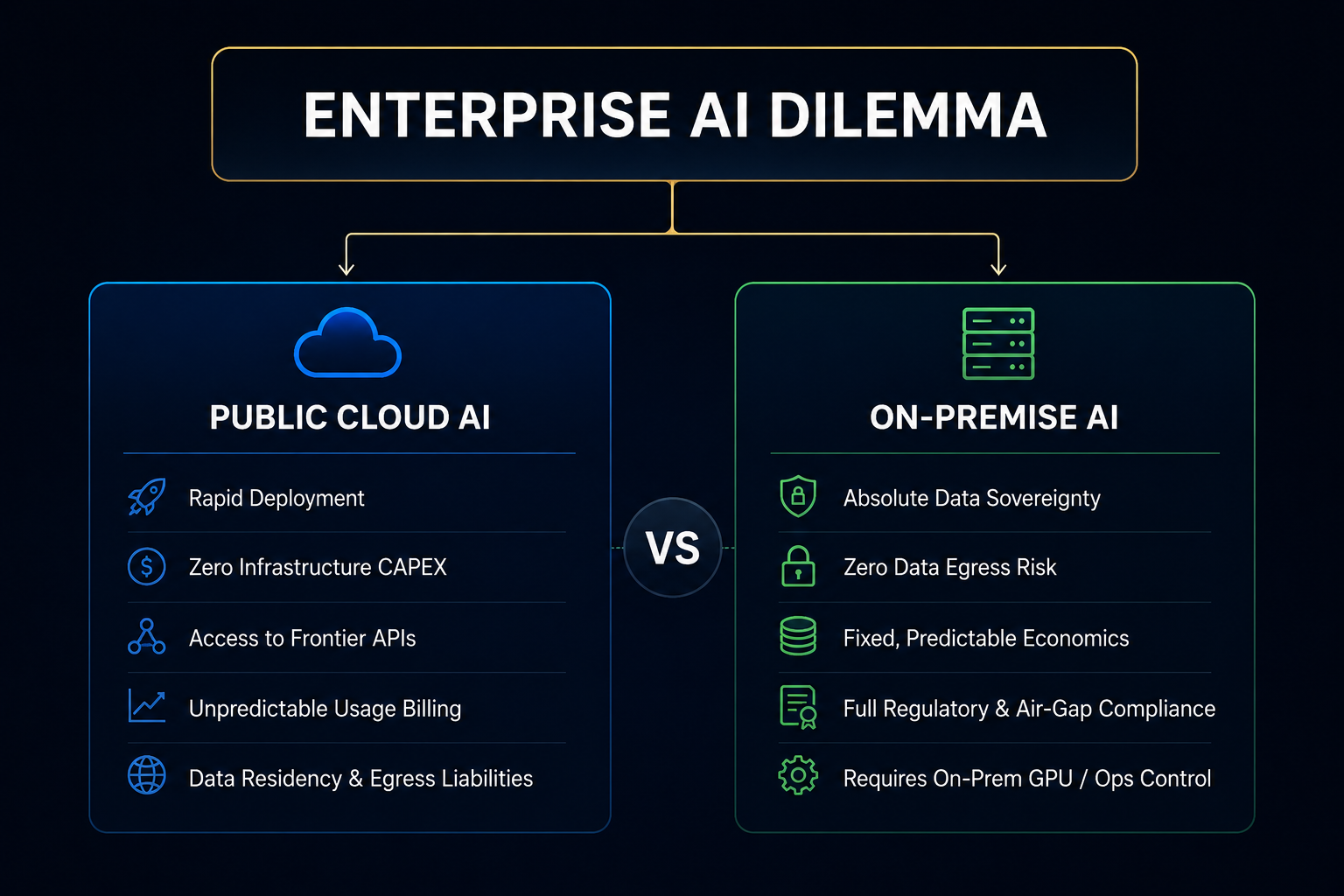
Before comparing on-prem vs cloud AI, it helps to drop the vague labels. Enterprise AI deployment really sits on a four-point spectrum.
Paradigm A: Public Cloud AI APIs:
You send prompts, document chunks, and tool payloads over the public internet to a third-party provider's multi-tenant API.
Data path: corporate data → public internet → provider cloud infrastructure.
The drawback: you give up physical data residency control, you carry third-party logging risk, and you're fully dependent on the vendor's uptime and pricing.
Paradigm B: Private Cloud / Dedicated VPC:
You run open-weights models (Llama, Mistral, Qwen) or dedicated vendor instances inside your own isolated VPC on AWS, Azure, or Google Cloud.
Data path: corporate network → encrypted VPC boundary.
The drawback: internet exposure drops, but your data still lives on someone else's cloud hardware, which leaves you exposed under extraterritorial access laws like the US CLOUD Act.
Paradigm C: On-Premise AI Platform:
You host both the generative AI infrastructure (the GPU clusters) and the on-premise AI platform inside your own data centers.
Data path: internal local network → local enterprise data center.
The advantage: your data and model weights never cross the perimeter, and you're fully aligned with local data residency rules.
Paradigm D: Air-Gapped Sovereign AI:
Built for national defense, central banks, energy, and classified agencies. Every layer, hardware, model weights, vector databases, orchestration, and tool connectors, runs in an environment physically cut off from the public internet.
Data path: isolated local network, zero outbound internet.
The advantage: sovereign AI with no route for external exfiltration and no remote vendor kill-switch.
2. Enterprise AI Security: Is On-Premise More Secure Than Cloud?
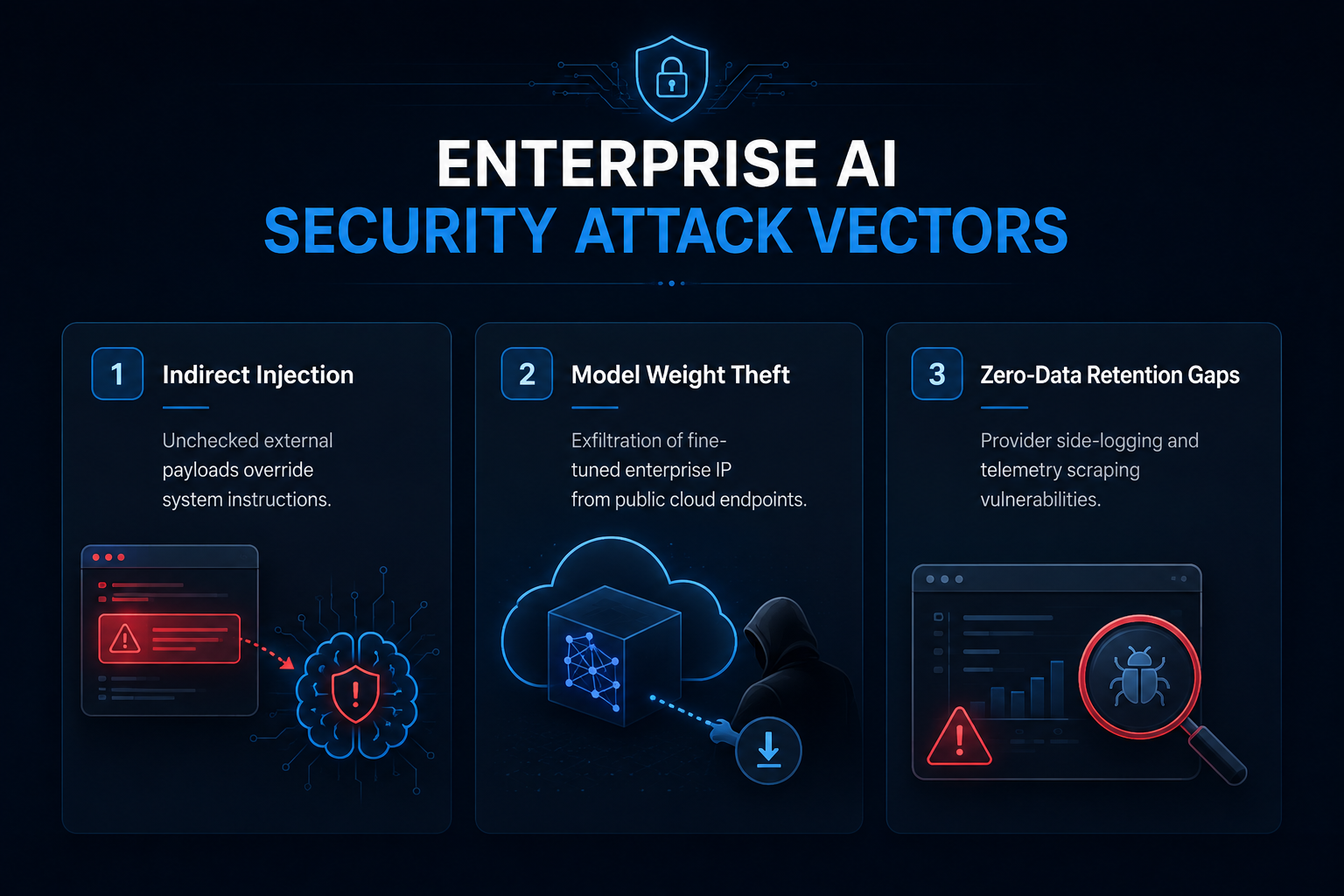
When a risk team asks whether on-premise AI is more secure than cloud, encryption is only the surface of the answer. Generative AI brings attack vectors that traditional cloud security was never built to handle.
The limits of cloud "Zero Data Retention" pledges
Most cloud AI vendors offer a Zero Data Retention agreement that promises your prompts won't be used to train future models. Useful, but ZDR is not the same as zero exposure:
Debugging and telemetry logs. Flag-triggered prompts are often retained for a period for abuse monitoring, sometimes reachable by vendor staff or automated guardrails.
Sub-processor egress. Providers routinely hand sub-tasks to third-party microservices, which quietly creates data egress paths you never documented.
Legal discovery. Data sitting in a multi-tenant public cloud can be pulled by subpoena or jurisdictional demand without the owner ever knowing.
Indirect prompt injection and data exfiltration
The moment an AI agent can touch external tools, emails, or databases, indirect prompt injection becomes a real threat. An attacker hides malicious instructions inside a document or web payload, and when a cloud-hosted agent parses it, the agent can be hijacked into shipping corporate context off to an external endpoint. An on-premise AI deployment shuts this down by keeping every execution loop, tool caller, and database connector behind firewall rules that physically block outbound traffic to unapproved addresses.
3. Generative AI Infrastructure & TCO: CAPEX vs. OPEX Realities
There's a common assumption that cloud AI is always cheaper because you skip the hardware bill. That's true in the proof-of-concept phase. It stops being true once AI hits high-concurrency production.
The cloud token trap:
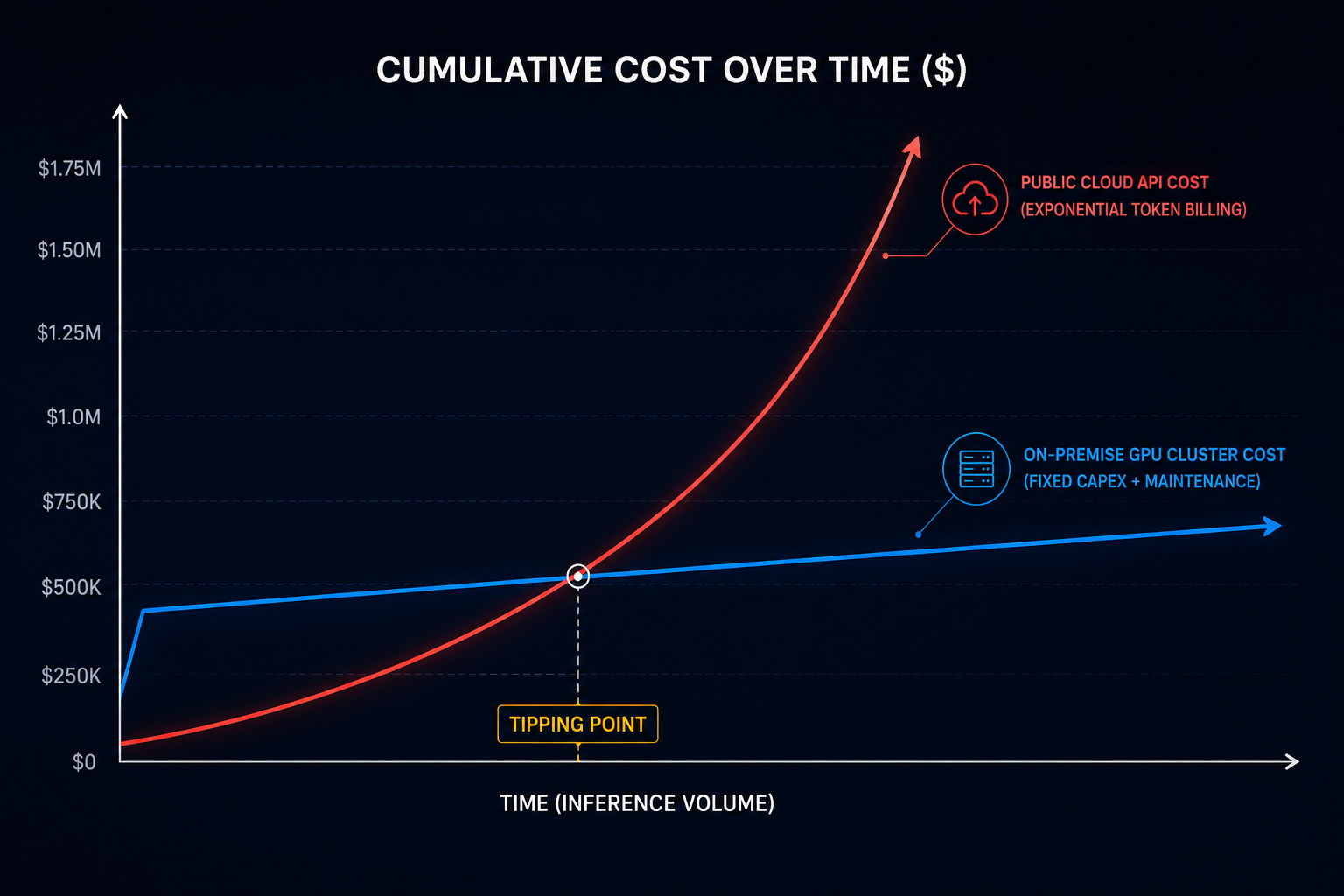
Public cloud vendors bill per token, input plus output. In a chat app, that usage grows in a straight line. In agentic AI it grows much faster: one request kicks off multi-turn agent loops, context windows fill up with retrieved RAG chunks, and agents pass fat JSON schemas back and forth as they call tools. Costs can climb fast and unpredictably, which is where a lot of teams get a nasty surprise when they scale. Model your own token volume before you commit, because the real number swings widely by use case.
CAPEX vs OPEX:
Cloud keeps cost as operating expense: cheap to begin, rising with usage. On-premise turns it into capital expense: a real upfront spend on GPUs and setup, then a largely fixed cost with no per-token meter running. The crossover point is what matters. A high-volume, always-on workload usually gets cheaper on-prem over time, while a spiky or experimental one stays cheaper in the cloud.
Latency:
Local on-prem inference skips the network round trip, which is the whole game for real-time uses like voice agents, trading support, or factory-floor systems where a lag is a failure. Cloud latency is usually fine for asynchronous work and weaker for anything real-time.
Operations:
This is the on-prem cost nobody puts in the slide. Someone has to patch the infrastructure, update the models, keep it up, and watch performance. Cloud hands all of that to the provider. Underestimating this operational load is the single most common on-prem mistake.
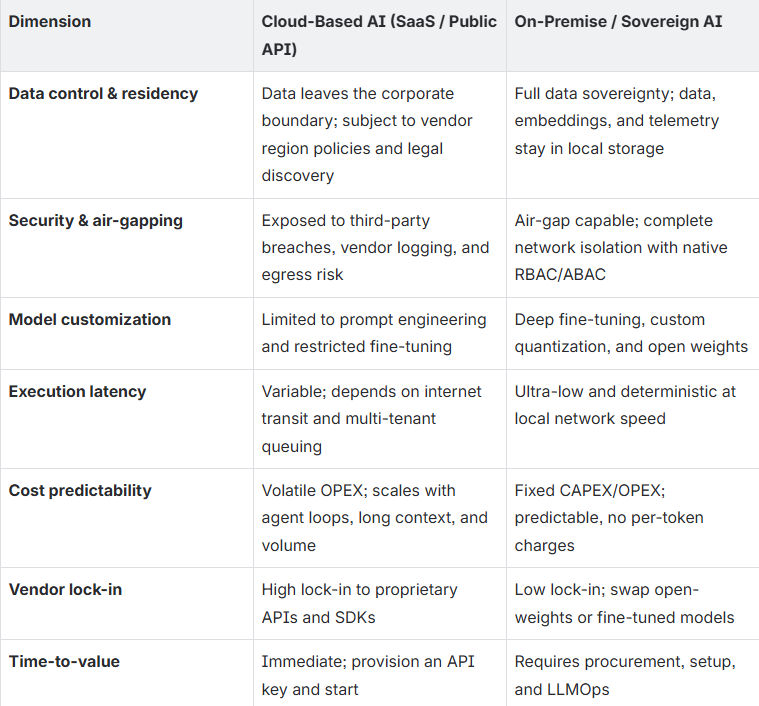
Advantages and Disadvantages of Cloud-Based AI vs On-Premise AI
What Is a Private LLM? (And Why Regulated Enterprises Deploy One)
A private LLM is a large language model you run inside your own controlled environment, your data center or private cloud, instead of calling it over the public internet. You get the full generative AI capability while your sensitive data, prompts, and model weights stay inside your perimeter.
Regulated enterprises reach for private LLMs for three reasons. Data never leaves a compliant location. They can fine-tune deeply on proprietary data without ever handing it to a third party. And they sidestep vendor lock-in by running open-weights models they actually control. The catch is that you own the hosting and upkeep, which is why private LLMs usually get pointed at the workloads carrying the most sensitive data.
On-Prem, Cloud, or Hybrid: A Workload Decision Framework
Run each workload through these questions, one workload at a time, not the whole company at once:
Does this workload touch regulated or sensitive data? If yes, lean on-prem or private.
Are you legally required to keep data in-country? If yes, you need sovereign or on-prem. That's a hard line, not a preference.
Is it real-time or latency-sensitive? If yes, on-prem local inference has the edge.
Is volume high and steady, or spiky and experimental? Steady and high favors on-prem economics; spiky favors cloud.
Do you have the IT operations capacity to run it? If not, cloud or a managed private deployment lightens the load.
Score your workloads this way and the answer usually comes back split, which is exactly why most regulated enterprises end up hybrid.
When Hybrid AI Deployment Makes Sense
Hybrid AI deployment lets you put each workload where it belongs. Sensitive, regulated, and real-time workloads, plus any private LLM handling customer data, run on-prem or in a private cloud. Lower-risk, bursty, or public-data workloads use public cloud AI for speed and scale. You hold control where it's required and take the convenience where it's allowed. For most banks, insurers, and industrial firms, that isn't a compromise, it's the architecture they were always going to need.
On-Premise AI Deployment for Regulated Industries
Banking and financial services: Customer financial data, KYC records, and transaction analysis almost always have to run on-prem or private, driven by data residency laws and what regulators expect. Non-sensitive content and internal productivity tools often sit in the cloud. The result is hybrid, with a hard on-prem line drawn around anything that touches customer money.
Insurance: Claims and underwriting data carry sensitive personal and health information, so core workloads stay on-prem, while general document processing and customer-facing assistants can live in the cloud with the right controls.
Oil and gas: Here the objection is as much connectivity and latency as compliance. Remote sites, refineries, and offshore rigs can't lean on a stable cloud link, and the operational data is sensitive. On-prem or edge deployment usually wins for operational workloads, with the cloud kept for corporate functions.
Government and public sector: Sovereign AI is often mandatory. Data localization laws mean in-country, on-prem, or sovereign-cloud deployment is the only compliant route for citizen data.
Common Mistakes to Avoid
Treating deployment as one company-wide call instead of deciding per workload.
Underestimating how much work it takes to run on-prem.
Putting a sensitive workload in the cloud because it was faster to start, then failing an audit for it.
Ignoring the cost crossover and leaving a high-volume workload in the cloud far longer than makes financial sense.
Assuming "private" in a vendor's name means your data stays private. Check where the inference data actually goes.
Frequently Asked Questions (FAQs)
1. Is on-premise AI more secure than cloud AI?
On-premise AI gives you more direct control over data, access, and audit, which is why regulated enterprises favor it for sensitive workloads. Cloud AI can be highly secure too, but security depends on configuration and the provider's terms. For data that cannot leave your perimeter, on-prem is the safer default.
2. What is a private LLM?
A private LLM is a large language model deployed inside your own controlled environment, your data center or private cloud, rather than accessed over the public internet. It gives you generative AI capability while keeping sensitive data inside your perimeter.
3. What is sovereign AI?
Sovereign AI is AI infrastructure and data kept within a specific country's borders and legal jurisdiction, to meet national data-residency and security requirements. It matters most for government and heavily regulated sectors.
4. When should an enterprise choose hybrid AI deployment?
When different workloads have different risk profiles, which is nearly always. Run sensitive and real-time workloads on-prem or private, and lower-risk workloads in the cloud.
5. What are the disadvantages of cloud-based AI for regulated industries?
Data leaves your perimeter, you inherit the provider's security posture and data-handling terms, audit granularity can be limited, and residency requirements may be impossible to meet. These are manageable for low-risk workloads but often disqualifying for sensitive ones.
Conclusion
Regulated enterprises don't choose on-prem or cloud AI on ideology. They choose based on what each workload's data is allowed to do. Cloud earns its place on speed and scale; on-premise and private LLMs earn theirs on control, residency, and audit; and hybrid is where most serious regulated deployments land. Decide per workload, be honest about your operational capacity, and let compliance, not convenience, draw the hard lines.
If you're mapping which AI workloads belong on-prem, in a private LLM, or in the cloud, Fluid AI deploys across on-premise, hybrid, private cloud, and sovereign environments, built for exactly these regulated constraints.
Book your Free Strategic Call to Advance Your Business with Generative AI!
Fluid AI is an AI company based in Mumbai. We help organisations kickstart their AI journey. If you're seeking a solution for your organisation to enhance customer support, boost employee productivity and make the most of your organisation's data, look no further.
Take the first step on this exciting journey by booking a Free Discovery Call with us today and let us help you make your organisation future-ready and unlock the full potential of AI for your organisation.
_1790254083168-CB8e8KXC.png)