Edge vs. Cloud: Where Should Your Voice AI Be Running in 2026

TL;DR
Cloud Voice AI provides scalability, deep learning models, and ease of updates—but can introduce latency and data compliance risks.
Edge Voice AI offers ultra-low latency, stronger privacy, and offline capabilities—but may struggle with large model updates or heavy workloads.
For enterprises in 2026, a hybrid approach—combining edge inference with cloud orchestration—is emerging as the gold standard.
Industries like banking, telecom, healthcare, and manufacturing need to consider regulatory compliance, integration with legacy systems, and real-time responsiveness before deciding.
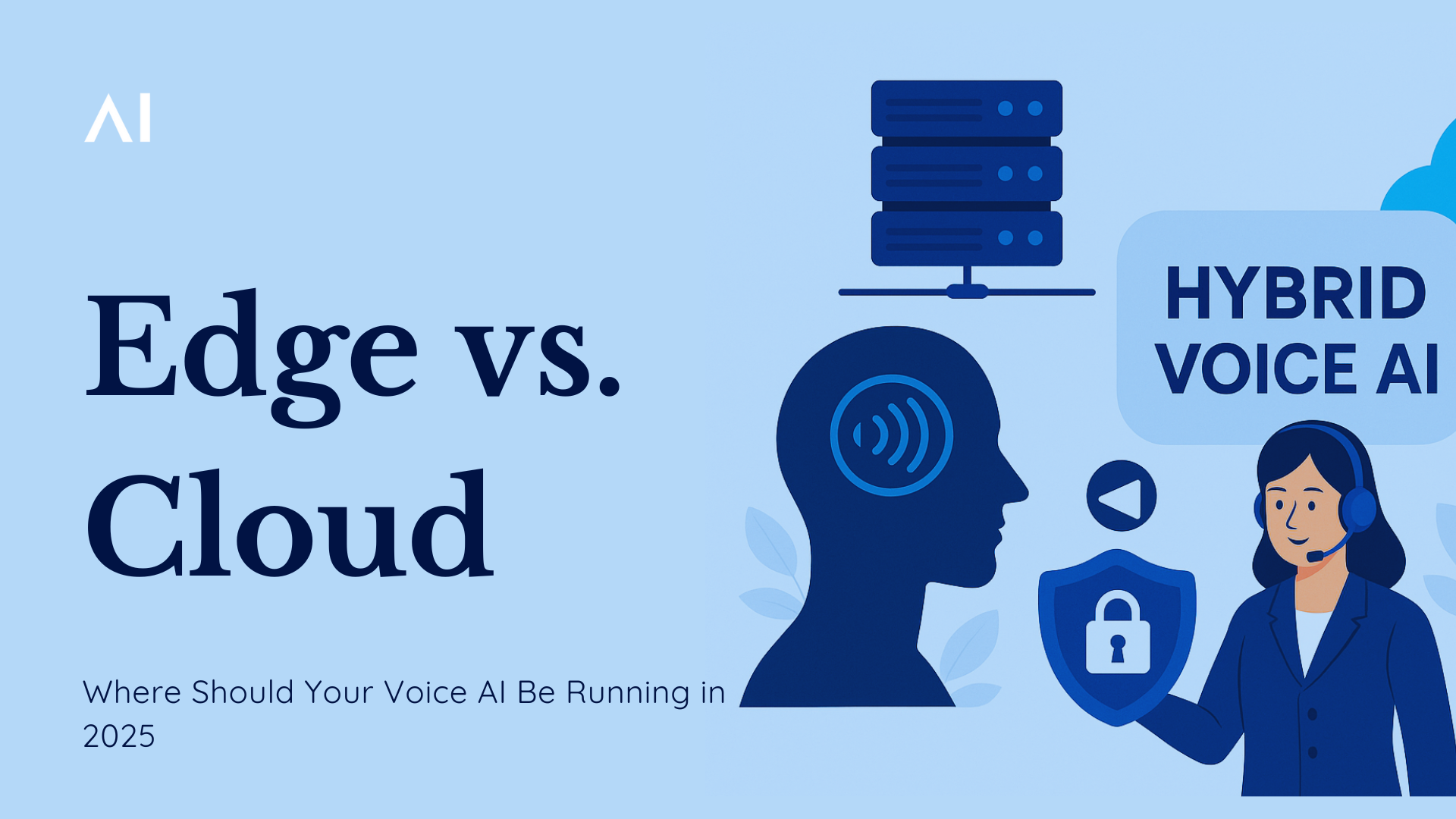
Voice AI has moved from being a futuristic experiment to an enterprise-critical technology powering everything from customer service IVRs to intelligent voice assistants in operations. But the question enterprises keep facing in 2026 is no longer whether to adopt Voice AI—it’s where to run it.
Should Voice AI Agents operate at the edge, close to the user, or in the cloud, leveraging massive compute power? The answer isn’t binary. For enterprises, this decision impacts not just performance, but also latency, compliance, data privacy, costs, and user trust.
This is particularly relevant in customer service, where many enterprises are realizing that traditional IVRs are becoming obsolete and shifting toward more intelligent, AI-driven solutions (Why Every Bank Will Replace IVRs with AI Voice Agents).
Why This Debate Matters More Than Ever
Voice AI Agents have evolved far beyond simple speech-to-text systems. Modern IVRs and conversational agents use LLMs, speech synthesis, intent recognition, and contextual memory to handle complex queries and workflows.
For example:
A banking voice bot must authenticate users and retrieve sensitive account details within seconds.
A healthcare voice AI agent must comply with HIPAA/GDPR while handling confidential patient data.
A manufacturing floor agent may guide technicians hands-free, even in environments with no reliable internet.
Where the Voice AI runs—edge or cloud—determines whether these experiences are smooth, compliant, and trustworthy or frustrating and risky.
This evolution is transforming industries at scale—especially in financial services, where the role of voice AI in banking is now inseparable from customer trust and competitive differentiation (The Future of Banking is Calling).
Cloud Voice AI: Strength in Scale
1. Unlimited Compute and Scalability
Running Voice AI in the cloud means access to massive GPU clusters and optimized compute resources. Enterprises can deploy large speech models, multilingual LLMs, and advanced NLP pipelines without worrying about device constraints.
2. Easier Model Updates
Cloud-based systems allow instant upgrades and fine-tuning across millions of endpoints. A new compliance feature or improved speech recognition model can be rolled out seamlessly.
3. Deep Integration with Enterprise Data
Since most enterprise data already resides in cloud storage or SaaS applications, Voice AI in the cloud can directly access customer records, transaction histories, and CRM workflows.
4. Challenges in Cloud-First Voice AI
Latency: Even a 200ms delay can break conversational flow. For high-volume call centers, this becomes a major issue.
Compliance: Financial and healthcare regulations often forbid raw audio from leaving the premises.
Connectivity Dependence: Outages or poor connectivity can cripple mission-critical use cases.
Edge Voice AI: Intelligence at the Source
1. Real-Time Responsiveness
When Voice AI runs on-device or at a local edge server, latency drops dramatically. Responses feel instantaneous—critical in call centers, emergency services, and industrial environments.
2. Privacy and Compliance Advantages
Edge-based processing ensures audio never leaves the enterprise perimeter. For industries bound by GDPR, HIPAA, PCI-DSS, or local data residency laws, this is often non-negotiable.
3. Offline and Remote Capabilities
Voice AI agents deployed at the edge can continue functioning even in low-connectivity zones—like oil rigs, mining sites, or rural healthcare setups.
4. Challenges in Edge-First Voice AI
Hardware Costs: Scaling to millions of endpoints with GPUs/NPUs can be expensive.
Model Size Limitations: Running giant speech models locally isn’t always feasible.
Update Complexity: Updating every edge device with the latest model requires robust orchestration.
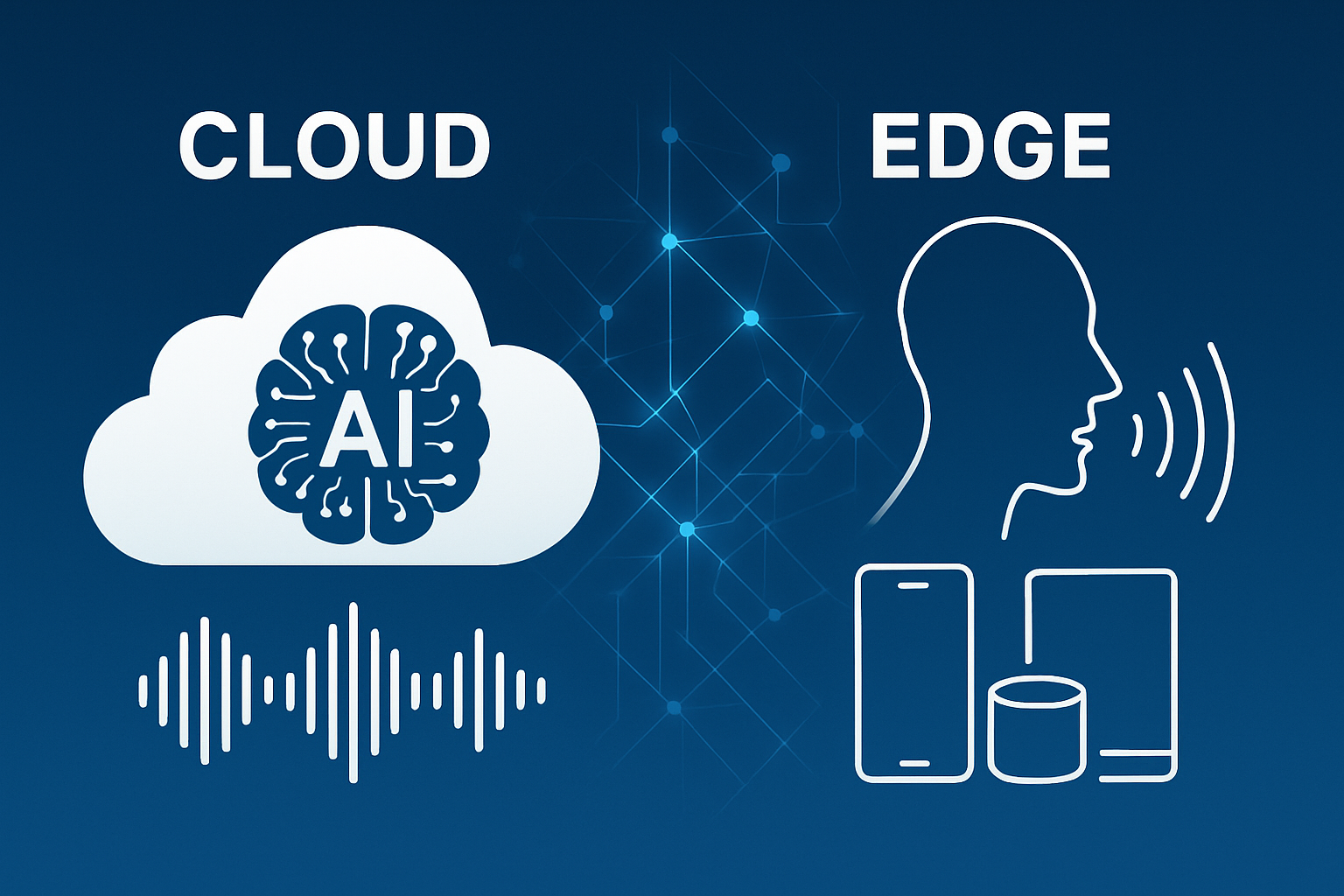
Cloud vs Edge: The future of enterprise Voice AI
This is also why many regulated industries are gravitating toward on-prem and edge-first deployments, where sensitive data never leaves enterprise boundaries (Why On-Prem Agentic AI Will Rule Regulated Industries in 2026).
The Enterprise Lens: What Really Matters
When choosing between edge and cloud Voice AI, enterprises must evaluate decisions not just technically, but strategically. Here are the key enterprise considerations:
1. Latency-Sensitive Customer Experience
For contact centers handling millions of calls daily, even half a second of lag affects Net Promoter Scores (NPS). Edge voice agents deliver real-time flow, but cloud can handle deep personalization.
2. Regulatory Compliance & Data Governance
Enterprises in banking, insurance, and healthcare face steep penalties for mishandling voice data. Edge AI aligns better with strict data-localization mandates, while cloud needs strong anonymization and encryption strategies.
3. Integration with Legacy Systems
Most enterprises still run critical operations on on-premise CRMs, mainframes, or ERP systems. Edge deployments integrate locally, while cloud Voice AI requires secure APIs and middleware.
4. Cost vs. Scale Trade-offs
Cloud Voice AI typically follows a pay-as-you-go model, which can balloon with millions of voice minutes processed monthly. Edge requires upfront infrastructure costs but may be cheaper long-term for high volumes.
5. Security and Trust
Data breaches in voice conversations could expose PII, financial transactions, or patient records. Enterprises must balance whether end-to-end encryption in cloud or data-local edge isolation better meets their risk profile.

Edge for speed, Cloud for scale — Hybrid Voice AI is how enterprises win in 2026
This balance has been especially challenging in financial services, where hidden inefficiencies in customer experience are costing banks both customers and revenue (The Hidden Gaps Costing Banks Customers).
The Rise of Hybrid Voice AI Architectures
By 2026, the leading enterprises are no longer asking “Edge or Cloud?”—they’re deploying hybrid Voice AI architectures.
Inference at the Edge: Core voice processing (speech-to-text, speaker authentication) happens locally for speed and privacy.
Orchestration in the Cloud: The cloud handles context management, advanced analytics, and LLM-powered conversation generation.
Model Updates via Cloud Sync: Enterprises push updates centrally but ensure minimal downtime for agents at the edge.
This approach offers low latency, compliance safety, and access to the latest models—without overwhelming edge devices.
Industry Use Cases: Edge vs. Cloud in Action
Banking & Financial Services
Edge-first: Authentication, fraud detection, and sensitive voice biometrics.
Cloud-first: Personal financial recommendations, cross-sell/up-sell insights.
Healthcare
Edge-first: Patient-doctor interactions where privacy is paramount.
Cloud-first: AI-driven medical transcription and analytics.
Telecom & Contact Centers
Edge-first: Real-time call routing, IVR intent detection.
Cloud-first: Customer sentiment analysis across millions of conversations.
Manufacturing & Logistics
Edge-first: On-floor agent instructions, hands-free troubleshooting.
Cloud-first: Predictive analytics, supply chain voice reporting.
What Enterprises Should Do in 2026
Audit Compliance Risks: Map out which voice workflows can leave your enterprise perimeter and which cannot.
Segment Latency-Critical Workflows: Deploy edge for functions requiring instant responsiveness.
Leverage Cloud for Scale: Use cloud for training, analytics, and model improvements.
Adopt a Hybrid Roadmap: Architect for the future—where edge and cloud are complementary, not competing.
Choose Vendors with Flexibility: Look for Voice AI providers that offer both edge and cloud deployment options with seamless orchestration.
Final Word
In 2026, enterprises can no longer rely solely on cloud IVRs or device-only agents. The stakes for latency, compliance, and trust are too high.
The future belongs to hybrid Voice AI Agents—running inference at the edge for speed and security, while using the cloud for intelligence, learning, and scale.
For enterprises, the decision isn’t where should Voice AI run? The real question is: How do we balance edge and cloud to create voice agents that are fast, compliant, and enterprise-ready?