Agentic AI in Oil & Gas: How Agentic AI Agents Are Assisting Energy’s Toughest Jobs

TL;DR
Oil & Gas faces extreme complexity, and Agentic AI delivers automation that thinks and acts, not just predicts.
AI agents transform exploration, drilling, safety, and supply chain into autonomous, self-correcting processes.
Predictive maintenance and real-time monitoring slash downtime and extend asset life.
Agentic AI integrates with SCADA, ERP, IoT, and cloud, making digital workers a reality.
Fluid AI and Fluid GPT bring domain-ready Agentic AI to Oil & Gas, benchmarked for compliance and safety.
Companies that scale early will gain efficiency, safety, and profitability edge over slower peers.

The State of Oil & Gas Today
Oil and gas companies run some of the most complex operations on the planet. Exploration spans deserts and oceans. Drilling rigs operate in harsh, unpredictable environments. Refineries juggle thousands of moving parts, and pipelines stretch across continents. Each node in this chain produces massive amounts of data, much of which goes underutilized.
Digital transformation has made inroads: IoT sensors monitor pipelines, cloud computing aggregates production data, and analytics tools crunch forecasts. Yet, the human bottleneck remains. Teams still interpret dashboards, switch between siloed systems, and take manual decisions that delay action.
That’s the gap Agentic AI fills. Instead of waiting for human direction, AI agents observe, analyze, plan, and act — becoming a new kind of digital workforce for energy.
This shift is similar to how AI agents are already redefining BI and ROI in enterprises.
Why Agentic AI Is Different
Traditional AI gives you predictions and reports. Agentic AI gives you action. These aren’t just models running in the background but autonomous AI agents that can chain tasks, make decisions, and execute across enterprise systems.
For Oil & Gas, this shift is critical. An AI drilling agent can read live data from SCADA systems, benchmark against safety protocols, and autonomously adjust parameters. A compliance agent can process thousands of environmental data streams and directly update ESG reports without waiting for a manager.
With Fluid GPT at the center and tuned through agentic benchmarks, these agents aren’t generic chatbots. They’re domain-ready, explainable, and integrated into workflows from the ground up.
For companies evaluating adoption, this is similar to the decision-making guide outlined in choosing the right enterprise AI provider.
Exploration and Seismic Data Analysis
Exploration often means interpreting terabytes of seismic imaging and geophysical data to identify promising drilling zones. Historically, this takes teams of geologists months to narrow down.
Agentic AI agents can handle the entire data pipeline: ingest seismic maps, overlay historical drilling records, compare against satellite datasets, and filter out noise. Instead of simply surfacing anomalies, the agent proposes a ranked list of drill sites with probability scores, estimated risks, and expected yield.
On the business side, this means faster go/no-go decisions and reduced exploration costs. On the tech side, agents plug into data lakes, run models across GPUs in the cloud, and continuously update insights as new seismic scans come in. Geoscientists remain in charge, but with an always-on AI exploration analyst at their side.
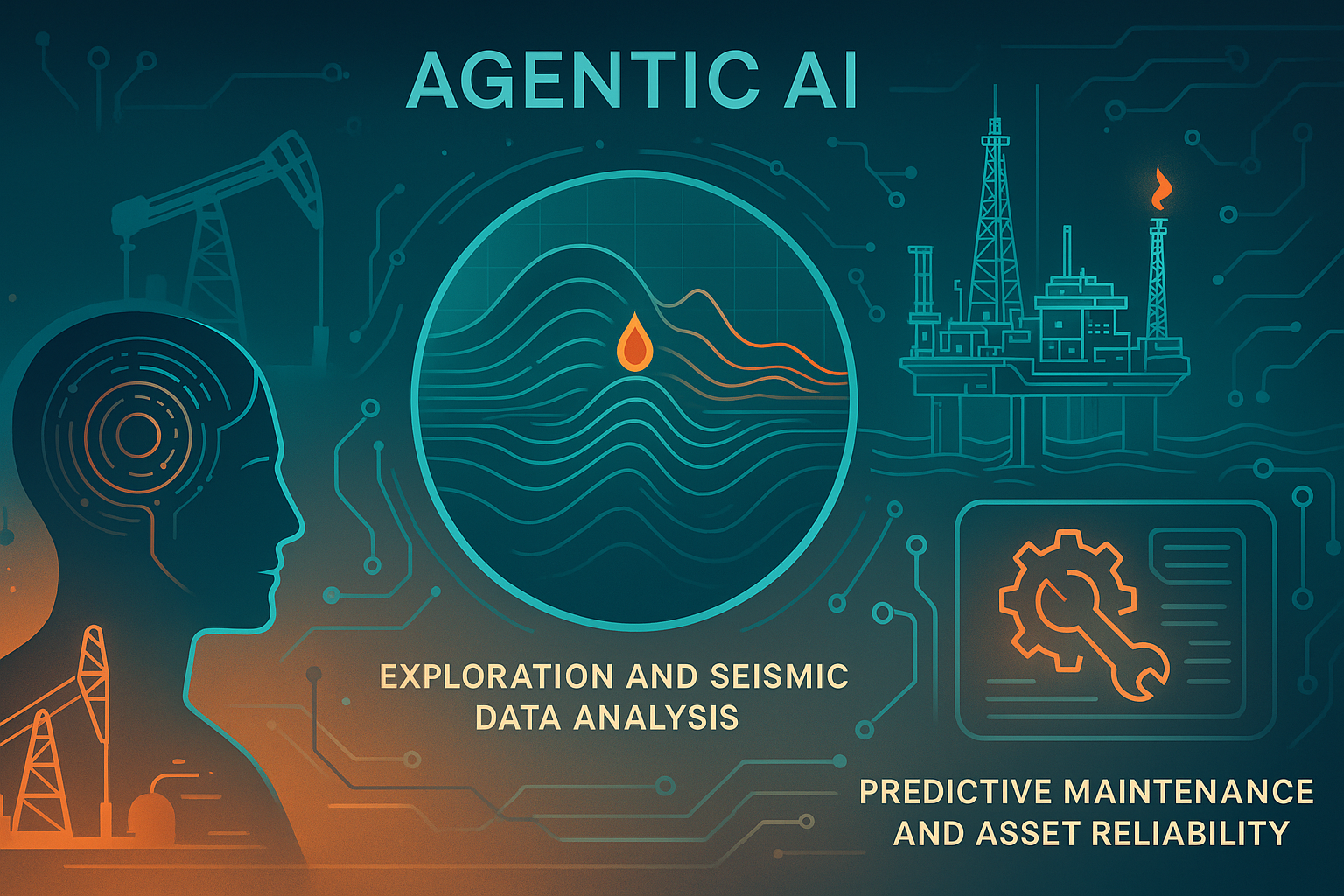
Agentic AI is transforming oil & gas with smarter, safer, efficient ops.
Predictive Maintenance and Asset Reliability
A refinery or offshore platform may have hundreds of thousands of sensors streaming temperature, pressure, vibration, and flow data every second. No human can monitor that volume continuously.
Agentic AI agents excel here. They use anomaly detection models and historical maintenance records to not only predict when equipment might fail but to autonomously act. An agent can:
Flag potential compressor failure days in advance.
Schedule maintenance in the ERP system.
Order parts automatically through the supply chain.
Alert the nearest available technician with instructions.
This closes the loop between detection and resolution. It cuts unplanned downtime, increases operational reliability, and even optimizes workforce allocation. In industries where downtime can cost millions per day, autonomous maintenance is a game-changer.
Drilling Optimization and Safety
Drilling presents constant risks: pressure kicks, blowouts, and equipment malfunctions can spiral into accidents. Traditionally, drill operators balance dozens of indicators in real-time — a cognitive overload.
An Agentic AI drilling copilot continuously monitors downhole pressure, mud weight, torque, and seismic feedback. If it detects early-warning patterns for a kick, it can autonomously adjust drilling speed, rebalance mud weight, and trigger safety valves. Simultaneously, it documents the incident in compliance logs and informs supervisors.
Beyond safety, AI agents can optimize drilling efficiency by tweaking parameters to reduce wear on drill bits or minimize energy consumption. The result: safer operations and reduced costs per barrel.
Supply Chain and Logistics
Managing oil and gas logistics is like orchestrating a global puzzle. From crude transport to refinery scheduling, disruptions at any point ripple across the chain.
Agentic AI agents can act as supply chain controllers. They analyze shipping routes, monitor weather conditions, track vessel positions, and adjust schedules in real time. If a port strike is predicted, the agent automatically reroutes shipments, negotiates with alternate suppliers, and updates the ERP with revised delivery times.
They can also predict demand fluctuations by analyzing market data, geopolitical events, and refinery consumption trends — allowing proactive stock adjustments. This turns supply chains from reactive systems into anticipatory, resilient networks.
This ties directly to how AI agents accelerate enterprise capabilities across industries.
Environmental Monitoring and ESG Compliance
Regulators and investors increasingly demand transparency on carbon footprints, emissions, and safety metrics. Manual compliance processes can’t keep pace with the volume and granularity required.
Agentic AI compliance agents continuously pull data from sensors monitoring emissions, water quality, and energy use. They combine it with satellite feeds and drone inspections to validate site conditions. Reports that once took months to prepare are generated daily, ready for audit submission.
If emissions exceed thresholds, the agent doesn’t stop at raising alarms. It can launch mitigation workflows — adjusting operations, triggering clean-up protocols, and logging evidence for regulators. For oil and gas companies balancing production with ESG commitments, this is a massive efficiency boost.
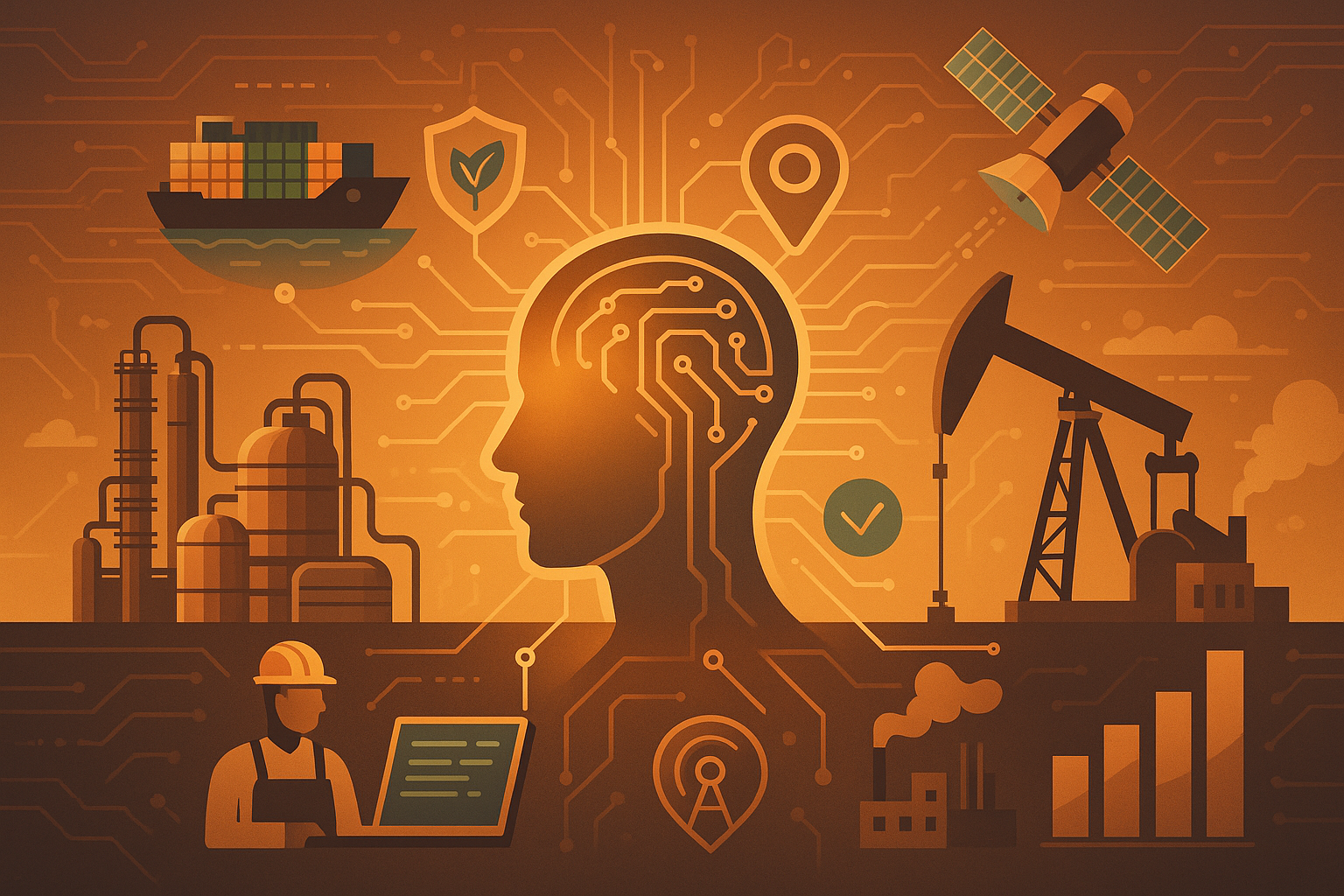
Autonomous agents connecting refineries, rigs, satellites, and supply chains for smarter, safer, sustainable energy
Workforce Empowerment and Knowledge Retention
One silent risk in oil and gas is knowledge attrition. Decades of hard-won expertise often disappear as senior engineers retire. Training new teams to the same standard is expensive and time-consuming.
Here, Agentic AI agents serve as digital mentors. Trained on historical data, incident reports, and operating manuals, they provide guidance in natural language. A junior engineer can ask, “What’s the protocol if pump vibration exceeds threshold X in offshore rigs?” and get context-specific answers along with recommended workflows.
This democratizes access to institutional knowledge and accelerates workforce upskilling, ensuring that expertise scales across geographies and generations.
Technical Backbone: How Agentic AI Fits In
For oil and gas, the real strength of Agentic AI lies in deep integration:
IoT + SCADA: Agents consume live sensor data, not static reports.
ERP + CRM: They initiate procurement, logistics, and HR tasks automatically.
LLMs + Domain Models: The best LLMs for AI agents, fine-tuned on oil and gas datasets, give them reasoning power.
Agentic Benchmarks: Every deployment is tested against operational benchmarks to ensure safety and compliance before scaling.
This isn’t standalone AI. It’s an intelligent mesh woven into the industry’s digital core.
Fluid AI doesn’t just deliver models. We deliver enterprise-ready digital workers, similar to how AI agents resolve customer issues without CRM queues in other industries.
How Fluid AI Powers Oil & Gas with Agentic AI
At Fluid AI, we’re taking Agentic AI beyond theory. Our Fluid GPT platform enables oil and gas enterprises to:
Deploy plug-and-play AI agents tailored to exploration, drilling, and maintenance.
Seamlessly integrate with existing SAP, Oracle, SCADA, and IoT systems.
Scale pilots into full digital workforces across upstream, midstream, and downstream.
Maintain enterprise-grade governance with SOC2, ISO, RBI, and GDPR compliance.
The Future: From Automation to Autonomy
The future of oil and gas won’t be defined by who has the best dashboards. It will be defined by who builds the most effective AI workforce. Those who embrace Agentic AI early will see faster ROI, safer operations, and stronger ESG performance.
This is more than automation. It’s autonomy — and it’s the new competitive advantage.
Closing Thoughts
Every leap in oil and gas — offshore rigs, seismic imaging, digital twins — has redefined the industry. Agentic AI is the next leap. By embedding autonomous AI agents into exploration, drilling, logistics, and compliance, energy companies are creating an AI-powered workforce that never sleeps, never misses a signal, and always acts in real time.
With Fluid AI leading the way, this transformation is no longer on the horizon. It’s already happening.
Frequently Asked Questions (FAQ)
1. How is agentic AI being used in oil and gas?
Agentic AI in oil and gas automates maintenance scheduling, equipment monitoring, compliance reporting, and procurement workflows. AI agents connect to ERP and SCADA systems to trigger actions when sensor thresholds are hit, without waiting for a human to notice.
2. Can AI predict equipment failures before they happen?
Yes. Agentic AI monitors equipment sensor data continuously and flags anomalies before they become failures. Fluid AI's agents can automatically schedule maintenance, notify engineers, and log the incident in ERP systems when a predictive alert fires.
3. Does oil and gas AI need to run on-premise?
Often yes. Many energy enterprises have strict data sovereignty requirements and operate in remote or air-gapped environments. Fluid AI supports full on-premise and data centre deployment, with no dependency on external cloud infrastructure.
4. What makes agentic AI better than traditional monitoring systems for industrial use?
Traditional monitoring alerts humans to act. Agentic AI acts itself - it schedules the maintenance, orders the part, and updates the work order autonomously. Human oversight is reserved for edge cases and strategic decisions, not routine responses.
5. How do you audit AI decisions in safety-critical industrial environments?
Fluid AI logs every agent action with full context, decision rationale, and data sources used. In safety-critical environments, all high-risk autonomous actions require human approval before execution, with a complete trail available for safety audits