How AI Agents Are Transforming Plant Operations: A Factory GPT Deep-Dive

TL;DR
Most plants can see their problems (dashboards, alerts) but still need a human to notice, diagnose, and act. That gap costs uptime and output every shift.
Factory GPT closes it: AI agents that understand your plant, answer in plain language, and take real action, not just show data.
Top uses: predictive maintenance, quality inspection, downtime root-cause, plant knowledge on demand, OEE monitoring, and SAP-integrated supply chain.
It works where other AI failed because it runs on-premise, integrates with SAP, and acts with guardrails, so data never leaves the plant.
Start with your biggest pain (usually downtime or lost knowledge), prove it on one line, then scale.
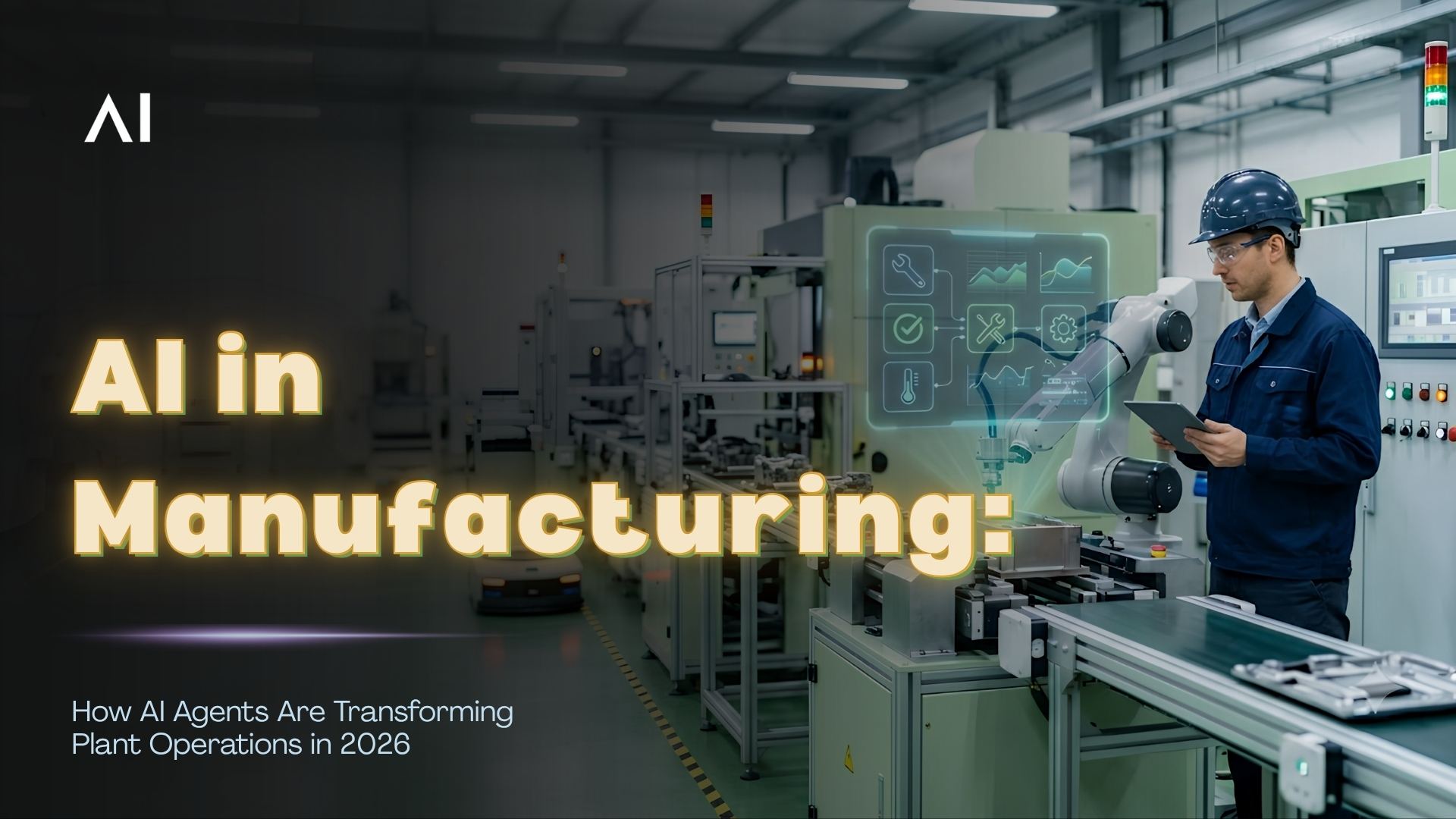
How AI Agents Are Transforming Plant Operations: A Factory GPT Deep-Dive
Manufacturing has been climbing the same ladder for a decade. It usually looks like this:
First came digital transformation in manufacturing, moving records, machines, and processes onto connected systems.
Then factory automation and industrial AI, using software and models to monitor and predict.
Then the smart factory, sensors and dashboards everywhere, showing you what's happening in real time.
And now the newest rung: AI agents in manufacturing that don't just show you the problem, they act on it.
Most plants are stuck on the dashboard rung. They can see downtime, defects, and delays, but a human still has to notice the alert, dig for the cause, and decide what to do. That gap between seeing and doing is where hours, output, and money leak out every single shift.
Factory GPT closes that gap. It's the plant's own AI layer, a set of agents that understand your operation, answer questions in plain language, and take real action inside your systems. This deep-dive walks through what that actually looks like on the floor.
What is Factory GPT?
Factory GPT is generative AI in manufacturing applied to the plant itself. Instead of a generic chatbot, it's an agent trained on your operation: your SOPs, your machine manuals, your maintenance history, your SAP data. It can answer an operator's question, pull a live production number, flag a failing machine, or kick off a work order, all in plain language.
The key difference from the AI most plants have tried: Factory GPT does work, it doesn't just talk. And critically for manufacturing, it runs on-premise, inside your own network, so sensitive production and operational data never leaves the plant.
How AI agents actually work in a plant
An AI agent isn't a smarter dashboard. It's software that can do three things in a loop: sense, decide, and act.
Sense. It reads live data from your machines, your SAP system, your maintenance logs, and your documents, the full picture, not one gauge.
Decide. It reasons over that data against what it knows: the SOP, the failure history, the compliance rule. It works out what the situation actually calls for.
Act. It does something about it, raises the work order, alerts the right operator, pulls the procedure, updates the record, or escalates to a human when judgment is genuinely needed.
That loop is the difference. A dashboard shows you a temperature is rising. An agent sees the temperature rising, recognizes the pattern that precedes a failure, checks the maintenance history, and raises the work order before the machine goes down, all before anyone in the control room has looked up. Factory GPT is a coordinated set of these agents, each handling a part of plant operations and handing off to each other and to humans as needed.
AI agents vs traditional plant automation
Plants already have automation, so the fair question is how this is different. Traditional automation follows fixed rules. AI agents reason and adapt.
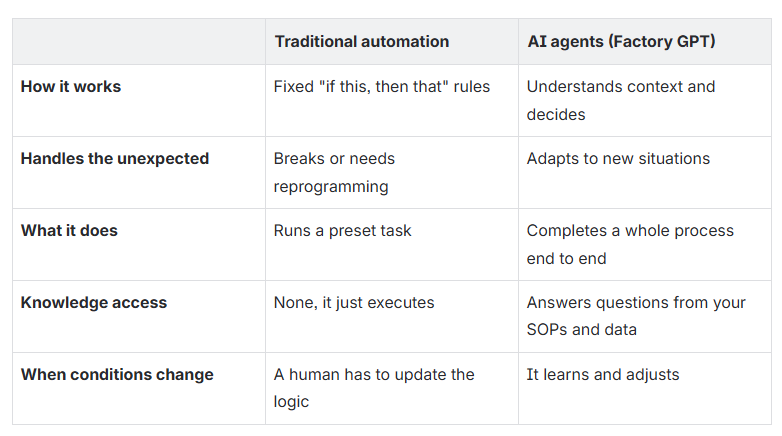
Traditional automation is a light switch: useful, but it only does the one thing it was wired for. An AI agent is closer to an experienced engineer who knows the plant, notices what's off, and handles it. That's why agents pick up where automation stops, on the messy, multi-step, judgment-heavy work that rules alone were never able to cover.
The use cases transforming plant operations
Plant knowledge on demand. A plant runs on knowledge buried in thousands of manuals, SOPs, and machine records. When a line goes down at 2 a.m., an engineer shouldn't be flipping through a binder. Factory GPT lets anyone ask "how do I reset this fault on line 3" and get the exact procedure in seconds. Tribal knowledge stops walking out the door when a veteran retires.
Predictive maintenance. Unplanned downtime is the most expensive thing in any plant. Predictive maintenance agents watch equipment data continuously, spot the pattern that precedes a failure, and flag it before the machine actually breaks. You move from fixing what's broken to preventing it, which is the single biggest cost lever on the floor.
Quality inspection. Human inspection can't hold consistent quality at line speed. Computer vision agents scan products in real time, catch defects the eye misses, and do it the same way on every unit, every shift, cutting scrap and rework.
Downtime root-cause analysis. When a line stops, the costly part is often figuring out why. An agent correlates machine data, maintenance logs, and production records to surface the likely cause in minutes instead of a half-day investigation, so the fix starts sooner.
Shop-floor operator assist. Operators need answers hands-free, mid-task. A voice-enabled agent lets them ask questions, log issues, and get guidance without stopping the line or hunting for a supervisor. It turns every operator into their most experienced version.
Production and OEE monitoring. Agents track throughput, bottlenecks, and overall equipment effectiveness in real time, and instead of just charting it, they flag what's dragging output and recommend the adjustment. The dashboard starts giving answers, not just numbers.
Maintenance and work-order automation. Raising, routing, and closing work orders is manual and slow. An agent digitizes the whole workflow, verifies it, and keeps it moving, so maintenance spends time fixing machines, not filling forms.
Supply chain and materials. Integrated with SAP, agents make plant inventory and material data searchable in plain language, forecast shortages, and reconcile stock in real time, so the line never waits on a part that "should have been there."
Safety and compliance. Agents monitor safety-permit workflows and compliance checks, digitizing what used to be paperwork and making sure standards are verified and recorded, not assumed.
Talk to your plant data. Plant managers shouldn't need a data analyst to answer a question. Natural-language querying lets them ask "what caused the yield drop on Tuesday" and get the answer from the database directly, no report request, no wait.
Key takeaway: Every use case above follows the same loop, sense, decide, act, inside your own systems. That's what separates a plant that sees its problems from a plant that resolves them.
Why this works in manufacturing when other AI didn't
Plenty of manufacturers have tried AI and watched it stall. The reason is rarely the model. It's everything around it. Factory GPT works because it clears the three barriers that kill most plant AI:
It runs on-premise. Production data, machine data, and operational records stay inside your walls. No cloud dependency, no data leaving the plant, which matters for both security and IP.
It integrates with SAP and legacy systems. Agents work off live plant data through approved integration patterns, not stale exports, connecting to the systems you already run rather than replacing them.
It acts, with guardrails. Agents take real action, but inside role-based access, verification, and a full audit trail, so autonomy never means loss of control.
That combination, agentic action plus on-premise, SAP-integrated deployment, is what moves AI from a pilot that impresses to a system that runs on the floor every day.
The outcome
Plants that deploy this don't get a shinier dashboard. They get shifts that run with less downtime, quality that holds without more inspectors, knowledge that's instantly available to everyone, and managers who get answers in seconds instead of reports in days. The measurable wins show up where manufacturing has always measured: uptime, yield, scrap, and output.
Want to see Factory GPT on your floor? Book a discovery workshop and we'll map your highest-impact use cases to a proven manufacturing playbook.
Frequently asked questions
1. What is AI in manufacturing used for?
The highest-impact uses are predictive maintenance, quality inspection, plant kno1.wledge access, downtime analysis, production and OEE monitoring, and SAP-integrated supply chain. The common thread is AI agents that take action inside plant systems, not standalone chatbots.
2. What is a smart factory?
A smart factory connects machines, sensors, and systems so operations can be monitored and optimized in real time. The next step beyond it is agentic AI, where the system doesn't just show data but acts on it.
3. What is Factory GPT?
Factory GPT is a plant-specific AI layer, agents trained on your SOPs, machine data, and SAP systems, that answer questions in plain language and take real action across plant operations.
4. Why does manufacturing AI need to run on-premise?
Production data, machine data, and process IP are sensitive and often can't leave the plant. On-premise deployment keeps that data inside your network while still integrating with SAP and maintaining a full audit trail.
5. Can AI agents work with existing plant and SAP systems?
Yes. Agents connect through approved SAP integration patterns and use live plant data, so they enhance the systems you already run rather than replacing them.
Where to start?
You don't roll out ten agents on day one. Pick the use case bleeding the most money today, usually unplanned downtime or lost plant knowledge, prove it on one line or one site, then scale across the plant.
Book your Free Strategic Call to Advance Your Business with Generative AI!
Fluid AI is an AI company based in Mumbai. We help organisations kickstart their AI journey. If you're seeking a solution for your organisation to enhance customer support, boost employee productivity and make the most of your organisation's data, look no further.
Take the first step on this exciting journey by booking a Free Discovery Call with us today and let us help you make your organisation future-ready and unlock the full potential of AI for your organisation.
_1790254083168-CB8e8KXC.png)