What Happens When 10,000 AI Agents Start Calling Your Enterprise Systems?

TL;DR
AI agents are moving from answering questions to taking actions across enterprise systems. At scale, thousands of agents could create new challenges around identity, permissions, APIs, orchestration, security, evaluation, cost, and governance. This article explores what enterprises need to build for a world where software agents become active participants in business operations.
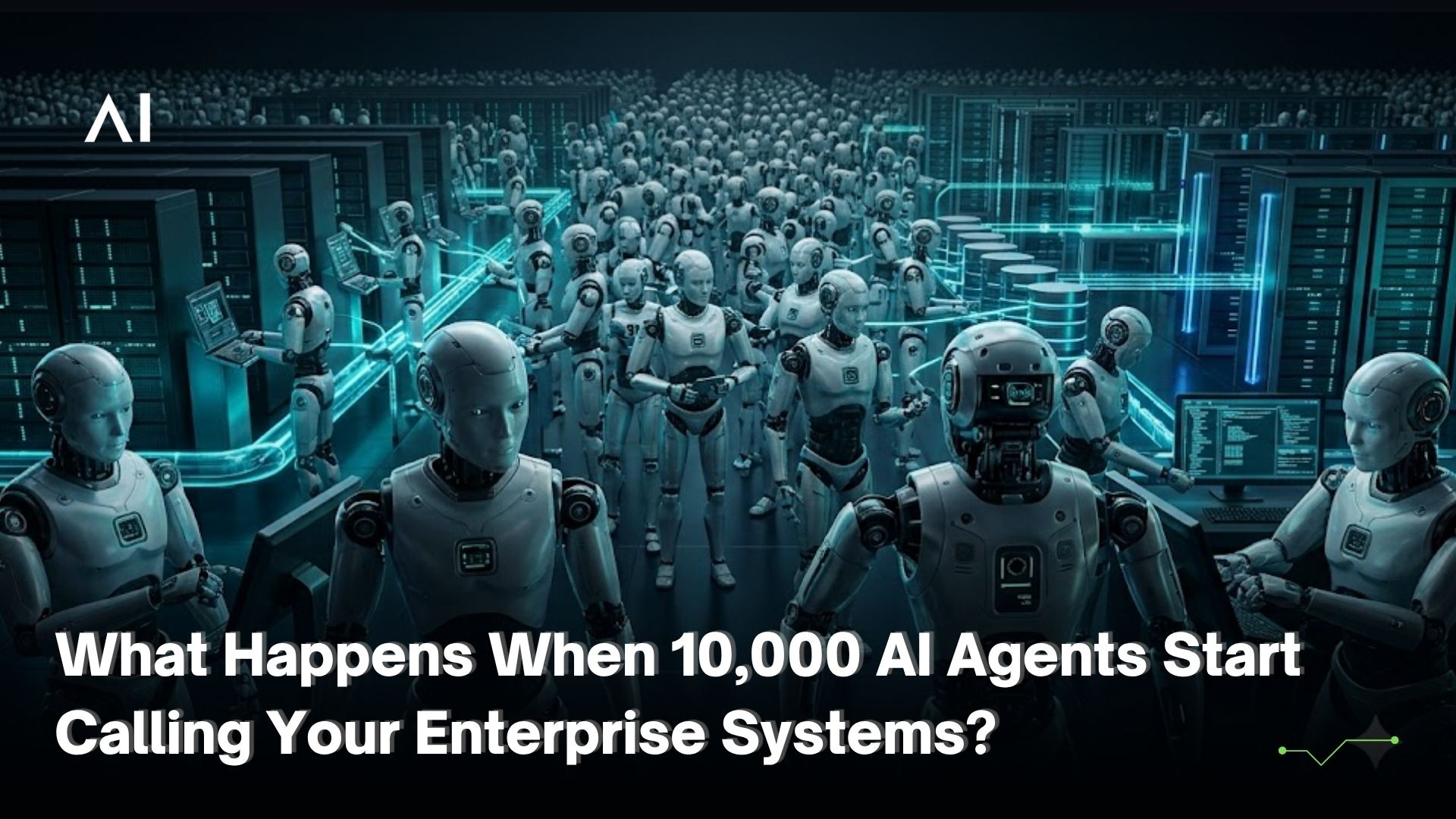
Enterprise software was built around people.
A person logs into an ERP system. A person checks a CRM record. A person runs a report. A person raises a service request. A person approves a transaction.
Even when an enterprise has thousands of applications, the systems underneath them were designed around one basic assumption:
Humans are the ones doing the work.
AI agents change that.
An AI agent can read information, reason over it, call an API, update a system, trigger a workflow, and move on to the next task.
Now imagine thousands of them doing this simultaneously.
Not 10,000 chatbots answering questions.
10,000 software agents taking actions across enterprise systems.
That changes the problem entirely.
The question is no longer whether an AI agent can connect to an enterprise application.
It is whether the enterprise can safely support a new class of users that are faster, more autonomous, and potentially operating around the clock.
A single agent can be useful.
Ten thousand agents become an infrastructure problem.
The scale changes everything
A human employee might interact with an enterprise system dozens of times during a working day.
An AI agent can make dozens of calls while completing a single task.
Consider a simple request:
“Why is this purchase order delayed?”
The agent may need to:
01 → Identify the purchase order
02 → Check supplier information
03 → Retrieve delivery records
04 → Search the relevant policy
05 → Compare dates and status
06 → Identify the bottleneck
07 → Recommend an action
08 → Trigger the appropriate workflow
To a person, this looks like one question.
To the enterprise architecture, it can mean a chain of system interactions.
Now multiply that by thousands of requests.
Enterprise AI is no longer only about generating responses.
It becomes an infrastructure problem.
AI agents become a new kind of enterprise user
Traditional enterprise architecture has clear categories.
There are employees.
There are applications.
There are databases.
There are APIs.
There are workflows.
Agents blur those boundaries.
An AI agent behaves like a user because it requests information and performs actions.
It behaves like an application because it can execute a defined workflow.
But it is different from both because it can dynamically decide what to do next.
That creates a new requirement for enterprise AI architecture.
The infrastructure has to understand not only what an agent can do, but why it is doing it, who authorized it, and what should happen if something goes wrong.
01 → Identity has to follow the action
A human employee has an identity.
That identity determines which systems they can access and what actions they are allowed to perform.
AI agents need the same principle.
But simply giving an agent the permissions of the person who created it isn't enough.
An agent working on a procurement task may need to read supplier information but not approve payments.
Another agent may need access to operational data but not employee records.
A third may be allowed to prepare an action but require human approval before executing it.
The system therefore needs to understand:
Who initiated the request → Which agent is performing it → What data it can access → What it can change → What requires approval → What actually happened
At small scale, these questions can be handled manually.
At thousands of agents, they become part of the platform.
Agent identity becomes infrastructure.
02 → APIs need to handle machine-scale activity
Enterprise APIs generally assume predictable behavior.
An application makes a request.
The system processes it.
The application receives a response.
An AI agent can behave very differently.
To complete one task, it might make several calls across multiple systems.
It may retrieve data → inspect a document → call a model → check the result → perform an action.
If something fails, it may retry.
If the result is incomplete, it may call another tool.
This creates a new form of machine-generated traffic.
The challenge is not simply handling more requests.
It is handling reasoning-driven requests, where the next request can depend on the result of the previous one.
At scale, the architecture needs to account for:
Concurrency → Rate limits → Retries → Timeouts → Priorities → Failure handling
An agent retrying a failed request is normal.
Thousands of agents retrying at the same time can become an outage.
03 → One action can trigger another
This is where multi-agent systems become particularly interesting.
Imagine:
Operations Agent
↓
detects a problem
Procurement Agent
↓
checks supplier information
Approval Workflow
↓
requests authorization
Enterprise System
↓
updates the transaction
Another Agent
↓
responds to the update
Every individual step might be valid.
The complete chain can still produce an unintended result.
This is one of the biggest differences between traditional automation and agentic AI.
Traditional workflows usually define the path in advance.
Autonomous AI agents can determine parts of the path dynamically.
That flexibility is powerful.
It also means the system needs boundaries.
04 → Autonomy needs boundaries
A production AI agent cannot simply be told to “do whatever is necessary.”
It needs constraints.
Which tools can it call?
Which systems can it modify?
How many actions can it perform?
How far can a workflow continue without approval?
When should it stop?
When should it ask for help?
These controls become especially important when agents operate across financial, operational, HR, customer, or other sensitive enterprise systems.
Good AI governance isn't about preventing agents from acting.
It is about defining:
What can happen → Who can authorize it → What the agent can execute → What needs approval → What happens when something goes wrong
The goal isn't zero autonomy.
It is controlled autonomy.
05 → Knowing when to stop is part of intelligence
Autonomy is often measured by how much an AI system can do without human involvement.
For enterprise AI, that is only half the equation.
A reliable agent also needs to recognize when it should not continue.
The information may be incomplete.
Two enterprise systems may disagree.
The requested action may exceed its permissions.
The potential impact may be too high.
The agent may not have enough evidence to make a reliable decision.
The correct flow then becomes:
Detect uncertainty → Stop → Explain why → Escalate → Let a human decide
Stopping is not failure.
It is correct behavior.
This is why human escalation remains an important part of enterprise automation.
The goal is not to remove people from every workflow.
The goal is to let AI handle the work it can handle reliably and bring people into the exceptions that genuinely require judgment.
06 → Evaluation has to move beyond the model
Traditional AI benchmarks ask whether a model can answer a question correctly.
An enterprise agent has a much bigger job.
Suppose an agent is asked to investigate a delayed order.
It needs to:
Retrieve the right record → Use the right data source → Interpret the information → Respect access controls → Choose the right tool → Perform the action → Verify the result → Escalate if necessary
A model can produce a convincing answer and still fail the task.
This is why AI agent evaluation needs to happen at the workflow level.
The important question becomes:
Did the system complete the task correctly?
Not simply:
Did the model generate a good response?
The unit of evaluation changes from the response → to the completed task.
07 → The model is only one part of the system
As enterprise AI becomes more complex, sending every task to one large model becomes increasingly inefficient.
Different workloads have different requirements.
A simple classification task may not need a large reasoning model.
A high-volume workflow may prioritize latency and cost.
A sensitive workload may require an open or privately deployed model.
A complex reasoning task may justify a more capable model.
And some decisions should be handled by deterministic software rather than generative AI.
The architecture therefore needs to decide:
Request → Router → Model / Tool / Database / Agent / Workflow / Human
This is AI orchestration.
The best enterprise AI architecture may not be the one with the biggest model.
It may be the one that knows which intelligence to use for each task.
08 → Cost becomes a workflow metric
Agentic AI also changes how enterprises need to think about cost.
A model may appear inexpensive when measured by tokens.
But a single agentic workflow can involve:
Inference → Data retrieval → API calls → Tool execution → Multiple reasoning steps → Retries → Infrastructure → Human intervention
The meaningful number is therefore not simply cost per token.
It is:
Cost per successfully completed task.
An enterprise should be able to measure:
Cost → Latency → Success rate → Failure rate → Human intervention → Business outcome
The cheapest model isn't necessarily the cheapest system.
A model that costs less but fails more often can make the complete workflow more expensive.
09 → Existing enterprise systems still matter
The rise of AI agents does not mean replacing the systems enterprises have spent decades building.
ERP systems will still exist.
CRM systems will still exist.
Data warehouses will still exist.
Document repositories, operational applications, workflow platforms, and internal databases will still exist.
What changes is the layer interacting with them.
The flow becomes:
Business request → AI reasoning → Enterprise data → Enterprise tools → Action → Verification
The underlying applications continue doing what they were designed to do.
The difference is that the interface is no longer limited to a human navigating screens.
Software can now work across them.
10 → The enterprise AI stack needs a new control layer
Once AI agents operate across hundreds of enterprise applications, individual integrations aren't enough.
There needs to be a layer that understands the complete environment.
It needs to manage:
Identity
Who is the agent?Access
What can it see?Orchestration
Where should the task go?Execution
What can it actually do?Observability
What happened?Evaluation
Did it work?Governance
Was it allowed?Cost
Was it efficient?
This is where the idea of an AI control plane becomes important.
Instead of treating every agent as an isolated application, enterprises can manage AI activity as part of a common infrastructure.
10,000 is not really the number
An enterprise may never deploy 10,000 AI agents.
It may deploy 50.
Or 500.
Or a handful of highly capable agents coordinating hundreds of workflows.
The number is only a way of describing the scale of the shift. For decades, enterprise software was optimized around human activity.
AI agents don't have the same constraints.
As more work moves from people to software, enterprise systems will increasingly have to support software as an active participant in the business.
That is the real transition happening with agentic AI.
The challenge isn't building an AI agent that can call an API.
It is building an enterprise where thousands of intelligent actions can happen without losing control, context, security, or accountability.
The next generation of enterprise AI won't be defined only by how intelligent its models are.
It will be defined by how well the entire system can:
Reason → Act → Coordinate → Verify → Learn → Know when to stop.
And that is what makes the next phase of AI infrastructure much bigger than another generation of chatbots.
Book your Free Strategic Call to Advance Your Business with Generative AI!
Fluid AI is an AI company based in Mumbai. We help organisations kickstart their AI journey. If you're seeking a solution for your organisation to enhance customer support, boost employee productivity and make the most of your organisation's data, look no further.
Take the first step on this exciting journey by booking a Free Discovery Call with us today and let us help you make your organisation future-ready and unlock the full potential of AI for your organisation.
Frequently Asked Questions (FAQs)
1. What are AI agents?
AI agents are autonomous software systems that can understand tasks, make decisions, use tools, and take actions with limited human intervention.
2. What happens when 10,000 AI agents run at once?
The challenge shifts from individual agent intelligence to scale, concurrency, system load, dependencies, security, and orchestration.
3. Can AI agents connect to enterprise systems?
Yes. Agents can interact with APIs, databases, ERP, CRM, internal applications, and other enterprise systems when properly integrated and authorized.
4. What problems can thousands of AI agents create?
High concurrency can lead to API bottlenecks, duplicate actions, excessive retries, queue buildup, permission issues, and cascading failures.
5. How can enterprises control thousands of AI agents?
Enterprises need strong identity, access controls, orchestration, routing, observability, guardrails, and governance to manage agents safely at scale.
_1790254083168-CB8e8KXC.png)