Enterprise AIOps for IT Leaders: Building a Governance-First Strategy That Scales

TL;DR
Enterprise AIOps is not just about automating IT tasks. As AI takes on more operational work, enterprises need governance built into the foundation. This means clear visibility across systems, strong security and compliance controls, defined decision boundaries, and the ability to monitor and manage AI-driven actions at scale.
A governance-first strategy helps IT leaders introduce automation without losing control, while creating a foundation that can scale across cloud, applications, infrastructure, cybersecurity, and day-to-day operations.
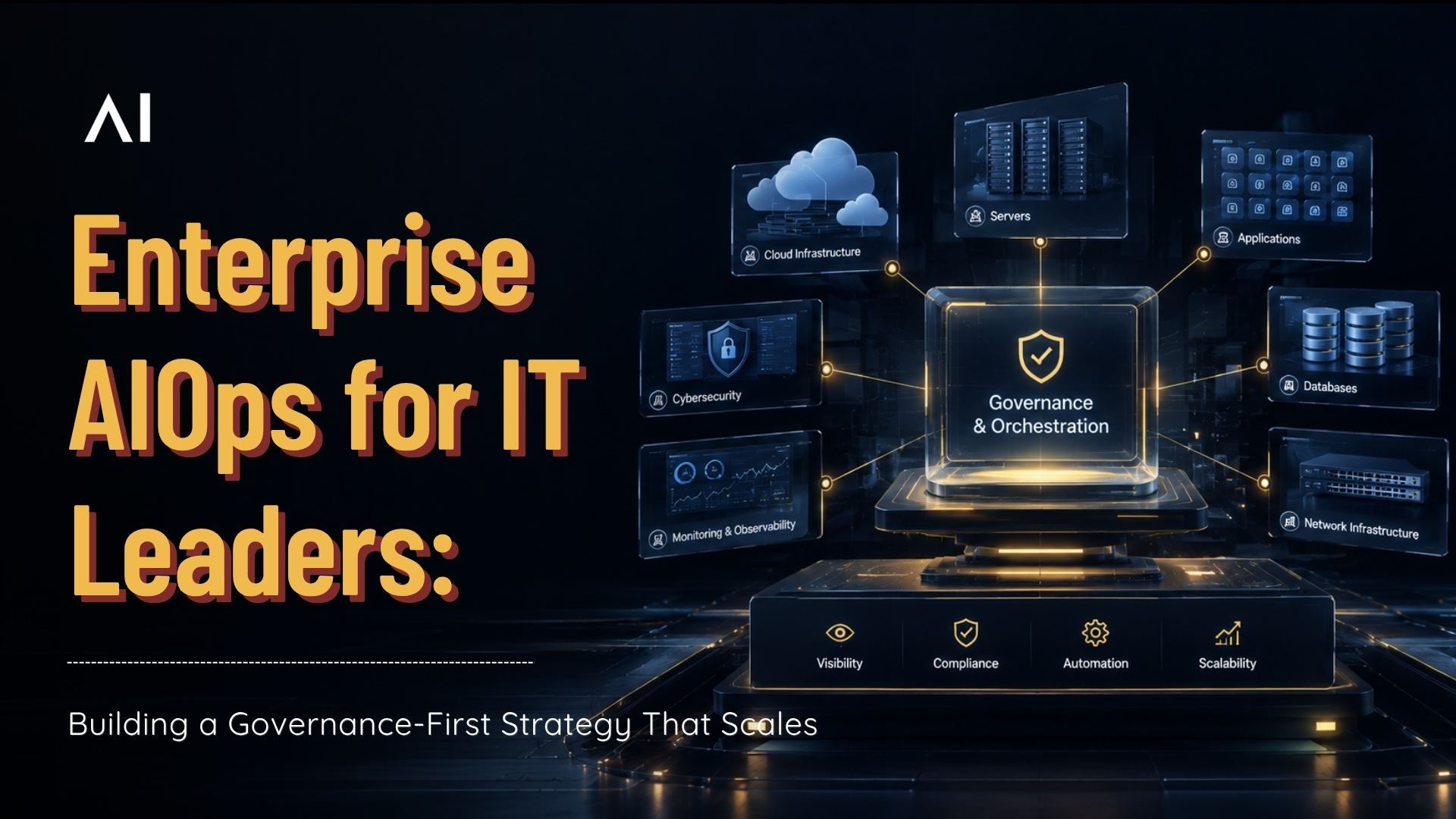
AIOps started with a fairly simple promise: help IT teams make sense of too much operational data.
Monitor infrastructure. Correlate alerts. Detect anomalies. Find the likely cause of an incident.
That is changing.
AI agents can now go beyond identifying a problem. They can investigate an incident, query systems, call APIs, recommend a fix, and in some cases execute that fix themselves.
“How do we let AI act without losing control of the environment?”
That is where governance-first AIOps comes in.
What is AIOps?
AIOps (Artificial Intelligence for IT Operations) is the use of AI and machine learning to monitor, analyze, and automate IT operations.
In simple terms, AIOps helps IT teams detect problems, understand what caused them, and take action faster.
For example, instead of an IT team manually checking thousands of alerts, AIOps can:
Detect unusual system behavior
Identify potential incidents
Find the likely root cause
Predict failures before they happen
Automate routine fixes
Bring data from different IT systems into one view
Think of it as an AI layer sitting across your IT environment, helping teams move from reacting to problems to proactively managing operations.
Why AIOps Is Becoming a Governance Problem?
Traditional AIOps was largely about visibility and recommendations. An AI system could detect that a server was behaving abnormally or that several alerts were probably connected to the same underlying issue.
The human operator still made the final decision.
Agentic AIOps changes that boundary. An agent may have access to monitoring platforms, ticketing systems, cloud infrastructure, deployment pipelines, databases, and internal tools. It can reason across those systems and take action based on what it finds.
That creates more potential value, but also a different operational risk.
The important shift is this:
When AI can act, governance has to cover behavior, not just outputs.
The Scaling Problem: Every Team Builds Differently
DevOps may create an agent for incident response. The cloud team may build one for infrastructure optimization. Security may deploy agents for investigation and remediation. Application teams may create their own agents for deployment monitoring or database operations.
Each team may choose different models, tools, permissions, approval processes, and monitoring systems.
Individually, these decisions can make sense.
At enterprise scale, they create fragmentation.
IT leaders can end up with dozens or hundreds of agents without one reliable answer to basic questions:
What agents exist? Who owns them? What systems can they access? What actions can they take? When did they last run? And what happened when they acted?
this platform-by-platform governance problem as a major challenge as enterprises deploy agents across multiple teams and technology environments.
This is why governance cannot be designed separately for every individual AIOps project.
The enterprise needs a common control layer.
What Governance-First AIOps Actually Means
Governance-first AIOps means building controls into the way agents are created, deployed, and operated from the beginning.
Instead of adding a governance review after an agent has already been built, the controls become part of the agent's operating environment.
A simple way to think about the architecture is:
Agent → Identity → Policy → Tools/APIs → Action → Observability → Human Escalation
Each layer answers a different question.
Identity: Who is this agent?
Policy: What is it allowed to do?
Tools and APIs: Which systems can it access?
Action: What can it actually change?
Observability: Can we see what it did and why?
Human escalation: When does it need a person to take over?
This creates a common foundation that different IT teams can build on without having to reinvent governance every time.
1. Give Every Agent an Identity
The first control is knowing exactly who or what is acting.
An AI agent should not operate as an anonymous automation script with broad credentials. It needs a traceable identity, ownership, defined permissions, and a clear lifecycle.
That identity should connect the agent to information such as its owner, environment, purpose, tools, permissions, version, and activity history.
This becomes particularly important when agents interact with each other.
If one agent triggers another, IT teams should still be able to trace the chain of actions back to the originating workflow.
Treating agents as privileged users is one approach recommended in current enterprise governance guidance, particularly because agents can interact with multiple systems and operate with delegated authority.
2. Define What an Agent Can Actually Do
Not every agent needs the same level of access.
A monitoring agent that reads logs does not need the same permissions as an incident-response agent that can restart services.
Likewise, an agent that can recommend a configuration change should not automatically be allowed to push that change into production.
This is where action boundaries become important.
For example:
Read: Access logs, metrics, tickets, and documentation.
Recommend: Suggest a remediation but wait for approval.
Execute low-risk actions: Restart a non-critical service or create a ticket.
Execute high-impact actions: Make production changes only with explicit approval.
Governance should therefore be proportional to the agent's autonomy and the impact of its actions.
3. Put Policies Between Agents and Production Systems
An agent should not have unrestricted access to every tool simply because it technically can.
A policy layer can determine which tools an agent can call, which environments it can access, what parameters it can use, and which actions require approval.
Imagine an agent investigating a production outage.
It may be allowed to query logs, check service health, inspect recent deployments, and create an incident ticket automatically.
But rolling back a production deployment could require human approval.
The agent can still move quickly. The difference is that its authority is explicitly defined.
This is especially important as enterprises adopt APIs, tool calling, and protocols such as MCP to connect agents with internal systems.
4. Make Observability Part of Governance
IT teams need visibility into agent activity as well as infrastructure activity.
That can include which tools an agent called, what information it accessed, what decision it made, which action it triggered, whether that action succeeded, and whether a human had to intervene.
This creates an operational trail for every significant action.
It also makes troubleshooting easier.
If an automated remediation causes a problem, the team should not have to reconstruct the event from scattered logs. They should be able to trace the agent's decision and the actions that followed.
For large enterprises, a central registry and shared visibility layer can provide a single view of agents, ownership, tools, configurations, and activity across platforms.
5. Keep Humans in the Right Places
Governance-first does not mean putting a human in front of every AI action.
That would remove much of the value of AIOps.
The better approach is to decide where human judgment actually matters.
An agent could automatically handle a low-risk, reversible action such as clearing a temporary cache or restarting a non-critical service.
A production database change, security control modification, or major infrastructure change may require approval.
The important thing is that escalation rules are defined before the agent encounters the situation.
Human oversight then becomes part of the workflow rather than an emergency brake added after something goes wrong.
Governance Should Be Embedded, Not Added Later
One of the easiest mistakes is to create governance as a separate program.
The engineering team builds the agent.
The security team reviews it later.
Compliance asks for documentation.
Operations discovers that the agent behaves differently in production.
By then, governance has become friction.
A better model is to create standardized, governed paths for building and deploying agents.
The identity layer is already connected. Policies are already defined. Logging is already enabled. Approved tools are already available. Monitoring is already configured.
Teams then focus on the business or operational problem instead of rebuilding the control framework every time.
Start With Low-Risk Autonomy, Then Expand
Enterprises do not need to solve every governance question before deploying their first AIOps agent.
A staged approach is more practical.
Start with workflows where the consequences of an incorrect action are limited.
For example, an agent can begin by monitoring incidents, summarizing root-cause signals, gathering relevant logs, or recommending remediation steps.
Once the organization understands its behavior, the agent can be given permission to execute specific low-risk actions.
Higher-impact actions can come later, with stronger approval requirements and tighter controls.
This creates a progression from:
Observe → Recommend → Act with limits → Act autonomously
The controls become stronger as the consequences become greater.
What IT Leaders Should Measure
AIOps success should not be measured only by the number of automated tasks.
Governance needs its own operational metrics.
IT leaders should track:
Automated resolution rate
Mean time to resolution
Failed remediation attempts
Human escalation rate
Policy violations
Agent and tool usage
Cost per workflow
Number of active agents
Production incidents involving agents
Audit and traceability coverage
These metrics show whether automation is actually improving operations without creating a new layer of operational risk.
They also help identify where an agent is ready for more autonomy and where additional controls may be needed.
The Enterprise AIOps Checklist
Before scaling agentic AIOps across teams, IT leaders should be able to answer:
1. Visibility
Do we have a complete inventory of AI agents?
Do we know who owns each one?
2. Identity and access
Does every agent have a traceable identity?
Are permissions scoped to its actual responsibilities?
3. Action boundaries
Which actions can happen automatically?
Which require approval?
4. Observability
Can we see what the agent accessed, decided, and changed?
Can we reconstruct an incident involving an agent?
5. Human oversight
Are escalation conditions clearly defined?
Can an agent be paused or stopped when necessary?
6. Lifecycle
Can agents be updated, reviewed, suspended, and retired?
Are old permissions removed when an agent is decommissioned?
If these answers are unclear, scaling autonomy will make the problem harder, not easier.
Governance Is What Makes AIOps Scalable
The promise of AIOps is not simply that AI can monitor more systems.
It is that AI can participate in the operational work of running those systems.
But once an agent can move from seeing to acting, the architecture around it matters just as much as the model behind it.
The scalable approach is not to give every team the same rigid rules.
It is to create a common foundation for identity, policy, access, observability, escalation, and accountability, while allowing teams to build the AIOps workflows they actually need.
That is what governance-first AIOps really means.
Not slowing automation down.
Making it possible to trust automation at scale.
Book your Free Strategic Call to Advance Your Business with Generative AI!
Fluid AI is an AI company based in Mumbai. We help organisations kickstart their AI journey. If you're seeking a solution for your organisation to enhance customer support, boost employee productivity and make the most of your organisation's data, look no further.
Take the first step on this exciting journey by booking a Free Discovery Call with us today and let us help you make your organisation future-ready and unlock the full potential of AI for your organisation.
Frequently Asked Questions (FAQs)
1. What is Enterprise AIOps?
Enterprise AIOps uses AI and automation to monitor, analyze, and manage complex IT environments across infrastructure, applications, networks, and security.
2. Why is governance important in AIOps?
Governance provides the controls, visibility, security, and accountability needed to use AI safely across enterprise IT operations.
3. What does a governance-first AIOps strategy include?
It typically includes access controls, compliance policies, monitoring, audit trails, human oversight, and defined boundaries for automated actions.
4. Can AIOps work across hybrid and multi-cloud environments?
Yes. AIOps can bring data and operational workflows together across on-premises infrastructure, private clouds, public clouds, applications, and networks.
5. How does Enterprise AIOps scale?
A scalable AIOps strategy uses centralized governance, reusable workflows, automation, and continuous monitoring so new systems and use cases can be added without losing operational control.
_1790254083168-CB8e8KXC.png)