AI Agent Identity: The Security Gap Behind Deepfakes and Rogue Agents

TL;DR
Deepfakes and over-permissioned AI agents look like separate problems, but they share one root cause: trusting an actor you never verified.
As enterprises deploy AI agents that access data and take actions, they create a new population of non-human identities, and most identity models were built only for humans.
Without a real identity, an agent has no accountability: you can't control what it touches or prove what it did.
The fix is treating every agent like an employee, a unique ID tied to an owner, role-based access, verification before sensitive actions, full audit trails, and anomaly detection.
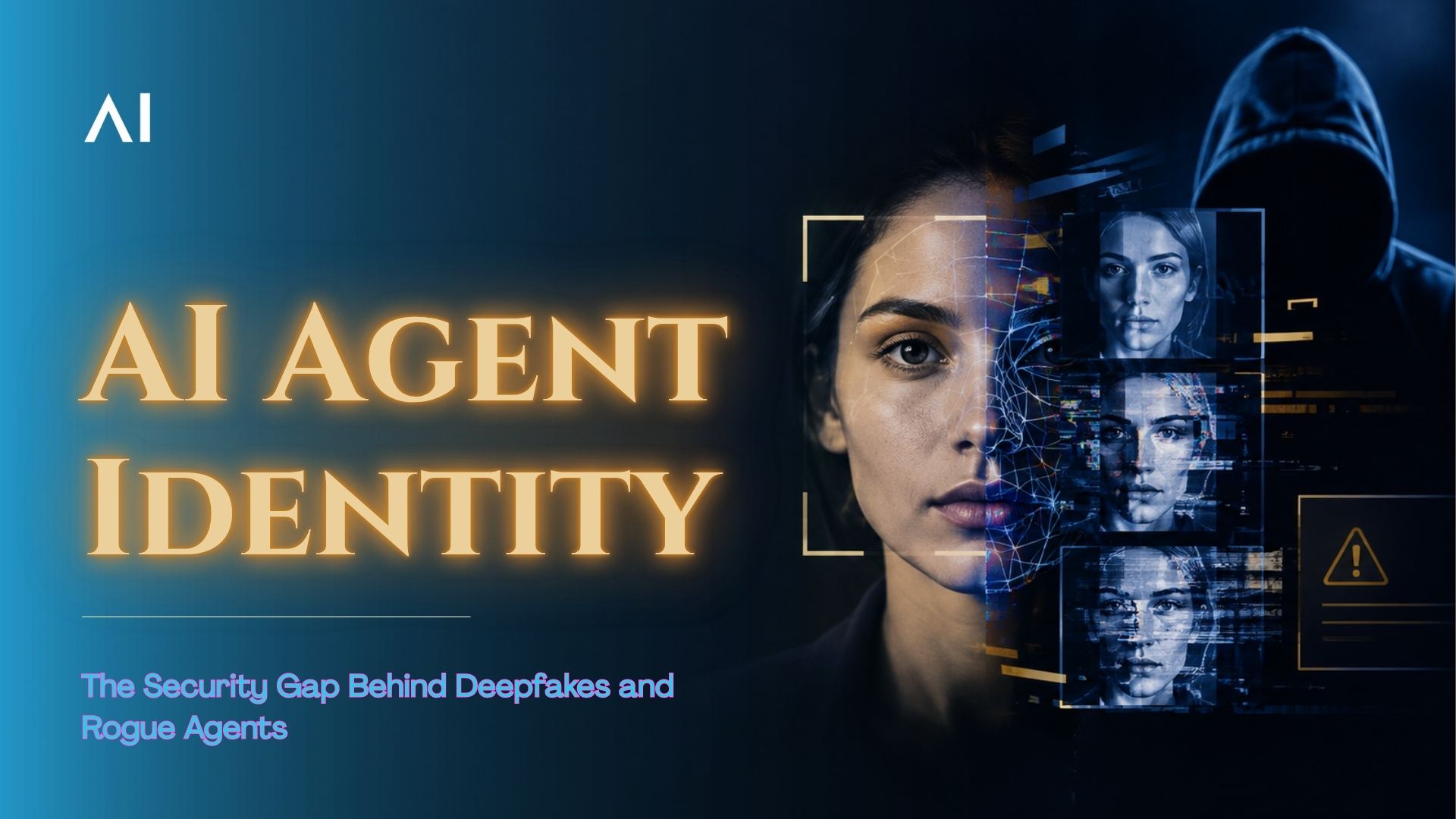
Two problems that look unrelated are, underneath, the same problem.
A deepfake tricks your people into trusting something that isn't real. An over-permissioned AI agent quietly does things nobody authorised. One is an external attack, the other an internal blind spot, but both come down to a single failure: your organisation can't reliably answer the question "who, or what, is actually acting here, and is it allowed to?"
That question sits at the centre of agentic AI security, and it's what this webinar set out to unpack. As enterprises deploy autonomous agents that read data, call systems, and take actions, they're creating a new population of actors inside the business, and most identity models were never built for actors that aren't human. Here are the takeaways worth keeping.
The shift nobody accounted for: agents are actors now
For decades, identity and access management assumed one thing: an identity belongs to a person. A human logs in, gets permissions, and is accountable for what they do.
Agentic AI breaks that assumption. An AI agent now logs into systems, queries databases, moves data, and executes actions, at machine speed, around the clock. It is, functionally, an actor in your environment. But if it's running under a shared service account or a developer's borrowed credentials, then when something goes wrong, you can't say who did it. That's the gap. The agents arrived before the ai agent identity model did.
Why deepfakes and over-permissioned agents are the same problem
The webinar's sharpest framing was connecting the two threats most security teams treat separately.
A deepfake exploits trust in what you can see and hear, you believe a face or a voice because it looks real. An over-permissioned agent exploits trust in what's inside your perimeter, you assume anything already operating in your systems is supposed to be there.
Both are failures of verification. Both happen because the organisation trusted an identity it never actually confirmed. And both get worse as AI gets better: deepfakes become more convincing, and agents become more capable and more numerous. The defence in both cases is the same discipline, verify the actor, scope what it can do, and log everything it does.
Non-human identity: the category most orgs haven't built for
The core idea the session kept returning to is non-human identity, often shortened to NHI. These are the service accounts, API keys, machine identities, and now AI agents that act inside your systems without a person directly driving each action.
Here's the uncomfortable part: in most enterprises, non-human identities already vastly outnumber human ones, and they're governed far more loosely. A human joiner-mover-leaver process is mature. The equivalent for an AI agent, provisioning it, scoping it, rotating its access, and decommissioning it, often doesn't exist. So agents accumulate permissions, keep credentials long after they're needed, and operate with no clear owner.
Non-human identity management is the discipline of closing that gap: treating every agent as a first-class identity with the same rigour you apply to employees.
What an agent identity layer actually looks like
The practical answer from the session was architectural. An agent becomes accountable only when it has a real identity, and that identity has layers:
Isolated compute instance, each agent runs in its own environment, not sharing a process with others.
A unique ID tied to a human owner, so accountability is assigned, not assumed. If an agent goes wrong, you know whose problem it is.
Role-based access controls, the agent inherits scoped permissions the same way an employee does, no more.
An audit trail, every action logged and traceable back to that ID.
Anomaly detection, monitoring for behaviour outside the agent's defined scope, the same way you'd flag an employee doing something off-pattern.
Without this, an agent is an action with no accountable actor behind it. With it, an agent can be governed exactly like a member of staff.
Trust is earned, and it should be measurable
A recurring theme in this kind of discussion, and one Fluid AI applies directly in regulated deployments, is that autonomy is not a switch you flip. It's earned.
The workable model treats an agent like a new hire: intern first, then apprentice, then trusted operator, with more autonomy granted only as it demonstrates reliable judgment. A human reviews the agent's proposed actions, and as the approvals outweigh the corrections, the leash lengthens. High-consequence decisions, compliance, security, anything irreversible, stay behind a human checkpoint regardless of track record. Trust accumulates action by action, and because every action is logged, it's measurable rather than assumed.
What to fix before either becomes an incident
The session closed on the practical order of operations. You don't need to solve everything at once, but you do need to start before an incident forces you to.
Inventory your non-human identities. You can't govern what you can't see. Most organisations are surprised by how many agents, service accounts, and keys are already operating.
Give every agent an owner and a scope. No agent should run without a named human accountable for it and permissions limited to exactly what it needs.
Turn on the audit trail and anomaly detection. Logging isn't optional; it's the only way to know whether an agent is behaving.
Verify, don't assume. Whether it's a face on a video call or an agent inside your systems, confirm the identity rather than trusting the appearance.
The takeaway
The uncomfortable truth from the session: your AI agents already have identities, whether or not you've defined them. The only question is whether those identities are governed or invisible. Deepfakes and over-permissioned agents are two faces of the same weakness, trusting an actor you never verified, and both are getting more dangerous as the technology improves.
The organisations that get ahead won't be the ones with the most agents. They'll be the ones that treated agent identity, ownership, and auditability as foundational, before an incident made it urgent.
Book your Free Strategic Call to Advance Your Business with Generative AI!
Fluid AI is an AI company based in Mumbai. We help organisations kickstart their AI journey. If you're seeking a solution for your organisation to enhance customer support, boost employee productivity and make the most of your organisation's data, look no further.
Take the first step on this exciting journey by booking a Free Discovery Call with us today and let us help you make your organisation future-ready and unlock the full potential of AI for your organisation.
Frequently Asked Questions (FAQs)
What is a non-human identity?
A non-human identity (NHI) is any actor in your systems that isn't a person, service accounts, API keys, machine identities, and AI agents. They now often outnumber human identities and need the same governance.Why do AI agents need their own identity?
Because an agent takes real actions in real systems. Without a unique identity tied to an owner, you can't control what it accesses or prove what it did, which is a security and audit failure.How are deepfakes and AI agent security related?
Both are failures of verification, trusting an actor you never confirmed. A deepfake fakes a human; an over-permissioned agent operates unchecked inside your perimeter. The fix for both is verify, scope, and log.What is agentic AI security?
The practice of securing autonomous AI agents: giving each a scoped identity, role-based access, verification before sensitive actions, full audit trails, and anomaly detection, so agents can act without becoming a risk.
_1790254083168-CB8e8KXC.png)