Iterative AI Agents: How One Agent Can Handle Thousands of Tasks Automatically

TL;DR
An iterative AI agent is an autonomous system that loops through tasks repeatedly, planning, acting, evaluating, and refining, without needing a human to intervene at each step. Unlike a single-shot AI prompt that gives you one output, an iterative agent keeps going until a goal is achieved. This makes it capable of handling thousands of sub-tasks from a single instruction. Enterprises are now using iterative agentic AI to automate complex workflows across operations, finance, customer service, and more.
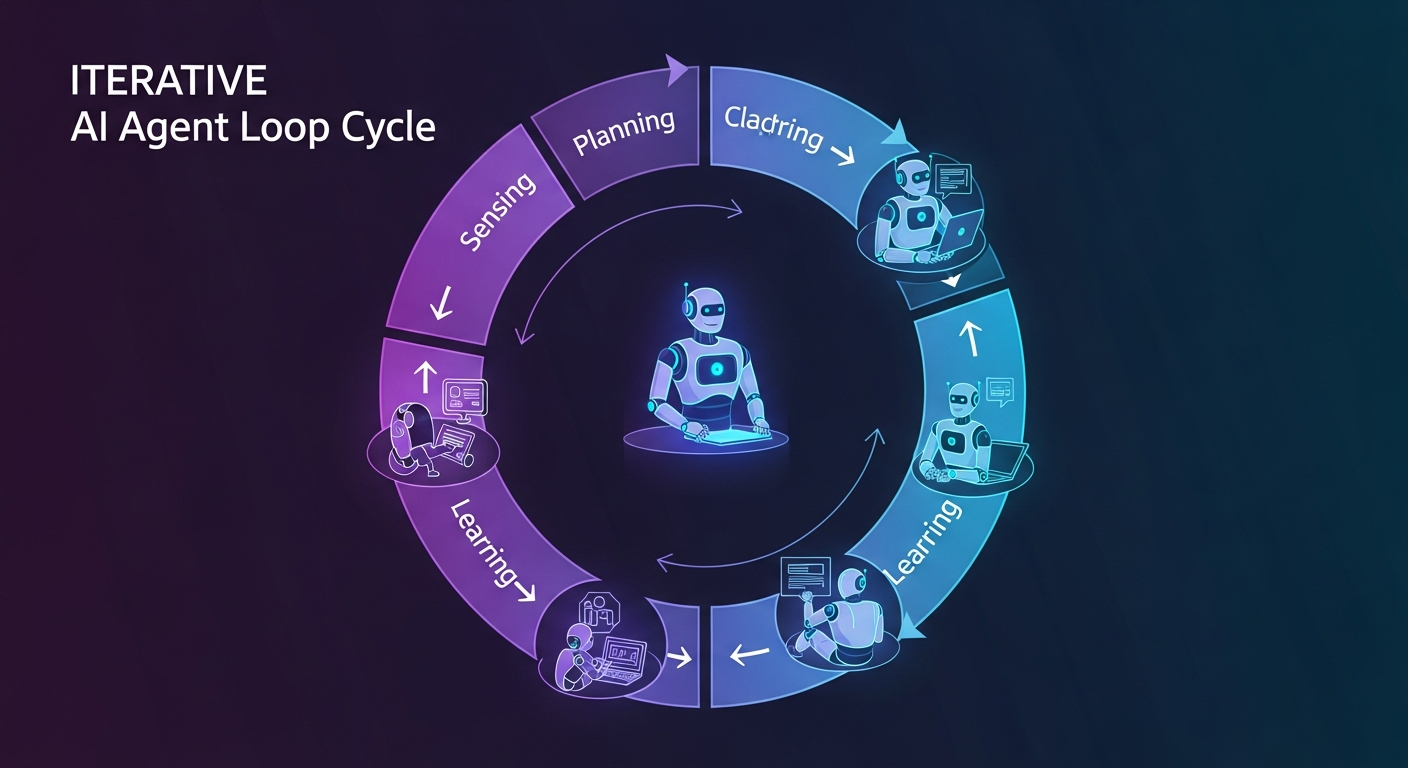
What Is an Iterative AI Agent?
Most people's first experience with AI is transactional: you type something, the AI responds, done. That's a single-pass model - input in, output out.
Iterative AI agents work differently.
They operate in a loop:
Receive a goal
Break it into tasks
Execute a task
Evaluate the result
Plan the next step based on what happened
Repeat - until the goal is complete
Each loop is called an iteration. The agent doesn't stop after one step. It keeps running, adjusting, correcting, and progressing, until the job is done or a human chooses to step in.
This is what separates a conversational AI assistant from a true autonomous AI agent.
How One Agent Handles Thousands of Tasks
The phrase "thousands of tasks" isn't hyperbole. It's architecture.
Here's how a single iterative agent scales to that level:
1. Task Decomposition
When given a high-level goal, the agent uses an internal planning module to break it into discrete sub-tasks. A goal like "process all customer support tickets from Q1" could decompose into:
Read ticket #1
Classify intent
Check resolution status
Draft a response or escalation flag
Log outcome
Move to ticket #2
Repeat for all 3,000 tickets
This decomposition happens automatically. The agent generates its own task list, a capability rooted in frameworks like ReAct (Reason + Act) and Chain-of-Thought prompting.
2. Memory Systems
For an iterative agent to function across thousands of tasks, it needs memory. There are two kinds:
Short-term memory (context window): What the agent holds in active processing right now
Long-term memory (external storage): A vector database or knowledge store the agent reads from and writes to across iterations
Without long-term memory, an agent forgets what it did three tasks ago. With it, the agent builds a growing picture of what's been done, what's outstanding, and what patterns are emerging exactly like a human analyst would.
3. Tool Use
Iterative AI agents don't just generate text. They call tools:
Web search
API calls (CRM, ERP, databases)
Code execution
File read/write
Email and calendar integrations
Other agents (multi-agent systems)
Each tool call is another action within the loop. An agent processing a financial reconciliation task might call a database API, execute a calculation, flag a discrepancy, and write a report, all without leaving the loop.
4. Self-Evaluation and Error Correction
This is the part most people underestimate.
After each action, a well-designed iterative agent evaluates its own output against the goal criteria. If the result doesn't meet the threshold, wrong format, incomplete data, failed API call, it doesn't stop. It retries, adjusts its approach, or escalates based on pre-defined rules.
This self-correction loop is what makes iterative agents reliable at scale. Human operators don't have to babysit every step.
Real-World Use Cases
Iterative AI agents are already being deployed across industries. Here's where they're having the most impact.
Enterprise Operations
Processing thousands of invoices: extract, validate, match against PO, flag exceptions, post to ERP
Automating vendor onboarding across multiple systems simultaneously
Running compliance checks across thousands of documents in a regulatory review cycle
Financial Services
Banks and financial institutions are using iterative agents for:
Loan application processing: each application runs through the same multi-step loop: document extraction, credit check, risk scoring, decision logging
Transaction monitoring: agents loop through flagged transactions, cross-reference rules, and escalate genuine anomalies
Report generation: pulling data from multiple systems, reconciling, and producing formatted reports without human assembly
Customer Support Automation
An iterative customer service agent can:
Read a support ticket
Check the customer's account history
Search the knowledge base
Draft a personalised response
Send it or route to human review based on confidence score
At scale, this means one agent handles thousands of tickets per day, not one at a time with human approval, but continuously, in a loop.
Content and Research
Iterative research agents can:
Scan hundreds of sources on a topic
Extract key claims
Cross-reference for consistency
Produce a structured synthesis
What would take a human analyst days takes an iterative agent hours.
The Architecture Behind Iterative AI Agents
If you're building or evaluating enterprise AI agents, understanding the architecture helps you ask the right questions.
A production-grade iterative AI agent typically has:
Orchestration Layer The brain. Decides what to do next at each iteration. Often powered by a large language model (LLM) using ReAct, Plan-and-Execute, or LLM-as-Judge patterns.
Tool Registry A catalogue of every tool the agent can call, APIs, databases, code interpreters, other agents. The orchestrator picks from this registry based on what the current task requires.
Memory Store Short-term: the active context window. Long-term: a vector database (like Pinecone, Weaviate, or a proprietary store) that persists information across iterations and sessions.
Evaluation Module Post-action checking. Did the output meet the criteria? If not, retry, escalate, or adapt. This is what makes the loop self-sustaining.
Human-in-the-Loop (HITL) Interface For high-stakes decisions, a well-architected agent pauses the loop and routes to a human. The human approves, adjusts, or overrides, and the agent continues from that point.
Guardrails and Governance Enterprise deployments require AI governance layers: content filters, permission controls, audit logs, and rate limiting. Without this, a loop-running agent can cause unintended downstream effects at scale.
Iterative Agents vs. Agentic Pipelines: What's the Difference?
A common point of confusion.
An agentic pipeline is a fixed sequence: Step A → Step B → Step C → done. It's deterministic. It doesn't adapt. If Step B fails, the pipeline breaks.
An iterative AI agent is dynamic. It decides what Step B is based on what happened in Step A. It handles failure gracefully. It can handle branching logic, exceptions, and edge cases without a human rewriting the workflow.
Pipelines are good for predictable, structured processes. Iterative agents are better for complex, variable, or large-scale tasks where conditions change across iterations.
In practice, the most powerful enterprise AI systems combine both: a pipeline orchestrates high-level flow, while iterative agents handle each stage autonomously.
What Makes an Iterative Agent Enterprise-Ready?
Not all agents are built for scale. Here's what separates a proof-of-concept from a production deployment:
Reliability: Does it handle API failures, bad data, and edge cases without breaking the loop?
Observability: Can your team see what the agent is doing at each iteration, and why? Full logging is non-negotiable.
Controllability: Can you pause, audit, or override the agent mid-loop? Human oversight can't be an afterthought.
Security: Does the agent operate within your data perimeter? Who has access to its outputs?
Speed: At thousands of tasks, latency compounds. Enterprise agents need optimised inference and parallel processing where possible.
This is why off-the-shelf AI tools often fall short for enterprise use. The gap between "demo" and "deployed at scale" is where most organisations get stuck.
Fluid AI builds iterative agentic systems that are deployed in production at banks, financial institutions, and global enterprises, not just in pilots. If you're exploring what iterative agents could automate in your organisation, talk to the Fluid AI team.
Common Mistakes When Building Iterative AI Agents
No exit condition An agent with no clear stopping criteria will loop indefinitely or hallucinate completion. Always define what "done" looks like before deployment.
Ignoring memory costs Every iteration that writes to memory has a cost. Poorly managed memory leads to bloated context windows, slower performance, and compounding errors.
Over-automating without HITL In high-stakes domains (finance, compliance, healthcare), full autonomy creates liability. Build human checkpoints at the right thresholds, not as a bottleneck, but as a safeguard.
No evaluation layer An agent that can't assess its own output quality will confidently produce wrong answers at scale. Evaluation modules aren't optional.
Treating it like a chatbot The mental model matters. An iterative AI agent is a worker, not a conversational assistant. Designing prompts and tasks with that frame changes everything about how you architect the system.
The Future of Iterative Agents: Multi-Agent Systems
The next evolution is already here: multi-agent systems where iterative agents coordinate with each other.
One orchestrator agent manages the overall goal. It spins up specialised sub-agents for specific tasks, a research agent, a writing agent, a validation agent, each running their own loops, reporting back to the orchestrator, which synthesises results and drives the overall workflow forward.
This is how complex enterprise workflows that used to require entire teams are now being handled autonomously at scale. Not by replacing people, but by compressing the time and effort required for high-volume, repeatable work, freeing human teams to focus on decisions that actually need them.
Iterative AI agents are not a future technology. They are being deployed right now, in production, at scale, across the industries that can least afford to be slow.
Book your Free Strategic Call to Advance Your Business with Generative AI!
Fluid AI is an AI company based in Mumbai. We help organizations kickstart their AI journey. If you’re seeking a solution for your organization to enhance customer support, boost employee productivity and make the most of your organization’s data, look no further.
Take the first step on this exciting journey by booking a Free Discovery Call with us today and let us help you make your organization future-ready and unlock the full potential of AI for your organization.