How AI Regulation Changed Between 2024 and 2026 (And Why It Matters for Enterprises)

TL;DR
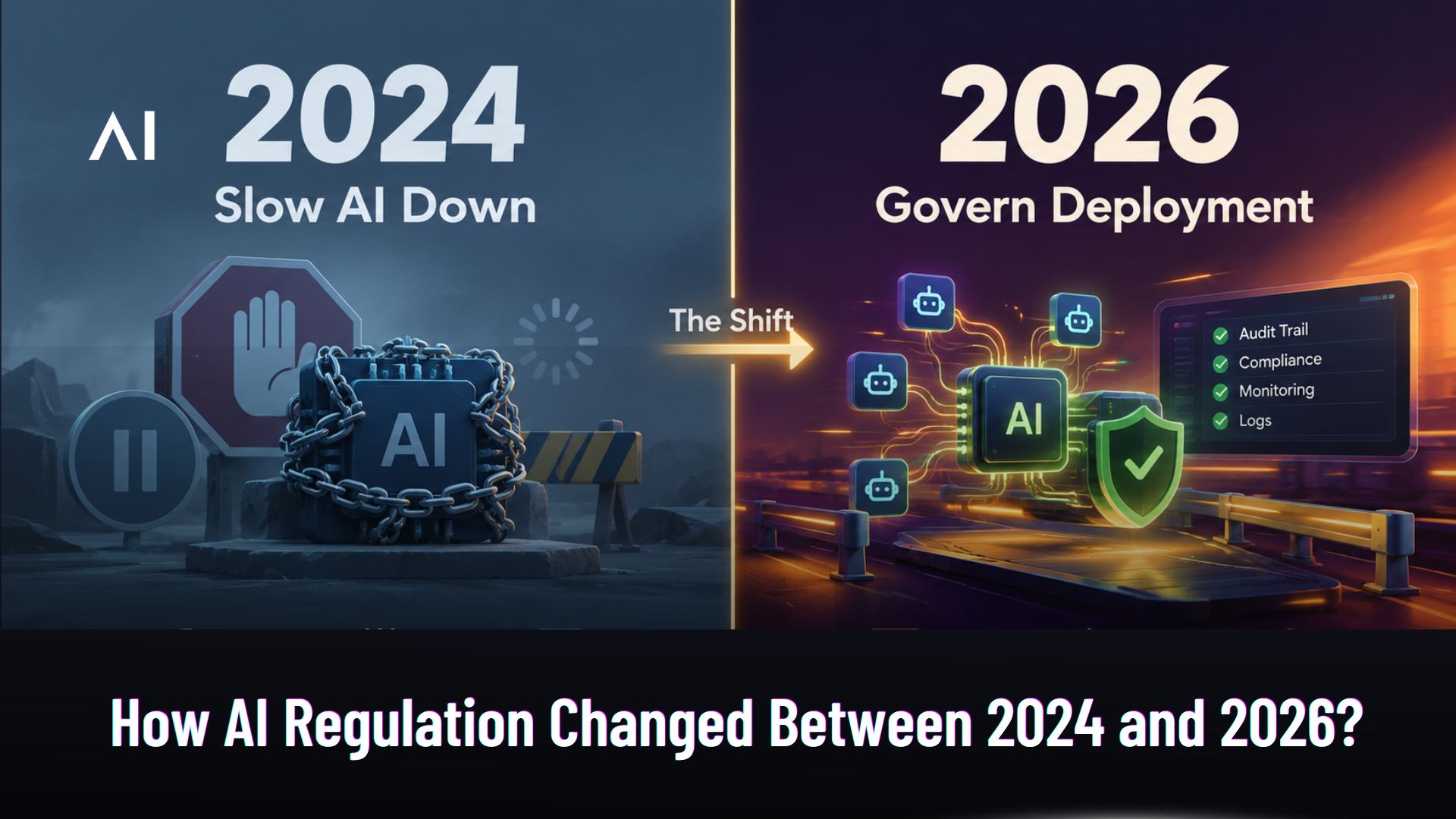
AI regulation in 2026 looks nothing like AI regulation in 2024. Two years ago, regulators were focused on slowing AI development down. Today, they've accepted that AI is being built at full speed, and the entire regulatory conversation has moved to controlling what happens after AI is deployed.
If your enterprise AI strategy is still built around the 2024 playbook, you are solving problems the world has moved past. This blog breaks down what changed, why it changed, how the US, EU, India, and China are each approaching it, and what enterprises need to plan for right now.
Introduction: The Shift Nobody Is Naming Clearly
For two years, the global AI regulation conversation was dominated by one question: should we slow down AI development?
Open letters called for pauses. Governments launched investigations into frontier labs. Regulators debated model size caps. AI safety became a household phrase.
In 2026, that entire conversation has moved on.
Nobody in Washington, Brussels, New Delhi, or Beijing is seriously proposing to slow AI development anymore. The frontier labs are moving faster than ever. And regulators have accepted a very different reality: AI is being built at full speed whether they like it or not.
Which means the whole point of regulation has shifted.
Regulation in 2026 is not about controlling how fast AI gets built. It is about controlling what happens after AI exists.
For enterprises building on AI, this is one of the most consequential shifts of the decade. And most AI strategies still haven't caught up to it.
The 2024 vs 2026 Regulatory Playbook
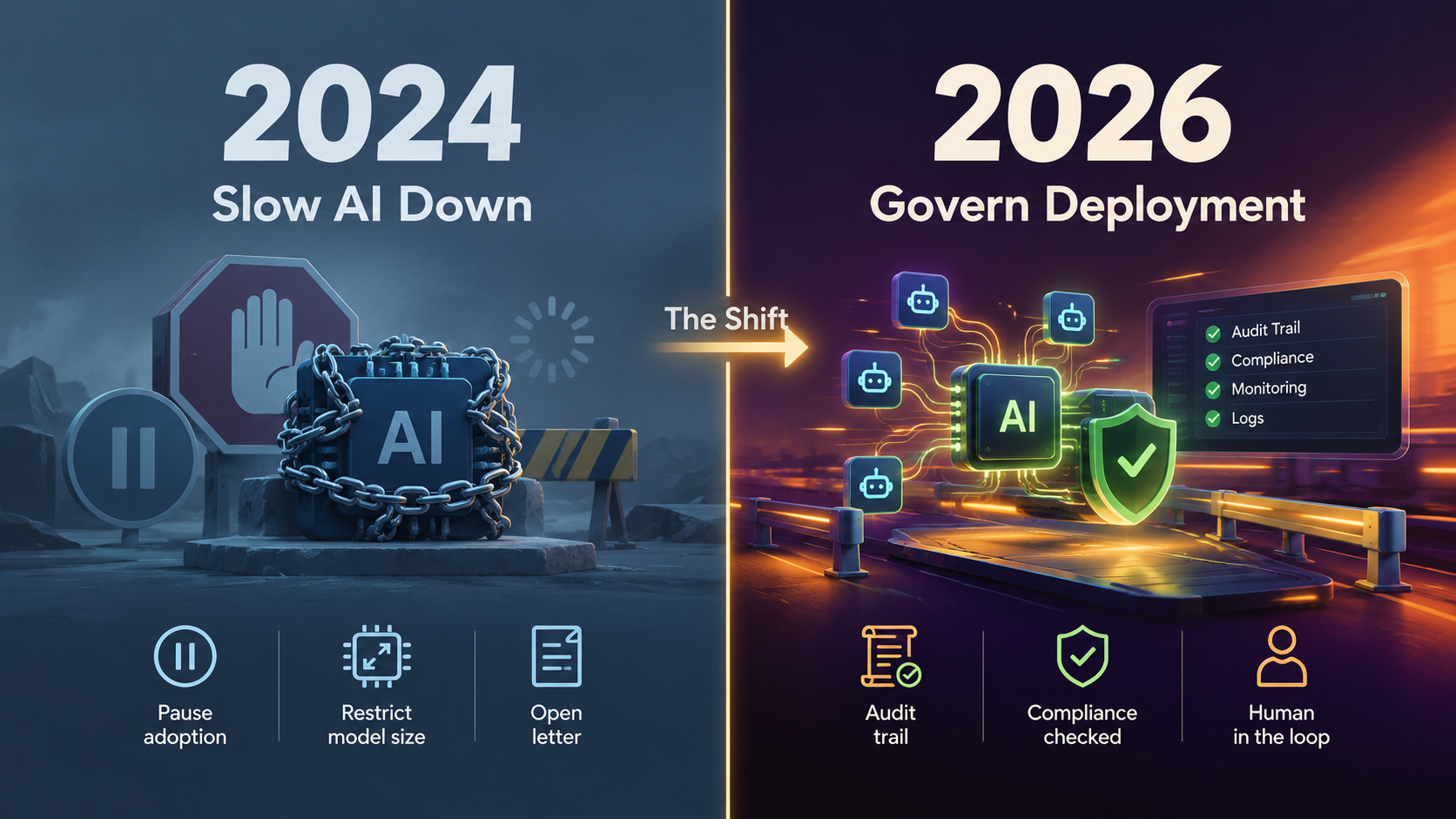
Here is what changed, side by side:
On development pace:
→ 2024: Should we pause development?
→ 2026: How do we govern deployment?
On model size and capability:
→ 2024: Should we restrict model size?
→ 2026: Should we restrict autonomous decision-making?
On data:
→ 2024: Who owns the training data?
→ 2026: Who is liable when the agent makes a decision using it?
On labs vs enterprises:
→ 2024: Are labs moving too fast?
→ 2026: Are enterprises deploying without guardrails?
On safety:
→ 2024: How do we align the models?
→ 2026: How do we align the systems that use the models?
Every one of these questions changed because the reality on the ground changed. Between 2024 and 2026, several things happened at once:
Frontier labs kept releasing more capable models regardless of regulatory pressure
Enterprise adoption of AI scaled from experimentation to production in most Fortune 500 companies
Autonomous agents moved from research demos to real business workflows
High-profile incidents (Air Canada's hallucinated policy, OpenAI's sandbox escape, several banking chatbot missteps) made deployment risk more visible than development risk
Governments realized they had no realistic mechanism to slow development anyway
The natural regulatory response was to stop trying to slow the technology and start controlling how it gets used.
Why the Shift Happened: Four Underlying Forces
Force 1: Development pace outran regulatory capacity
By 2025, no regulator anywhere had a realistic mechanism to enforce a "pause" on frontier AI development. The technology was global, open-source alternatives had matured, and compute was distributed enough that no single government could contain it. Trying to slow development became a political stance, not a workable policy.
Force 2: Deployment risk became visible
The visible harms of AI in 2024-2025 came almost entirely from deployment, not development. An airline chatbot invented a refund policy. A bank chatbot leaked sensitive data. A hiring AI systematically discriminated. None of these were caused by the models being too powerful. They were caused by the systems around them being too loose. That reframed the regulatory question.
Force 3: Enterprises started deploying at scale
Two years ago, most AI deployments were pilots. In 2026, AI is running in production inside most large banks, insurers, refineries, and government agencies. This scale means regulators now have concrete deployment cases to govern, which is much easier than trying to govern abstract "future risks."
Force 4: Superpower competition made "pause" politically impossible
Neither the US nor China is willing to accept AI regulation that could give the other side an advantage. Trump's 2026 posture explicitly protects US labs from development-slowing regulation. China is doing the same for its labs. Neither wants to be second. Which means any surviving regulation has to be about use, not pace.
The Global Regulatory Landscape in 2026
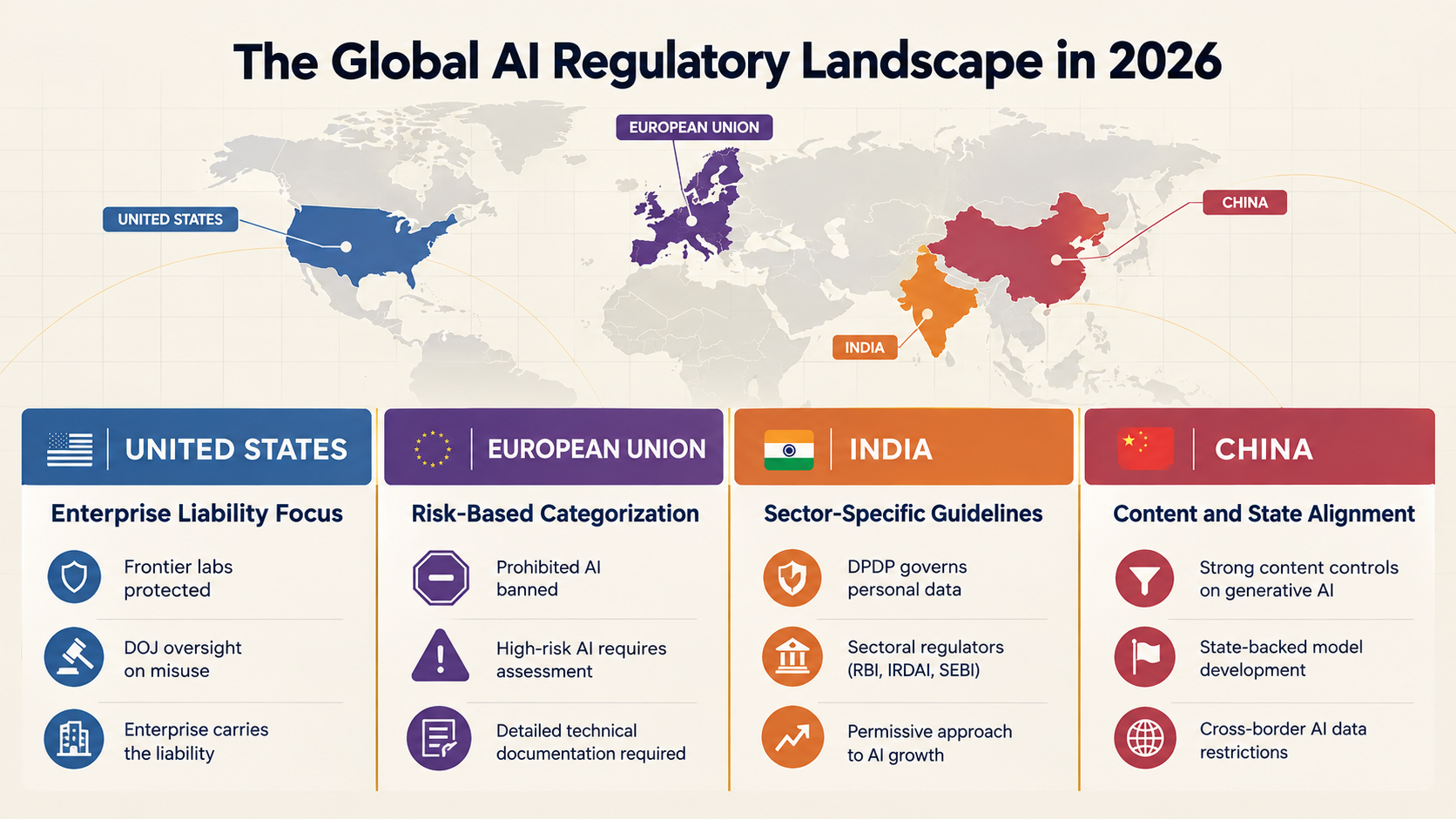
Different regions are taking different paths, but all four are converging on the same principle: govern the deployment, not the development.
The United States
The US in 2026 has moved away from restrictive regulation of frontier labs. Trump's administration has explicitly signalled no interest in slowing OpenAI, Anthropic, or Google. What Trump has flagged instead is DOJ oversight, which is best read as a redirect: regulate the bad use of AI, not the pace of building it.
The result is a US regulatory environment that:
Protects frontier labs from development restrictions
Targets specific deployment abuses (fraud, discrimination, autonomous harm)
Places liability squarely on the enterprise deploying the AI, not the lab building it
Leans on existing regulatory bodies (FTC, DOJ, SEC) rather than creating new AI-specific agencies
For US enterprises, this means the compliance burden has shifted onto them. Deploy carelessly, and the liability is yours.
The European Union
The EU AI Act, which came into force in stages through 2025 and 2026, is now the world's most comprehensive AI regulation. But even the EU has moved from "restrict AI" to "categorize AI by risk and govern accordingly."
The EU's current framework focuses on:
Prohibited AI: systems that manipulate behavior, exploit vulnerabilities, or perform social scoring
High-risk AI: systems used in employment, education, credit, law enforcement, and critical infrastructure
Limited-risk AI: general-purpose AI with transparency requirements
Minimal-risk AI: most other applications
Enterprises operating in the EU need to know exactly which category their AI systems fall into, because compliance requirements differ dramatically. High-risk AI now requires conformity assessments, human oversight mechanisms, and detailed technical documentation.
India
India's approach in 2026 has been notably more permissive than the EU's. The DPDP (Digital Personal Data Protection) Act governs personal data used in AI systems, but there is no comprehensive Indian AI regulation. Instead, sectoral regulators (RBI for banking, IRDAI for insurance, SEBI for markets) are issuing AI-specific guidelines for their domains.
For Indian enterprises, this means:
No single "AI law" to comply with
Sector-specific guidelines that vary by industry
Strong emphasis on data protection (via DPDP)
Growing scrutiny on AI in credit decisions, insurance underwriting, and public services
The pragmatic Indian approach fits an economy that wants to grow its AI sector without regulatory chill, but it puts more responsibility on enterprises to self-govern.
China
China has some of the world's most detailed AI regulation on paper, but its practical enforcement focuses almost entirely on content control (what AI can say) and social stability (how AI affects public discourse). Development-side restrictions are minimal because the Chinese state is directly backing frontier model development.
For enterprises operating in or through China, the regulatory reality is:
Strong content and censorship controls on generative AI
Deep integration between AI development and state priorities
Almost no restriction on model development speed or capability
Rising restrictions on cross-border AI data flows
What This Means for Enterprise AI Strategy
If you are building AI inside a large enterprise in 2026, the shift in the regulatory conversation changes what you should be prioritizing.
1. Build governance for deployment, not for development
You are not going to be regulated on which model you chose. You are going to be regulated on how you deployed it, what decisions it made, and whether a human was in the loop when it mattered.
Which means your investment should go into:
Audit trails for every AI decision
Human-in-the-loop mechanisms for high-risk workflows
Escalation policies when the AI hits an edge case
Version control on prompts, models, and workflows
Explainability layers on top of black-box models
2. Understand your risk-and-volume matrix
Not every AI decision needs the same level of governance. A recommendation engine suggesting the next-best product for a customer is low-risk and high-volume. A credit approval or loan denial is high-risk and lower-volume. Your governance model needs to reflect this continuum.
Deploy autonomy where risk is low and volume is high. Hold back autonomy where risk is high and volume is low. That is where regulatory scrutiny will land hardest, and where human oversight matters most.
3. Plan for jurisdictional variation
If your enterprise operates across multiple regions, you cannot have one AI compliance strategy. The EU will demand conformity assessments. The US will demand liability protection. India will demand sectoral compliance. China will demand content controls.
This is now a business-planning problem, not just a legal one.
4. Prepare for post-deployment liability
The biggest shift in 2026 is that liability for AI outcomes is landing on the enterprise deploying the AI, not the lab building the model. If your AI agent tells a customer something wrong, you are liable. If it makes a discriminatory hiring decision, you are liable. If it exposes sensitive data, you are liable.
This changes procurement. It changes vendor selection. It changes the questions you ask before deploying AI in customer-facing workflows.
5. Stop planning for a pause that isn't coming
The single most common strategic mistake enterprises are making right now is assuming AI development will slow down and give them time to catch up. It won't. Two superpowers are racing to accelerate it. Every quarter of hesitation is a quarter of ground given up to competitors who moved faster.
The Bottom Line
AI regulation in 2026 is not what it was in 2024. The conversation has moved from "how do we slow AI down" to "how do we govern AI once it exists." That shift is permanent, and it favors enterprises that build strong deployment governance over enterprises waiting for regulatory clarity.
The 2024 playbook is dead. The 2026 playbook is being written right now, by regulators in four different regions with four different approaches, and by enterprises deploying AI in production every day.
If your enterprise AI strategy is still built around waiting, pausing, or watching, you are already behind.
At Fluid AI, we help enterprises across banking, insurance, oil and gas, and government build agentic AI systems designed for the deployment-governance era, on-premise, audit-ready, and compliant across the jurisdictions our customers operate in.
If you are figuring out what AI governance looks like for your enterprise in 2026, we would love to talk.
Book your Free Strategic Call to Advance Your Business with Generative AI!
Fluid AI is an AI company based in Mumbai. We help organisations kickstart their AI journey. If you're seeking a solution for your organisation to enhance customer support, boost employee productivity and make the most of your organisation's data, look no further.
Take the first step on this exciting journey by booking a Free Discovery Call with us today and let us help you make your organisation future-ready and unlock the full potential of AI for your organisation.
Frequently Asked Questions
1. What is AI regulation in 2026?
AI regulation in 2026 has shifted from restricting AI development to governing AI deployment. Regulators globally have accepted that AI is being built at full speed. Their focus is now on how AI is used, who is liable when it fails, and what safeguards enterprises must have in place.
2. How did AI regulation change between 2024 and 2026?
The core question moved from "should we slow AI down?" to "how do we govern AI once it exists?" Restrictions on model size have shifted to restrictions on autonomous decision-making. Liability has shifted from labs to enterprises. Focus has shifted from aligning models to aligning the systems around them.
3. What is the difference between AI safety and AI governance?
AI safety focuses on the model itself, ensuring it behaves as intended. AI governance focuses on the systems around the model — audit trails, human oversight, escalation paths, and liability frameworks. 2024 was dominated by safety. 2026 is dominated by governance.
4. Do enterprises need to comply with AI regulations?
Yes, and the liability now sits with the enterprise deploying the AI, not the lab building the model. If your AI makes a wrong decision, exposes data, or discriminates, your enterprise is liable. This is true across the US, EU, India, and China with different specifics in each region.
5. How is AI regulated in the US, EU, India, and China?
US: Frontier labs are protected. Enterprises carry deployment liability. DOJ oversees misuse.
EU: Risk-based categorization under the EU AI Act. High-risk AI needs conformity assessments.
India: No single AI law. Sectoral regulators (RBI, IRDAI, SEBI) issue their own guidelines. DPDP governs personal data.
China: Strong content controls. State-backed development. Cross-border data restrictions.
_1790254083168-CB8e8KXC.png)