Autonomous Procurement Explained: How AI Agents Are Replacing Manual Sourcing in 2026

TL;DR
Autonomous procurement is when AI agents handle the entire purchasing process end-to-end, supplier discovery, RFQ generation, bid comparison, compliance checks, and PO creation, with minimal human involvement.
Traditional procurement automation breaks when specs are ambiguous or suppliers send quotes in different formats. AI-powered procurement agents reason through that complexity, adapt, and learn, making it the most advanced form of supply chain automation available today.
This guide breaks down what autonomous procurement actually is, how it works, where it's different from traditional automation, and what it takes to implement it.
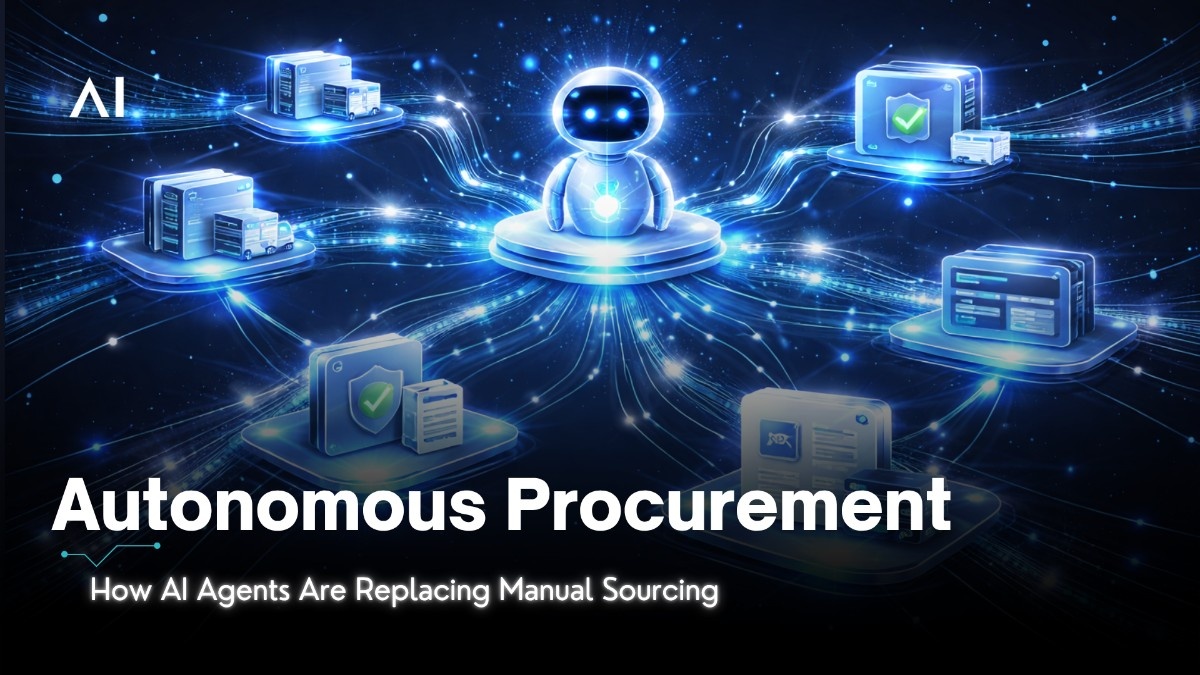
Procurement is one of those functions that every company depends on but nobody wants to talk about. It's slow, it's manual, and it's full of back-and-forth emails that feel like they belong in 2010.
And here's the thing most procurement automation tools didn't actually fix the problem. They just digitized the same broken process. You still have someone manually writing RFQs, chasing suppliers for quotes, building comparison spreadsheets, and routing approvals through email chains. That's not digital procurement, that's a manual process wearing a software costume.
Autonomous procurement changes that equation entirely. Instead of automating steps within a manual process, it replaces the process itself with AI agents that can think, decide, and execute.
What Is Autonomous Procurement?
Autonomous procurement is a technology-driven approach where AI agents independently manage end-to-end procurement workflows, from identifying a purchasing need to issuing a purchase order, with human oversight reserved for strategic decisions, exceptions, and final approvals.
The word "autonomous" is doing real work here. This isn't assisted procurement, where AI suggests and a human does. It's not automated sourcing with rigid rules. Autonomous sourcing means the system actively reasons through ambiguity, makes judgment calls within defined guardrails, and executes multi-step tasks without being told each step. Think of it as an intelligent purchasing system that handles the entire procure-to-pay cycle.
How It Works
A typical autonomous procurement workflow looks like this:
Step 1: A procurement need is triggered, by an internal request, an inventory threshold, or a demand forecast. An AI agent picks it up, interprets the requirement, identifies the commodity category, and pulls historical spend data for pricing benchmarks.
Step 2: The agent searches approved supplier databases, evaluates vendor capabilities, and generates RFQs tailored to each supplier. When quotes come back, different formats, different currencies, different terms, the agent normalizes everything into an apples-to-apples comparison.
Step 3: Here's where it goes beyond basic automation. The agent evaluates total cost of ownership, flags compliance risks, checks supplier performance history, and weighs delivery timelines against production schedules. It might even negotiate terms within pre-approved parameters.
Step 4: It routes a recommendation to the procurement manager with full justification, not a 40-page report, but a clear "here's what I recommend and why." The human approves, adjusts, or escalates. The agent processes the PO.
That entire cycle, which traditionally takes days to weeks, runs in hours.
Why It Matters
The average enterprise procurement team spends 60-70% of their time on operational tasks: creating purchase orders, chasing approvals, managing supplier communications, reconciling invoices. That's experienced professionals doing data entry and email follow-ups instead of strategic sourcing.
Autonomous procurement flips that ratio. The AI handles operational execution. Humans focus on supplier relationships, contract negotiation strategy, and spend optimization, the work that actually creates value.
For supply chain teams under pressure to reduce costs while maintaining quality, that shift isn't a nice-to-have. It's how you stay competitive.
Autonomous Procurement vs Traditional Procurement Automation
| Aspect | Traditional Procurement Automation | Autonomous Procurement |
|---|---|---|
| How it works | Rule-based: If X happens, do Y | Agent-based: AI reasons through each situation |
| Handles ambiguity | Breaks when inputs don't match predefined rules | Interprets ambiguous specs, adapts to variations |
| Supplier communication | Templates and predefined workflows | Dynamic RFQ generation, format normalization, contextual follow-ups |
| Decision-making | Flags everything for human review | Makes recommendations within guardrails, escalates exceptions |
| Learning | Static, same rules forever | Improves over time from procurement history and outcomes |
| Quote comparison | Structured data only | Unstructured quotes, PDFs, emails, normalizes everything |
| Integration | Connects to ERP via fixed APIs | Multi-agent systems |
The Core Technologies Behind Autonomous Procurement
Autonomous procurement isn't a single piece of software. It's a stack of AI capabilities working together.
1. AI Agents and Multi-Agent Systems
Procurement involves parallel workstreams, supplier research, quote management, compliance checking, approval routing. A single AI model can't handle all of these with the depth each requires. Multi-agent systems solve this by deploying specialized agents for each function, with a coordination layer (an agentic orchestration layer) making sure they share context and don't duplicate effort.
2. NLP for Unstructured Data
Supplier quotes arrive as PDFs, Excel files, emails, and sometimes faxes. Product catalogs use inconsistent naming. Contract terms are buried in legal language. Modern NLP and LLM capabilities let agents read, interpret, and extract structured information from all of it, no manual data entry, no standardized templates required from suppliers.
3. RAG for Organizational Knowledge
Good procurement decisions depend on institutional knowledge, past pricing, supplier performance, compliance requirements. That knowledge usually lives in people's heads or scattered systems. RAG architectures connect procurement agents to verified internal knowledge bases so every quote evaluation is compared against your actual history and organizational standards.
4. ERP and System Integration
Every procurement leader asks the same question first: "How does this integrate with our ERP?" Autonomous procurement platforms connect directly to SAP, Oracle, NetSuite, and custom ERPs through API-based integrations and MCP (Model Context Protocol). The agent creates POs in your ERP, triggers approval workflows, and updates inventory, bi-directional sync, no manual re-keying.
Where Autonomous Procurement Creates the Most Impact
Not every procurement task benefits equally from autonomy. Here's where the ROI is clearest.
Indirect Procurement and Tail Spend
The low-hanging fruit. Tail spend, high-volume, low-value purchases making up 20% of spend but 80% of transactions, is perfectly suited for autonomous sourcing. Office supplies, MRO items, IT peripherals, facility services. Nobody wants to manage these manually. AI agents handle the entire cycle autonomously, freeing procurement teams for strategic categories.
RFQ and RFP Management
Generating, distributing, and managing RFQs across multiple suppliers is tedious and error-prone. Autonomous agents generate category-specific RFQs, distribute them to qualified suppliers, track responses, send reminders, and normalize incoming quotes, all without manual intervention.
Supplier Discovery and Qualification
Need a new supplier? The research traditionally takes weeks. AI procurement agents scan supplier databases, industry directories, and public financial records to generate a shortlist in hours, complete with risk assessments and capability matching. It's vendor management on autopilot.
Spend Analysis and Optimization
Most companies don't actually know where their money goes at a granular level. Autonomous procurement agents continuously analyze spend data, identify consolidation opportunities, flag maverick spending, and recommend category strategies, running in the background without anyone building a report. This kind of always-on spend management simply isn't possible with manual processes.
Compliance Monitoring
Procurement compliance isn't a one-time check. Supplier certifications expire. Regulations change. Contract terms need to be enforced across thousands of POs. Autonomous agents can monitor compliance continuously, flagging issues before they become audit findings rather than catching them after the fact.
Cost Savings in Manufacturing
For manufacturing companies, procurement costs directly hit the bottom line. Raw materials, components, MRO supplies, and contract manufacturing services often represent 50-70% of total costs. Autonomous procurement creates savings in three ways: better price benchmarking through real-time market data, reduced maverick spend through enforced buying channels, and faster sourcing cycles that prevent costly production delays from material shortages. Manufacturing enterprises adopting AI-powered procurement are reporting 8-15% annual savings on managed categories, that's procurement optimization at a scale manual teams simply can't match.
Real-World Impact: What the Numbers Show
Let's talk about what autonomous procurement actually delivers in production environments.
| Metric | Before (Manual / Basic Automation) | After (Autonomous Procurement) |
|---|---|---|
| Sourcing cycle time | 2–4 weeks | 2–5 days |
| RFQ processing time | 3–5 days per RFQ cycle | Hours |
| Cost savings on managed categories | 3–5% annual | 8–15% annual |
| Tail spend under management | 20–30% | 70–90% |
| Procurement team time on operations | 60–70% | 20–30% |
| Maverick spend | 25–40% of total | Under 10% |
| Supplier onboarding time | 2–4 weeks | 3–5 days |
These aren't projections. These are the ranges being reported by enterprises that have moved from traditional procurement automation to AI-powered procurement systems.
Want to see these numbers for your procurement operation? Fluid AI helps enterprises in manufacturing, banking, and financial services model the ROI of autonomous procurement before deployment.
Challenges in Implementing Autonomous Procurement
This isn't plug-and-play. Autonomous procurement systems face real implementation challenges, and ignoring them is how pilots fail.
1. Data Quality and Integration
Challenge: Autonomous agents are only as good as the data they can access. If your supplier master is a mess, your spend data is fragmented across 15 systems, and your contract repository is a SharePoint folder someone named "Contracts_FINAL_v3," the agents will struggle.
The Fix: Start with data hygiene. Clean your supplier master, standardize category taxonomies, and consolidate spend data before deploying autonomous agents. The best autonomous procurement platforms include data normalization layers, but they work better with cleaner inputs.
2. Change Management and Trust
Challenge: Procurement professionals are understandably skeptical about handing decisions to AI. "The system recommended the wrong supplier" is a career risk that no one wants to take.
The Fix: Start with human-in-the-loop workflows where agents recommend but humans approve. As confidence builds and accuracy is proven, gradually expand the autonomy boundary. The goal isn't to remove humans, it's to remove the operational burden so humans can focus on what they're actually good at.
3. Supplier Ecosystem Readiness
Challenge: Your suppliers need to be part of this equation. If your autonomous system sends AI-generated RFQs but your suppliers still respond via fax or unstructured email, the system needs to handle that gracefully.
The Fix: Modern autonomous sourcing agents are built to handle supplier responses in any format like email, PDF, portal submissions, even scanned documents. The system adapts to your supplier ecosystem; you don't need to force your suppliers to adapt to the system.
4. Compliance and Auditability
Challenge: Procurement decisions in regulated industries need audit trails. When an AI agent selects a supplier, regulators and internal audit want to know why, not "the algorithm decided."
The Fix: Autonomous procurement systems must provide full decision transparency: what data was considered, what alternatives were evaluated, what criteria drove the recommendation, and what guardrails were in place. This isn't optional for enterprise deployments, it's a requirement.
Autonomous Procurement vs Autonomous Sourcing: What's the Difference?
These terms get used interchangeably, but there's a distinction worth knowing.
Autonomous sourcing specifically refers to the supplier identification, evaluation, and selection process. It's the "finding and choosing" part, who do we buy from, and on what terms?
Autonomous procurement is broader. It covers the entire procure-to-pay cycle: from need identification through sourcing, contracting, PO creation, receipt, invoice matching, and payment authorization.
Think of autonomous sourcing as one (critical) stage within a fully autonomous procurement pipeline.
In practice, most companies start with autonomous sourcing, automating supplier discovery and bid management and expand toward end-to-end autonomous procurement as they build confidence and integration maturity.
Conclusion
Autonomous procurement isn't about replacing procurement teams. It's about giving them the leverage to do the work that matters, strategy, supplier relationships, and spend optimization instead of RFQs, spreadsheets, and approval chains.
The technology is ready. The companies adopting it today aren't experimenting and they're executing. If your procurement team still spends most of its time on operations, the question isn't whether to explore autonomous procurement. It's how quickly you can get there.
At Fluid AI, this is exactly the kind of enterprise problem our platform is built for. We combine autonomous AI agents, RAG-powered knowledge retrieval, multi-agent orchestration, and enterprise-grade guardrails to help organizations in banking, manufacturing, and financial services move from manual procurement to intelligent, autonomous workflows with humans in control where it matters most.