The 5% Problem: Why Your AI Compute Is Sitting Idle (and How to Fix It)

TL;DR
Enterprise GPUs often run at as low as 5% utilization, meaning most of the compute you pay for sits idle, waiting for data.
The bottleneck was never FLOPS. It's data movement, getting weights and activations to the chip fast enough to keep it busy.
Idle GPUs are a board problem: an idle GPU wastes dollars an hour, and prices are rising, not falling.
The fix isn't buying more GPUs. On the same hardware, the best teams hit ~10x higher utilization through scheduling, sharing, and sizing to real demand.
The real question isn't how powerful your chip is. It's how much of that power you're actually using.

Our GPUs were running at under 15% utilisation. So I asked our lead compiler engineer why.
Me: We have all this compute. Why aren't we using it?
Engineer: Because the GPUs are waiting.
Me: Waiting for what?
Engineer: Data.
That answer stuck with me. The whole industry brags about how powerful AI chips are, more FLOPS, bigger clusters, the next accelerator. But a powerful chip does nothing if the data can't reach it fast enough.
The chef is Michelin-starred. The kitchen is the problem.
And 15%, it turns out, was us doing well.
The 5% problem is real, and it's on balance sheets
Our experience wasn't unusual. It's the norm, and worse than most leaders think.
Industry research in 2026, measured across tens of thousands of production clusters, put average enterprise GPU utilization at roughly 5%. That means around 95% of the most expensive compute in history spends its life waiting for work.
Now set that against the spend:
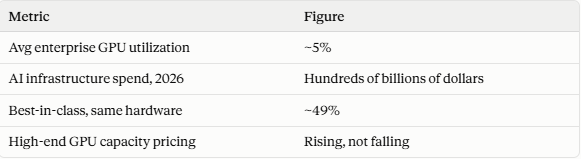
Record spending and record waste, scaling together.
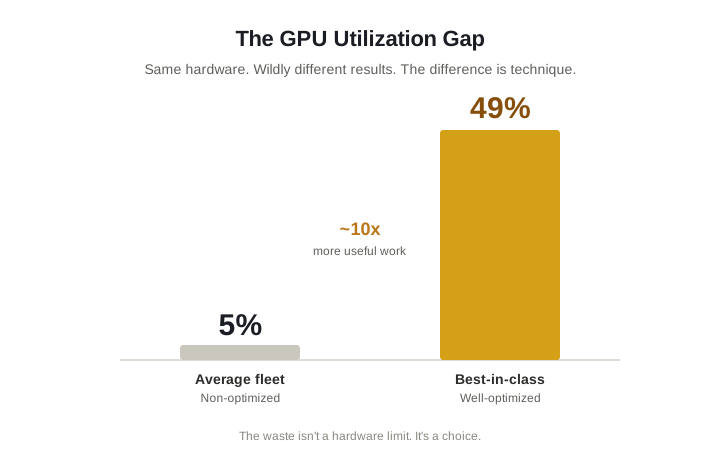
The two rows that matter most are the last two. Some teams sustain nearly 49% utilization on the same class of hardware, about ten times the average. And prices are rising, not falling. Which means the waste isn't a hardware limit. It's a choice, made by scheduling, procurement, and operating discipline.
FLOPS is the number everyone brags about and nobody hits
Hardware is sold on peak FLOPS, the theoretical maximum operations per second. Big, clean number. Sells chips.
It's also a ceiling real workloads almost never touch, because peak FLOPS assumes the chip is always fed. It never is.
Real AI workloads are limited by data movement, how fast weights, activations, and the KV cache reach the compute units. When that can't keep up, the cores stall. You bought a chip rated for enormous throughput and you're running it at 5%. The spec sheet was technically true and financially meaningless.
This is why two chips with near-identical FLOPS perform completely differently on the same job. The one that moves data better wins, even with a lower headline number.
Performance stopped being about the math. It's about the memory system feeding the math. Most enterprises are still buying the other way around.
Why GPUs actually sit idle?
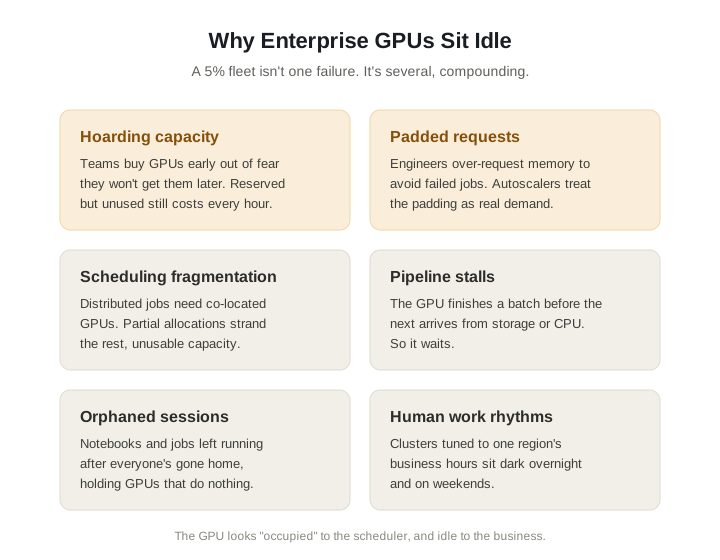
A 5% fleet isn't one failure. It's several, compounding. The usual culprits:
Hoarding ahead of demand. Teams buy capacity early, afraid they won't get it later. Reserved-but-unused GPUs still cost money every hour.
Padded requests. Engineers over-request memory to avoid failed jobs. Autoscalers treat the padding as real demand and provision to match.
Scheduling fragmentation. Distributed jobs need co-located GPUs. Partial allocations strand the rest, capacity exists but can't be used.
Pipeline stalls. The GPU finishes a batch before the next arrives from storage or the CPU. It waits.
Orphaned sessions. Notebooks and jobs left running after everyone's gone home, holding GPUs that do nothing.
Human rhythms. Clusters tuned to one region's business hours sit dark overnight and on weekends.
From the scheduler's view, the GPU is "occupied." From the business's view, an expensive asset is doing almost nothing. That gap is where the money leaks.
Why idle GPUs are a board problem, not an engineering footnote?
Idle capacity always existed in the cloud era. What changed is the price of idleness.
An idle CPU wastes cents an hour. An idle GPU wastes dollars an hour. And the asset keeps getting pricier, memory, power, networking, and cooling costs all climbing together. High-end GPU capacity pricing has even risen recently, a rare upward move in compute.
So the old bet, "tolerate low utilization, prices will fall", is dead. Holding idle GPUs in a rising market isn't inefficiency you can shrug off. It's runway burning quietly in the background. For AI startups, where compute is often the single largest cost line, it burns fastest.
And here's the reflex that makes it worse: when AI feels too slow or too expensive, teams buy more GPUs. That's adding chefs to a kitchen that already can't feed the ones it has. More hardware doesn't fix a data-movement problem. It just gives you more idle hardware.
The gap is technique, not silicon
The most useful fact in all of this: on the same chips, the best teams run about 10x higher than the average. So the lever isn't a better GPU. It's using the one you have.
What separates the high-utilization teams from the 5% teams:
They measure activity, not allocation. A dashboard showing every GPU "assigned" says nothing about work done. The teams that win watch real compute utilization, per-job activity, and idle hours, so hoarding and stalls become visible.
They share the hardware. Lightweight inference and dev jobs rarely need a whole GPU. Partitioning and sharing pack more useful work onto each one.
They schedule for density. Gang scheduling so partial allocations don't strand capacity. Quota borrowing so idle team budgets flow to busy teams. Sharing fleets across time zones so nothing sits dark overnight.
They size to real demand. A fleet sized for worst-case forecasts idles by design. One sized to observed demand, with a plan for peaks, runs far hotter.
None of that is exotic. It's discipline, and it's the difference between paying for compute and using it.
Utilisation is the new capacity planning
For years the hard question in AI infrastructure was where do we get GPUs. That era is ending. The harder, more valuable question now is why aren't the GPUs we already pay for running.
The answer usually points at architecture, scheduling, and operating discipline, not a capacity shortage. Most teams that look honestly discover they don't need more GPUs. They need better-shaped, better-used ones.
This also reframes cost. If you want enterprise AI to get dramatically cheaper, the fastest path isn't buying fewer GPUs or waiting for prices to drop. It's raising utilization on the fleet you already have. Every point of utilization you recover lowers the effective cost of every job that runs.
The real question
It was never how powerful is your chip.
It's how much of that power are you actually using.
The winners in enterprise AI won't be the ones with the biggest GPU fleets. They'll be the ones who get the most useful work out of every accelerator they own, because in a market where compute is scarce, expensive, and getting pricier, the cheapest GPU you'll ever have is the one you already bought and finally started using.
Book your Free Strategic Call to Advance Your Business with Generative AI!
Fluid AI is an AI company based in Mumbai. We help organisations kickstart their AI journey. If you're seeking a solution for your organisation to enhance customer support, boost employee productivity and make the most of your organisation's data, look no further.
Take the first step on this exciting journey by booking a Free Discovery Call with us today and let us help you make your organisation future-ready and unlock the full potential of AI for your organisation.
Frequently Asked Questions (FAQs)
1. What is a good GPU utilization rate?
There's no universal target, but a well-run mixed fleet sustains far more than the 5% average, often around 30% with normal day/night cycles, and 40 to 70% when fully optimized. The right target depends on workload mix, not hardware.
2. Why does an idle GPU cost more than an idle CPU?
An idle CPU wastes cents per hour; an idle GPU wastes dollars per hour, and rising server costs mean every idle GPU hour wastes a more expensive asset than the last.
3. Why are enterprise GPUs so underused?
Capacity hoarding, padded resource requests, scheduling fragmentation, pipeline stalls, orphaned sessions, and single-timezone work rhythms, compounding into fleets that look allocated but aren't productive.
4. How do you fix low GPU utilization?
Measure real activity (not allocation), share hardware through partitioning, schedule for density, and size the fleet to observed demand. The gap is mostly technique, not hardware.
_1790254083168-CB8e8KXC.png)