The Architecture of an Agentic OS: How AI Operating Systems Actually Work

TL;DR
An Agentic OS, or AI operating system, is the enterprise layer that allows AI agents to understand requests, access context, connect with tools, coordinate workflows, and complete business actions safely.
Unlike a chatbot, which mainly responds to questions, an Agentic OS manages the full journey from user intent to enterprise action. It connects AI agents, memory, applications, data, permissions, approvals, monitoring, and human oversight.
For businesses, the value of an Agentic OS is not just automation. It is controlled intelligence at scale. It helps enterprises move from disconnected AI tools to coordinated, governed, and outcome-driven AI operations.
What Is an Agentic OS?
An Agentic OS is an AI-powered operating layer that coordinates AI agents, business systems, data, workflows, and governance.
In simple terms, it is the system that helps AI agents do real work across an enterprise.
A traditional operating system manages hardware, software, memory, files, and processes. An Agentic OS manages AI agents, context, tools, permissions, workflows, and decisions.
That difference matters because enterprise AI is no longer only about generating answers. Businesses now want AI that can understand goals, retrieve information, trigger actions, update systems, escalate exceptions, and improve operations.
For example, a chatbot may answer, “Your request has been received.”
An Agentic OS can understand the request, identify the customer, check the right system, route the workflow, trigger the next step, ask for human approval if needed, and log the entire process.
That is the shift from conversational AI to operational AI.
Why AI Agents Need an Operating System
AI agents are powerful, but individual agents are not enough for enterprise-scale automation.
A single AI agent can perform a task. But enterprises need more than isolated task execution. They need coordination, memory, security, auditability, compliance, and control.
Without an Agentic OS, businesses often end up with scattered AI tools that work in silos. One agent handles support. Another handles sales. Another summarizes documents. Another updates internal systems. But if they do not share context or follow the same governance rules, the business creates more complexity instead of less.
An Agentic OS solves this problem by creating a shared foundation for AI agents.
It gives every agent a defined role, access boundary, workflow path, escalation rule, and monitoring layer. This allows businesses to scale AI without losing visibility or control.
In other words, the Agentic OS becomes the “control center” for enterprise AI.
What Makes an Operating System “Agentic”?
An operating system becomes agentic when it can support AI agents that act toward goals instead of simply following static instructions.
A basic automation system follows predefined rules.
A chatbot answers user questions.
A copilot assists a person with a task.
An Agentic OS coordinates autonomous or semi-autonomous agents that can reason, plan, use tools, and complete workflows.
An Agentic OS typically enables AI agents to:
Understand user intent
Access approved business data
Use enterprise tools and applications
Coordinate with other agents
Maintain context across steps
Follow permissions and guardrails
Escalate to humans when needed
Track actions through audit logs
Optimize workflows over time
This is why Agentic OS architecture is becoming important. The value is not only in the AI model. The value is in how the system connects intelligence to real business operations.
The Core Architecture of an Agentic OS
A strong Agentic OS is built in layers. Each layer plays a specific role in turning a user request into a governed business action.
The architecture can be understood as a flow:
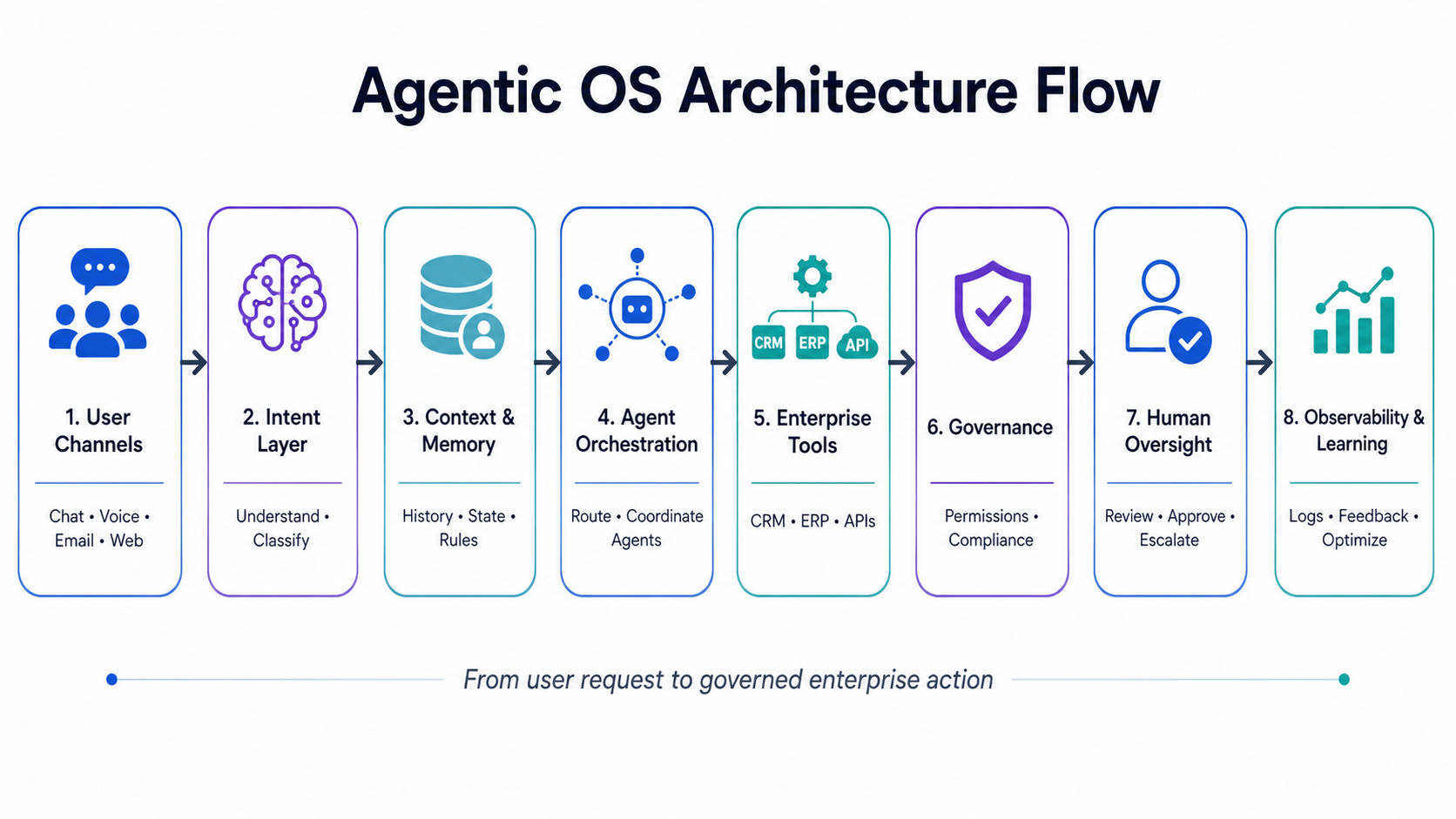
Let’s break this down.
1. User Channels Layer
The user channels layer is where people interact with the Agentic OS.
This may include:
Chat
Voice
Email
WhatsApp
Web apps
Mobile apps
Internal dashboards
Customer portals
For enterprises, this layer is critical because customers and employees do not use only one channel. A customer may start a request on chat, continue over email, and later call support. An employee may begin a workflow in an internal portal and receive updates through Slack or email.
An Agentic OS should maintain continuity across these channels.
This means the system should understand the same customer, the same request, and the same workflow state even when the channel changes.
For Fluid AI | Agentic AI Platform for Enterprises , this is especially relevant because enterprise AI is not only about building smarter agents. It is about making those agents available across the channels where customers and employees already interact.
2. Intent and Input Layer
The intent layer identifies what the user wants.
This sounds simple, but in enterprise workflows, intent detection can be complex. A customer may say, “My payment didn’t go through,” but the underlying intent could involve transaction failure, fraud risk, insufficient balance, merchant error, card issue, or network downtime.
The Agentic OS must classify the request correctly before taking action.
This layer usually handles:
Intent detection
Request classification
Urgency detection
Sentiment analysis
Risk flagging
Language understanding
Input validation
The goal is to understand not only what the user said, but what needs to happen next.
This is one of the biggest differences between a basic chatbot and an Agentic OS. A chatbot responds to the message. An Agentic OS interprets the message as part of a workflow.
3. Context and Memory Layer
The context and memory layer gives AI agents the background they need to act intelligently.
Without memory, every interaction starts from zero. The user has to repeat information, the agent lacks history, and the experience feels disconnected.
With memory, the Agentic OS can understand previous conversations, customer profile data, business rules, transaction history, product information, and workflow status.
This layer may include:
Conversation history
Customer profile data
Past support tickets
Document history
Business policies
Knowledge base content
Workflow state
Previous agent actions
User preferences
For example, if a customer asks about a delayed loan application, the Agentic OS should know whether the customer has already submitted documents, whether verification is pending, and whether the case has been escalated.
This makes the AI agent more useful, more accurate, and more personal.
In enterprise AI, context is the difference between a generic answer and a meaningful action.
4. Agent Orchestration Layer
The agent orchestration layer is the heart of the Agentic OS.
It decides which agent should act, what tools should be used, what steps should happen next, and when the workflow should escalate.
In a mature Agentic OS, there is rarely just one agent. There may be multiple specialized agents working together.
For example:
A support agent understands the customer request.
A knowledge agent retrieves policy information.
A workflow agent updates internal systems.
A compliance agent checks rules.
A sales agent identifies upsell opportunities.
A risk agent flags suspicious behavior.
The orchestration layer coordinates these agents so they work as one system.
Without orchestration, agents may duplicate work, miss context, or take inconsistent actions. With orchestration, every agent plays a defined role inside a controlled workflow.
This is why Agentic OS architecture is often compared to an enterprise command center. It organizes intelligence, routes tasks, manages dependencies, and keeps work moving.
5. Enterprise Tools and Systems Layer
AI agents become valuable when they can connect with real business systems.
Most enterprise work happens inside tools such as:
CRM platforms
ERP systems
Core banking systems
Ticketing tools
Document management systems
Knowledge bases
Payment platforms
Analytics tools
Customer data platforms
Internal APIs
An Agentic OS connects AI agents to these systems through secure integrations.
This allows agents to retrieve information, update records, create cases, generate reports, check statuses, and trigger workflows.
For example, if a customer asks for the status of an insurance claim, the Agentic OS may need to retrieve claim data, check missing documents, review policy rules, summarize the case, and create a follow-up task.
A chatbot without system access can only provide a general answer.
An Agentic OS with secure integrations can move the process forward.
This is where AI becomes operational.
6. Governance and Permissions Layer
Governance is one of the most important parts of an Agentic OS.
As AI agents become more capable, businesses must control what those agents are allowed to do.
The governance layer defines:
What data an agent can access
What actions an agent can perform
Which workflows need approval
Which users can trigger certain tasks
When an agent must escalate
What logs must be stored
Which compliance rules apply
This is especially important for regulated industries such as banking, insurance, healthcare, telecom, and financial services.
In these industries, AI cannot operate like an uncontrolled assistant. It must follow strict rules around data privacy, security, customer consent, auditability, and accountability.
For example, an AI agent may be allowed to summarize a loan application, but not approve the loan. It may be allowed to detect a fraud signal, but not freeze an account without human review. It may be allowed to draft a customer response, but not send sensitive information without verification.
A strong Agentic OS makes these boundaries clear.
7. Human-in-the-Loop Layer
An Agentic OS does not remove humans from the enterprise. It brings humans into the right moments.
The human-in-the-loop layer ensures that people review, approve, or override AI actions when needed.
This is useful for:
High-risk decisions
Complex customer cases
Compliance-sensitive workflows
Fraud investigations
Legal or financial decisions
Emotional customer interactions
Unclear or unusual requests
Human oversight builds trust. It also helps businesses avoid over-automation.
The best Agentic OS does not ask, “How do we replace humans?”
It asks, “Where should AI act, and where should humans decide?”
This balance is critical for enterprise adoption. AI agents can handle repetitive, time-consuming, and data-heavy tasks. Humans can focus on judgment, empathy, strategy, and accountability.
8. Observability and Learning Layer
The observability layer tracks what the Agentic OS is doing.
This includes logs, monitoring, performance metrics, error rates, escalation patterns, response quality, cost, and workflow outcomes.
Without observability, businesses cannot trust AI at scale. They need to know:
Which agent acted?
What data was used?
What decision was made?
Was the action successful?
Did the workflow need escalation?
How long did it take?
Did the customer get the right outcome?
This layer helps enterprises monitor performance and continuously improve the system.
It also supports compliance and audit requirements. If something goes wrong, the business needs a clear record of what happened.
Over time, observability also helps improve the Agentic OS. Teams can identify bottlenecks, refine prompts, improve workflows, update permissions, and train agents on better outcomes.
How an Agentic OS Handles a Real Enterprise Workflow?
To understand how an Agentic OS works, let’s look at a practical example.
Imagine a banking customer says:
“My card payment failed, but the money was deducted.”
A basic chatbot might respond with a generic support message.
An Agentic OS can do much more.
First, the intent layer identifies the issue as a failed transaction query. The system detects urgency because money has been deducted. The context layer retrieves the customer’s profile, recent transactions, previous complaints, and account status.
Next, the orchestration layer assigns the right agents. A support agent handles the customer conversation. A transaction agent checks payment records. A policy agent retrieves the bank’s failed transaction rules. A risk agent checks whether the issue may involve fraud or duplicate processing.
The enterprise integration layer connects to the transaction system, CRM, and ticketing platform. The governance layer checks what information can be shown to the customer. If the case is low risk, the Agentic OS may create a support ticket and give the customer a status update. If the issue looks suspicious, it escalates the case to a human fraud specialist.
Finally, the observability layer logs the full workflow.
This is the power of an Agentic OS. It turns a customer message into a controlled, multi-step business process.
Why Agentic OS Architecture Matters for Regulated Industries
Regulated industries cannot adopt AI casually.
Banks, insurers, healthcare organizations, telecom companies, and financial institutions handle sensitive data and complex compliance obligations. For them, AI must be secure, explainable, auditable, and controlled.
An Agentic OS architecture helps by creating clear layers for access, permissions, human review, monitoring, and compliance.
This is especially important when AI agents are allowed to interact with customer records, financial data, policy documents, or operational systems.
A strong Agentic OS for regulated industries should support:
Secure data access
Role-based permissions
Audit trails
Human approvals
Deployment flexibility
Compliance monitoring
Multi-channel interactions
Enterprise system integrations
Multilingual support
Escalation workflows
This is where Fluid AI | Agentic AI Platform for Enterprises ’s enterprise positioning becomes valuable. For regulated businesses, the goal is not just to deploy AI agents. The goal is to deploy AI agents that can operate safely inside real business environments.
Common Mistakes When Building an Agentic OS
Many businesses are excited about AI agents, but they often make avoidable mistakes when trying to scale them.
Deploying Agents Without Orchestration A company may create multiple AI agents but fail to define how they work together. This leads to duplication, confusion, and inconsistent outcomes.
Connecting AI to Systems Without Permissions Giving agents system access without clear controls can create security and compliance risks.
Ignoring Memory and Context Without memory, AI agents cannot maintain continuity. Customers repeat themselves, employees lose time, and workflows become fragmented.
Skipping Human Oversight Some workflows should not be fully automated. Sensitive decisions need human review.
Measuring Activity Instead of Outcomes The number of AI interactions does not matter if business outcomes do not improve. Enterprises should measure resolution rate, response time, productivity, customer satisfaction, escalation quality, and cost savings.
What the Future Agentic OS Stack Will Look Like
The future of enterprise AI will not be built around one chatbot or one large language model. It will be built around connected systems of agents that can work across departments, applications, and customer journeys.
The Agentic OS will become the layer where business intent becomes business action.
In the future, enterprises will use Agentic OS platforms to manage:
Customer support workflows
Employee service desks
Sales operations
Compliance reviews
Risk monitoring
Document processing
Onboarding journeys
IT operations
Financial workflows
Personalized customer engagement
As this matures, the Agentic OS will become a strategic layer in the enterprise technology stack, similar to CRM, ERP, and cloud platforms.
But the winning systems will not simply be the most autonomous. They will be the most trustworthy, integrated, observable, and secure.
Conclusion
An Agentic OS is more than a new AI buzzword. It is the architecture that allows enterprises to move from isolated AI tools to coordinated, governed, and intelligent operations.
It connects user channels, intent understanding, memory, AI agents, enterprise systems, governance, human oversight, and observability into one operating layer.
This is what makes AI useful at scale.
For businesses, the opportunity is clear. An Agentic OS can improve customer experience, accelerate workflows, reduce manual work, support better decision-making, and help teams scale AI responsibly.
But success depends on architecture. AI agents need context. Workflows need orchestration. Enterprise systems need secure integrations. Regulated industries need permissions, audit trails, and human approvals.
The future of AI is not just agentic. It is operating-system driven.
Book your Free Strategic Call to Advance Your Business with Generative AI!
Fluid AI is an AI company based in Mumbai. We help organizations kickstart their AI journey. If you’re seeking a solution for your organization to enhance customer support, boost employee productivity and make the most of your organization’s data, look no further.
Take the first step on this exciting journey by booking a Free Discovery Call with us today and let us help you make your organization future-ready and unlock the full potential of AI for your organization.
_1790254083168-CB8e8KXC.png)