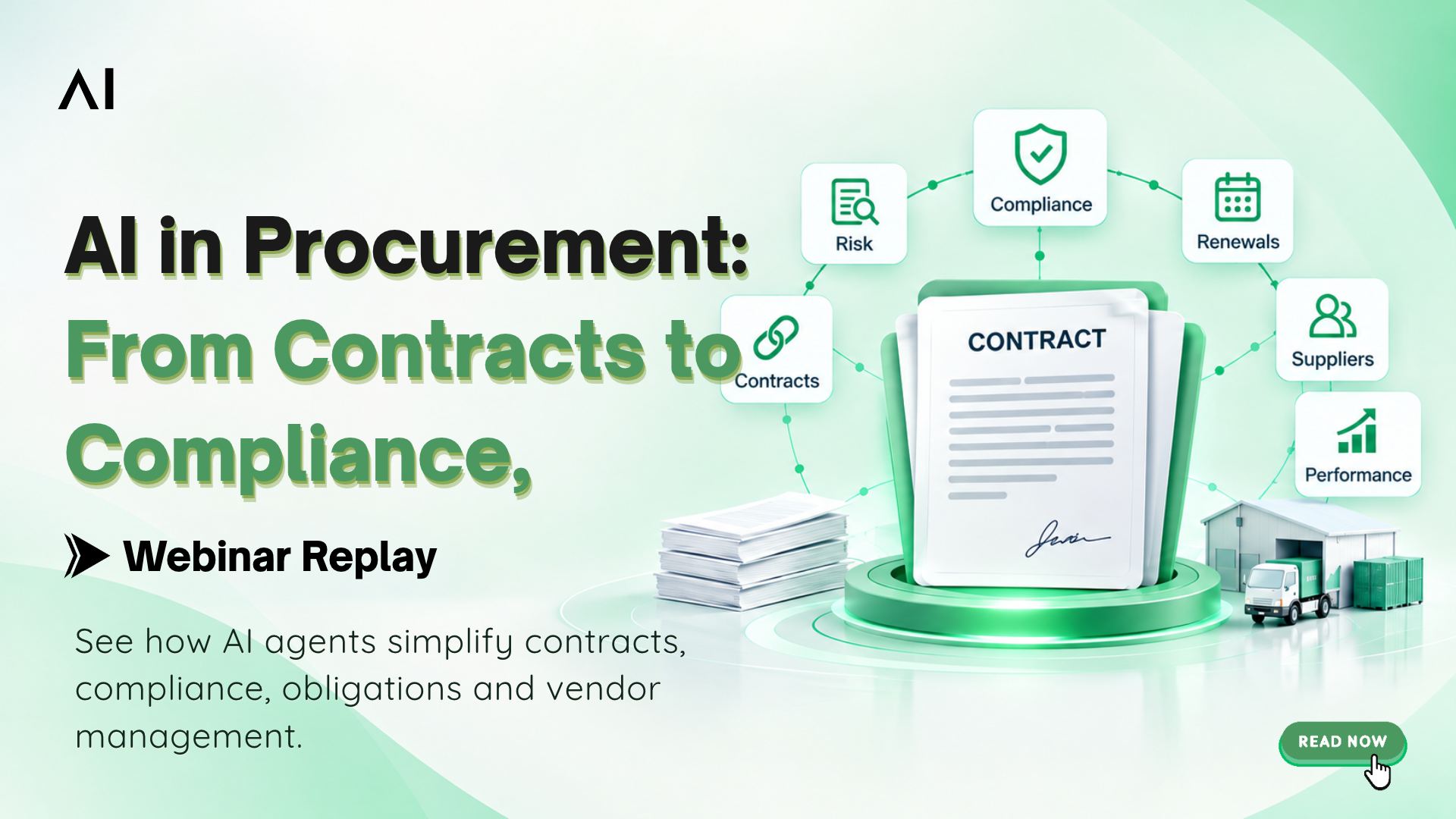
AI in Procurement: From Contracts to Compliance, Webinar Replay

TL;DR
Procurement is often overlooked in enterprise AI discussions, even though a lot of contract value is lost after an agreement is signed.
This webinar explored how AI agents can help procurement teams move beyond manual checks and take a more proactive approach to contract and vendor management.
The live demos covered contract creation, contract summarisation, risk identification, purchase order checks, obligation tracking, renewals, supplier performance and contract portfolio search.
The session also answered practical questions about using existing contract templates, keeping regulatory information updated, working without a contract management system and protecting sensitive contracts.
The key takeaway: AI in procurement is not just about finding information. It is about connecting systems, understanding the information and helping teams act on it.
▶ Watch the full replay
Prefer to read? The key takeaways are below. Runtime: ~45 min.
AI in Procurement: Why the Work Doesn't End When a Contract Is Signed
Recently, Fluid AI hosted a webinar on AI in procurement, where we explored how AI agents can help procurement teams manage contracts, monitor vendors and identify value that often gets missed after an agreement is signed.
There is already a lot of discussion around AI in customer support, finance and HR. Procurement, however, often gets treated as an afterthought.
However, the opportunity is much larger than document review or automating the document when you look at the procurement process closely.
Consider what will occur once a contract is signed.
Negotiations have concluded. The terms have been agreed upon. The lawyers have completed their review.
As, someone must ensure that the vendor is complying with the terms agreed; they need to make sure that the correct discounts are applied and to ensure that obligations are being fulfilled and renewals are being processed within a timely period.
Much of this continues to be done in spreadsheets, PDFs, email and manual follow-ups.
In the webinar, Raghav, Fluid AI Co - Founder, pointed out the following statistic: 13% of contract value lost on the buy side. This was centered around the question of why this is so, and how AI agents can bridge that divide.
As he put it:
"The money is lost after the signature, not at it."
The idea behind the session was simple: can procurement move from being a function that reacts to problems to one that actively identifies risks and opportunities?
What We Explored During the Webinar
The session went beyond just introducing the concept of AI agents. He explained to delegates how he was able to pass through the 'real world' procurement processes and interact with the systems and information that enterprises already use.
The first difference was between a chatbot and an AI agent.
A chatbot can provide answers to questions based on the information it obtains. A Business Agent can be used to access business systems, reason about the data and perform actions in a specified business workflow.
Raghav described this as:
Retrieve → Reason → Act
Retrieve: Connect to systems such as SAP, procurement platforms, contract repositories and document management systems to access relevant information.
Reason: Understand the information, compare records, identify risks and explain what needs attention.
Act: Prepare outputs, trigger workflows and bring important issues to the team's attention, with human involvement where needed.
The webinar then walked through eight areas where these capabilities can support the procurement lifecycle.
1. Contract Creation
The first demonstration focused on creating a new engineering contract.
Raghav entered a simple prompt:
"I need a new engineering contract with vendor XYZ."
The agent used information from the RFP pack, vendor proposals, legal templates and negotiated terms to prepare a draft agreement.
It also presented a table of functions and highlighted areas where additional information or user input was needed.
The idea was not to start every contract from a blank page. The agent could use the organisation's existing templates and negotiated information to prepare a more relevant first draft.
2. Contract Summarisation
Contracts often contain important information spread across lengthy documents.
In the next demonstration, the agent worked with documents stored in repositories such as SharePoint and Confluence, as well as contract management or document management systems.
The user could ask it to summarise an agreement. The output brought key details into a structured view, including:
Payment terms
Renewal terms and important dates
Governing laws
Key obligations
Commercial provisions
Areas that need attention
The same process could be used across multiple contracts and vendors.
This is where contract lifecycle management becomes more useful. Instead of opening individual files every time someone needs an answer, teams can search and work with contract information in a more structured way.
3. Contract Risk Identification
The next demonstration looked at identifying risks across multiple agreements with a vendor.
Rather than reviewing each contract individually, the agent analysed the available agreements and organised the findings into legal, commercial and financial risk categories.
It assigned high, medium and low risk ratings and presented the results in a chart and table that could also be exported to Excel.
This gives procurement and legal teams a starting point for deciding which agreements need closer attention.
4. Purchase Order and Contract Compliance
This was one of the most important demonstrations because it addressed the problem raised at the beginning of the webinar: value lost after signing.
Raghav demonstrated a workflow that could review purchase orders against the terms agreed in vendor contracts.
The user could ask:
Run a contract compliance review of all purchase orders across a particular vendor or time period.
The agent connected information from the ERP system, such as SAP, with the contract repository. It then compared purchase order details with the agreed contract terms.
The output showed which purchase orders followed the contract and where exceptions existed. It could also organise findings by business unit.
For example, a contract may specify a discount after a certain purchase threshold. If the purchase orders do not reflect that discount, the difference becomes something the procurement team can investigate.
The same approach can help identify missed late-delivery penalties and other agreed safeguards.
This is a practical example of how AI contract management can help teams check whether the value negotiated in a contract is actually being realised.
5. Contract Obligation Management
Once an agreement is signed, teams need to keep track of everything they have committed to.
The obligation management demonstration showed how an agent could identify obligations across selected vendors and contracts, along with their dates and status.
It created an obligation tracker that could be downloaded as an Excel file or presented as a small application.
Teams could filter obligations due in the next 30 days or the next quarter. They could also set up scheduled reports, such as one every 60 days.
Instead of relying entirely on someone remembering to check a spreadsheet, teams get a clearer view of what is due and what needs attention.
6. Contract Renewal and Expiry Management
Missing a renewal deadline can have real commercial consequences.
The renewal demonstration focused on finding contracts that were approaching expiry, identifying notice periods and spotting agreements that might renew automatically.
The agent could help teams find contracts due in the next 30, 60 or 90 days, identify missed notice periods and flag expired contracts where spending was still continuing.
This gives procurement and legal teams more time to review an agreement before a renewal decision becomes urgent.
7. Supplier Performance and Vendor Management
Supplier performance is rarely captured in one place.
Finance may have pricing and payment information. Quality teams may maintain inspection records. Health and safety teams may receive compliance documents over email. Delivery information may sit in another system.
The demonstration brought these different sources together.
The agent collected supplier information from finance, quality and health and safety systems, then created a small application to explore vendor performance.
The view included supplier ratings, spending, delivery delays, incidents and performance trends.
Users could compare vendors, see which suppliers were performing well and identify those that needed closer attention.
This gives teams a more complete view for vendor management, supplier risk management and vendor scorecards.
8. Searching Across the Contract Portfolio
The final demonstration showed how users could ask questions across an entire contract portfolio.
Raghav entered the prompt:
"Which contracts are above 1 million and are due in the next six months?"
The agent returned a table of matching contracts.
He then narrowed the question to a specific supplier and asked about its contract termination terms.
The important part was the shift from a broad portfolio-level question to a specific question about one contract.
This is useful for procurement analytics because teams can explore their contracts and vendors without manually searching through every document.
Questions Attendees Asked During the Webinar
The demonstrations led to several practical questions from attendees. These were not just questions about what the technology could do. They were about how it would fit into an actual procurement environment.
Can we use our own contract templates and clauses?
Yes. Raghav explained that agents can work with an organisation's existing templates and clauses.
They can use these as context while preparing a specific agreement, taking into account information from the RFP and the negotiated terms.
The goal is to work with the organisation's existing contracting approach rather than force teams to start with a completely new template.
Does the AI model need to be retrained every time laws or regulations change?
No. Raghav explained that organisations can maintain a library of relevant laws and regulations and update it as requirements change.
This can be done manually or through an agent that helps keep the information updated. The agents then retrieve the latest available context when they are drafting or reviewing contracts.
Do we need a dedicated contract management system to use these agents?
No. Raghav explained that agents can work with existing document repositories such as SharePoint and Confluence.
Organisations can also upload documents into the Fluid AI knowledge base.
This means teams do not necessarily need to replace their current document storage setup before exploring these workflows.
Can AI agents handle the complete procurement workflow? Will this reduce the need for procurement staff?
Raghav explained that the different agents can be connected on one platform and linked to one another.
For example, contract drafting can connect to obligation management, supplier scorecards and renewal workflows. Human involvement can remain at the points where review or decisions are needed.
His view was that this can help existing teams manage a much larger volume and greater complexity of procurement work, without needing to expand their teams at the same rate.
Our contracts are highly sensitive. How can we keep them secure?
This was an important question, especially for organisations that cannot send sensitive contract information outside their own environment.
Raghav explained that these agents do not have to run only on public cloud models.
They can be deployed on-premise, on a private cloud or in an air-gapped environment using local AI models. This allows organisations to keep sensitive data within their own infrastructure.
How quickly can these workflows go live?
Raghav shared that Fluid AI had seen some clients go live in as little as 35 days, with a typical timeline of around 60 days in the examples discussed during the webinar.
The actual timeline depends on the systems, data and workflows involved.
Why Watch the Webinar?
The webinar is useful if your procurement team is still spending a significant amount of time checking documents, following up on obligations, comparing purchase orders and tracking supplier performance manually.
It covers more than the idea of using AI in procurement. It shows how agents can work across the procurement lifecycle and connect information that is often spread across different systems.
Watch the full replay if you want to see:
How AI agents can prepare contracts using existing templates, RFPs and vendor proposals.
How purchase orders can be checked against signed contract terms.
How teams can track obligations, renewal dates and supplier performance.
How agents can answer questions across an entire contract portfolio.
How sensitive procurement workflows can run in on-premise and private environments.
The biggest takeaway from the session: procurement does not have to stop at negotiating a good contract. With the right systems and workflows in place, teams can also monitor whether that contract delivers the value it promised.
▶ Watch the full webinar replay:
Frequently Asked Questions
1. How is AI used in procurement?
AI can help procurement teams create and summarise contracts, identify risks, review purchase orders, track obligations, manage renewals and analyse supplier performance. AI agents can connect these tasks to existing enterprise systems.
2. What is an AI agent in procurement?
A procurement AI agent is a system that can retrieve information from business platforms, reason over contracts and procurement data, and support actions such as identifying exceptions, preparing reports or tracking obligations.
3. Can AI help with contract lifecycle management?
Yes. AI can support different stages of contract lifecycle management, including drafting, summarisation, risk identification, compliance checks, obligation tracking and renewal management.
4. Can AI agents work with SAP and existing procurement systems?
AI agents can connect with enterprise systems such as SAP and procurement platforms, subject to the available integrations and access permissions. They can use this information to compare purchase orders, contracts and supplier records.
5. Can AI in procurement be deployed on-premise?
Yes. AI procurement workflows can be deployed on-premise, in private cloud environments or in air-gapped setups. The deployment approach depends on the organisation's security and infrastructure requirements.
Book your Free Strategic Call to Advance Your Business with Generative AI!
Fluid AI is an AI company based in Mumbai. We help organisations kickstart their AI journey. If you're seeking a solution for your organisation to enhance customer support, boost employee productivity and make the most of your organisation's data, look no further.
Take the first step on this exciting journey by booking a Free Discovery Call with us today and let us help you make your organisation future-ready and unlock the full potential of AI for your organisation.