Sovereign AI: Control, Compliance, and the Future of Banking Infrastructure

TL;DR
Sovereign AI is the principle that AI systems should be owned, operated, and governed by the entity they serve, not a third-party cloud provider in another country. For banks and financial institutions, this means on-premise or in-country sovereign AI infrastructure where customer data never crosses borders, model outputs are fully auditable, and the institution retains complete control. Governments across the Gulf, South Asia, Southeast Asia, and Europe are actively mandating this. Enterprises that haven't built a sovereign AI strategy yet are already behind.
What Is Sovereign AI?
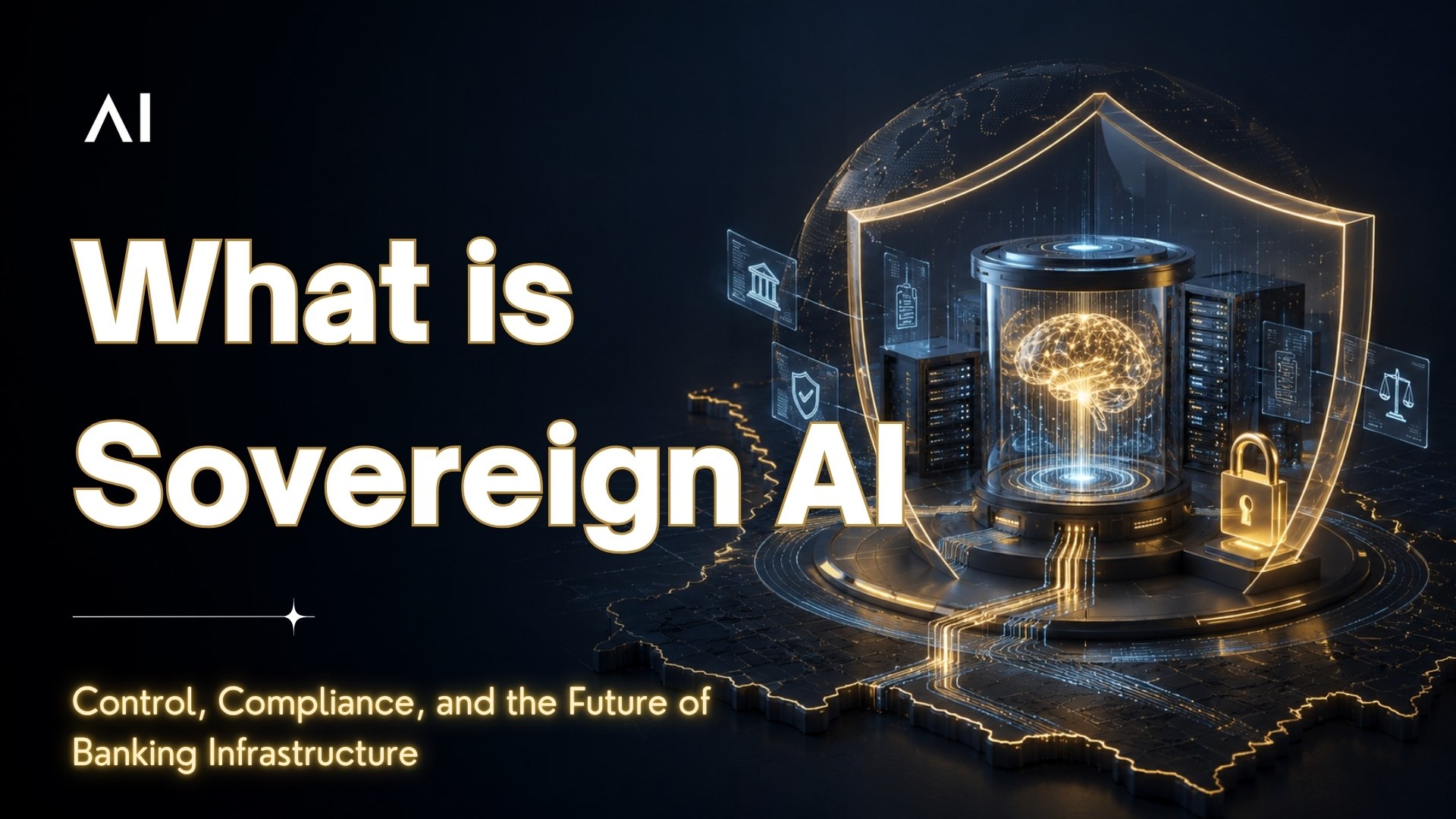
Sovereign AI means you own your AI. Really own it. Your data doesn't leave. Your models run on your own infrastructure. Your compliance team can pull any decision log without filing a request with a vendor. And if a foreign government wants access to your systems, the answer is no, because there's nothing for them to reach.
2023 was when this stopped being a niche concern. Governments looked at how dependent their banking systems had become on a handful of American cloud providers and got uncomfortable. That discomfort turned into policy. Fast.
Why Sovereign AI Is Suddenly Everywhere
Three things happened at once.
First, regulators caught up. Central banks and financial regulators across India, Saudi Arabia, UAE, the EU, and Southeast Asia started issuing data localisation requirements with teeth. The RBI's framework on cloud adoption for banks. Saudi Arabia's National Data Management Office directives. The EU AI Act. These aren't suggestions. They're compliance requirements with enforcement consequences.
Second, geopolitical risk became real. The idea that critical national infrastructure, including banking systems, should depend on foreign-owned AI platforms started feeling genuinely uncomfortable to governments. The UAE launched its own sovereign AI infrastructure. India launched IndiaAI. Saudi Arabia is building out NEOM's AI layer domestically.
Third, something subtler happened. Banks started getting burned by AI they couldn't explain. A credit application gets rejected. A transaction gets flagged. The compliance team asks why. And the answer is "the model decided" - because the model lives on someone else's servers, runs on someone else's logic, and the vendor isn't legally obligated to tell you more than that. That's not a technical problem. That's a governance problem. Sovereign AI fixes it by putting the explainability burden back where it belongs - inside the institution.
Sovereign AI vs. Regular Cloud AI: What's Actually Different
The gap between the two isn't really about geography. A bank in Mumbai using a cloud server in Singapore isn't just dealing with a latency issue. It's dealing with a control issue.
Model control: With sovereign AI, the bank decides which model version runs on a given day, when updates get applied, and how the model gets fine-tuned on its own data. With cloud AI, the provider makes those calls. You find out when the API behaves differently.
Auditability: Sovereign AI gives compliance teams direct access to inference logs, decision trails, and model versions. Cloud AI gives you a dashboard the vendor built. Those are not the same thing.
Data residency: Customer data in a sovereign setup never leaves the institution's environment. In a typical cloud deployment, that same data might touch infrastructure across three countries before a response comes back. Most banking regulators have an opinion about that now. It's usually not a permissive one.
Regulatory posture: Sovereign AI is designed from the ground up to satisfy data localisation requirements and AI governance in financial services. Cloud AI requires workarounds. Sometimes regulators accept those workarounds. Increasingly, they don't.
Geopolitical independence: Sovereign AI removes dependency on foreign infrastructure. Cloud AI creates it. That used to sound theoretical. It doesn't anymore.
Where Sovereign AI Is Already Mandatory
This isn't a future trend. It's happening now, in specific markets, with real regulatory force behind it.
India: The Reserve Bank of India has been explicit that customer financial data must remain within Indian borders. Banks deploying AI at scale, whether for KYC, collections, or customer service, are doing it on-premise or through private cloud environments hosted domestically. The IndiaAI Mission has further accelerated investment in sovereign compute infrastructure.
The Gulf didn't ease into this. Saudi Arabia, UAE, Qatar, and Bahrain drew hard lines on data localisation and financial institutions had to figure out how to comply. Emirates NBD and First Abu Dhabi Bank didn't wake up one day and decide to build out on-premise AI infrastructure for fun. Their regulators closed off the alternative. The UAE's AI Strategy 2031 says it plainly: controlling your AI means controlling your infrastructure. One doesn't exist without the other.
Europe got there through a different route. The EU AI Act dropped a high-risk classification on several categories of financial AI, and suddenly banks needed documentation, audit trails, and human oversight baked in at every layer. That's hard to deliver when your AI runs on someone else's cloud. GDPR was already pushing in the same direction. Together they've made sovereign architecture the path of least resistance for European banks that want to stay compliant without constant legal gymnastics.
Southeast Asia is the one catching people off guard. Indonesia, Thailand, Vietnam, and the Philippines are moving on data localisation faster than most observers expected. Singapore's MAS has published AI governance frameworks that sound collaborative but functionally require the kind of transparency that only sovereign deployments can reliably provide.
Africa and Latin America: Regulatory frameworks are earlier stage here, but the direction is clear. Banks in Nigeria, Kenya, Brazil, and Colombia are watching what happens in more regulated markets and building toward sovereign architectures proactively.
What Sovereign AI Looks Like in Practice for a Bank
Sovereign AI isn't an abstract principle. It has a very specific technical shape inside a financial institution.
→ AI models run on GPU infrastructure inside the bank's own data center or a private cloud hosted in-country
→ Customer data is processed entirely within that environment, with no egress to external systems
→ Every AI decision, whether a credit recommendation, a fraud flag, or a collections priority, is logged with full auditability
→ Model updates are controlled by the institution, not pushed automatically by a vendor
→ Compliance teams can pull complete decision trails on demand, with no dependency on vendor cooperation
→ The institution can switch AI providers or models without losing its data or its deployment history
Fluid AI is built specifically for this architecture. The platform runs fully on-premise, including GPU infrastructure, supports air-gapped environments where no external network connection is permitted, and gives compliance teams direct access to every layer of the AI stack. Banks across India, the Gulf, and the Caribbean have deployed Fluid AI in sovereign AI infrastructure configurations, including institutions where regulatory requirements explicitly prohibit cloud AI.
The Business Case Beyond Compliance
Trust as a competitive asset.
Customers are increasingly aware that their financial data has value. Banks that can credibly say "your data never leaves our environment, ever" have a differentiation story that cloud-dependent competitors can't match.Long-term cost efficiency.
Cloud AI inference costs scale with usage. At the volumes that large banks operate, running AI on owned infrastructure consistently outperforms cloud economics by year three or four. Sovereign AI is an investment with a calculable return.Vendor independence.
Banks that build sovereign AI infrastructure aren't locked into any single provider's pricing, model availability, or terms of service. That negotiating leverage has real financial value.Resilience.
On-premise sovereign AI continues operating during cloud outages, provider incidents, or connectivity disruptions. For a bank, uptime isn't just a technical metric. It's a customer promise.
Book your Free Strategic Call to Advance Your Business with Generative AI!
Fluid AI is an AI company based in Mumbai. We help organisations kickstart their AI journey. If you're seeking a solution for your organisation to enhance customer support, boost employee productivity and make the most of your organisation's data, look no further.
Take the first step on this exciting journey by booking a Free Discovery Call with us today and let us help you make your organisation future-ready and unlock the full potential of AI for your organisation.
Frequently Asked Questions (FAQ)
What is sovereign AI in simple terms?
Sovereign AI means an organization or country controls its own AI systems, data, and infrastructure without depending on foreign or third-party cloud providers. For banks, it means AI that runs inside your own environment with full auditability and regulatory compliance.
Why do banks need sovereign AI?
Because regulators in most major banking markets now require financial data to stay within national borders, and AI decisions to be fully auditable. Cloud AI often can't satisfy these requirements. Sovereign AI is built specifically to meet them.
Is sovereign AI the same as on-premise AI?
Not exactly. On-premise AI is one form of sovereign AI, but sovereign AI also includes private cloud environments hosted in-country, air-gapped systems, and hybrid architectures where sensitive workloads stay local. The defining feature is control, not just location.
Which countries are mandating sovereign AI for banks?
India, Saudi Arabia, UAE, Qatar, and EU member states have the most explicit requirements today. Singapore, Indonesia, and several African markets are moving in the same direction. The trend is global and accelerating.
What is the difference between sovereign AI and public cloud AI?
In sovereign AI, the institution owns and controls the infrastructure, data, and models. In public cloud AI, a third-party provider owns the infrastructure, often processes data across multiple geographies, and controls model updates and availability.
_1790254083168-CB8e8KXC.png)