AI Agents in Banking: A Comprehensive Guide for Enterprises

TL;DR
AI agents are not smarter chatbots. They are autonomous systems that complete entire banking workflows without a human approving every step. Banks getting this right are cutting loan turnaround times from days to hours, resolving customer queries at scale, and building operational infrastructure that compounds in value over time.
What Even Is an AI Agent?
Not a chatbot. That part matters more than it sounds.
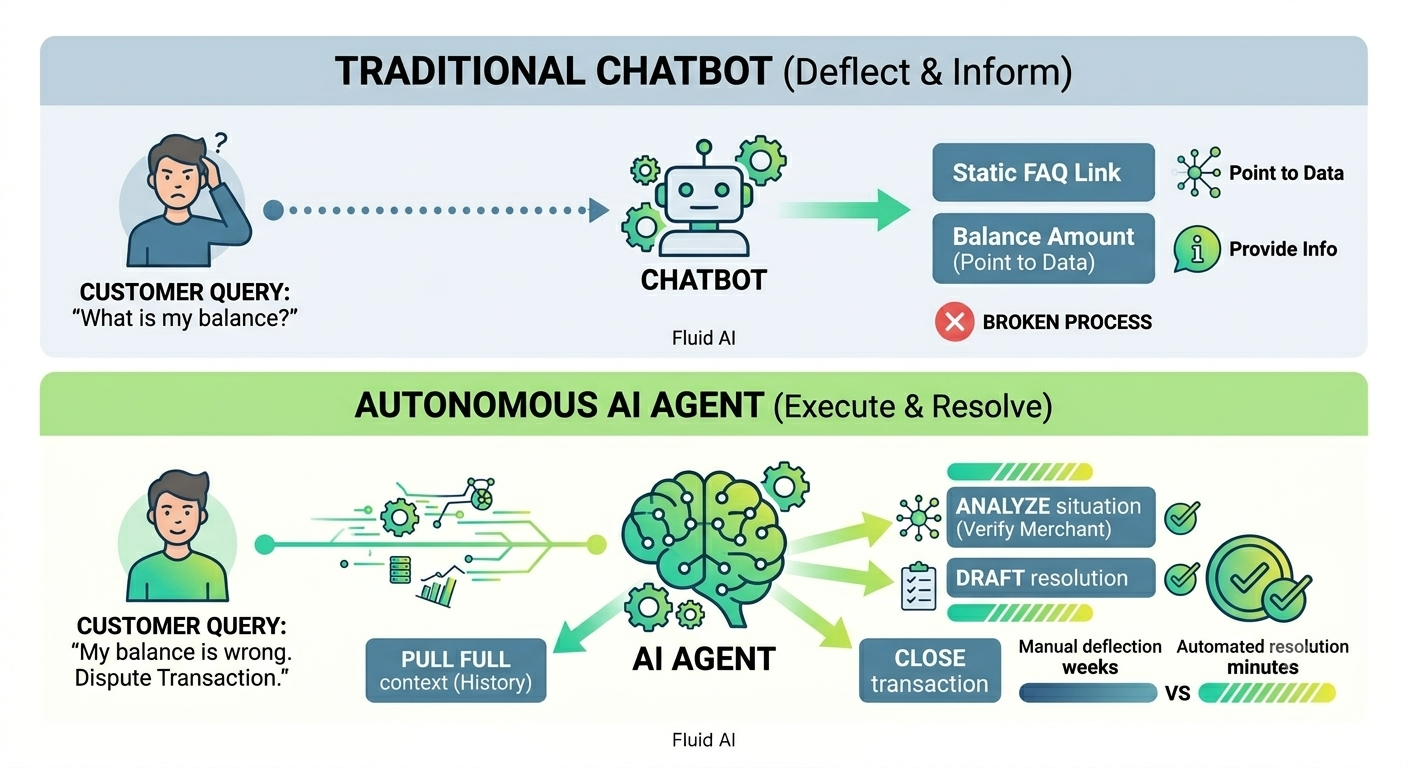
A chatbot answers questions. An AI agent actually does things. It looks at a situation and figures out what needs to happen next, uses whatever tools it has access to, takes the action, and checks whether it actually worked. No human walking it through every step.
The easiest way to see why that matters:
→ A chatbot tells a customer their balance.
→ An AI agent spots the disputed transaction, pulls the history, checks the merchant, drafts the resolution, and closes it out.
Same starting point. Completely different outcome.
Banks have been throwing money at the chatbot version for years and the ROI never quite adds up. Answering questions is only half of it.
What you actually need is something that acts on the answer, and that is a completely different category of tool.
Why Banking Specifically
Banking is not just a decent use case for AI agents. It might genuinely be the best one.
On any given day a bank is dealing with:
→ Thousands of loan applications moving through document checks, credit reviews, and compliance sign-offs
→ Fraud alerts firing constantly, each needing a decision in minutes not hours
→ Customers expecting answers at 11 PM who do not care the branch is closed
→ Compliance teams buried under regulatory updates
That is a lot of volume, urgency, and complexity hitting at the same time. The data already exists. The workflows are already mapped.
What has been missing is an intelligent layer that can move through all of it without a human at every checkpoint.
Where This Is Actually Being Used
Customer Service: Not the chatbot kind that deflects with FAQ links. Agents that pull full account context, understand what the customer is genuinely trying to resolve, take the action needed, and close it out. Resolution rates above 80% without human involvement are real and happening right now.
Loan Processing: Agents handle document collection, data extraction, credit checks, and anomaly flagging, then hand the officer a structured recommendation instead of a stack of paperwork.
→ What used to take 5 to 7 days is taking hours.KYC and Onboarding: A lot of account opening attempts never get finished because the process is too slow or confusing. Agents guide customers through in real time, ask for clarification instead of rejecting, and run compliance checks in the background. Completion rates go up. Nothing gets skipped.
Fraud Detection: Agents analyze patterns, make a call, and either block automatically or escalate with the full evidence brief already written. The customer communication gets handled too, which matters more than people realize when a false positive hits.
Compliance: The least glamorous use case but honestly one of the highest-impact ones. Continuously monitoring transactions, flagging potential breaches early, generating audit reports. Compliance officers doing less manual reading and more actual judgment work.
What Fluid AI Is Doing in This Space
Fluid AI works with 60 plus banks and financial institutions globally. The platform was built for BFSI from the ground up, not repurposed from something else.
In practice that means:
→ On-premise deployment for data-sensitive institutions
→ Integration with legacy core banking systems
→ Multi-agent orchestration across departments
→ Full audit trails that regulators will actually accept
One deployment worth knowing about involved a large development finance institution whose staff needed access to decades of institutional knowledge but finding anything meant digging through documents manually for hours. Fluid AI built a system that turned all of it into something anyone could just ask a question to and get a straight answer.
That is AI as infrastructure. Not AI as a demo.
The Things That Actually Trip Banks Up
Data security is the first real conversation, not a checkbox. For institutions with strict data residency requirements, a cloud-only vendor is out regardless of how good the product looks. Confirm this before anything else.
Legacy integration is where vendor promises fall apart. Push for specifics:
→ Which core banking systems specifically → How long integration actually took → What ongoing maintenance looks like
Change management is what kills more deployments than bad technology does. Getting teams to use the agent instead of working around it is the real project. Plan for it.
The Compounding Part
Banks deploying agents now are mostly handling individual workflows. That is genuinely valuable on its own. But every workflow an agent handles generates data that makes the next decision sharper. Every integration builds a more complete view of the customer and the risk.
The banks building this infrastructure today are not just solving this year's problem.
They are compounding an advantage that gets harder to close every year.
Book your Free Strategic Call to Advance Your Business with Generative AI!
Fluid AI is an AI company based in Mumbai. We help organisations kickstart their AI journey. If you're seeking a solution for your organisation to enhance customer support, boost employee productivity and make the most of your organisation's data, look no further.
Take the first step on this exciting journey by booking a Free Discovery Call with us today and let us help you make your organisation future-ready and unlock the full potential of AI for your organisation.
_1790254083168-CB8e8KXC.png)