The Bank That Never Sleeps: Understanding 24/7 Agentic AI for Customers

TL;DR
It's 1am. Your card just got declined and you have no idea why. You open your banking app half expecting to leave a complaint that someone will read on Tuesday.
A year ago, that was a Monday morning problem.
Today, it's a 40 second conversation with an AI agent that already knows your account, already sees the flag, and already knows what to do.
No hold music. No ticket number. Nobody even woke up.
Why Banking Always Had Hours And Why That Was Never Acceptable
For as long as most of us can remember, banking had hours.
9 to 5. Monday to Friday. Public holidays not included.
And if your problem didn't fit inside those hours — a blocked card at midnight, a failed transfer on a Sunday, a fraud alert at 6am — it waited. You waited. Sometimes for days.
The call centre queue was its own kind of patience test. Hold music that feels personally chosen to break you. Being transferred three times and having to explain yourself from scratch every single time. Finally reaching someone who was helpful, genuinely helpful, but couldn't actually do anything without "raising it with the relevant team."
That's just how banking worked.
The branch was the bank. The banker was the service. And when neither was available, neither were you.
And the worst part? You accepted it. Because what was the alternative?
Then Something Changed Quietly
Not overnight. Not with a big announcement. No bank sent you a notification saying "hey, we're about to completely rethink how we serve you." It just quietly started working differently.
The app got smarter. The responses got faster. The answers got more specific. Not "please visit your nearest branch" but actual answers, to your actual question, at whatever hour you happened to ask.
And then one day you realised you hadn't called your bank in months.
Not because your problems went away. Because they were being solved before you even had time to get frustrated about them.
That's the shift. Not a feature update. Not a new chatbot. A fundamentally different idea about when a bank should be available to you.
The answer, it turns out, is always.
What 24/7 AI Banking Actually Looks Like in Real Life
So what does it actually mean in real life?
It means the duplicate charge you didn't notice gets flagged before you do. Not because you filed a complaint. Because the system was already watching.
It means the EMI that was about to bounce gets a heads up sent to you at 7am on a Saturday. Not a generic alert. A specific one, with context, with options, with a way to fix it right there in the same conversation.
It means you're travelling, your card gets flagged for unusual activity, and instead of being declined at a restaurant in front of everyone you're with, you get a message, you confirm it's you, and you're done before the waiter comes back with the machine.
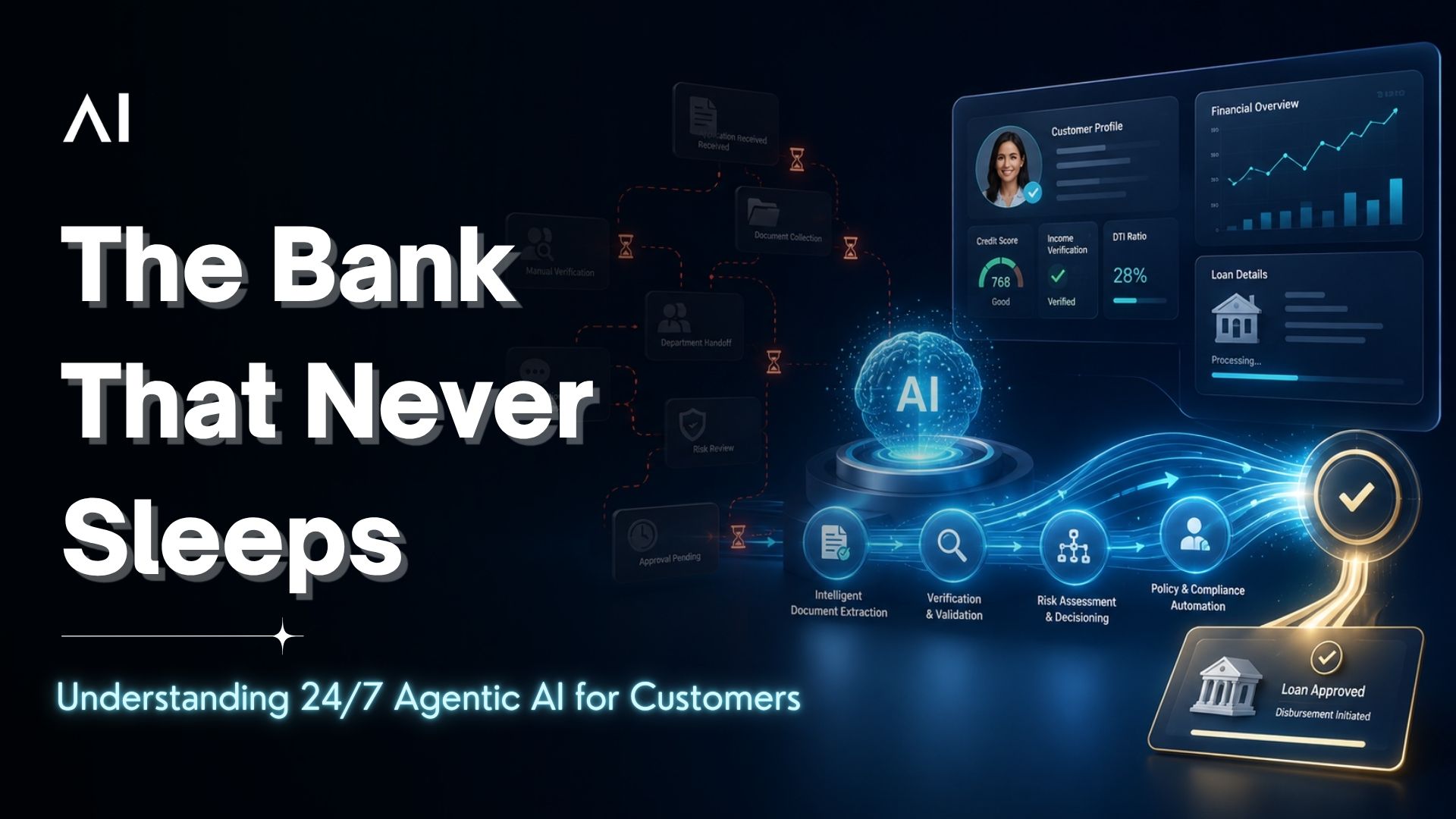
It means your loan application doesn't sit in a queue over the weekend. It moves. Documents get reviewed. Checks get run. And by Monday morning you're not starting the process. You're finishing it.
These aren't edge cases. These are Tuesday afternoons and Sunday mornings and 1am moments that used to fall through the cracks of a system that was only built to work part of the time.
24/7 AI doesn't just extend banking hours. It removes the idea of banking hours entirely.
What Is Agentic AI And Why It's Different From a Chatbot
So what's actually making this possible?
It's not a smarter FAQ. It's not a fast chatbot. It's not a better search bar in your banking app.
It's agentic AI. And the difference matters more than most people realise.
A regular chatbot responds. It pulls an answer from somewhere and hands it to you. That's it. The conversation ends there and the work, if there is any, still has to be done by a human somewhere down the line.
An AI agent does something fundamentally different. It understands what you actually need, connects to the systems that hold your information, makes decisions about what should happen next, and then makes it happen. End to end. Without a handoff. Without a queue. Without a Tuesday.
Think of it like the difference between asking someone for directions and having someone actually drive you there.
The agent doesn't just tell you your refund is being processed. It processes the refund. It doesn't just tell you your card was flagged. It tells you why, shows you the transaction, and asks if you want it reversed. Right there, in the same message.
That's what agentic AI actually means in a banking context. Not AI that talks about doing things. AI that does things.
And because it's connected to your account, your history, your preferences, and your bank's systems all at once, it can act with context. It knows you. In a "this person has banked with us for six years and always pays their EMI on the 5th" kind of way.
That context is everything. It's what turns a response into a resolution.
The Banks Deploying Agentic AI Are Already Ahead
The bank that never sleeps isn't a dream. It's not a marketing line. It's not something that's coming in five years.
It's already here. And for the customers experiencing it, there's no going back.
The relationship between a customer and their bank is changing. Not because banks suddenly decided to care more. But because the technology behind that relationship finally caught up to what customers actually needed all along.
Someone available at 1am. Someone who already knows your history. Someone who doesn't just listen but actually does it.
That someone is an AI agent. And the banks deploying it aren't doing it to cut costs or chase a trend. They're doing it because their customers are done waiting.
Fluid AI is building the agentic AI infrastructure that makes this possible for banks and financial institutions. The kind that doesn't just answer questions but resolves them, across every channel, at any hour, without dropping context or passing the customer along.
The Bottom Line
Banking availability was always the promise. Agentic AI is how banks are finally keeping it.
The question is no longer whether AI will transform banking. It already has. The question is whether your bank has made the shift yet.
Because the customers whose banks have? They've stopped waiting. They've stopped calling. They've stopped accepting a system built to work only part of the time.
They expect their bank to be there. Not tomorrow, not after the queue, not on Tuesday.
Now. 24/7.
_1790254083168-CB8e8KXC.png)