The Procurement Agent: AI That Automates Sourcing, POs, and Approvals

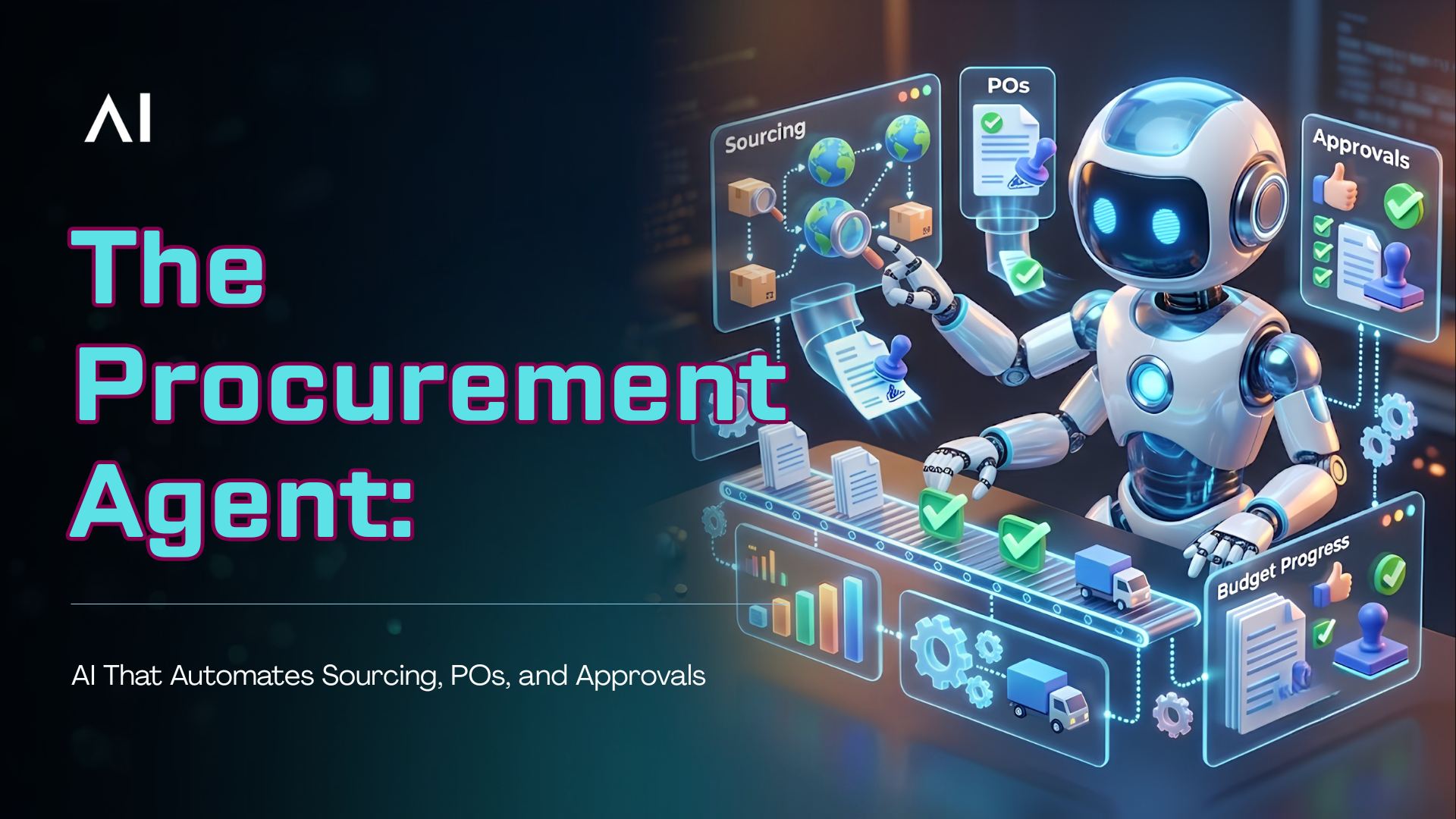
Procurement runs on repetitive work. Raising requests. Drafting RFQs. Chasing vendors for quotes. Routing approvals through five inboxes. Checking every purchase against policy. Updating the ERP. None of it is complex, but all of it is slow, and most of it eats the time your team should spend negotiating better deals.
A procurement AI agent takes that load off. It runs the entire sourcing and purchasing workflow for you, within your rules, and escalates only what genuinely needs a human. The result: faster cycles, consistent pricing, and full compliance, without adding headcount.
Here’s what procurement automation actually is, how the agent works, and why deployment matters as much as capability.
TL;DR
Procurement automation uses AI to handle sourcing, POs, and approvals end to end.
A procurement AI agent generates RFQs, benchmarks vendors, routes approvals, checks policy, and updates your ERP.
Guardrails keep it compliant: spend limits, approval thresholds, verification before action, full audit trail.
It cuts cycle times, enforces consistent pricing, and stops missed approvals and off-contract spend.
Fluid GPT runs on-premise or in your private cloud, so sensitive vendor and spend data stays with you.
What Is Procurement Automation?
Procurement automation is the use of AI and workflow software to handle sourcing, purchasing, and approval tasks, from RFQ to PO to payment, with minimal manual effort.
Instead of people pushing every request through by hand, the system does the repetitive work and flags only what needs a human.
What Is a Procurement AI Agent?
A procurement AI agent is an AI system that executes procurement workflows, generating RFQs, benchmarking vendors, routing approvals, and updating the ERP, all within your procurement policy.
It doesn’t just answer questions. It takes action across your systems.
Why Procurement Is Slow Today
Most procurement delays come from manual, fragmented work:
Manual RFQs: drafting and sending quote requests by hand, every time.
Vendor chasing: endless back-and-forth emails to get responses.
Fragmented approvals: requests stuck in inboxes, no visibility.
Manual policy checks: compliance verified by hand, easy to miss.
Data trapped in ERP/SAP: buyers digging through systems for basic information.
The information almost always exists somewhere. The problem is that moving it, between vendors, systems, and approvers, is slow and human-dependent. That’s exactly the kind of work AI handles well.
How a Procurement AI Agent Works
The agent runs the full procurement cycle, step by step, with humans in control where it counts.
Intake. A buyer describes what they need in plain language, or the request comes in from a form. The agent structures it into a proper requisition.
Data gathering. It pulls approved vendors, existing contracts, and past pricing from your systems automatically.
RFQ generation. It drafts and sends quote requests to the right vendors, no manual templating.
Vendor benchmarking. It compares incoming quotes on price and terms, and against historical pricing, so you see the best option and any outliers.
Approval routing. It sends each request to the correct approver based on value and category, and tracks it to completion.
Policy check. It flags anything that breaks procurement rules, over a spend limit, off-contract, missing documentation, before it proceeds.
ERP update. It writes the final PO and records back into SAP or your ERP using live data, with no manual entry.
What used to take days of coordination happens in minutes. The human steps in to approve, negotiate, or handle the exceptions, not to do data entry.
Guardrails: What Makes Procurement Automation Enterprise-Safe
Guardrails are the rules that keep an AI agent acting within policy. They’re what separate useful autonomy from reckless autonomy. For procurement, the essential ones are:
Spend limits: the agent can’t commit beyond set thresholds.
Approval thresholds: high-value or high-risk purchases always route to a human.
Policy enforcement: every action checked against procurement rules automatically.
Verification before action: sensitive steps are confirmed, not fired blindly.
Full audit trail: every request, quote, approval, and action is logged and inspectable.
With these in place, automation speeds procurement up without ever letting it act outside the rules, which is exactly what finance, compliance, and audit teams need to sign off.
Procurement Use Cases Ready to Automate
Not everything should be automated at once. These are the highest-impact, most repetitive workflows to start with:
RFQ generation and distribution: the clearest time sink, fully automatable.
Vendor communication: quote requests, follow-ups, and clarifications.
Purchase order creation: drafting and issuing POs from approved requests.
Approval workflows: routing, tracking, and reminders across approvers.
Spend and policy compliance: real-time checks against rules and budgets.
Vendor and contract lookup: instant answers from your own procurement data.
Stock and reorder requests: triggering purchases when inventory runs low.
Start with the one causing the most delay today, usually RFQs or approvals, prove it, then expand across the cycle.
Where Procurement Automation Saves Time and Money
The payoff shows up fast and in numbers finance cares about:
Faster cycles: RFQ to PO in minutes instead of days.
Consistent pricing: benchmarking stops off-contract and overpriced spend.
No missed approvals: every request tracked to completion, nothing lost in an inbox.
Fewer errors: no manual data entry mistakes flowing into your ERP.
Lower operational cost: the same team handles far more volume.
Strategic focus: buyers spend time negotiating and managing vendors, not chasing paperwork.
The goal isn’t just speed. It’s turning procurement from an administrative bottleneck into a function that actively saves money.
Why On-Premise Deployment Matters for Procurement
Procurement data is some of the most sensitive data a company holds, vendor contracts, negotiated pricing, spend history, supplier terms. Handing all of that to a public cloud AI is a risk most enterprises, especially in regulated industries, can’t take.
That’s why deployment matters as much as capability:
On-premise or private cloud: data never leaves your environment.
ERP and SAP integration: works with the systems you already run, through approved patterns and live data.
Role-based access and audit: every action governed, permissioned, and logged.
Fluid GPT, the agentic AI platform from Fluid AI, is built for exactly this: enterprise-grade procurement automation that runs inside your walls, so the agent gets the power of AI without your spend data ever leaving your control.
How to Get Started With Procurement Automation
You don’t automate the whole function on day one. The proven path:
Pick the biggest bottleneck. Usually RFQ generation or approval routing.
Set your guardrails first. Spend limits, approval thresholds, policy rules.
Prove it on one workflow. Run it end to end, measure the time saved.
Expand across the cycle. Add vendor comms, PO creation, compliance checks.
Keep humans on the decisions. Let the agent handle volume; keep people on negotiation and exceptions.
Start narrow, prove the value, then scale, with governance built in from the start.
Key Takeaways
Procurement automation isn’t about replacing buyers. It’s about removing the repetitive sourcing, RFQ, and approval work so your team focuses on the decisions that actually save money, while every purchase stays compliant and every byte of spend data stays inside your walls.
The enterprises that win won’t be the ones with the biggest procurement teams. They’ll be the ones whose teams spend their time on strategy, because the agent handles the rest.
Book your Free Strategic Call to Advance Your Business with Generative AI!
Fluid AI is an AI company based in Mumbai. We help organisations kickstart their AI journey. If you're seeking a solution for your organisation to enhance customer support, boost employee productivity and make the most of your organisation's data, look no further.
Take the first step on this exciting journey by booking a Free Discovery Call with us today and let us help you make your organisation future-ready and unlock the full potential of AI for your organisation.
Frequently Asked Questions
What is procurement automation?
Procurement automation is the use of AI to handle sourcing, purchasing, and approval tasks, from RFQ to PO to payment, with minimal manual effort while staying within company policy.
What does a procurement AI agent do?
It generates RFQs, benchmarks vendors, routes approvals, checks policy compliance, and updates the ERP, taking action across procurement systems rather than just answering questions.
Does procurement automation replace buyers?
No. It automates repetitive sourcing and approval work so buyers focus on negotiation and strategic sourcing, with humans approving high-value or sensitive decisions.
Is AI procurement automation secure?
Yes, when deployed on-premise or in a private cloud with role-based access, verification before action, and full audit trails, so sensitive spend and vendor data stays protected.
What systems does a procurement agent connect to?
It integrates with ERP and SAP systems through approved patterns, working from live data instead of manual exports.
Where should I start with procurement automation?
Start with your highest-volume bottleneck, usually RFQ generation or approvals, set your guardrails, prove it on one workflow, then expand across the cycle.
_1790254083168-CB8e8KXC.png)