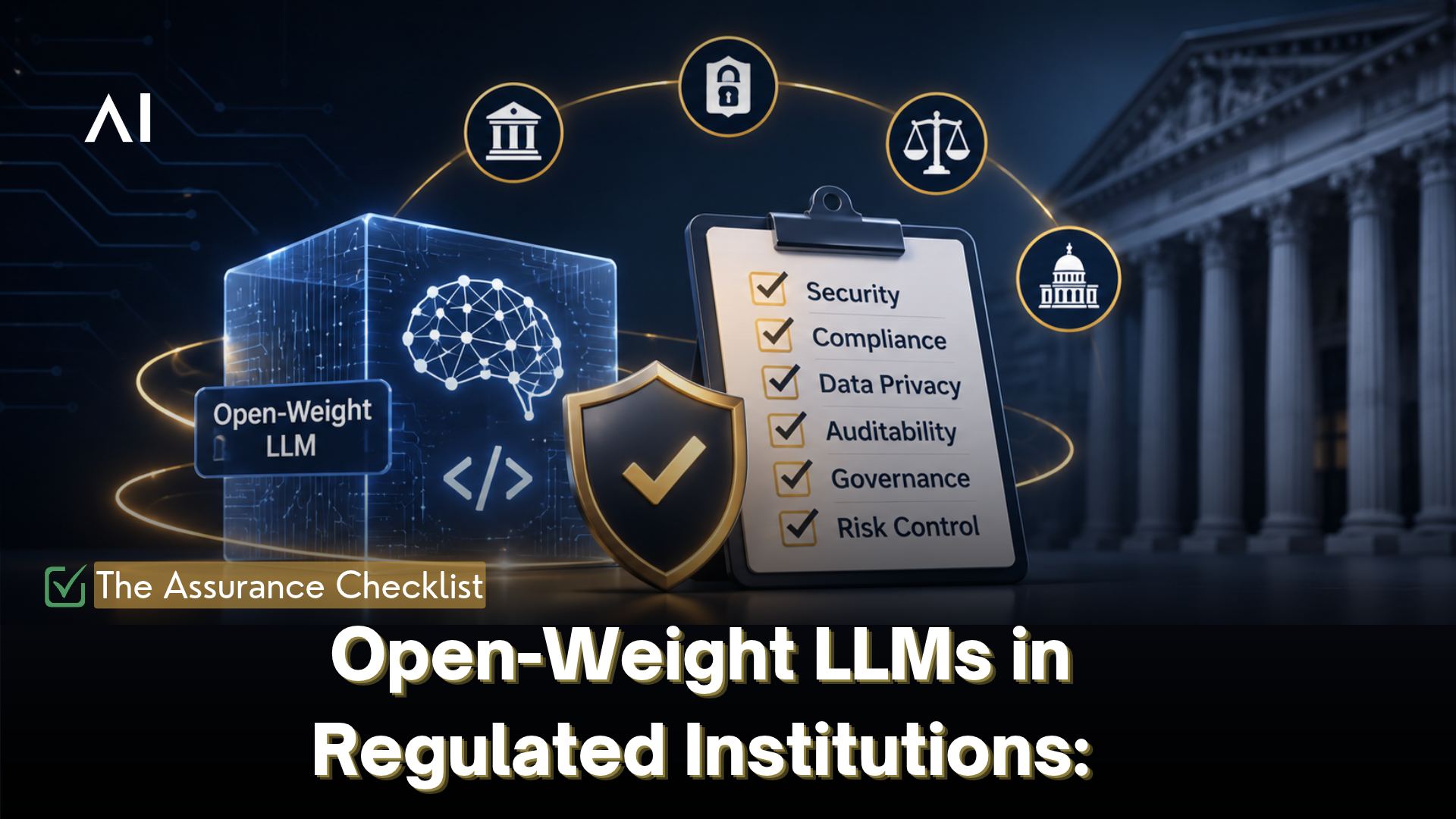
Open-Weight LLMs in Regulated Institutions: The Assurance Checklist

TL;DR
Open-weight models are cheaper, customizable, and increasingly powerful. But “open” doesn’t mean “ready for a regulated institution.” Before an open-weight LLM goes anywhere near production data inside a bank, insurer, or government body, it needs to pass a very specific set of checks that most vendors skip entirely. This blog is that checklist.
The question every regulated institution is asking right now
“Can we use an open-source model instead of paying for a proprietary one?”
It’s a fair question. Open-weight models like LLaMA, Mistral, Qwen, and others have gotten remarkably good. In many benchmarks they match or come close to proprietary alternatives. And the cost savings are significant.
But here’s the problem. The conversation usually stops at “it’s cheaper and it’s good enough.”
For a bank, an insurer, or a government institution, “good enough” isn’t a standard. “Auditable, explainable, secure, and legally clear” is the standard. And that’s where most open-weight evaluations fall apart.
We’ve worked with institutions across banking, insurance, and government that wanted to use open-weight models. The ones that succeeded all went through the same set of checks. The ones that didn’t? They skipped one or more of these and paid for it later.
Here’s the full checklist.
1. Benchmark against your actual use case, not a leaderboard
Leaderboard scores are useful for researchers. They’re almost useless for enterprise deployment.
A model that ranks #3 on a general reasoning benchmark might perform terribly on your specific task. Credit memo generation, compliance document review, customer query resolution in a specific language. These are very different from the tasks benchmarks measure.
What to do:
Build an evaluation set from your own data. 200 to 500 representative examples from your actual workflows. Run the open-weight model against these and compare with the proprietary model you’re considering replacing.
Measure what matters for your use case: factual accuracy, task completion rate, material error rate, and the time it takes for a human reviewer to verify the output.
A model that scores 2% lower on a public benchmark but handles your specific document format better is the better model for you.
2. Verify the licence before your legal team has to
Not all “open” models are open in the same way. This is where things get complicated fast.
Some models are truly open-source with permissive licences (Apache 2.0, MIT). Some are “open-weight” but come with restrictions on commercial use, usage in certain industries, or deployment above certain user thresholds. Some have changed their licence terms after release.
What to check:
Does the licence permit commercial use in your industry? Are there user or revenue thresholds that trigger different terms? Has the licence changed since the model was first released? Does the licence restrict use in specific geographies or sectors?
For regulated institutions, especially banks and government bodies, the legal review of an open-weight model’s licence should be as thorough as any vendor contract review. Because it effectively is one.
3. Run it air-gapped and prove nothing leaves
This is the non-negotiable for most regulated institutions we work with. The model must run entirely within the institution’s own infrastructure. No external API calls. No telemetry. No data leaving the perimeter. Ever.
What to verify:
Can the model run fully on-premise or in your own cloud tenancy without any outbound connections? Does the runtime make any external calls during inference, logging, or model loading? Is there telemetry built into the serving framework that phones home?
How to prove it:
Run the model in a monitored network environment for a defined period. Log every outbound connection attempt. The result should be zero. If it’s not zero, you need to understand exactly what’s calling out and whether it can be disabled without breaking the model.
This isn’t paranoia. It’s the baseline expectation from every CISO we’ve worked with in regulated finance.
4. Hash-check every upgrade
One of the biggest risks with open-weight models that nobody talks about: silent updates.
A model you evaluated three months ago might not be the same model you’re running today if the weights were updated, the tokenizer changed, or the serving framework was modified. In a regulated environment, any change to the model is effectively a change to the system, and it needs to go through the same change management process as a code deployment.
What to implement:
Generate and store a cryptographic hash of the model weights, configuration files, and tokenizer at the time of evaluation and approval. Before any model is loaded into production, verify its hash against the approved version. Any mismatch triggers a review before deployment, not after.
This ensures that the model running in production is exactly the model that was evaluated and approved. No surprises.
5. Build a periodic “no data has left” report
Trust but verify. Even after proving air-gapped deployment at the start, institutions need ongoing assurance that the isolation holds.
What to build:
A periodic report (monthly or quarterly, depending on your regulator’s expectations) that documents: total outbound connection attempts (should be zero), data egress volume (should be zero), any changes to the network configuration, any changes to the model or serving infrastructure.
This report becomes part of your model assurance pack. When the regulator asks “how do you know customer data isn’t leaving your infrastructure?” you hand them this report. That conversation becomes very short.
6. Plan your fallback model before you need it
What happens if the open-weight model you chose gets discontinued? Or the community discovers a critical vulnerability? Or the licence terms change and your legal team says you can no longer use it?
If your answer is “we’ll figure it out when it happens,” you’re not ready for production.
What to plan:
Identify at least one alternative model (open-weight or proprietary) that can handle the same use cases. Test it against the same evaluation set. Document the switchover process. Know how long it takes.
The goal isn’t to run two models in production. It’s to know that if you need to switch, you can do it in days, not months.
7. Check the geopolitical landscape
This is a newer consideration but an increasingly important one. Some open-weight models originate from organizations in specific countries, and some regulated institutions have policies (or are developing policies) around which models they can deploy based on origin.
What to consider:
Does your institution or regulator have any guidance on model provenance? Are there sanctions, export controls, or procurement restrictions that apply? Is the training data sourced from jurisdictions that could create legal complications?
This isn’t about whether a model is technically good. It’s about whether deploying it creates a compliance or procurement risk that could surface later.
We’re not suggesting institutions avoid models based on origin by default. We’re saying: check, document, and decide deliberately rather than discovering a problem after deployment.
The complete assurance pack
When all seven checks are done, you should have a single document (or set of documents) that you can hand to your CISO, compliance team, and regulator. It should contain:
Benchmark results against your own evaluation set, with comparison to proprietary alternatives
Legal review of the licence terms, with sign-off from your legal team
Air-gap verification report showing zero outbound connections during the test period
Hash records for all approved model components
Template for the periodic no-data-egress report
Fallback model documentation with switchover process and timeline
Geopolitical and provenance review
If you can produce this pack, you’re not just “using an open-weight model.” You’re deploying one with the same rigour as any other regulated system. And that’s the bar.
How Fluid AI handles this
Our platform is built to support open-weight models alongside proprietary ones, on the same infrastructure, with the same governance layer.
We deploy fully on-premise and air-gapped. We hash-verify every model component before it enters production. We generate the egress reports. We support model swapping without rebuilding your workflows.
Whether you choose GPT, Claude, an open-weight model, or a mix of all three, the security and governance layer stays the same. That’s by design.
Because in regulated finance, the model is a choice. The governance is not.
Book your Free Strategic Call to Advance Your Business with Generative AI!
Fluid AI is an AI company based in Mumbai. We help organisations kickstart their AI journey. If you're seeking a solution for your organisation to enhance customer support, boost employee productivity and make the most of your organisation's data, look no further.
Take the first step on this exciting journey by booking a Free Discovery Call with us today and let us help you make your organisation future-ready and unlock the full potential of AI for your organisation.