7 Game-Changing AI Use Cases in Banking: How AI Is Transforming the Future of Finance

TL;DR
AI in banking has moved far beyond chatbots and basic automation. This blog breaks down 7 real AI use cases transforming banking in 2026, from fraud detection and KYC automation to agentic AI running entire workflows. Whether you're a banker, fintech leader, or enterprise decision-maker, here's what's actually changing and why it matters.
Introduction: Why Banking Can't Afford to Ignore AI Anymore
Banking is one of the oldest industries in the world. It's also becoming one of the fastest-moving.
Not long ago, "digital transformation" in financial services meant putting a loan form on a website or launching a mobile app. Today, AI in banking means autonomous systems that verify identities, flag fraud, assess credit risk, and personalize financial advice, all in real time, often without a human in the loop.
By 2024, over 90% of banks were already investing in AI. McKinsey estimates that generative AI in banking could deliver between $200 billion and $340 billion in annual value globally. That's not a future projection, that's money on the table right now.
What Is AI in Banking? A Quick Definition
AI in banking is the application of machine learning, NLP, computer vision, OCR, predictive analytics, and generative AI to automate decisions, personalize experiences, and reduce operational risk across financial services.
What separates 2026's AI from earlier rule-based automation is the rise of agentic AI in banking: systems that don't just respond to inputs but autonomously plan, reason, and execute multi-step workflows end to end. These aren't tools. They're intelligent operators.
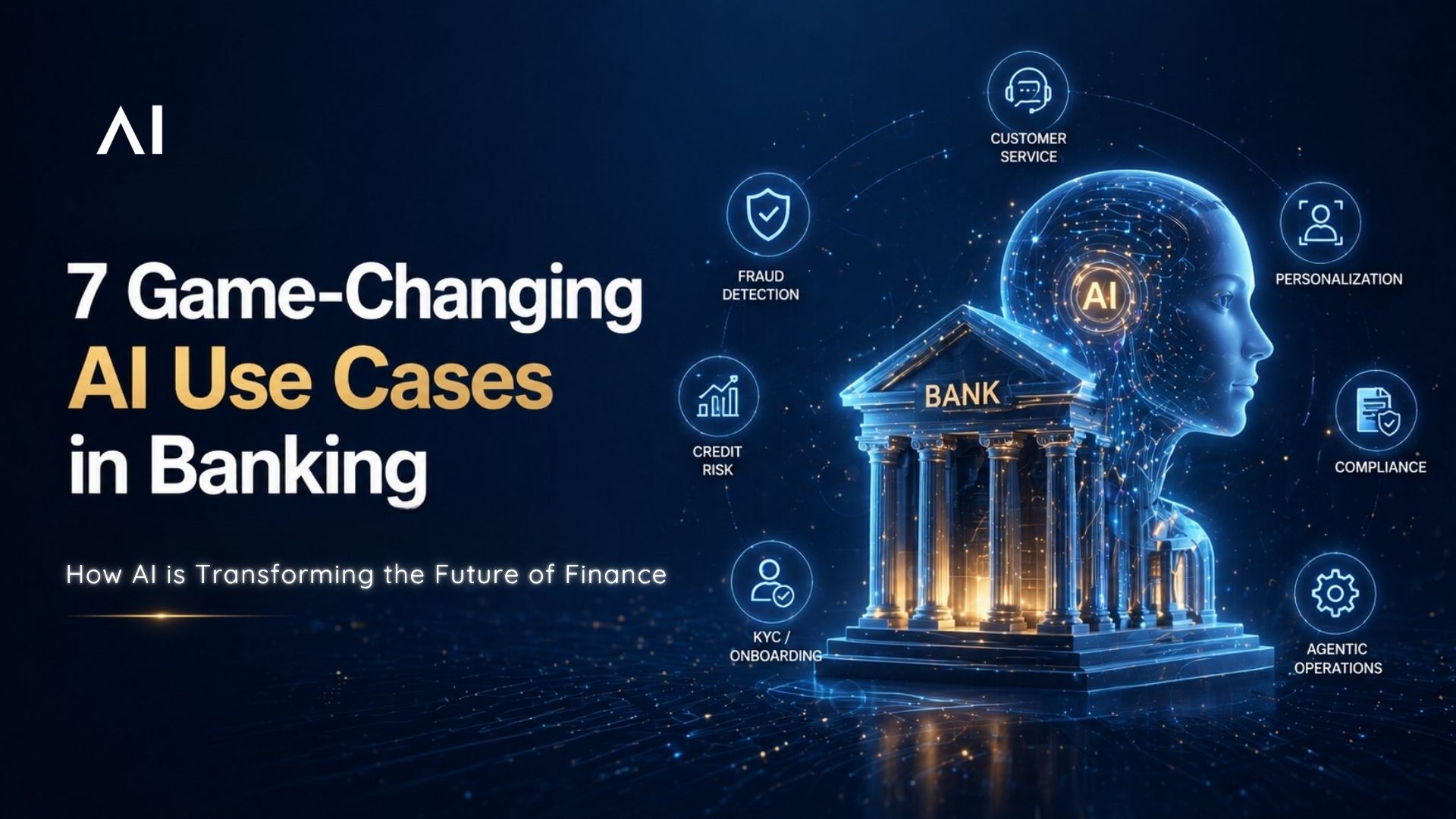
7 Game-Changing AI Use Cases in Banking

1. AI Chatbots and Voice Agents for Customer Service
What This Means
The chatbot of 2019 could barely answer "what's my balance." The AI-powered banking assistant of 2026 is a different animal. Powered by large language models (LLMs), these systems function as digital concierges, handling fund transfers, bill payments, card management, and complex account queries autonomously, with up to 85% first-contact resolution.
Why It Matters
Detects customer sentiment in real time and adjusts tone accordingly
Drives a 40% reduction in customer service operating costs
Operates 24/7 across digital and voice channels without fatigue
Example: A customer messages their bank at midnight to dispute a transaction and raise a credit limit. An AI voice agent verifies identity, initiates the dispute, updates the limit, and confirms, no call center agent involved.
2. Fraud Detection and Real-Time Transaction Monitoring
What This Means
AI-powered fraud detection replaces static rule sets with behavioral ML models that learn from millions of transactions in real time. Instead of matching fixed patterns, these systems identify anomalies, deviations from normal customer behavior, that signal account takeovers, synthetic identity fraud, or card-not-present scams.
Why It Matters
Dramatically reduces false positives that frustrate legitimate customers
Operates at transaction speed, flagging threats in milliseconds
Protects revenue while maintaining a frictionless customer experience
Example: A card is used in Singapore three minutes after a purchase in Chicago. The ML model flags the transaction instantly, freezes the card, and sends a real-time alert, before any loss occurs.
3. Credit Risk Analysis and AI-Powered Loan Underwriting
What This Means
Traditional credit scoring has a structural blind spot: it excludes anyone with a thin credit file. AI in credit risk replaces static FICO scores with multi-dimensional profiles built from alternative data, utility payments, cash flow behavior, and e-commerce patterns.
Why It Matters
Expands lending access to previously "credit invisible" populations
Reduces default rates through predictive anomaly detection
Compresses loan approval timelines from days to minutes
Example: A gig economy worker with no formal credit history applies for a personal loan. An AI underwriting model analyzes 18 months of cash flow and bill payment consistency, and approves the loan in four minutes with a risk score more accurate than any FICO-based decision.
4. KYC, Customer Onboarding, and Document Automation
What This Means
KYC automation powered by AI integrates OCR, computer vision, biometric authentication, and liveness detection into a seamless verification pipeline. Documents are extracted and validated in seconds. Real-time selfie matching catches deepfakes that human reviewers miss.
Why It Matters
Cuts KYC processing time by up to 60%
Enables "straight-through processing" for new account openings
Produces audit-ready compliance logs automatically
Example: A new customer uploads their passport and takes a selfie. The AI extracts document data, confirms liveness, cross-checks against sanctions databases, and opens the account, in under three minutes.
5. Personalized Banking and Next-Best-Action Recommendations
What This Means
Generic product marketing in banking is dead. Personalized banking powered by AI uses unified customer data, transactions, behavioral signals, life events, to predict exactly what a customer needs and when.
Why It Matters
Next Best Action (NBA) models replace broadcast campaigns with individual-level predictions
Increases product cross-sell and offer acceptance rates significantly
Positions the bank as a proactive financial partner, not a product vendor
Example: A customer's transaction data shows rising rent payments and recent mortgage searches on the bank's app. The AI surfaces a pre-qualified home loan offer the following morning, before the customer calls a branch.
6. AML, Compliance, and Regulatory Reporting
What This Means
AI for AML uses graph-based machine learning to map relationships between accounts, entities, and transactions, surfacing laundering networks that pattern-matching systems miss entirely. On the reporting side, AI automates extraction, formatting, and filing of regulatory documents.
Why It Matters
Reduces false positive alerts drowning compliance teams
Detects complex, multi-layered money laundering schemes
Delivers explainable AI (XAI) outputs that satisfy regulators across jurisdictions
Example: An AI compliance system detects 14 accounts across three countries routing funds through a common intermediary in a structured pattern. A human analyst receives a complete relationship map and risk narrative, ready for filing.
7. Agentic AI for Banking Operations and Workflow Automation
What This Means
This is where most conversations about AI in banking stop, and where the real competitive frontier begins. Agentic AI in banking goes beyond individual use cases. An AI agent plans, reasons, and executes multi-step workflows autonomously, coordinating across systems, APIs, and data sources without constant human handoffs.
Why It Matters
Eliminates manual handoffs across fragmented banking workflows
Scales operations without proportional headcount growth
Creates fully auditable, governance-ready autonomous processes
Example: An agent receives a commercial mortgage application. It pulls credit data, orders a property valuation, runs compliance checks, generates a risk summary, and routes the file to the correct underwriter, all before a human opens their inbox.
Benefits of AI in Banking: What the Numbers Show
Here's why banking AI use cases are no longer optional for competitive institutions:
Faster operations: Loan approvals in minutes, KYC in seconds, fraud flagged in milliseconds
Lower costs: Up to 40% reduction in customer service operating expenses
Better compliance: Explainable, audit-ready decisions across every AI-driven process
Expanded revenue: Lending to previously excluded segments, higher offer conversion rates
Scalable infrastructure: AI agents that handle volume spikes without additional headcount
Common Misconceptions About AI in Banking
AI in banking isn't just about chatbots. The chatbot is one layer. The real transformation is happening in underwriting, compliance, fraud, and autonomous operations, areas customers never see.
AI doesn't replace human judgment. High-stakes decisions still require human oversight. The best implementations have human-in-the-loop checkpoints built in from day one.
Legacy systems aren't a dead end. They're an integration challenge, not an insurmountable barrier. Banks that invest in a unified data layer can connect modern AI to existing core infrastructure without a full system replacement.
How to Get Started with AI in Your Bank
Identify one high-friction workflow. Start with KYC, loan processing, or fraud triage, areas where speed and accuracy directly impact revenue or risk.
Audit your data layer. AI is only as good as the data it works with.
Define your governance framework first. Explainability, audit trails, and human oversight requirements should be designed in, not retrofitted later.
Build toward integration, not isolation. A fraud detection model that doesn't talk to your KYC system is half a solution.
Move to production quickly. Real performance data comes from live environments, not pilots.
Conclusion: The Banks That Move Now Will Define What Comes Next
The seven use cases covered here, from AI chatbots and fraud detection to KYC automation, credit risk analysis, personalized banking, AML compliance, and agentic AI for banking operations, represent where intelligent systems are delivering measurable value today.
The question isn't whether your bank needs AI. That decision has already been made across the industry. The question is whether you're building toward an intelligent operating model, or patching together point solutions that won't scale.
Book your Free Strategic Call to Advance Your Business with Generative AI!
Fluid AI is an AI company based in Mumbai. We help organizations kickstart their AI journey. If you’re seeking a solution for your organization to enhance customer support, boost employee productivity and make the most of your organization’s data, look no further.
Take the first step on this exciting journey by booking a Free Discovery Call with us today and let us help you make your organization future-ready and unlock the full potential of AI for your organization.
_1790254083168-CB8e8KXC.png)