AI Credit Memo Automation: How Banks Can Cut the Manual Grind in Lending

TL;DR
AI credit memo automation helps banks generate faster, cleaner, and more consistent credit memos.
It reduces manual effort across document extraction, financial spreading, borrower analysis, risk commentary, and memo drafting.
The goal is not to replace credit analysts. It is to let them spend less time assembling information and more time making judgment calls.
For regulated banks, the winning model is human-in-the-loop automation with strong audit trails, source citations, and deployment control.
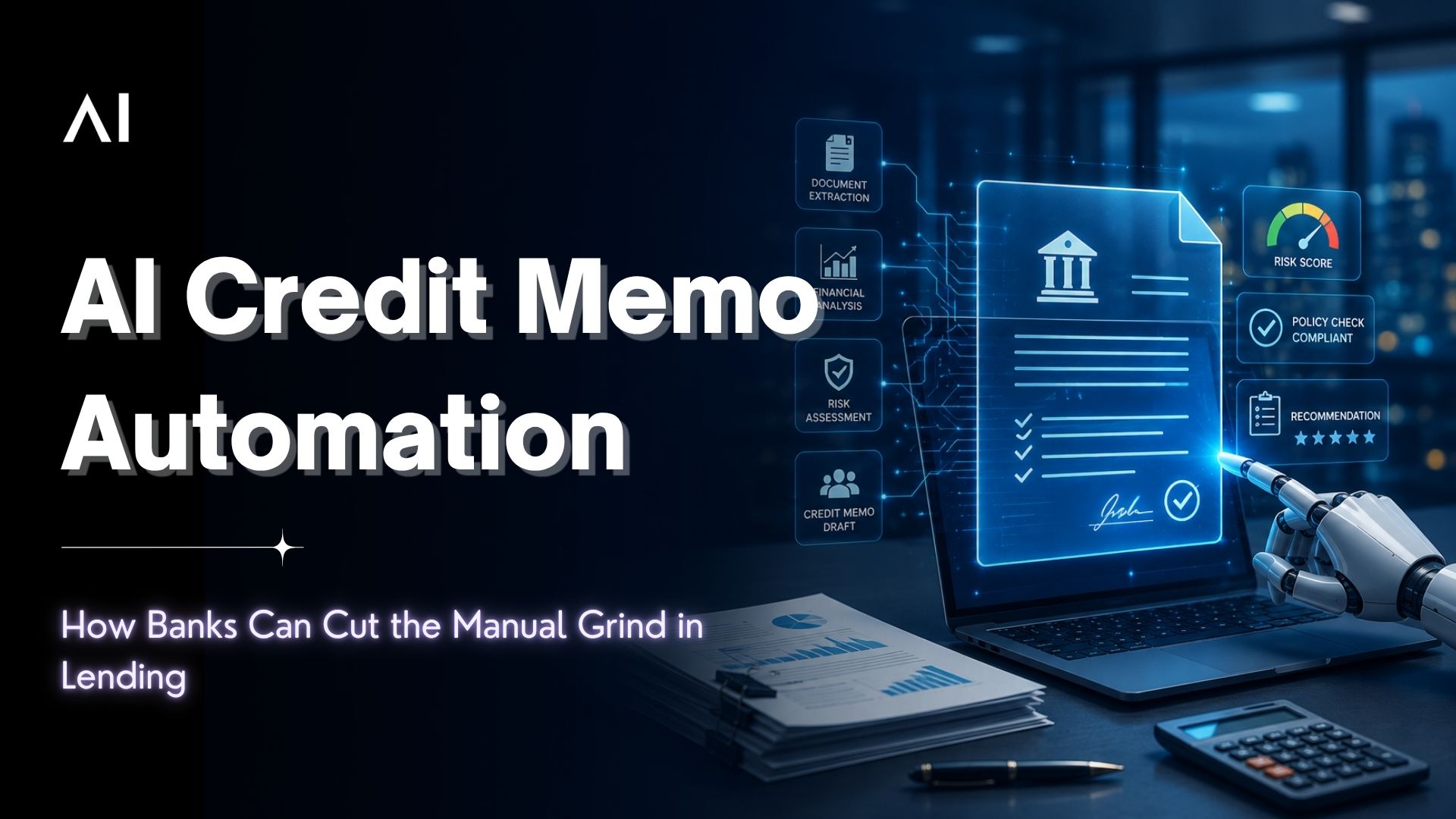
The credit memo is still one of lending’s biggest bottlenecks
In commercial lending, the credit memo is not just paperwork. It is the document that tells the complete borrower story.
It captures the purpose of the loan, borrower background, financial performance, repayment capacity, collateral, risk rating, covenant compliance, exposure, key risks, and final recommendation. For many banks, it is the central artifact that goes to the credit committee.
The problem is how much manual work goes into creating it.
Analysts often spend hours or days collecting borrower data, reviewing financial statements, spreading numbers, reconciling mismatched documents, checking ratios, searching past memos, and drafting narrative sections. A complex corporate credit memo can easily stretch across dozens of pages.
That creates a strange problem. The most skilled credit people in the bank spend too much time preparing the memo and not enough time challenging the risk.
This is where AI credit memo automation becomes useful.
What is credit memo automation?
Credit memo automation is the use of AI, document intelligence, workflow automation, and credit risk logic to reduce the manual effort involved in preparing a lending credit memo.
A strong system can ingest borrower documents, extract structured data, calculate ratios, summarize financial trends, check policy requirements, draft memo sections, and prepare the file for human review.
In simple terms, the analyst no longer starts with a blank memo.
They start with a structured first draft.
That draft may include:
Borrower overview
Business and industry summary
Financial spreading
Ratio analysis
Debt service coverage
Collateral summary
Covenant checks
Risk rating support
Policy exceptions
Credit recommendation
Source citations
The important point is this: credit memo automation should not automate credit judgment. It should automate preparation.
The analyst still owns the decision. AI simply removes the repetitive work around data gathering, formatting, extraction, and first-draft writing.
Why traditional credit memo preparation is broken?
Traditional credit memo preparation is slow because the workflow is fragmented.
Borrower data may sit in the loan origination system. Financial statements may be PDFs. KYC documents may sit in another system. Collateral details may come from a separate repository. Prior memos may be buried in shared drives. Risk rating logic may live in spreadsheets or policy documents.
The analyst becomes the connector between all these systems.
That means the credit team spends time on:
Copying figures from financial statements
Rechecking spreadsheet formulas
Finding missing documents
Writing repetitive borrower summaries
Comparing current numbers with past years
Preparing committee-ready language
Formatting the memo for internal standards
Manual work also creates inconsistency. Two analysts may write the same risk differently. Ratio calculations may vary. Important exceptions may be missed. Supporting evidence may not be linked clearly.
This is why credit memo workflow automation is not just about speed. It is about consistency, auditability, and better use of analyst time.
How AI-powered credit memo workflows work?
An AI-powered credit memo workflow usually works in five stages.
1. Document ingestion
The system receives borrower documents from the LOS, email, upload portal, or document management system. These may include audited financials, bank statements, tax returns, collateral documents, sanction letters, KYC documents, bureau reports, and past credit notes.
2. Structured data extraction
Document AI extracts key information from tables, PDFs, scans, forms, and unstructured text. It pulls items like revenue, EBITDA, debt, net worth, cash flow, repayment obligations, security details, and borrower identifiers.
3. Financial spreading and analysis
The system maps extracted financial data into the bank’s spreading template. It calculates ratios such as DSCR, current ratio, leverage, interest coverage, EBITDA margin, and debt-to-equity.
4. Credit policy and risk checks
AI compares borrower data against policy rules. It can flag covenant breaches, missing documents, exposure limit issues, financial deterioration, or risk-rating triggers.
5. Memo drafting and human review
The system drafts the borrower overview, financial commentary, risk assessment, collateral section, covenant analysis, and recommendation summary. The analyst then reviews, edits, verifies, and approves the memo before it moves forward.
This is where AI for credit memo writing becomes practical. The system does not just write paragraphs. It grounds those paragraphs in borrower documents, financial data, policy rules, and source references.
Manual credit memo workflow vs AI-powered workflow
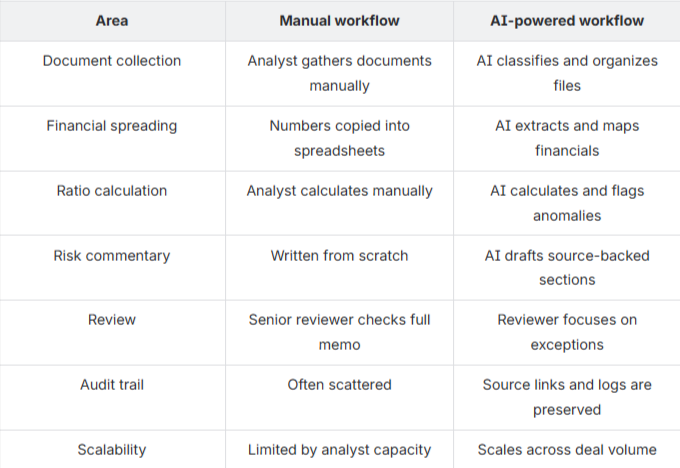
The biggest benefit is not that AI creates a memo faster. The bigger benefit is that it creates a more structured starting point for better credit review.
The role of agentic AI in credit memo automation
Simple generative AI can draft text. But credit memo automation needs more than drafting.
It needs agentic AI in banking.
In an agentic workflow, multiple AI agents work together across the credit process. One agent may extract documents. Another may spread financials. Another may calculate ratios. Another may check credit policy. Another may draft the memo. Another may validate sources and flag weak claims.
This multi-agent approach is important because credit appraisal is not one task. It is a chain of connected tasks.
A practical agentic credit memo workflow may include:
Document extraction agent
Financial spreading agent
Risk analysis agent
Policy compliance agent
Narrative drafting agent
Source validation agent
Human review assistant
The system can use RAG to retrieve information from internal credit policies, historical memos, borrower files, risk frameworks, and approval templates.
This makes the memo more grounded. Analysts can trace where a figure came from, why a risk was flagged, and which document supports the statement.
That matters because banks cannot afford black-box credit workflows.
1. Human-in-the-loop credit underwriting is essential
AI should support credit underwriting. It should not replace credit accountability.
A bank can automate memo preparation, but final judgment still needs human review. Credit decisions involve business context, borrower behavior, relationship history, management quality, market conditions, and exceptions that may not be obvious from documents alone.
That is why human-in-the-loop credit underwriting is the safest model.
AI can:
Extract data, calculate ratios, draft summaries, flag missing documents, identify covenant issues, prepare reviewer notes, suggest risk areas
Humans should:
Challenge the assumptions, Review source evidence, Assess management quality, Approve policy exceptions, Validate the final recommendation, Own the final credit decision
This is especially important for regulated banks. Creditworthiness assessment is a sensitive area. AI systems must be explainable, auditable, and controlled.
The right design keeps AI close to the work, but keeps humans close to the decision.
Deployment models for regulated banks
Credit memo AI for regulated banks must be deployed carefully because it handles sensitive borrower data.
Banks usually evaluate three models.
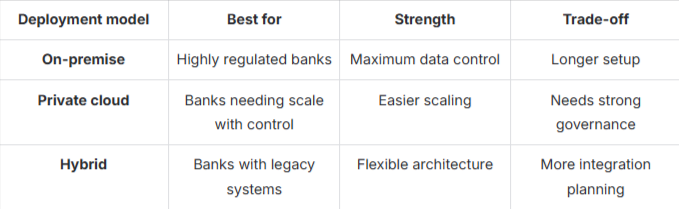
The key question is not only which model is most powerful. The real question is where borrower data goes, who can access it, how prompts are logged, and whether outputs can be audited later.
For banks, deployment is not an IT detail. It is part of the risk framework.
Common mistakes banks make with AI credit memo tools
Many banks make the same mistake. They treat credit memo automation as a writing problem.
It is not.
It is a data, policy, workflow, and governance problem.
Common mistakes include:
Using generic AI tools that do not understand lending
Failing to connect the system to LOS and document repositories
Not mapping internal credit policy into the workflow
Generating memo text without source citations
Ignoring human approval gates
Skipping audit trail requirements
Trying to automate complex credit decisions too early
A good demo can still fail in production if the underlying workflow is weak.
The best AI credit memo software should support bank-specific templates, structured data extraction, policy configuration, LOS integration, human review, audit trails, and controlled deployment.
Where Fluid AI fits naturally
Fluid AI helps enterprises build AI systems that work across documents, workflows, channels, and enterprise systems.
For credit memo automation, the real value is not just generating a memo. It is creating an AI-powered credit appraisal workflow that can ingest borrower documents, extract financial data, calculate ratios, retrieve internal policy context, draft credit commentary, and keep the analyst in control.
In banking environments, this matters because credit workflows need more than speed. They need security, auditability, governance, and integration with existing systems.
A Fluid AI-style credit memo assistant can support analysts by preparing the first draft, highlighting missing information, surfacing risk signals, and creating a review-ready memo while preserving human approval.
That is the difference between a generic AI writer and a production-grade lending workflow.
The ROI of automating credit memos
The ROI of credit memo automation usually comes from four areas.
First, preparation time drops. Analysts spend less time assembling documents and more time reviewing risk.
Second, consistency improves. The same template, ratio logic, policy rules, and review structure can be applied across deals.
Third, approval cycles become faster. Cleaner first drafts mean fewer back-and-forth corrections before credit committee review.
Fourth, capacity improves. Banks can handle more credit files without adding proportional analyst headcount.
The real metric is not only time saved per memo. Banks should also track:
Review quality
Exception rates
Manual override rates
Approval cycle time
Audit findings
Analyst productivity
Credit committee rework
Borrower turnaround time
The goal is not to write faster for the sake of speed. The goal is to improve the full credit workflow.
The future of AI in commercial lending
The future of corporate lending AI is not one model writing one document.
It is a system of specialized agents working across the lending lifecycle.
When new financials arrive, the system can refresh analysis. When covenants weaken, it can flag risk. When exposure changes, it can update the review package.
That is where lending is heading.
Conclusion
AI credit memo automation is not about replacing underwriters.
It is about removing the manual grind that keeps them from doing their best work.
The strongest systems combine credit memo automation, AI-powered credit appraisal, financial spreading automation, RAG, multi-agent orchestration, human review, and audit-ready workflows.
For banks, the next step is not to automate everything at once. Start with one high-volume credit memo workflow, measure preparation time and review quality, and build from there.
The credit memo should not remain a bottleneck.
It should become a strategic asset.
Book your Free Strategic Call to Advance Your Business with Generative AI!
Fluid AI is an AI company based in Mumbai. We help organizations kickstart their AI journey. If you’re seeking a solution for your organization to enhance customer support, boost employee productivity and make the most of your organization’s data, look no further.
Take the first step on this exciting journey by booking a Free Discovery Call with us today and let us help you make your organization future-ready and unlock the full potential of AI for your organization.
_1790254083168-CB8e8KXC.png)