Fine-Tuning Multi-Agent Collaboration: Teaching AI Agents to Work as a Team

TL;DR
- Fine-tuning transforms generic LLMs into domain-specialized, context-aware AI agents.
- It allows enterprises to design multi-agent workflows where specialized agents collaborate seamlessly.
- Beyond prompt engineering, fine-tuning encodes enterprise expertise directly into each agent, ensuring consistent communication and decision-making.
- Use cases range from banking compliance chains to manufacturing troubleshooting teams and hyper-personalized CX ecosystems.
- The future lies in continuous fine-tuning pipelines, orchestration frameworks, and self-improving multi-agent teams.
What Does Fine-Tuning LLM-Powered AI Agents Mean?
Fine-tuning takes a general-purpose LLM — GPT, Claude, or Llama — and reshapes it for specific team roles inside an enterprise workflow.
For AI agents, this means:
- Embedding role-specific expertise: Each agent learns a distinct domain (compliance, risk, CX, IT operations).
- Aligning reasoning styles: Agents follow the same institutional logic, making handoffs smooth and predictable.
- Building workflow awareness: Agents “understand” not just their job, but also how to collaborate and pass context.
This transforms a set of disconnected chatbots into a cohesive digital workforce, capable of teamwork, escalation, and collective decision-making.
If you’re curious about how enterprises are already shifting into the age of agentic AI, check out our blog: 7 Hints That You’re Running on Agentic AI.
Why Fine-Tuning Matters for Multi-Agent Collaboration
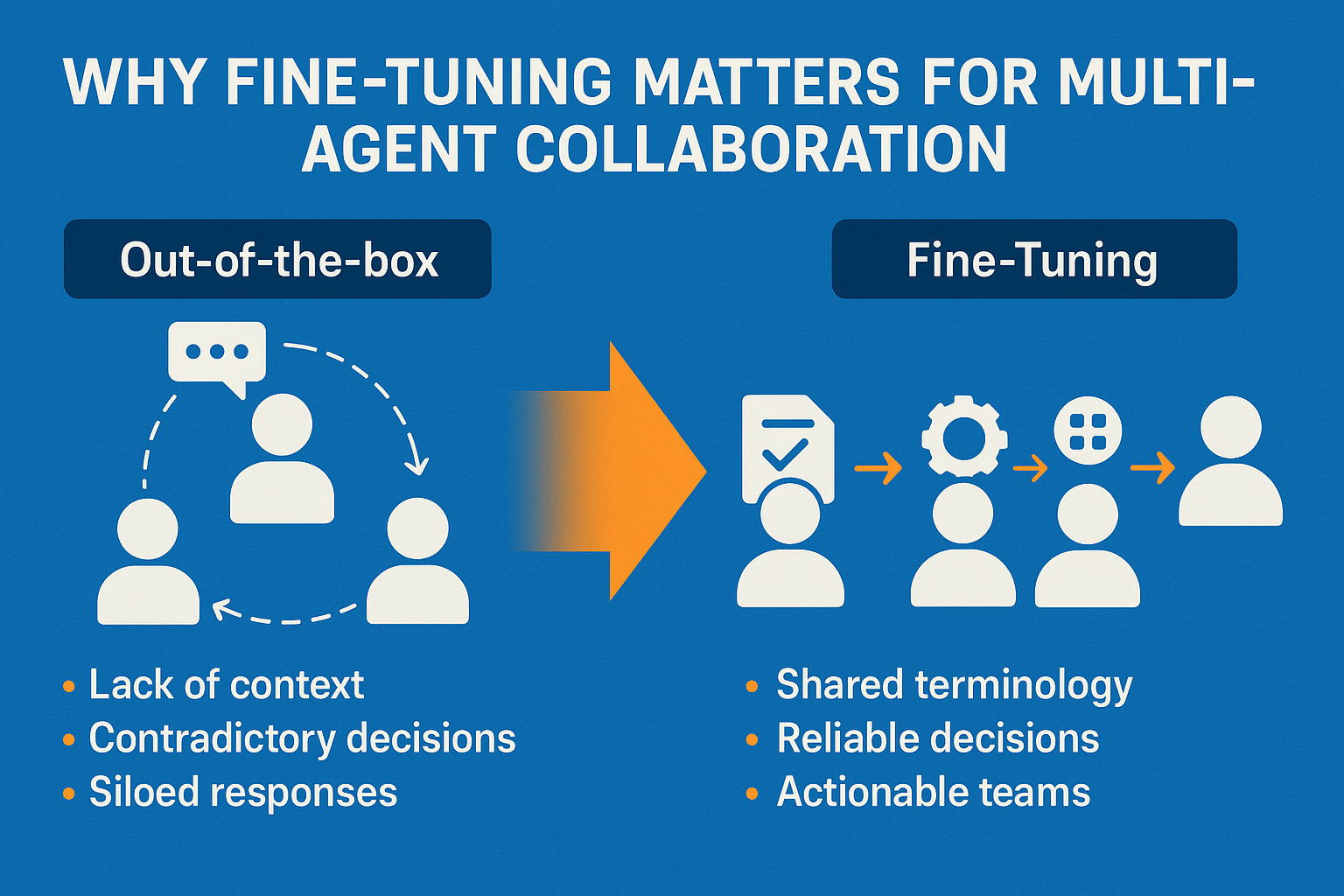
Out-of-the-box LLMs are generalists. They can converse, but they don’t naturally collaborate. In multi-agent systems, collaboration is key: one agent validates, another acts, another communicates the outcome.
Fine-tuning ensures that:
- Context flows across agents: Shared terminology and reasoning reduce misunderstandings.
- Decisions are reliable: Agents align to the same enterprise rules, avoiding contradictory outputs.
- Teams become actionable: Instead of siloed responses, agents form chains that execute real business processes.
In other words, fine-tuning doesn’t just make agents smarter — it makes them better teammates.
How Fine-Tuning Works in Multi-Agent Ecosystems
At a high level, fine-tuning adds role specialization + team alignment on top of a base LLM.
Step 1: Data Curation
- Gather role-specific datasets: compliance manuals, risk models, CRM logs, IoT data.
- Label collaborative workflows: e.g., “Agent A validates documents → Agent B flags risks → Agent C updates customer.”
Step 2: Training Strategy
- Instruction Fine-Tuning (IFT): Each agent learns its role instructions.
- Reinforcement Learning with Human Feedback (RLHF): Ensures agents’ collaboration tone and decision-making match enterprise standards.
- Continual Fine-Tuning: Keeps teams updated as workflows, rules, and products evolve.
Step 3: Integration into Workflows
Agents are orchestrated into chains or teams where each handoff is seamless:
- A KYC agent validates documents.
- A compliance agent checks AML rules.
- A risk agent scores the application.
- A customer agent communicates outcomes.
Fine-tuning ensures every step aligns with the same institutional knowledge.
To see how the underlying LLM choice impacts these workflows, dive into The Hidden Engine Behind AI Agents: Choosing the Right LLM.
Fine-Tuning vs. Prompt Engineering in Multi-Agent Systems
Prompt engineering is like telling each team member what to do in every scenario. Fine-tuning is like training them beforehand so they naturally collaborate.
- Prompt Engineering: Quick but brittle. Needs constant supervision, especially in team workflows.
- Fine-Tuning: Encodes collaboration patterns into the model itself, ensuring consistency across all agents.
For multi-agent systems, fine-tuning provides the glue that keeps teamwork efficient and error-free.
Use Case 1: Fine-Tuned Banking Compliance Teams
In banking, compliance isn’t a one-agent job. It’s a team effort.
Fine-tuned collaboration chain:
- Onboarding Agent: Collects customer data and IDs.
- Compliance Agent: Cross-verifies against AML/KYC rules.
- Risk Agent: Assesses fraud exposure and creditworthiness.
- Customer Agent: Communicates next steps clearly and compliantly.
Without fine-tuning, handoffs create confusion (e.g., inconsistent interpretation of AML guidelines). With fine-tuning, agents operate as a synchronized compliance team, cutting onboarding time from days to minutes.
Use Case 2: Manufacturing Troubleshooting Squads
Factories run on interconnected machines — and now, interconnected agents.
Fine-tuned collaboration squad:
- Monitoring Agent: Reads IoT sensor anomalies.
- Repair Agent: References manuals and past fixes.
- Operator Agent: Guides technicians step-by-step.
- Safety Agent: Ensures all steps follow compliance and safety standards.
Instead of siloed diagnosis, fine-tuning lets these agents collaborate like a digital repair crew. The result: faster root cause detection, less downtime, and safer operations.
Use Case 3: Customer Experience Ecosystems
Customer interactions span multiple touchpoints. A fine-tuned CX agent team looks like this:
- Personalization Agent: Reads customer history.
- Recommendation Agent: Suggests next-best offers.
- Fraud Agent: Monitors for anomalies during the session.
- Brand Voice Agent: Ensures all replies match the enterprise’s tone.
Together, these agents act as a cohesive CX department, delivering service that feels human while being scalable to millions of customers.
The Mechanics of Fine-Tuned Multi-Agent Workflows
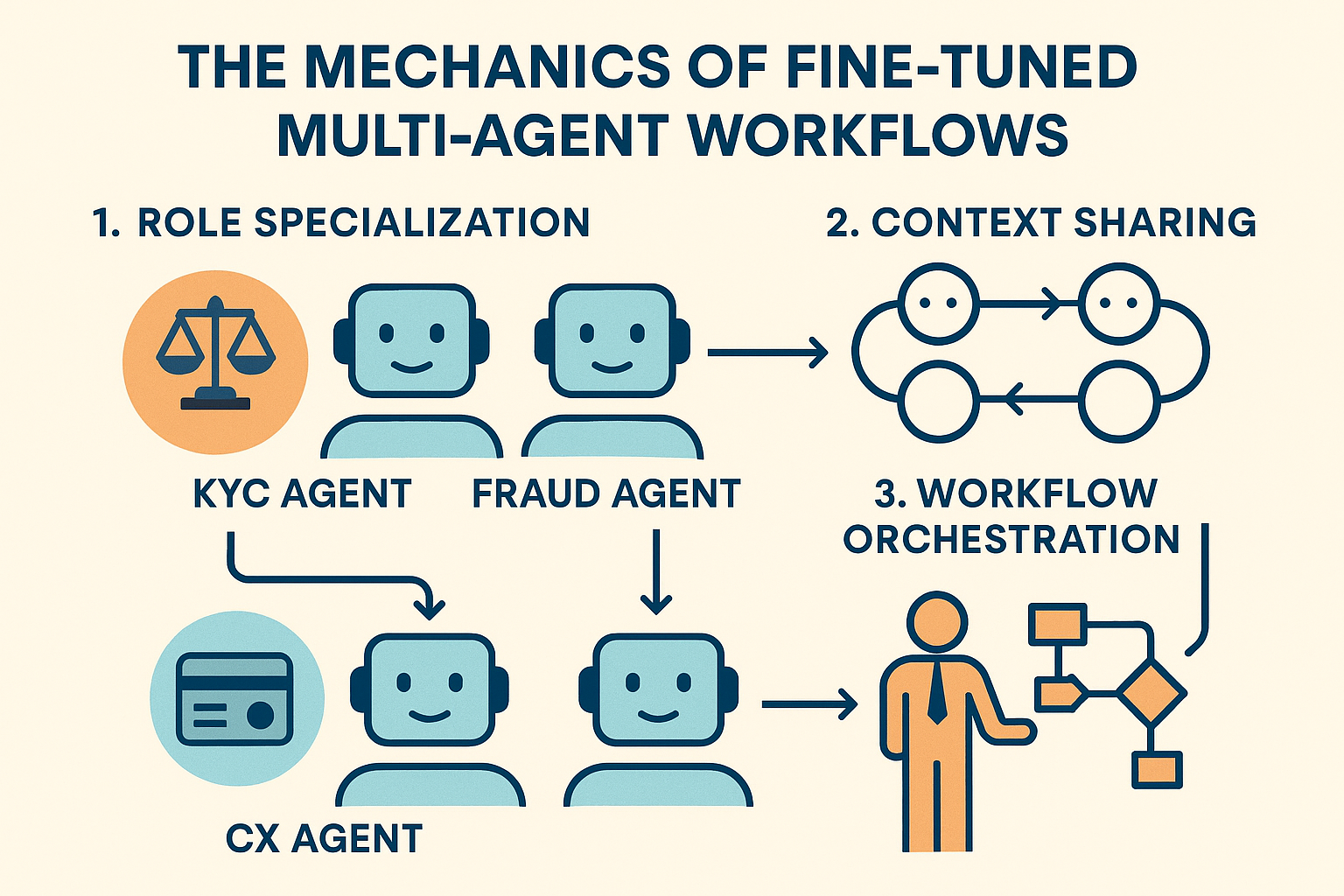
Fine-tuned collaboration works through three principles:
1. Role Specialization
Each agent is fine-tuned for a role, ensuring expertise. Example:
- KYC Agent: Documents + regulation datasets.
- Fraud Agent: Transaction anomalies.
- CX Agent: Customer service transcripts.
2. Context Sharing
Fine-tuning standardizes terminology and reasoning so agents pass tasks without confusion.
3. Workflow Orchestration
Orchestrators manage task order: who acts, who validates, and when to escalate.
This creates autonomous, auditable teamwork among AI agents.
Continuous Fine-Tuning Pipelines for Teams
In dynamic industries, static fine-tuning isn’t enough. Teams must evolve.
- Data Streams: New logs, customer queries, compliance updates feed into retraining loops.
- Automated Evaluation: Benchmarks measure team accuracy, compliance, and collaboration efficiency.
- Hot-Swapping: Fine-tuned agents can be deployed on demand (e.g., for new geographies or regulations).
The result is a living ecosystem of AI teams that improves continuously. Curious about where AI benchmarks are heading to evaluate these pipelines? Read Rethinking LLM Benchmarks for 2025.
Technical Enablers of Multi-Agent Fine-Tuning
Several tools make multi-agent collaboration possible:
- Vector Databases (Snowflake, Pinecone): Ground teamwork in shared domain knowledge.
- LoRA (Low-Rank Adaptation): Fine-tune efficiently without retraining massive LLMs.
- Multi-Agent Frameworks (LangChain, CrewAI, AutoGen): Orchestrate collaboration chains.
- Observability Tools: Monitor not just outputs but also inter-agent reasoning.
These enablers ensure fine-tuned agent teams are scalable, transparent, and enterprise-ready.
The Future: Fine-Tuning as the Operating System for AI Teams
What’s next in multi-agent fine-tuning?
- Industry-Specific Teams: Pre-fine-tuned for banking, telecom, pharma.
- On-Demand Squads: Spun up for campaigns or investigations.
- Self-Fine-Tuning Teams: Agents that refine their collaboration patterns autonomously.
- Cross-Enterprise Networks: Teams of fine-tuned agents collaborating across supply chains or financial ecosystems.
The long-term vision: fine-tuning not just models, but multi-agent collaboration itself, turning AI into an autonomous workforce.
Final Word
Fine-tuning is the invisible foundation that turns LLMs into teams of enterprise-ready agents. By shaping collaboration, decision flows, and role-specific expertise, it enables organizations to build AI ecosystems that act like cohesive digital workforces.
For enterprises aiming to scale AI beyond chatbots, fine-tuning multi-agent collaboration isn’t just powerful — it’s essential for building reliable, specialized, and future-ready AI teams.
_1790254083168-CB8e8KXC.png)