Enterprise AI Failures: Lessons From the First Wave of Agent Deployments

TL;DR
The first wave of enterprise AI agent deployments taught the industry hard lessons. This blog breaks down why AI projects fail in production, from bad data and broken integrations to governance gaps and misaligned expectations, and what enterprises need to do differently in the second wave. If you're planning an AI deployment, read this before you start.
Introduction: The Hype Met Reality, and Reality Won
Every enterprise wanted to be an AI-first company. Budgets were approved. Vendors were hired. Pilots were launched.
Then the results came in.
Not every enterprise AI deployment failed, but enough did to reveal a pattern. A McKinsey study found that while 92% of companies plan to increase AI investment, the 'scaling gap' is expected to be the defining challenge of 2026. Gartner put it more bluntly: through 2025, at least 30% of generative AI projects would be abandoned after proof of concept.
The problem wasn't the technology. It was everything around it.
This blog breaks down the most common enterprise AI failures from the first wave of agent deployments, why they happened, and what the second wave needs to look like to actually deliver ROI.
What Is an Enterprise AI Failure? A Quick Definition
An enterprise AI failure isn't always a dramatic system crash. More often it's quieter, a pilot that never scales, a model that performs in testing but breaks in production, an agent that gets deployed and then quietly sidelined because users don't trust it.
Failures fall into three broad categories:
Technical failures: bad data, poor integration, model drift
Organizational failures: wrong use case, no ownership, poor change management
Governance failures: no explainability, no audit trail, no human oversight
Understanding which category your risk lives in is the first step to avoiding it.
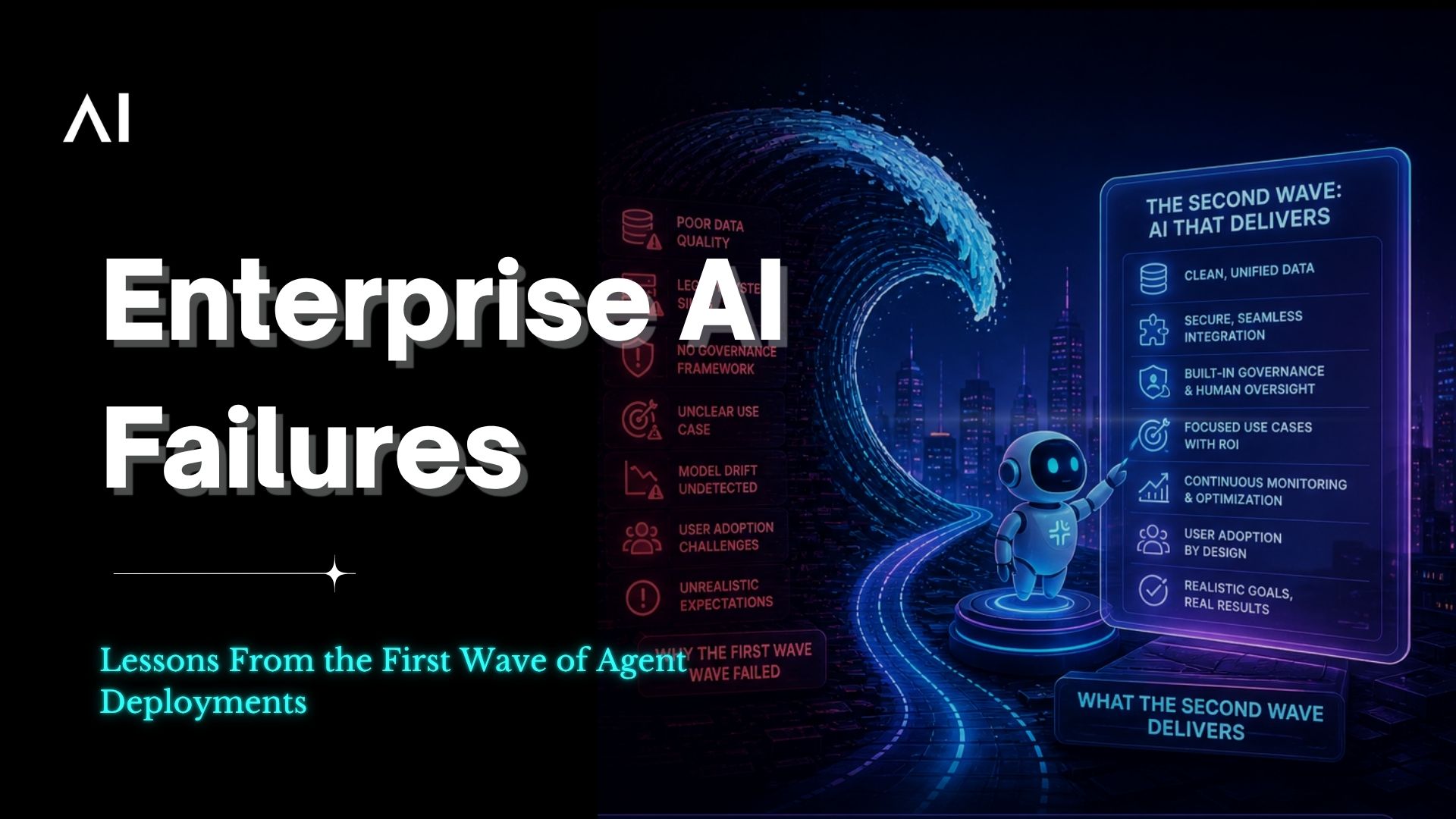
7 Lessons From the First Wave of Enterprise AI Agent Deployments
1. The Data Was Never Ready
What Went Wrong
Most enterprises underestimated how broken their data infrastructure was before they started building AI on top of it. AI agents require clean, structured, accessible data to function. What they found instead: siloed systems, inconsistent formats, duplicate records, and data locked inside 20-year-old legacy platforms with no accessible API.
Why It Matters
Garbage in, garbage out, a well-designed agent running on poor data produces confidently wrong outputs
Data preparation typically consumed 60–80% of total project time, destroying timelines
Siloed data meant agents couldn't connect context across systems, breaking multi-step workflows
The Lesson: Before deploying any enterprise AI solution, run a full data audit. Map where your data lives, who owns it, and whether it's clean enough to trust. The unified data layer isn't a nice-to-have, it's the foundation everything else runs on.
2. The Use Case Was Too Broad
What Went Wrong
Executives wanted transformation. Vendors promised it. The resulting brief was something like: "Build us an AI agent that handles all customer queries across every channel." No scope. No phasing. No clear definition of success.
Why It Matters
Broad mandates produce bloated architectures that are hard to test and impossible to govern
Teams couldn't define what "working" looked like, so the project never officially failed — it just drifted
Resources spread across too many workflows meant nothing was done well
The Lesson: The most successful enterprise AI deployments started narrow. One workflow. One measurable outcome. A mortgage document processing agent. A compliance alert triage system. Specific enough to test, small enough to fix, valuable enough to justify the next phase.
3. Legacy Integration Was Underestimated
What Went Wrong
The demo worked perfectly against a clean test environment. Production was a different story. Enterprise banks and large institutions often run 20 to 40 disconnected legacy systems — core banking platforms, CRMs, document management tools, risk engines — none of which were designed to talk to an AI agent.
Why It Matters
Integration consumed more time and budget than the AI build itself in most failed projects
Brittle connectors broke when upstream systems updated, taking the entire agent workflow down
Security and compliance teams flagged integrations that hadn't gone through proper review, stalling deployment
The Lesson: Legacy system integration isn't a technical afterthought, it's the critical path. Any serious enterprise agentic AI deployment needs an integration architecture designed upfront, not bolted on after the model is built.
4. There Was No Governance Framework
What Went Wrong
In the rush to deploy, governance was deferred. Nobody defined who owned the AI agent's outputs, what happened when it made a wrong decision, how errors would be caught, or what the audit trail looked like. This created serious exposure, especially in regulated industries like banking and financial services.
Why It Matters
Regulators in the EU, UK, and US are increasingly demanding explainable, auditable AI decisions
Without a human-in-the-loop framework, high-stakes errors went uncaught until they caused real damage
Responsible AI frameworks that weren't built in from the start were nearly impossible to retrofit
The Lesson: AI governance isn't a compliance checkbox, it's what separates a production-grade deployment from a liability. Explainability tools, audit logs, escalation protocols, and defined human oversight checkpoints need to be part of the architecture from day one.
5. The Model Drifted and Nobody Noticed
What Went Wrong
A model that performed well at launch silently degraded over time. Customer behavior changed. Market conditions shifted. The training data became stale. Without proper monitoring in place, nobody caught the drift until the outputs were meaningfully wrong, and in some cases, until a customer or regulator did.
Why It Matters
Model drift is one of the most common causes of long-term AI project failure
Enterprises that lacked ML monitoring infrastructure had no visibility into degrading performance
Trust, once broken by a bad AI output in a high-stakes context, is very hard to rebuild internally
The Lesson: Deployment is not the finish line. Every enterprise AI system needs continuous performance monitoring, automated drift detection, and a retraining pipeline. If you're not measuring it after launch, you don't actually know if it's working.
6. Employees Didn't Trust It - or Use It
What Went Wrong
The agent was deployed. The training sessions happened. Then usage flatlined. Compliance officers kept running their manual checks anyway. Underwriters ignored the AI risk scores and made their own calls. The technology existed, but the workflow hadn't actually changed.
Why It Matters
AI adoption requires change management, not just deployment
Employees who weren't involved in the design process felt no ownership of the output
Without clear communication about what the AI does and doesn't do, distrust filled the vacuum
The Lesson: Technology adoption is a people problem as much as a technical one. The teams using the AI need to understand how it works at a functional level, what its limitations are, and how it makes their work better, not just faster for someone else.
7. ROI Was Never Defined Before Deployment
What Went Wrong
Many first-wave enterprise AI projects were approved on the strength of vendor benchmarks and industry case studies. Nobody defined what success looked like for this specific deployment, in this specific context, against this specific baseline. When leadership asked for results, teams had no clear answer.
Why It Matters
Without baseline metrics, you can't prove value even when the AI is genuinely working
Undefined ROI meant budget renewals were based on sentiment, not evidence
Projects got cut not because they failed, but because they couldn't prove they hadn't
The Lesson: Before any AI deployment, lock in your success metrics. Time-to-decision. False positive rate. Cost per resolved query. Processing time. These numbers need to be measured before the AI goes in, and tracked continuously after.
What the Second Wave Needs to Look Like
The enterprises succeeding with AI right now aren't the ones who moved fastest ,they're the ones who learned from what broke.
The second wave of enterprise AI deployment looks different:
Narrow, high-value use cases first, not transformation theater
Data infrastructure built before the model, not alongside it
Governance and explainability designed in, not audited in after the fact
Integration architecture as a first-class concern, not a delivery sprint afterthought
Change management running in parallel, not scheduled after go-live
Continuous monitoring from day one, not a post-launch plan
Common Misconceptions About Enterprise AI Failures
Failure means the AI was bad. Usually, the AI was fine. The data, integration, governance, or change management was the problem.
More data fixes everything. More bad data makes things worse faster. Quality and accessibility matter more than volume.
A successful pilot means you're ready to scale. Pilots run in controlled conditions. Production is messy. The gap between them is where most projects die.
Conclusion - The First Wave Was the Education. Now Build Accordingly.
The first wave of enterprise AI agent deployments was expensive, often painful, and, critically, instructive. The lessons aren't complicated. They're just inconvenient for anyone who wants to skip the foundations and go straight to the transformation story.
Bad data, wrong use cases, missing governance, broken integrations, no monitoring, and poor adoption killed more AI projects than any model limitation ever did.
The second wave belongs to enterprises that treat AI deployment as an organizational capability, not a technology purchase.
Book your Free Strategic Call to Advance Your Business with Generative AI!
Fluid AI is an AI company based in Mumbai. We help organizations kickstart their AI journey. If you’re seeking a solution for your organization to enhance customer support, boost employee productivity and make the most of your organization’s data, look no further.
Take the first step on this exciting journey by booking a Free Discovery Call with us today and let us help you make your organization future-ready and unlock the full potential of AI for your organization.
_1790254083168-CB8e8KXC.png)