The AI Layer Every Enterprise Needs: How Fluid AI Makes Systems Think and Work Together

TL;DR
- Fluid AI’s Agentic platform replaces fragmented user interfaces with one reasoning layer that connects, understands, and acts across all enterprise systems.
- It integrates with CRMs, ERPs, email, voice, and core banking systems — then executes workflows autonomously across them.
- Its memory and reasoning engine convert human intent into business outcomes — not replies or tickets.
- The result: enterprises move from people managing tools to agents managing outcomes.
The Problem: Humans Have Become the Middleware
Enterprises have digitized every process — and in doing so, buried their people under dozens of dashboards and portals.
Every day, employees jump between CRMs, ticketing tools, ERPs, chat systems, spreadsheets, and compliance trackers.
They’re not working smarter; they’re translating — moving data from one system to another, summarizing reports, updating cases, and sending follow-ups.
That “digital friction” is now one of the biggest hidden costs in enterprise operations.
Fluid AI’s Agentic platform was designed to end this.
It doesn’t create another tool for humans to manage. It creates an intelligence layer that manages the tools themselves.
The Shift: From Clicking to Thinking

Instead of opening ten different systems, imagine saying:
“Close all loan applications that are fully verified and send the disbursement notices.”
You don’t touch a system.
The AI agent fetches the data from the core banking platform, validates eligibility, generates the communication, and triggers the action.
That’s not a chatbot.
That’s Agentic AI — AI that can remember context, reason over workflows, and act across your enterprise stack.
Fluid AI’s platform was built specifically to power this kind of autonomy. It serves as the orchestration brain that sits above your existing software, taking in intent (from voice, chat, or email) and outputting completed actions.
The Architecture: How Fluid AI Makes It Work
Fluid AI’s Agentic platform is a complete cognitive stack built for enterprise-grade reasoning and execution.
Here’s what that means in practice:
1. System Connectivity Layer
Fluid integrates directly with existing systems — CRMs, ERPs, email servers, ticketing tools, and industry-specific platforms like Core Banking, Insurance Policy Administration, or SAP.
No rip-and-replace. The platform connects via APIs, IMAP, SIP, or data pipelines and builds a unified context graph around them.
2. Reasoning and Memory Core
At the heart of Fluid’s Agentic platform is a persistent memory and reasoning engine.
It stores organizational knowledge, past interactions, and contextual cues — allowing the agent to “remember” what happened last time, learn from it, and act accordingly.
This means if a customer asks a follow-up question tomorrow, the AI doesn’t start from scratch; it continues the conversation where it left off.
3. Agentic Workflow Engine
Instead of static automation, Fluid uses Agentic RAG (Retrieval-Augmented Generation with reasoning) — where the system not only retrieves information but plans and executes the next steps.
For example:
- Retrieve policy documents → understand terms → detect eligibility → execute action → confirm completion.
Each step is reasoned, verified, and executed autonomously.
This is how Fluid moves from text generation to task completion — bridging analytics, planning, and operations.
A similar idea is expanded in Agentic AI Delivers Executive-Ready Insights on Autopilot.
4. Multi-Agent Collaboration
Complex workflows aren’t handled by one model; they’re coordinated between multiple agents.
Planner agents break a task into goals.
Retriever agents gather data.
Executor agents act through APIs or system commands.
Supervisor agents audit actions for compliance.
This multi-agent orchestration lets Fluid handle layered, real-world enterprise processes — from loan disbursal and dispute resolution to KYC verification and collections.
For an overview of real use cases across industries, check out the Agentic AI Use Case Playbook.
Beyond Chat: True Omnichannel Autonomy
Fluid AI doesn’t just run in chat windows. It operates wherever your business communicates.
- Voice: Using SIP integration, Fluid’s Voice AI connects directly to your existing phone numbers. It understands callers, authenticates them, executes tasks in your systems, and resolves queries — all in natural language.
- Email: The Email Agent reads incoming messages, extracts intent, retrieves relevant data, composes responses, and executes if authorized — closing loops without human input.
- Chat: Embedded directly into your website or mobile app with a single line of code, the Chat Agent offers instant, accurate responses grounded in your enterprise knowledge base.
All three channels share one memory layer — so the AI that spoke to a customer yesterday can respond today via email or chat with full context intact.
For end-to-end details on deploying calling agents on your numbers, start here: https://www.fluid.ai/channel-autonomous-ai-voice-and-calling-agents
That’s what makes it Agentic: continuous cognition across modalities.
The Result: Outcomes, Not Interfaces
Traditional automation ends at task completion.
Fluid’s agents work until the business goal is achieved — whether that’s resolving a complaint, approving a form, sending a notification, or updating a ledger.
You don’t need dashboards to manage these tasks; you just monitor performance.
The platform removes the cognitive overhead of clicking, searching, and switching — turning human interaction into human supervision.
This is what we call the Great Interface Collapse: the moment when software stops needing a user interface because intelligence takes over the interaction layer.
Built for the Enterprise Reality
Fluid AI isn’t a research prototype. It’s built for the complexity, governance, and compliance demands of large organizations — particularly in sectors like Banking, Insurance, Oil & Gas, and Manufacturing.
1. On-Premise or Cloud Deployment
Depending on data sovereignty and regulatory needs, Fluid AI can be deployed fully on-premise or within private clouds.
This flexibility makes it viable for BFSI and government clients where data never leaves controlled infrastructure.
2. Compliance and Governance
Every action taken by an agent is logged, auditable, and reversible.
Agents operate under bounded autonomy — they can only act within defined compliance and policy limits.
That’s why Fluid’s systems are deployed even in highly regulated environments with RBI, ISO, and SOC-2 governance frameworks.
3. Multilingual and Multi-Model
Fluid’s agents work in multiple languages and dynamically select the most efficient model (large or small) depending on the task — balancing reasoning quality with compute cost.
4. Scalable Intelligence
From one workflow to hundreds, new agents can be added modularly, each trained on different contexts but coordinated by a shared reasoning graph.
You’re not scaling people; you’re scaling intelligence.
What This Means for Leaders
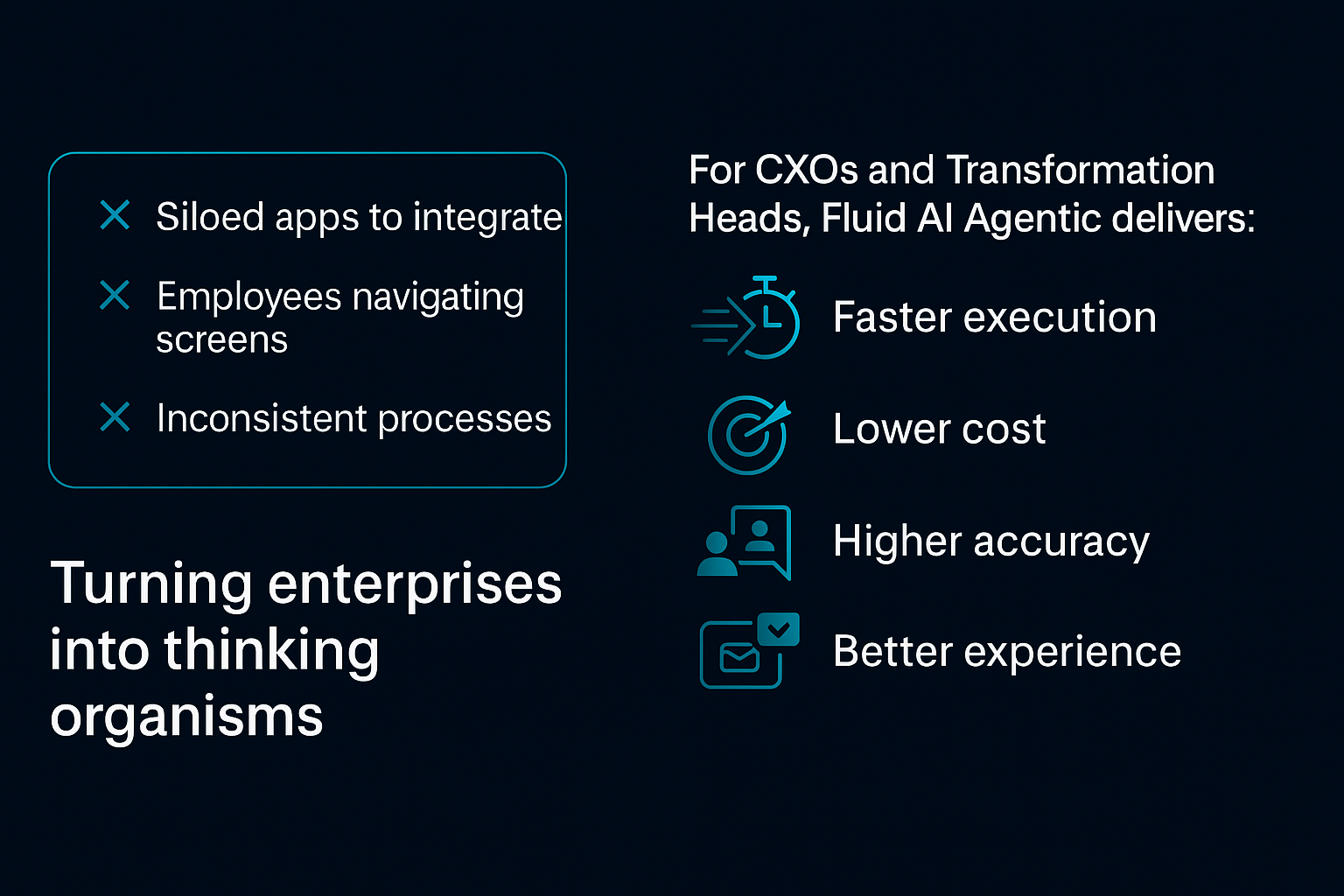
For CXOs and transformation heads, Fluid AI’s Agentic platform changes how you think about enterprise software:
- No more siloed apps to integrate.
- No more employees spending hours navigating screens.
- No more inconsistency in how policies or processes are applied.
Instead, you gain:
- Faster execution: Tasks that took hours now complete in minutes.
- Lower operational cost: Agents handle repetitive, high-volume interactions.
- Higher accuracy: Every action grounded in enterprise knowledge, not memory lapses.
- Better experience: Customers and employees interact through one consistent intelligence across voice, chat, and email.
Fluid AI effectively turns your enterprise into a thinking organism — where every system, process, and interaction is coordinated by agents that understand your business logic.
The Future: The Layer After Software
The enterprise stack is evolving:
People → Agentic Layer → Systems → Data.
The new middle layer — the Agentic Layer — is what Fluid AI already builds and deploys.
It’s not a chatbot, not an integration hub, and not an automation script.
It’s the reasoning brain of the modern enterprise — connecting, contextualizing, and executing seamlessly across everything you own.
When that layer takes over, the need for traditional interfaces fades.
You don’t log into ten apps; you state your goal once.
The AI does the rest.
That’s not the future of work — that’s Fluid AI’s present.
A platform where systems think, agents act, and intelligence becomes infrastructure.
When a customer reconnects, the AI remembers the relationship, not just the query — a capability explored in When Your Bank Starts to Remember You: Where Agentic AI Turns Data Into Foresight.
_1790254083168-CB8e8KXC.png)