Multilingual Voice AI: Can Your AI Speak Your Customers’ Language?

TL;DR
Voice AI is moving beyond basic call automation. In 2026, businesses need voice agents that can understand different languages, handle regional accents, and manage natural conversations.
→ Multilingual support helps businesses serve more customers.
→ Understanding accents and dialects matters as much as language support.
→ Switching between languages should not interrupt a conversation.
→ Fluid AI supports 150+ languages and showcases banking voice call demos in several languages and dialects.
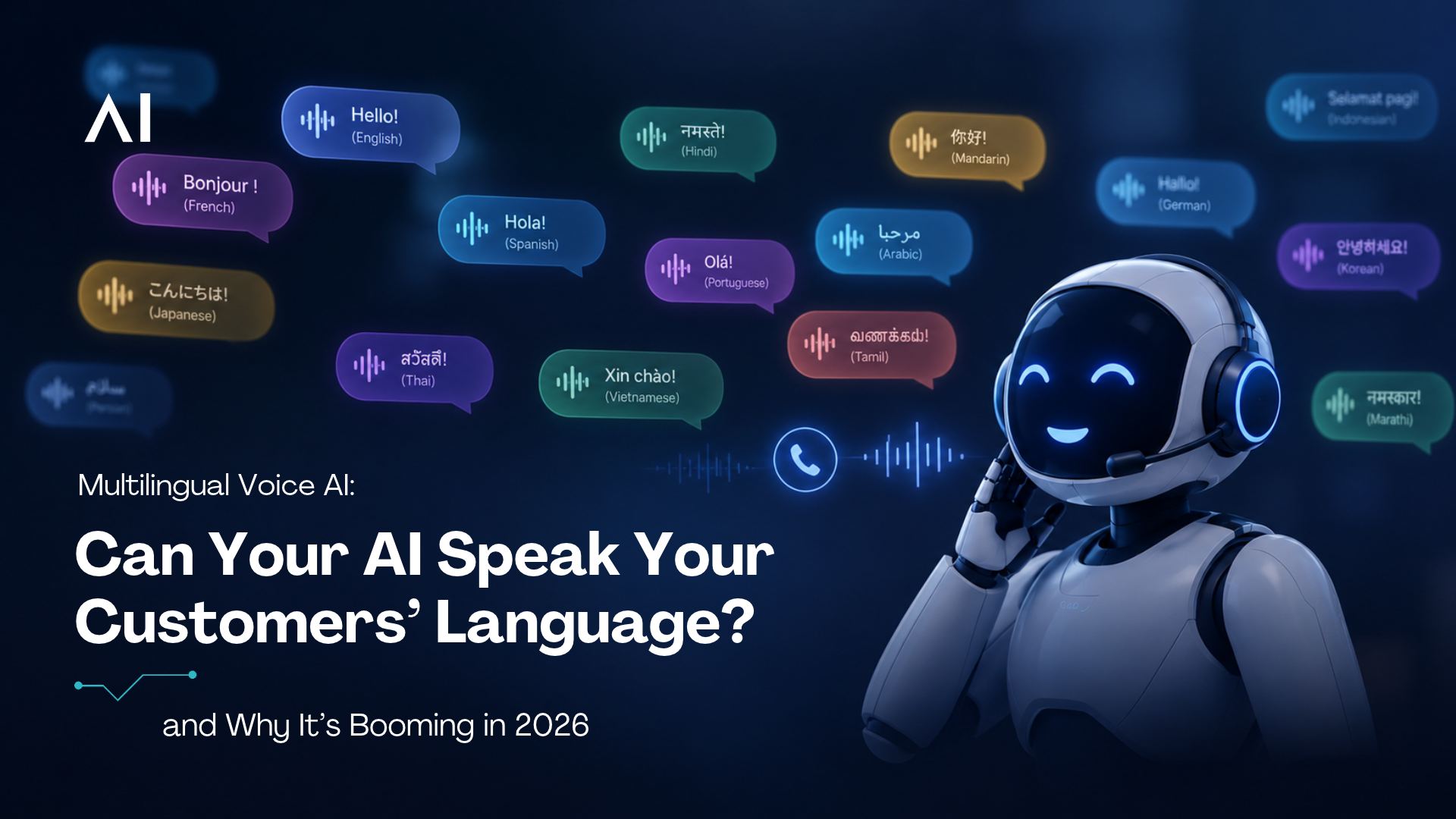
Voice AI is growing fast in 2026. Businesses are using AI voice agents to answer customer calls, handle support requests, follow up on payments, and automate conversations.
But there is one question businesses need to ask before choosing a voice AI solution.
How many languages can your AI actually speak?
Think about a bank serving customers in India, the Philippines, Jamaica, and the Middle East. These customers don't all speak the same language. Even when they do, their accents, dialects, and everyday expressions can be very different.
An AI voice agent that works well in English may struggle when a customer switches to Hindi, speaks Marathi, or uses a regional dialect.
And customers shouldn't have to change the way they speak just to use AI.
1. Why Is Multilingual Voice AI Growing in 2026?
Voice AI is moving from experimentation to real business use.
According to the October 2026 India Voice AI Readiness report by NASSCOM and Krisp, 31% of surveyed organisations had moved Voice AI into limited production, while 13% had scaled it across multiple customer journeys. The report also found that two-thirds of organisations expected their Voice AI investments to increase by up to 50%.
Why are businesses investing in it?
1.1 Customers Want Faster Responses
Customers don't want to wait in long call queues to check a payment, ask about an insurance policy, or resolve a banking issue.
→ AI voice agents can answer calls instantly and handle routine requests at any time.
1.2 Businesses Need to Handle More Calls
Call volumes can increase during payment deadlines, product launches, or seasonal demand. Hiring more people every time call volumes rise is not always practical.
→ AI voice agents can handle multiple conversations at once, while human employees focus on complex cases.
1.3 Customer Support Is Going Beyond English
Businesses serving multiple regions need to communicate with customers in their preferred languages.
The NASSCOM and Krisp report identified multilingual and Indian-language accuracy as a major investment priority for Voice AI.
→ Businesses need AI that can do more than speak clearly. It must understand what customers actually say.
2. Speaking a Language Is Not the Same as Understanding It
Imagine a customer calling their bank about a failed transaction.
They explain the issue in Hindi, switch to English to mention the transaction ID, and return to Hindi to explain what happened.
A useful voice agent should understand the complete conversation without asking the customer to repeat everything.
Now imagine the same conversation in Marathi, Tagalog, or Jamaican Patwa.
The challenge becomes more complex.
2.1 Language Support Is Only the Starting Point
A voice AI tool might list dozens of supported languages. But that doesn't automatically mean it can handle every real-world conversation accurately.
Businesses should check whether the system can:
→ Understand everyday speech, not just formal sentences.
→ Recognise regional accents and dialects.
→ Handle customers who mix two languages in one sentence.
→ Maintain context when a customer switches languages.
→ Respond naturally without repeatedly asking customers to clarify themselves.
2.2 Regional Dialects Matter
Customers don't always speak the standard version of a language taught in textbooks.
Arabic varies across regions. Caribbean English and Creole varieties have their own expressions and speech patterns. Indian customers may switch between English and their regional language during a single call.
If an AI voice agent misunderstands the customer, the conversation can quickly become frustrating.
The real test isn't how many languages appear on a product page. It's how well the AI handles an actual conversation.
3. What Should Businesses Look for in Multilingual Voice AI?
Before choosing a voice AI platform, businesses should evaluate more than its language count.
3.1 Support for Multiple Languages
Check whether the platform supports the languages your customers speak.
For a bank serving customers across India, this may include Hindi, Marathi, Tamil, Telugu, Gujarati, and other regional languages.
For a global business, the requirements may include languages spoken across Asia, Europe, the Middle East, and the Caribbean.
3.2 Real-Time Language Switching
Customers may switch languages naturally during a conversation.
A capable voice agent should maintain context when the language changes, rather than treating every switch as a new conversation.
3.3 Natural Speech and Regional Accents
Language support should include the ability to understand different speech patterns.
Businesses should test voice agents with realistic conversations, including regional accents, informal expressions, and mixed-language speech.
3.4 The Ability to Complete Tasks
A voice agent shouldn't simply understand a question and read out an answer.
In business settings, it may need to retrieve customer information, check a transaction, update a record, or process a request.
The ability to execute actions through connected systems is what makes a voice agent useful beyond basic call handling.
3.5 Security and Human Escalation
Customer calls may involve financial information, personal details, or sensitive business data.
Businesses should evaluate how the platform handles customer information, applies access controls, and transfers conversations to human employees when needed.
4. How Fluid AI Approaches Multilingual Voice Calls
Fluid AI supports 150+ languages, with capabilities for real-time language switching, accents, dialects, and mixed-language conversations. Its voice agents are designed to understand customer requests, retrieve information, execute actions, and resolve issues or escalate them when necessary.
But rather than relying only on a language count, you can explore Fluid AI's recorded voice call demos to hear how its agents handle different banking conversations.
4.1 English Voice AI
The English demo showcases a banking customer support conversation.
4.2 Tagalog Voice AI
The Tagalog demo showcases a collections call handled in Tagalog and Taglish, reflecting how customers may naturally combine languages.
4.3 Jamaican Patwa Voice AI
The Jamaican Patwa demo features a customer blocking their bank card through a conversation in Jamaican Patwa.
→ Explore Jamaican Patwa Voice AI
4.4 Jordanian Arabic Voice AI
The Jordanian Arabic demo showcases an outbound collections conversation in the regional language variety.
→ Explore Jordanian Arabic Voice AI
4.5 Kuwaiti Arabic Voice AI
The Kuwaiti Arabic demo features a banking customer support conversation.
→ Explore Kuwaiti Arabic Voice AI
4.6 Hindi Voice AI
The Hindi demo showcases a banking customer support conversation in Hindi.
4.7 Marathi Voice AI
The Marathi demo showcases a banking customer support conversation in Marathi.
These recordings give businesses a way to explore how Fluid AI approaches voice interactions across different languages and dialects.
Explore Fluid AI's Voice AI Solutions
5. Where Can Multilingual Voice AI Make a Difference?
Multilingual voice AI can help businesses serve customers across different regions without building a separate manual process for every language.
5.1 Banking and Financial Services
Banks receive calls about transactions, card blocking, payments, account information, and collections.
→ Multilingual voice agents can help customers complete routine requests in their preferred language.
5.2 Insurance
Customers may call to ask about policies, claims, premiums, or application status.
→ Voice AI can answer common questions, retrieve relevant information, and guide customers through supported workflows.
5.3 Telecom
Telecom providers handle large volumes of calls about billing, network issues, plans, and service requests.
→ Multilingual agents can help customers get answers without navigating complicated phone menus.
5.4 Customer Support
Businesses serving customers across countries need consistent support across languages.
→ Voice AI can help manage routine requests across regions while escalating complex cases to human employees.
6. How to Evaluate a Multilingual Voice AI Agent
Before deploying a solution, test it with the kinds of conversations your customers actually have.
Use this checklist:
→ Language accuracy: Does it understand the languages your customers use?
→ Dialect handling: Can it recognise regional speech patterns and informal expressions?
→ Language switching: Can customers switch languages without losing context?
→ Task completion: Can it complete supported requests instead of simply answering questions?
→ System integration: Can it connect to your existing CRM, banking systems, ticketing tools, and other applications?
→ Security: Does it meet your organisation's data protection and compliance requirements?
→ Escalation: Can it transfer a call to a human when the situation requires it?
Don't evaluate a voice agent only through scripted questions. Test real-world scenarios, interruptions, unclear requests, and conversations where customers change languages.
Conclusion
Voice AI is becoming an important part of customer service in 2026. But scaling voice automation across regions requires more than an agent that can speak.
It needs to understand different languages, handle accents and dialects, maintain context, and help customers complete their requests.
For businesses serving customers across multiple markets, these capabilities can make the difference between an automated call that frustrates customers and one that actually helps them.
Fluid AI supports 150+ languages and showcases recorded banking voice call demos in English, Tagalog, Jamaican Patwa, Jordanian Arabic, Kuwaiti Arabic, Hindi, and Marathi.
The question for businesses is no longer just whether AI can answer a call. It's whether it can understand the person on the other end.
Explore Fluid AI's Voice AI solutions to learn more.