The Untapped AI Goldmine in Oil and Gas: Real Results From 14 Live AI Solutions

TL;DR
Oil and gas automated the plant years ago. The untapped value is in office work: documents, SAP, safety and HR.
One of India’s largest oil and gas companies proved it with 14 AI solutions now in daily use.
The results: about $420K saved a year, 508 km of pipeline protected, 150,000+ SAP items searchable in seconds, and 60,000+ employees helped 24/7.
The secret wasn’t fancy AI. It ran on the company’s own servers, used live SAP data, went live in 3 months and did real work.
You don’t need a big program. Start with one task, prove it, then grow.
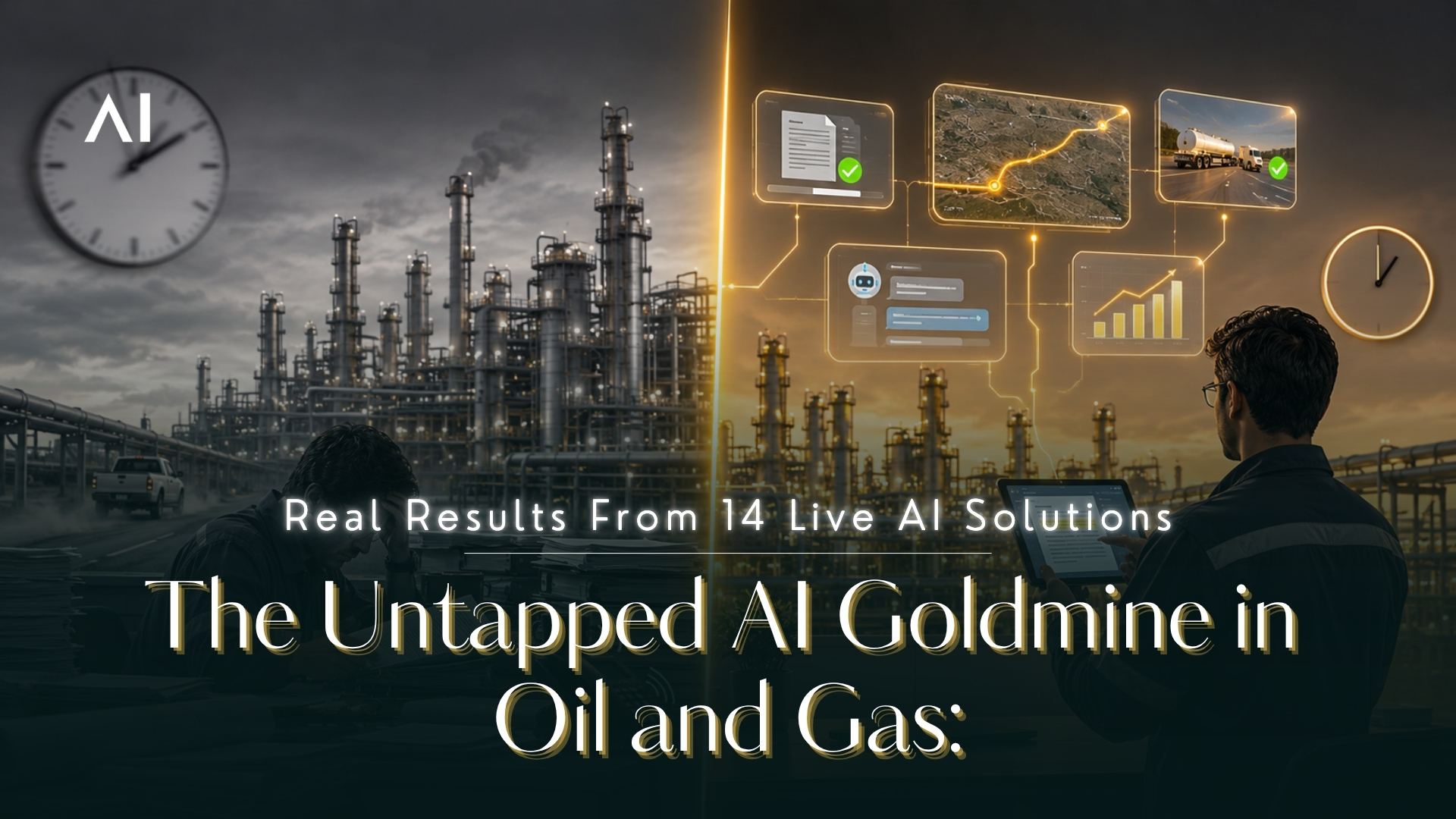
Oil and Gas: The Untapped AI Goldmine
The most valuable thing in a refinery today isn’t the oil. It’s the 6 terabytes of documents that nobody can find.
Oil and gas companies have used technology on the plant floor for many years. Sensors watch pumps, valves and pipelines every second. Control systems keep processes running safely. Machine learning in oil and gas helps predict when a machine might break down, so it can be fixed before it fails. This side of the business is well developed, and most large companies have already invested heavily in it.
But walk out of the control room and into the offices around the plant, and the picture changes completely. Engineers spend hours looking for the right manual or safety procedure. Buying teams struggle to find items in their own systems. Security officers drive long distances to check alarms that turn out to be false. HR teams answer the same leave and policy questions again and again, day after day.
None of this work is glamorous, so it rarely gets attention. But it quietly eats thousands of hours every month and costs a lot of money.
This is the untapped goldmine for AI in oil and gas. The biggest gains aren’t on the plant floor anymore. They’re in the everyday work that happens around it.
In this post, we’ll walk you through what happened when one of India’s largest oil and gas companies put AI to work across its business. You’ll see the problems they faced, what the AI does, and the real numbers from a live deployment.
Why AI in the Oil and Gas Industry Is Still Untapped
AI in the oil and gas industry has mostly been used to watch machines and predict failures. Using it for office work, like finding documents, handling supplier questions or answering employee queries, has been much slower to catch on. That’s surprising, because this is exactly the kind of work modern AI is good at.
There are three simple reasons why this opportunity has stayed untouched.
1. Data Can’t Leave the Company
Oil and gas companies hold some of the most sensitive data in any industry: refinery layouts, pipeline maps, equipment drawings, supplier contracts and pricing. Most of these companies simply won’t send this information to an outside AI service running on the public internet. The risk is too high.
This is a big reason why so many generative AI in oil and gas projects never made it past the testing stage. A team might build an impressive demo, but when it’s time to use real company data, the security team says no, and the project stops there.
2. Old Documents Are Hard to Search
Oil and gas companies have been running for decades, and they’ve built up huge archives along the way: operating manuals, safety procedures, equipment drawings, maintenance records and research reports. Much of this knowledge exists only in shared folders, and a lot of it is scanned paper copies.
Normal search tools can’t read scanned documents, and they only work if you type the exact right words. So even though the answer to an engineer’s question is sitting somewhere in the archive, finding it can take hours. Often, people give up and ask a senior colleague instead, which only works until that colleague retires.
3. SAP Is Hard to Connect To
Most large oil companies run their business on SAP, the software that tracks materials, purchase orders, stock and suppliers. It’s the central record for almost everything the company buys and uses.
The problem is that most AI tools can’t connect to SAP directly. Instead, they work with exported copies of the data, which go out of date the moment they’re created. When an AI gives an answer based on last month’s stock levels, people quickly lose trust and stop using it.
Fix these three problems, and the results come surprisingly fast. That’s exactly what this deployment did.

6 Real Results From a Live AI Deployment
The company started small, with one AI solution. Today it runs 14 AI solutions in daily use across the refinery, safety, buying, sales and HR teams. Here’s what changed in each area, and why it matters.
1. Finding Documents: From Hours to Seconds
The refinery had built up 6 terabytes of documents over the years, including manuals, procedures, drawings and maintenance records. Engineers were spending hours every day just searching for the information they needed to do their jobs. That’s time taken away from actual engineering work.
Now, an engineer simply types a question in plain English, like “What is the shutdown procedure for Unit 4?” The AI searches the entire archive, finds the right document, and gives a clear answer in seconds. It also shows exactly which document the answer came from, so the engineer can check it before acting.
This is oil and gas knowledge management that actually works in real life. It also solves a problem every oil company worries about: losing knowledge when experienced engineers retire. Their know-how is captured in documents the AI can now reach, so new engineers can learn faster by asking questions instead of hunting through folders.
2. Cost Estimates: About $420K Saved Every Year
Before buying or building new equipment, the company needs a cost estimate. This process used to be slow and manual. Someone had to study the drawings, list every part, look up prices and put it all together. On top of that, every estimate looked a little different depending on who prepared it.
Now the AI does most of this work. It reads the equipment drawing, picks out the parts needed, creates a full list of materials, checks the latest prices directly in SAP, and prepares a draft purchase request. A person reviews it and approves it, but the hours of manual work are gone.
This one task alone saves the company about $420K every year.
It also shows the most important idea in this whole story. The AI doesn’t just answer questions. It actually does the work. That’s the difference between a basic chatbot and an AI agent, and it’s where the biggest savings come from.
3. Pipeline Security: 508 km Protected
Pipelines run across long distances, and protecting them is a serious job. Security systems along the pipeline send alarms whenever they detect something unusual. The trouble is that alarms go off all the time, and most of them turn out to be false.
Every alarm still had to be checked. This took security officers about 2 hours every shift, and teams were driving more than 200 km a day just to inspect alarms that turned out to be nothing.
Now, AI watches 508 km of pipeline. It helps officers quickly understand which alarms need attention and which can be safely ignored. Each officer saves about 2 hours every shift, and far fewer vehicles are sent out on unnecessary trips. That means lower costs, less wasted fuel, and more attention on the alarms that really matter.
4. Tanker Safety: Every Problem Handled in Under 20 Minutes
The company moves fuel and gas using tanker trucks, and every truck is tracked. When a driver breaks a safety rule, for example by speeding, stopping in an unsafe place or going off the planned route, the company needs to respond quickly.
This used to be handled by hand. Staff had to spot the problem, find the driver’s details and make the call. Responses were often late, not every problem got followed up, and there was no proper record of what happened.
Now, the AI watches for safety problems and automatically calls the driver when something goes wrong. Every safety problem now gets a response in under 20 minutes, and every action is recorded. This makes the roads safer and gives the company a clear record for audits.
The company also uses AI to check customer sites for gas safety risks. Photos of the site are reviewed by the AI, which flags possible hazards so they can be fixed before anything goes wrong.
5. Finding Materials: 150,000+ Items in Seconds
A large refinery uses an enormous number of different parts and materials. This company had more than 150,000 items in SAP. Finding the right one was a daily struggle, because you needed the exact item code or exact description. Even the notes written on purchase orders couldn’t be searched by most staff.
Now, SAP AI agents let staff find any item by simply describing what they need in plain language. The AI understands the request, searches SAP’s live data, and shows the right items in seconds.
The AI also handles supplier communication. It answers 40 to 50 supplier questions every day on its own, such as questions about orders, payments or delivery status. This frees the buying team from a huge amount of repetitive email so they can focus on negotiating better deals and managing important suppliers.
This was also the very first AI solution the company put into live use, just three months after the project began.
6. HR: 60,000+ Employees Helped Around the Clock
With 60,000 employees, even simple HR questions add up fast. How many leave days do I have left? What’s the travel policy? How do I claim this expense? Every one of these questions used to go to the HR team, creating long waiting times and keeping HR staff busy with routine replies.
Now, an AI assistant answers these questions at any time of day or night. Employees get instant answers, whether they work the day shift, the night shift or are on the road. Where needed, the assistant can look up live information, like an employee’s own leave balance.
HR teams can now spend their time on work that truly needs a human touch: hiring, training, employee concerns and planning.
This is intelligent automation in oil and gas that people use every single day, not a tool that sits unused after launch.
19 Artificial Intelligence Use Cases in Oil and Gas
The six results above are the highlights, but they’re only part of the picture. Fluid AI’s full set of artificial intelligence use cases in oil and gas covers 19 different uses across 7 areas of the business. Here’s what each area includes.
1. Refinery Operations
This is where most of the value starts. AI helps engineers find documents and procedures instantly, prepares cost estimates for new equipment, and supports pipeline security by helping officers sort real alarms from false ones.
2. Logistics and Safety
Moving fuel safely is a top priority. AI monitors tankers and calls drivers automatically when safety rules are broken, checks customer sites for gas safety risks, keeps track of stock levels so shortages are spotted early, and manages digital work permits so safety checks are never skipped.
3. Buying and Supply Chain
Procurement involves huge amounts of data and paperwork. AI lets teams search materials in plain English, helps prepare cost estimates, answers supplier questions automatically, and checks stock records to find mismatches before they become problems.
4. Sales
Sales teams benefit too. AI runs practice calls where salespeople can train their negotiation skills against a realistic AI customer. It also gives sales teams quick answers about their numbers, and supports customers through conversational AI that can answer common questions.
5. HR and Internal Teams
Beyond the HR assistant, AI also runs an IT helpdesk that solves common technical problems, like password resets or software questions, without employees waiting in a ticket queue.
6. Data and Reports
Managers often wait days for someone to pull numbers and build a report. With AI, they can ask their database a question in plain English, like “Which units went over budget last month?”, and get an answer straight away. AI can also create monthly performance reports automatically. This is oil and gas business intelligence without the long wait.
7. Research
Research teams produce valuable reports over many years, but old work is easy to forget. AI makes years of research reports searchable, so teams can quickly find what has already been studied and avoid repeating the same work.
Each of these AI use cases in oil and gas can start on its own. A company can begin with just one, prove the value, and then add more over time on the same platform.
4 Reasons This Worked When Most AI Projects Fail
Many oil and gas companies have tried AI, and most projects never get past the testing stage. Most AI solutions for oil and gas end up as impressive demos that never reach daily use. This project was different. It went from a signed contract to 14 live AI solutions. Four simple choices made the difference.
1. It Runs Inside the Company
The AI runs entirely on the company’s own servers, inside its own buildings. No data is sent to any outside service, and nothing leaves the company’s control. This removed the biggest fear that stops most oil and gas AI projects.
For this industry, on-premise AI isn’t a nice extra. It’s the only way most companies will ever agree to use AI on their real, sensitive data.
2. It Connects Directly to SAP
Instead of working with old copies of data, the AI connects directly to SAP and uses live information. When someone asks about stock, prices or orders, they get today’s answer, not last month’s.
This sounds simple, but it’s a major reason people kept using the tools. Trust is everything. If an AI gives one wrong answer because its data was outdated, people stop relying on it.
3. The First Result Came in Three Months
The first AI solution went live just three months after the project started. The servers and the private AI model were set up in the first two months, and material search went live in month three.
After that, more solutions were added step by step. Quick early results built confidence across the company and made it easier to win support for each new use case. There was no long, expensive testing phase that dragged on for years.
4. The AI Does Real Work
The biggest savings didn’t come from answering questions. They came from AI that finishes tasks: preparing purchase requests, calling drivers about safety problems and replying to suppliers.
Answering questions saves minutes. Completing work saves hours, and hours add up to real money.
The project itself was won through an open tender, where Fluid AI ranked first on both technical quality and price.
What Each Team Gets From AI
AI in oil and gas isn’t just a project for the IT department. It changes the daily work of people across the company. Here’s what it means for each team.
Engineers get answers from manuals, procedures and past records in seconds. They spend less time searching and more time solving real engineering problems.
Plant and security managers spend less time chasing false alarms. Their teams can focus on genuine risks, and fewer vehicles are sent out for nothing.
Buying teams find materials faster, prepare cost estimates more quickly and deal with far fewer routine supplier emails.
Safety teams know that every rule break gets a fast response. They also have a clear, complete record of every action, which makes audits much easier.
HR teams stop answering the same questions all day. They can focus on hiring, training and supporting employees who need real help.
Leaders get reports and numbers just by asking a simple question. They no longer have to wait days for someone to build a spreadsheet before making a decision.
5 Questions to Find the Best AI Agent for Refinery Operations
If you’re looking for the best AI agent for refinery operations, or comparing different oil and gas AI companies, it’s easy to be impressed by polished demos. Instead, ask these five practical questions. They’re based on what actually worked in this deployment.
1. Does It Run on Your Own Servers?
Your data should never leave your company. Ask the provider exactly where the AI runs, where your documents are stored and who can access them. If the answer involves sending your data outside, think carefully before going ahead.
2. Does It Connect to Your Live SAP Data?
Many tools look great with sample data. Ask to test the AI with your real SAP data instead. If it can only work with exported files, its answers will always be out of date.
3. Can It Read Old and Scanned Documents?
Most of your company’s knowledge sits in old files, and many of them are scanned. Try the AI on your oldest and messiest documents, not just clean new ones.
4. Does It Do Work, or Just Chat?
A chatbot that answers questions is helpful, but the real value comes from finishing tasks. The best AI reasoning agents for oil and gas operations can complete work from start to end, like preparing a purchase request or calling a driver.
5. Can It Go Live in About Three Months?
Long projects lose support and budget. If a provider can’t show you a working result within about three months, that’s a warning sign.
The same five questions also apply when you’re comparing AI platforms for oil and gas maintenance optimization or AI process optimization platforms for oil and gas plants. Whatever the tool, what matters most is that it works with your data, inside your company, and delivers results quickly.
5 Steps to Start Your Refinery Digital Transformation
Refinery digital transformation can sound like a huge, years-long project. It doesn’t have to be. Here’s a simple, practical way to get started.
Pick One Time-Wasting Task: Start with a single task that wastes a lot of time across many people. Finding documents and searching for materials are great choices, because almost everyone feels the pain.
Measure the Hours It Takes Today: Before you start, write down how long the task takes now. How many hours does an engineer spend searching each day? How long does a cost estimate take? These numbers become your business case and show the value clearly later.
Choose AI That Runs on Your Servers: Keep your data safe from day one. Choosing on-premise AI from the start avoids security roadblocks later and makes it much easier to get approval.
Get the First Task Live in Three Months: Aim to have one working result within about three months. A quick win builds trust across the company and makes it far easier to get support for the next step.
Add More Areas One at a Time: Once the first task is working well, expand to other areas like safety, HR, buying and sales, using the same setup. Good oil and gas IT solutions grow like this. Each new use case builds on the same secure foundation, so every step gets faster and cheaper than the last.
The Goldmine Is Already on Your Servers
Oil and gas companies don’t need to collect more data. They need to use the data they already have: decades of documents, years of SAP records, alarm logs, safety reports and HR policies. All of it is sitting on their own servers right now, waiting to be used.
The companies that unlock this first will work faster, run safer and spend less than those still searching through folders and answering the same questions by hand.
Fluid AI builds AI for oil and gas that does exactly this. It runs entirely on your own servers, connects directly to SAP and is already proven at large scale in a live oil and gas deployment. Fluid AI is ISO 27001 and SOC 2 Type II certified, and a standard deployment takes 12 weeks.
See what AI can do for your operations. Explore Fluid AI for Oil and Gas or book a demo.
Frequently Asked Questions
1. How is AI used in the oil and gas industry?
AI in the oil and gas industry is used for much more than watching machines. Today it helps engineers find documents instantly, prepares cost estimates, supports pipeline security, responds to tanker safety problems, searches materials in SAP and answers employee questions around the clock.
2. What are the main AI use cases in oil and gas?
The most valuable uses include document search, cost estimation, pipeline security, tanker safety monitoring, material search and HR support. Fluid AI covers 19 uses across 7 areas, from refinery operations to sales and research.
3. What is generative AI in oil and gas exploration and operations?
Generative AI in oil and gas is often linked to exploration, like studying underground data. But some of the fastest savings come from daily operations, such as answering engineers’ questions from manuals, preparing purchase requests from drawings and writing monthly reports automatically.
4. How is machine learning in oil and gas different from agentic AI?
Machine learning in oil and gas usually focuses on predictions, like spotting when a pump might fail. Agentic AI goes a step further. It understands requests, connects to company systems and completes tasks, like turning an equipment drawing into a ready-to-approve purchase request.
5. Can AI run on a company’s own servers?
Yes. Fluid AI runs fully on-premise, on the company’s own servers, with no outside cloud connection. Your documents and data never leave your company.
6. Does AI work with SAP?
Yes. Fluid AI’s SAP AI agents connect directly to SAP and use live data, so answers about materials, stock and orders are always up to date.
7. How long does it take to set up AI in oil and gas?
In this project, the first AI solution went live three months after the start. Fluid AI’s standard deployment takes 12 weeks, and more use cases can be added step by step after that.