What Is Agentic AI? Meaning, Examples, and How to Learn It in 2026

TL;DR
Agentic AI refers to AI systems that can plan, make decisions, use tools, and execute multi-step tasks with limited human guidance.
Unlike Generative AI, which mainly creates content, Agentic AI moves from answering questions to completing workflows across systems.
To learn Agentic AI in 2026, you need to understand LLMs, tool usage, orchestration, RAG, memory, evaluation, governance, and production deployment.
For enterprises, the real value of Agentic AI is not just automation. It is faster execution, better customer experience, stronger decision-making, and scalable AI governance.
The Rise of Agentic AI: Moving from Generation to Action
In 2022, Generative AI took the world by storm, wowing us with its ability to draft emails, write code, and summarize documents. Yet, as we navigate 2026, many enterprises have run into what is known as the "GenAI Paradox": despite widespread adoption, many organizations are still struggling to turn AI experiments into measurable productivity, cost, or revenue gains.
Gartner has also warned that a significant share of GenAI projects were expected to be abandoned after proof of concept because of poor data quality, weak risk controls, rising costs, or unclear business value.
Why? Because traditional Generative AI is fundamentally an assistant that waits for your prompt and stops at content generation.
To achieve real business outcomes, we need systems that don't just answer questions - we need systems that take action. Enter Agentic AI.
What is Agentic AI?
Agentic AI refers to artificial intelligence systems designed with "agency," meaning they can autonomously make decisions, formulate plans, and execute multi-step actions to achieve specific goals. Rather than waiting for a human to tell it exactly what to do at every single step, an agentic system breaks down a complex objective and works independently to complete it.
To put it simply: GenAI lowered the cost of generation, but Agentic AI is lowering the cost of action.
The Core Characteristics of Agentic AI
What separates a standard AI chatbot from a true Agentic AI system? It comes down to a few core capabilities:
Goal-oriented planning and multi-step reasoning: You can give the AI a complex goal (e.g., "Prepare for a new intern's arrival next Monday"), and it will use reasoning to build a step-by-step plan, such as scheduling welcome meetings, creating IT tickets, and ordering a laptop.
Autonomy: These systems operate without continuous human guidance, acting as proactive digital operators rather than reactive assistants.
Adaptability and memory: Agentic systems use short-term and long-term memory to learn from interactions, remember user preferences, and adjust their algorithms or approaches based on past feedback.
Tool usage: An agentic AI doesn't just generate text; it connects to the outside world. It utilizes APIs to access external tools like CRMs, HR management platforms, Outlook, or third-party web search to execute tasks.
Governance and human oversight: In real enterprise environments, Agentic AI cannot be a free-running black box. It needs permissions, approval gates, audit trails, escalation rules, and human-in-the-loop controls, especially in industries such as banking, insurance, healthcare, and financial services.
Agentic AI vs Generative AI: How is it Different?
Generative AI (GenAI) helps users by creating text, summarizing data, or brainstorming ideas, but it acts primarily as an assistant that waits for prompts and stops at content generation. By contrast, agentic AI operates as an active worker.
For example, while GenAI might draft an email for you, an agentic AI system can independently segment an audience, write the personalized emails, send them out, track the responses, and book follow-up meetings. "While GenAI lowered the cost of generation, Agentic AI is lowering the cost of action"
Another way to think about it: Generative AI produces the output, while Agentic AI manages the workflow. GenAI may write the response. Agentic AI can decide when the response is needed, pull the right context, check the customer record, send the message, update the CRM, and escalate the case if needed.
How Agentic AI Works: A Simple Agentic AI Architecture
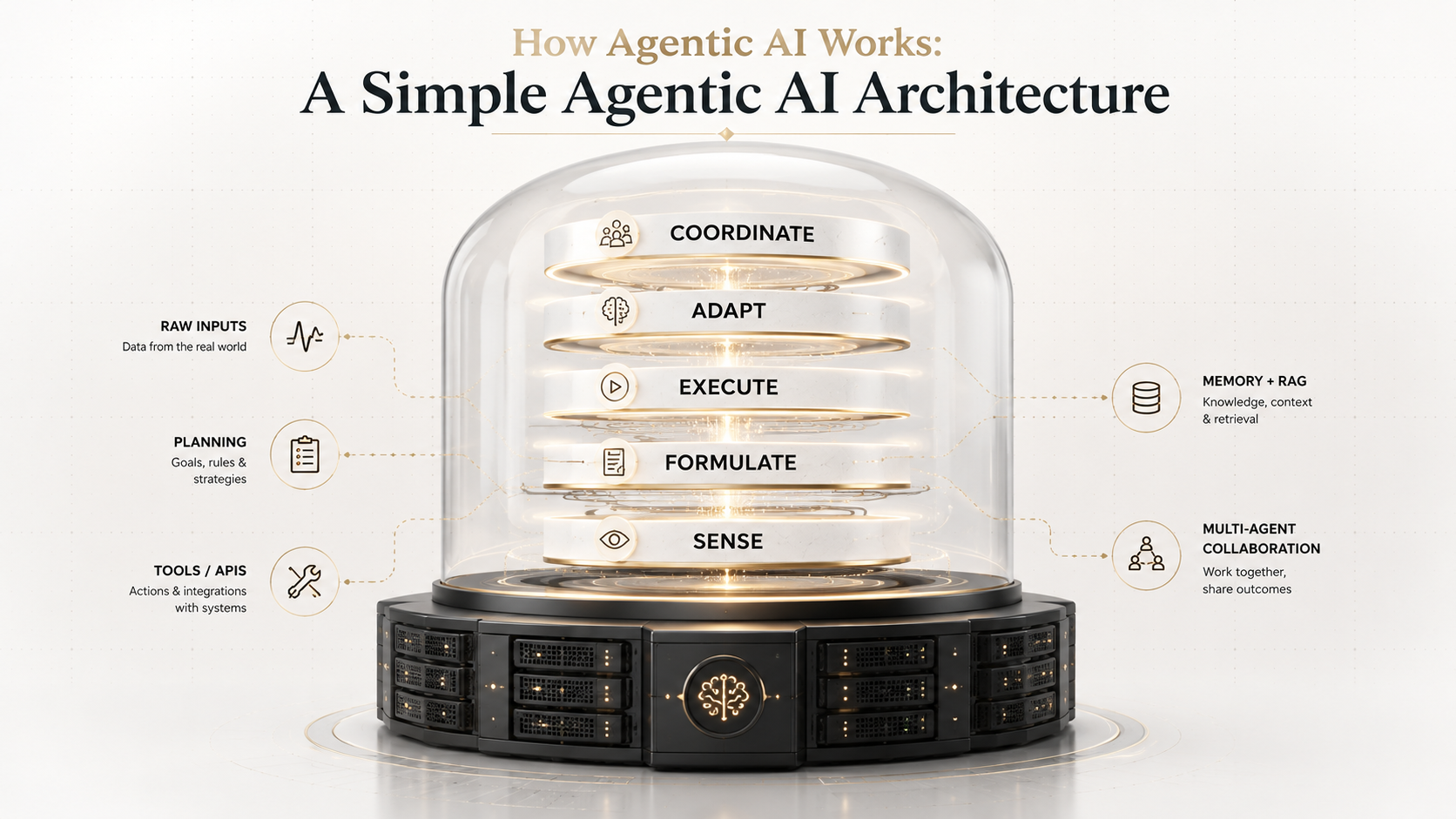
While Large Language Models (LLMs) act as the "brain" for reasoning, an LLM alone cannot take action. It needs to be part of a broader architecture that follows a five-stage operational model:
Sense: The agent takes in raw inputs, such as a system alert or a user query, and understands the context to figure out what needs attention.
Formulate (Plan): A built-in planner translates the overarching goal into actionable, sequential steps.
Execute: An "orchestrator" manages the workflow, invoking the correct external APIs and tools to carry out the steps autonomously.
Adapt: By utilizing context, memory, and Retrieval-Augmented Generation (RAG), the system logs its outcomes and learns for next time.
Coordinate: In advanced environments, multiple specialized agents work together to solve massive, cross-departmental problems.
This article gives you the practical foundation: what Agentic AI means, how it differs from Generative AI, how it works, and where it is being used today. Read here, how Agentic AI works through architecture, RAG, MCP, tool calling, governance, and AgentOps to build secure, production-ready AI agents.
Benefits of Agentic AI for Enterprises
Agentic AI matters because it connects intelligence to execution. For businesses, this means fewer manual handoffs, faster workflows, and better use of enterprise data.
The biggest benefits include:
Faster workflow automation: AI agents can complete multi-step processes across systems instead of only answering questions.
Better customer experience: Agentic AI can maintain context across chat, voice, email, WhatsApp, websites, and apps, so customers do not have to repeat themselves.
Higher employee productivity: Employees can spend less time searching, summarizing, updating systems, or routing requests manually.
Stronger decision-making: Agents can pull context from documents, systems, and past interactions to support faster and more informed decisions.
Scalable AI governance: Enterprises can manage approvals, permissions, audit trails, and compliance rules from a central layer instead of letting AI tools spread without control.
For enterprises, the real shift is from isolated AI tools to agentic workflows that can move across systems, channels, approvals, and business processes.
At Fluid AI, this is the direction we see enterprise AI moving in: from standalone chatbots to agentic systems that understand context, connect to business systems, and complete workflows across chat, voice, email, and internal tools.
What are the Seven Steps to Learn Agentic AI?
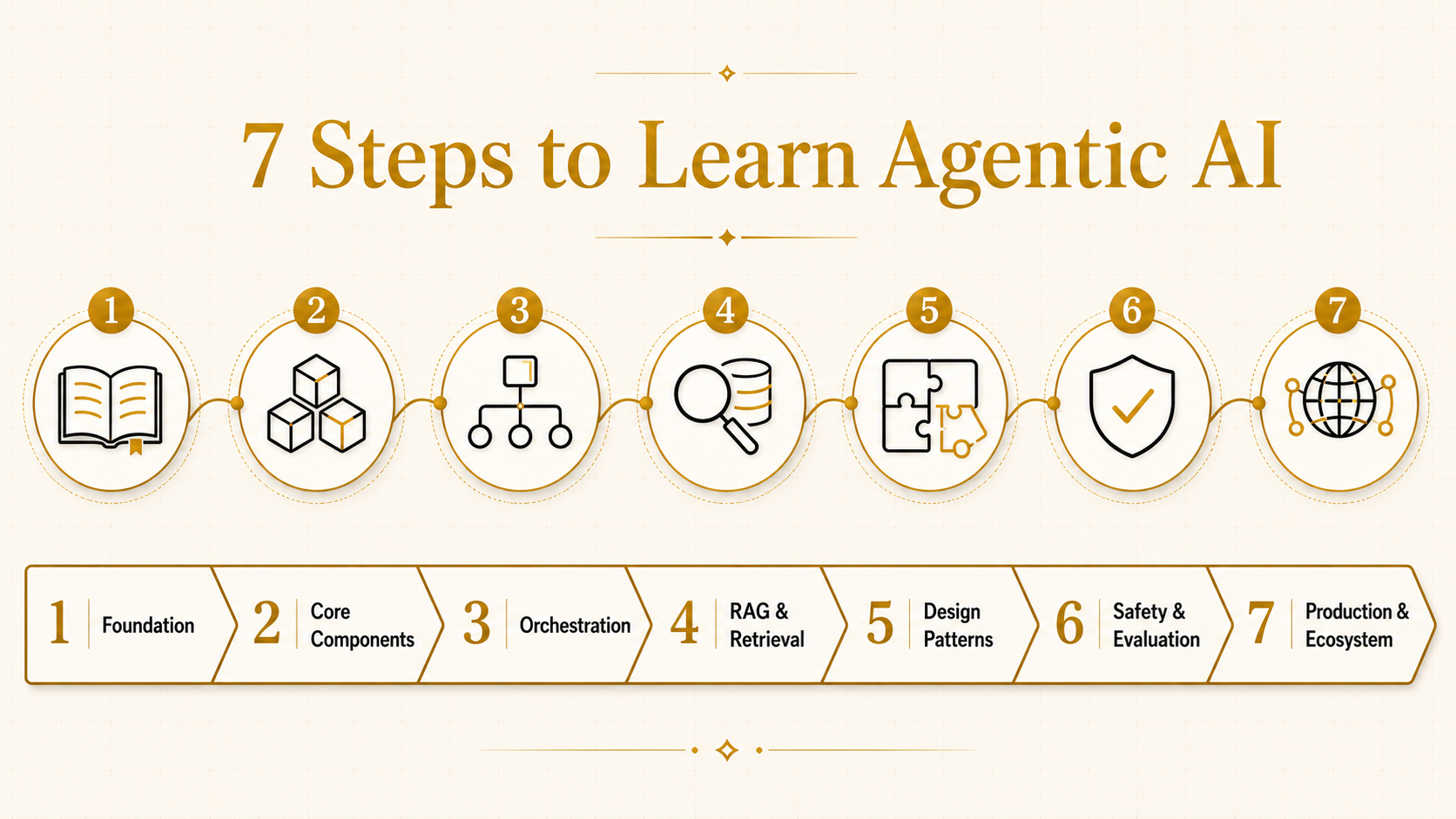
1 ➝ Foundation
Start by understanding Large Language Model (LLM) fundamentals, which includes learning how to provide inputs and receive outputs from an LLM, whether through coding in Python or using no-code tools. You must also master prompting techniques to properly instruct the LLM on how to behave, as well as grasp concepts like context and sampling.
2 ➝ Core components
This step focuses on connecting your LLM to the outside world. Because LLMs have a knowledge cutoff date, you must learn the ReAct pattern, which connects the LLM to third-party tools (like internet search APIs or vector databases) to retrieve current context. You will also need to learn the agent lifecycle (how to plan, execute, and reflect), tool usage, function calling, context engineering, and how to implement memory systems (in-memory, external, and long-term).
3 ➝ Orchestration
To run your AI agents quickly and efficiently, you must learn orchestration frameworks like LangGraph and LangChain. This step covers creating stateful graphs, routing tasks, and building multi-agent architectures, such as the supervisor and worker pattern. It also involves integrating "human-in-the-loop" functionalities to ensure the AI's decisions go through human approval gates.
4 ➝ RAG and Retrieval
Since you cannot fine-tune an LLM on all company data, you must learn Retrieval-Augmented Generation (RAG). This involves chunking data, using vector databases, and applying advanced techniques like reranking and self-reflective RAG. You should also explore new methods like vectorless RAG, which uses an LLM tree of summarized nodes instead of relying on a vector database.
5 ➝ Design patterns
Once the core skills are established, you need to understand advanced design patterns to build highly capable AI agents. Key patterns to study include the router agent, reflection agent, and plan-and-solve (or self-reflection) patterns.
6 ➝ Safety and evaluation techniques
Before an agent can be taken into production, it must be secure and tested. You will need to implement guardrails to fix security issues like prompt injections and the mishandling of Personally Identifiable Information (PII). Additionally, you must learn evaluation techniques and metrics to assess the accuracy and performance of your AI agents.
7 ➝ Production and Ecosystem
The final step is deploying your agentic AI application to the real world. This involves using the Model Context Protocol (MCP) to host the agent and integrate it with IDEs or other applications. You must also learn production operations, optimizing for latency, cost, and observability, and how to scale the system using cloud platforms like AWS or Azure.
Agentic AI Use Cases and Real-World Examples
Agentic AI is no longer a theoretical concept; it is already driving massive ROI across various sectors:
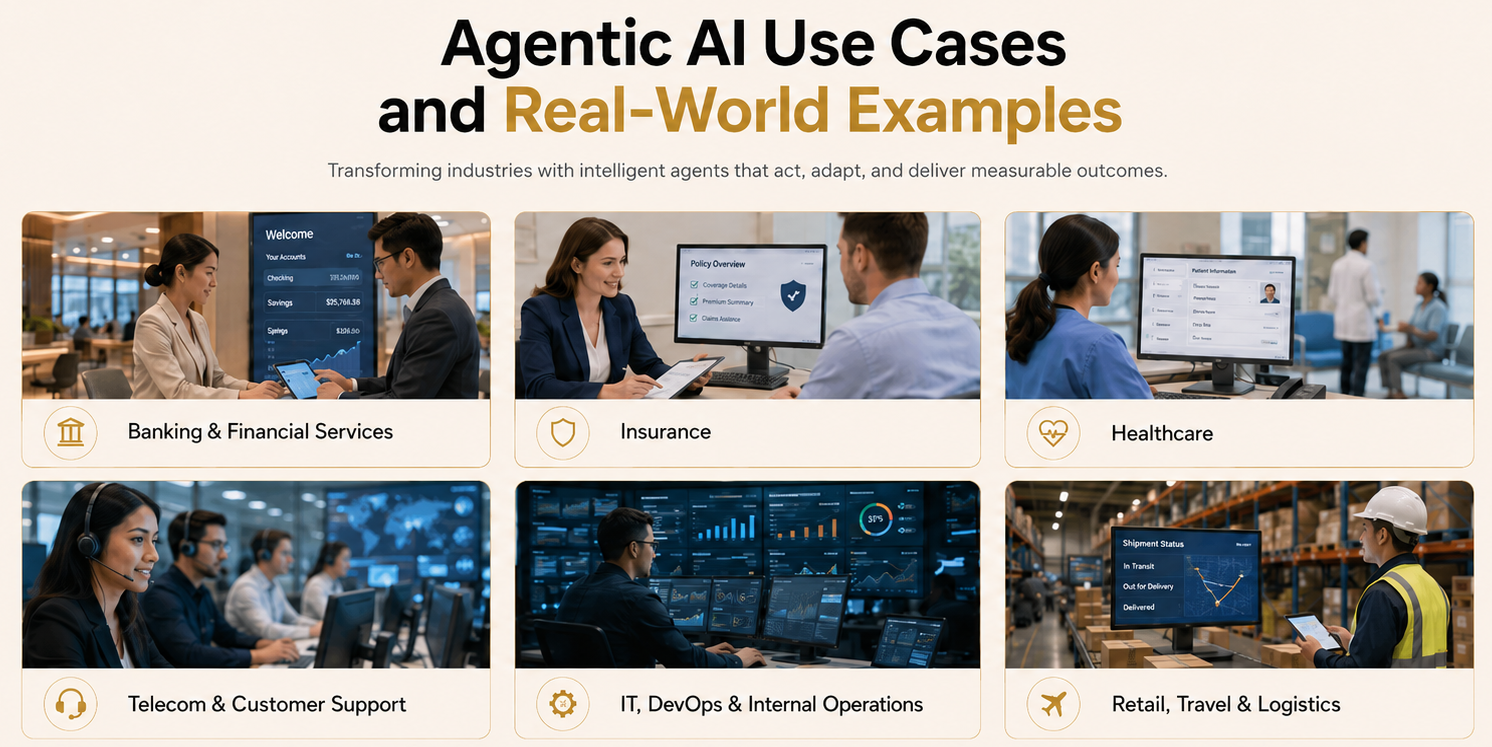
1. Banking and Financial Services
Agentic AI can support customer service, loan servicing, KYC, onboarding, fraud triage, collections, credit memo preparation, and compliance workflows. AI agents can retrieve customer context, check policies, trigger backend workflows, update records, and escalate only the cases that need human judgment.
At Fluid AI, this is where Agentic AI becomes especially relevant: regulated enterprises need AI agents that can work across chat, voice, email, WhatsApp, CRMs, policy documents, and backend systems without losing security, compliance, auditability, or human oversight.
2. Insurance
In insurance, Agentic AI can help with claims processing, policy servicing, renewals, document verification, and customer communication. An AI agent can read claim documents, check policy coverage, identify missing information, update internal systems, and route complex cases to human teams.
This helps insurers reduce turnaround time while keeping sensitive decisions under proper review.
3. Healthcare
Agentic AI can support patient intake, appointment coordination, prior authorization, claims support, medical document processing, and administrative workflows. The goal is not to replace clinical judgment, but to reduce repetitive operational work around care delivery.
For example, an agent can collect patient details, verify insurance information, check appointment availability, summarize documents, and escalate cases that require a medical professional.
4. Telecom and Customer Support
Telecom companies can use Agentic AI for plan upgrades, complaint resolution, outage communication, billing queries, SIM activation, and service requests. Agents can connect across CRM, billing, network status, ticketing tools, and customer communication channels to resolve cases faster.
This is where Agentic AI moves beyond chatbots. It does not just answer a question. It checks the issue, understands the customer context, triggers the next step, and keeps the customer updated.
5. IT, DevOps, and Internal Operations
Agentic AI can support IT helpdesks, incident triage, ticket routing, code review, deployment checks, HR queries, employee onboarding, procurement approvals, and internal knowledge search.
For example, if an employee has a VPN issue, an AI agent can diagnose the problem, check access permissions, run approved remediation steps, create a ticket if needed, and notify the right team.
6. Retail, Travel, and Logistics
In retail, Agentic AI can support order tracking, returns, inventory updates, personalized recommendations, pricing workflows, and customer complaints. In travel and logistics, agents can manage bookings, handle disruptions, update itineraries, track shipments, and coordinate across multiple systems.
For example, if a delivery is delayed, an agent can detect the issue, notify the customer, offer alternatives, update the order status, and trigger a refund or replacement workflow if required.
Designing the Workforce of the Future
As businesses scale their AI usage, they are employing different types of agentic frameworks. Some use autonomous single-agent systems for narrow tasks, while others deploy multi-agent systems (MAS) where specialized agents - like a finance agent, a logistics agent, and a compliance agent, collaborate horizontally or vertically to solve complex workflows. For sensitive tasks involving financial risk or regulatory compliance, companies utilize Human-in-the-loop (HITL) systems, where the AI does the heavy lifting but pauses to seek human approval before finalizing high-stakes decisions.
The Bottom Line
The era of AI simply acting as a conversational partner is ending. Gartner predicts that by 2028, 33% of enterprise software applications will include agentic AI, up from less than 1% in 2024, completely reshaping how organizations operate. The enterprise of the future will be supported by a massive ecosystem of agents - having humans firmly in control of strategy, while AI takes the reins on execution
Book your Free Strategic Call to Advance Your Business with Generative AI!
Fluid AI is an AI company based in Mumbai. We help organizations kickstart their AI journey. If you’re seeking a solution for your organization to enhance customer support, boost employee productivity and make the most of your organization’s data, look no further.
Take the first step on this exciting journey by booking a Free Discovery Call with us today and let us help you make your organization future-ready and unlock the full potential of AI for your organization.
_1790254083168-CB8e8KXC.png)