Is Your Enterprise Ready for Agentic AI? Fluid AI’s Playbook for Real-World Readiness

TL;DR
- Most enterprises aren’t ready for agentic AI — their infrastructure and governance still reflect the GenAI era.
- Agentic AI isn’t about responses; it’s about decisions and actions. That requires data unification, guardrails, and traceability.
- The hidden costs of autonomy lie in governance, monitoring, and organizational alignment — not just infrastructure.
- Readiness starts with three steps: Data audit, governance blueprint, and sandbox-to-scale roadmap.
- Fluid AI’s Agentic Platform helps enterprises deploy autonomous yet controlled workflows across CRM, ERP, email, and voice systems — securely and at scale.
- The goal isn’t more automation. It’s intelligence you can trust.

The Illusion of Readiness
Every enterprise wants to say it’s “AI ready.” The truth? Most aren’t — at least not for the kind of AI that thinks, reasons, and acts across systems. Running a chatbot pilot or testing a few GenAI prompts doesn’t mean your organization is ready for autonomy.
Agentic AI doesn’t just generate outputs. It observes data, makes decisions, executes tasks, and learns from outcomes — all inside your enterprise stack. That shift from assistance to autonomy is where most organizations stumble.
Why Traditional AI Foundations Fall Short
Let’s break it down.
Enterprises spent the last few years building GenAI prototypes, POCs, and departmental integrations. Each of these lives in isolation — separate data, security, and governance layers. When you try to scale beyond pilots, the gaps show up fast.
Here’s what usually breaks:
- Data silos: Marketing, support, operations, and finance still run on disconnected ecosystems. Agents can’t reason effectively without full context.
- Legacy infrastructure: Outdated APIs and slow data lakes can’t support real-time decision loops.
- Governance ambiguity: Who’s responsible if an agent acts incorrectly? Most organizations don’t have an answer yet.
- Security blind spots: Granting agents cross-system access without tight guardrails is a recipe for risk.
In short, traditional AI setups were built for insight, not intelligence. Agentic AI flips that — it demands end-to-end execution, traceability, and trust.
To see how this shift impacts enterprise efficiency, read: How Agentic AI Cuts Vendor Complexity by 50%.
The Hidden Cost of Autonomy
Deploying agentic AI isn’t just about “buying a model.” It’s about building the scaffolding for responsible autonomy.
The hidden costs are what catch enterprises off guard:
- Continuous tuning — agents must evolve as business logic changes.
- Cross-department coordination — agents interact with multiple workflows, requiring unified governance.
- Monitoring and audit systems — full traceability is essential to understand why an agent acted a certain way.
- Talent upskilling — teams must shift from prompt engineers to orchestration designers.
Without these in place, autonomy turns into chaos. You don’t deploy a tool — you deploy a decision-maker. That demands structure.
Governance: The Backbone of Enterprise-Grade AI
The most advanced enterprises aren’t chasing new models; they’re building governed intelligence frameworks.
Think of this as your organization’s AI constitution — defining what agents can do, who supervises them, and how accountability works.
Core elements include:
- Decision boundaries: Clear thresholds between autonomy and human review.
- Role-based access: Agents must operate within tightly defined domains.
- Audit trails: Every decision and system call must be logged.
- Agentic workflow orchestration: Structured flow from trigger → validation → execution → feedback.
- Human-in-the-loop controls: Humans remain the decision circuit breakers when needed.
With this foundation, agentic systems can act confidently — without compromising compliance or control.
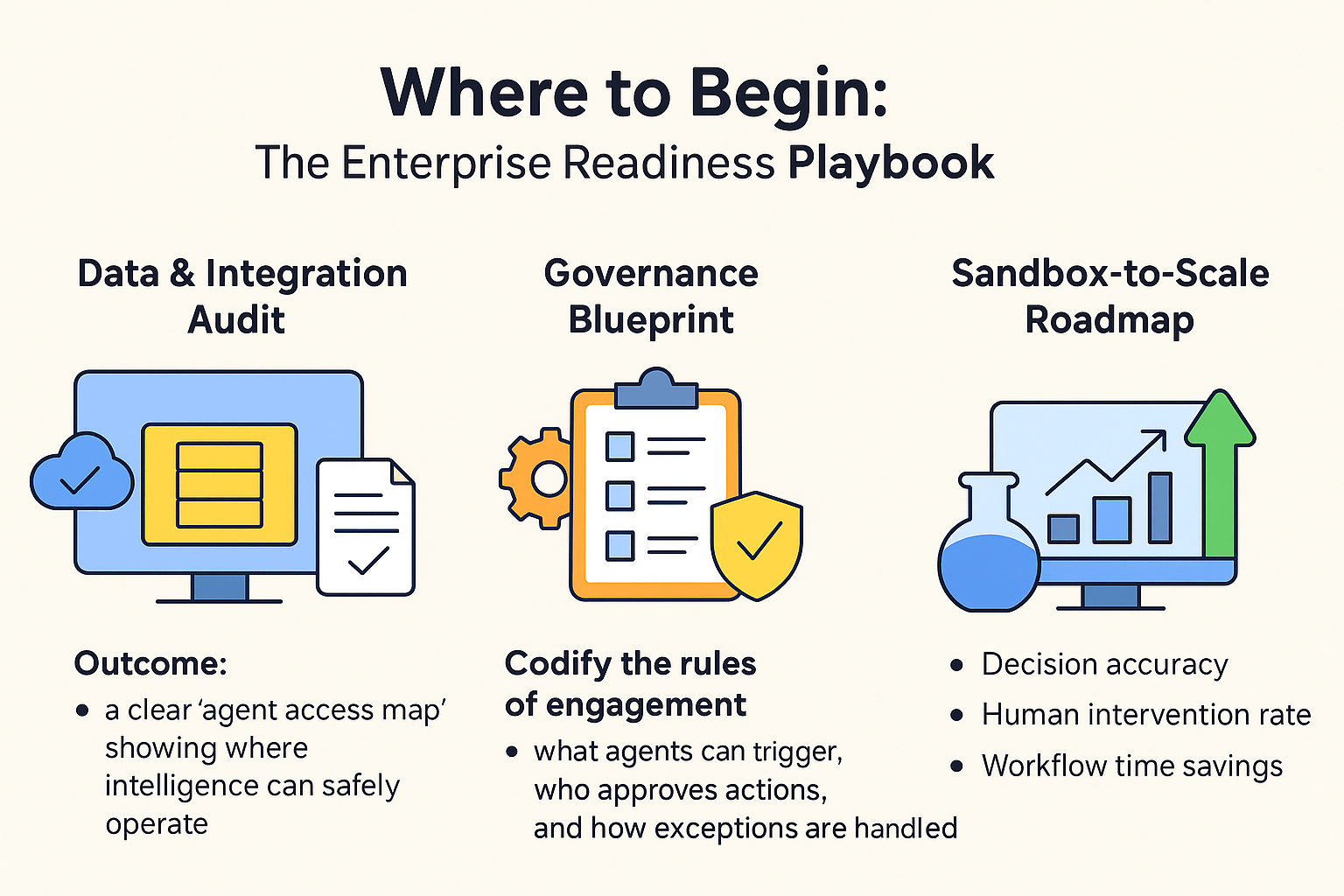
Where to Begin: The Enterprise Readiness Playbook
Before going live, enterprises need a readiness sprint — a 60–90 day effort to establish the right environment for autonomy.
1. Data & Integration Audit
Map every system your future agents will touch — CRM, ERP, HRMS, ticketing, analytics.
Ask:
- Where does the data live?
- How is it accessed?
- What context does it lack?
Outcome: a clear “agent access map” showing where intelligence can safely operate.
2. Governance Blueprint
Codify the rules of engagement — what agents can trigger, who approves actions, and how exceptions are handled.
This playbook must include compliance, IT, and operations.
3. Sandbox-to-Scale Roadmap
Start small, but with structure. Build a sandbox where agents run controlled workflows, such as ticket summarization or data analysis.
Measure:
- Decision accuracy
- Human intervention rate
- Workflow time savings
Once stable, scale gradually — system by system, with rollback mechanisms in place.
Starter Agentic Workflows Every Enterprise Can Begin With
The easiest way to start isn’t by reinventing the enterprise — it’s by embedding small, high-impact agents into existing systems. These are some starter workflows that help organizations experience autonomy safely:
1. Customer Support Copilot
An agent that reads inbound emails or chat messages, fetches customer history, drafts responses, and even initiates backend actions (like resetting passwords or generating statements).
Start with semi-autonomy, then scale toward full end-to-end resolution.
To see what’s possible, explore Fluid AI’s Customer Support Solutions.
2. Finance & Operations Assistant
An internal agent that can summarize monthly reports, validate expenses, or generate supplier insights directly from ERP data — without requiring multiple dashboards.
3. Compliance Intelligence Agent
A reading-and-reasoning agent that scans new regulations, summarizes relevant sections, and alerts compliance heads when action is required. Perfect for BFSI, insurance, and energy.
4. HR Query & Policy Assistant
Agents that handle employee FAQs, generate policy explanations, or draft HR letters — freeing HR teams from repetitive admin work.
5. Collections & Risk Workflow
For banks and credit institutions, agents that identify overdue accounts, draft outreach emails, and update CRM records autonomously.
6. IT Service Desk Agent
Agents that monitor ticket queues, categorize incidents, and initiate remediation steps using internal playbooks.
Each of these can run within a controlled environment, delivering measurable efficiency while preparing your teams for deeper autonomy later.
What This Looks Like in Practice — Fluid AI’s Agentic Platform
Enterprises often ask: “How do we even begin building all this?”
That’s where Fluid AI’s Agentic Platform changes the game. It’s a full orchestration layer that makes enterprises agent-ready from day one.
1. Agentic Workflows Across Systems
Fluid AI connects directly to your CRM, ERP, email, and voice systems — creating agents that don’t just chat, but act.
A support agent can read an email, fetch customer data, initiate a core banking transaction, and close the loop — all autonomously and auditable.
That’s where Fluid AI’s Agentic Platform changes the game. It’s a full orchestration layer that makes enterprises agent-ready from day one.
2. Controlled Autonomy
Every action passes through configurable guardrails — permissions, escalation paths, and checkpoints. You define when agents act and when humans step in.
3. Built-In Governance & Observability
Fluid’s platform embeds complete reasoning logs, audit trails, and decision memory. Every action is explainable. Every workflow is reversible.
4. Modular, Secure, and Scalable
Run it on-prem, in cloud, or hybrid. Agents act across systems while maintaining full data sovereignty.
5. Proven Enterprise Use Cases
- Customer Service: Multi-channel agents resolving 90%+ of routine queries.
- Compliance & Risk: Agents scanning, flagging, and summarizing regulatory updates.
- Operations: AI copilots managing ticket flows, approvals, and internal support tasks.
This isn’t theory. It’s already live in banks, insurers, and public enterprises that needed autonomy — without losing control.
You can explore more about the evolving enterprise landscape in our report on 10 Fintech Trends That Will Redefine 2026.
Why Readiness Matters More Than Models
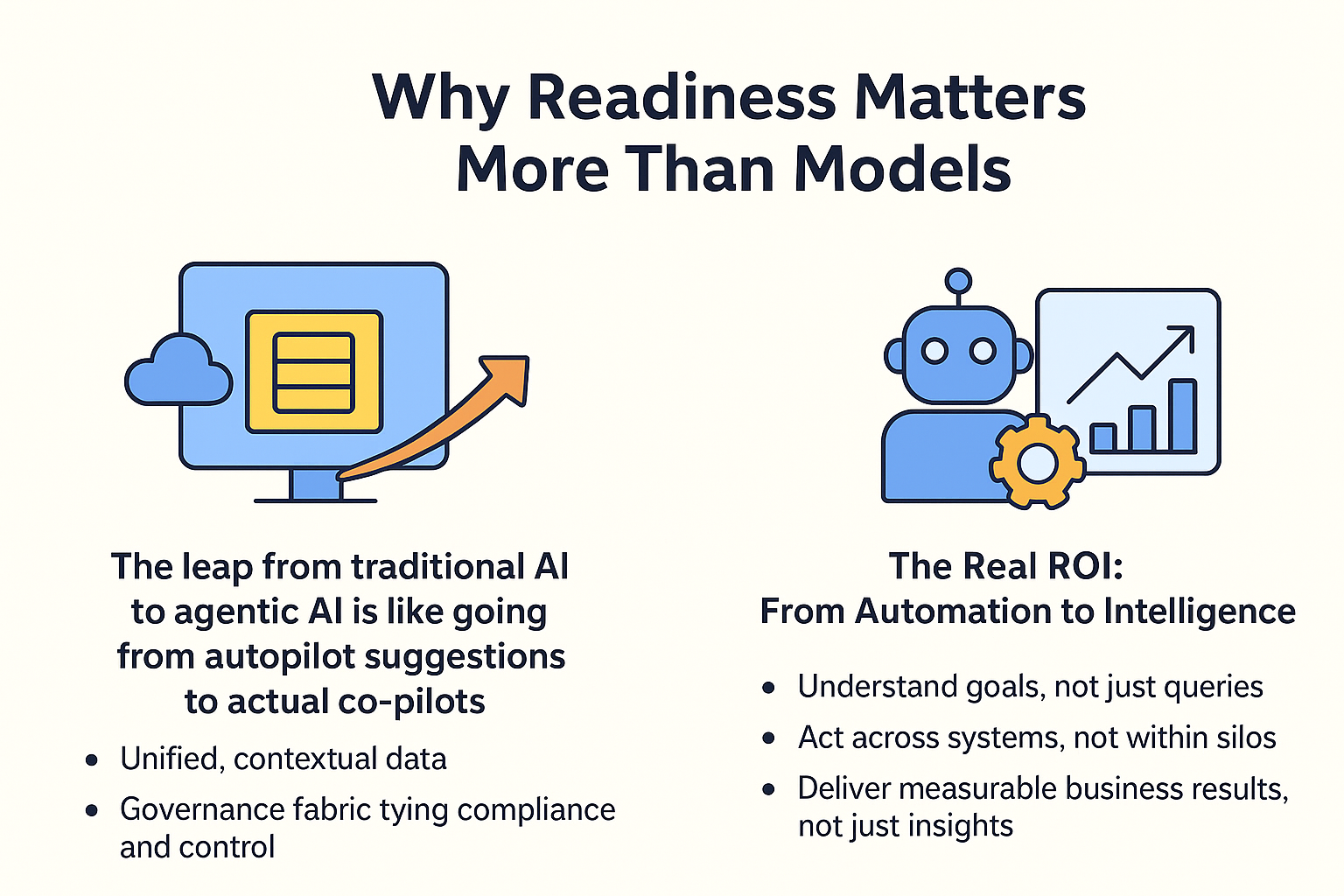
The leap from traditional AI to agentic AI is like going from autopilot suggestions to actual co-pilots.
You can’t fake readiness. Either your systems support intelligent action, or they don’t.
Ready enterprises share three things:
- Unified, contextual data.
- Governance fabric tying compliance and control.
- Workflow architecture that allows safe autonomy.
That’s exactly what Fluid AI builds — the Agentic OS that lets enterprises deploy, supervise, and scale autonomous intelligence responsibly.
The Real ROI: From Automation to Intelligence
When readiness meets the right platform, AI stops being a project and becomes a capability.
Instead of people managing dashboards, you have agents managing outcomes.
They:
- Understand goals, not just queries.
- Act across systems, not within silos.
- Deliver measurable business results, not just insights.
That’s the leap Fluid AI’s clients are already making — from automation to autonomy.
Final Thought
Agentic AI isn’t some far-off promise — it’s already reshaping how enterprises operate. But autonomy without readiness is risk, not progress.
The smarter move is to prepare your enterprise first: fix the data foundation, establish governance, and adopt agentic workflows within a controlled framework.
Fluid AI’s Agentic Platform was built exactly for that — helping enterprises move from pilots to production-grade intelligence with speed, safety, and strategy.
Because once your systems can think, act, and collaborate on their own, the question isn’t “Are we ready for AI?”
It’s “What do we want our intelligence to achieve next?”
_1790254083168-CB8e8KXC.png)