Understanding Agentic AI: Architecture, RAG, Tool Calling, and Governance for Enterprise Workflows

TL;DR
Agentic AI works by placing an LLM inside a larger architecture that can perceive inputs, plan steps, retrieve context, use tools, execute actions, and learn from feedback.
Unlike a normal chatbot, an agentic system connects reasoning with enterprise systems through orchestration, RAG, tool calling, MCP, memory, governance, and human approval layers.
For enterprises, the real challenge is not building a demo agent. It is making the agent secure, auditable, permission-aware, and reliable enough for production workflows.
Introduction
While the world spent the last few years marveling at Generative AI’s ability to draft emails, summarize documents, and write code, enterprises quickly realized that generating content is only half the battle.
To truly drive productivity, we need systems that do not just answer questions. We need systems that can take action.
Enter Agentic AI.
Unlike traditional reactive AI models, Agentic AI operates proactively. It can make decisions, plan steps, use tools, and execute multi-step workflows without needing constant human prompts. It moves AI from simply knowing to actively doing.
But how does a Large Language Model, or LLM, transform from a static text generator into an autonomous digital operator?
The answer lies in a broader agentic AI architecture. The LLM is only one part of the system. To work in production, it needs memory, retrieval, tool calling, orchestration, governance, security, and monitoring.
Here is a step-by-step breakdown of how Agentic AI works under the hood.
Why an LLM Alone Is Not an Agent
An LLM can reason, generate text, summarize information, and answer questions. But by itself, it cannot reliably complete real-world enterprise work.
It does not automatically know which system to check. It cannot update a CRM unless it has tool access. It cannot approve a refund, create a support ticket, retrieve a policy, or escalate a case unless it is connected to the right systems.
That is the difference between an LLM and an AI agent.
An LLM produces intelligence. An agentic system turns that intelligence into action.
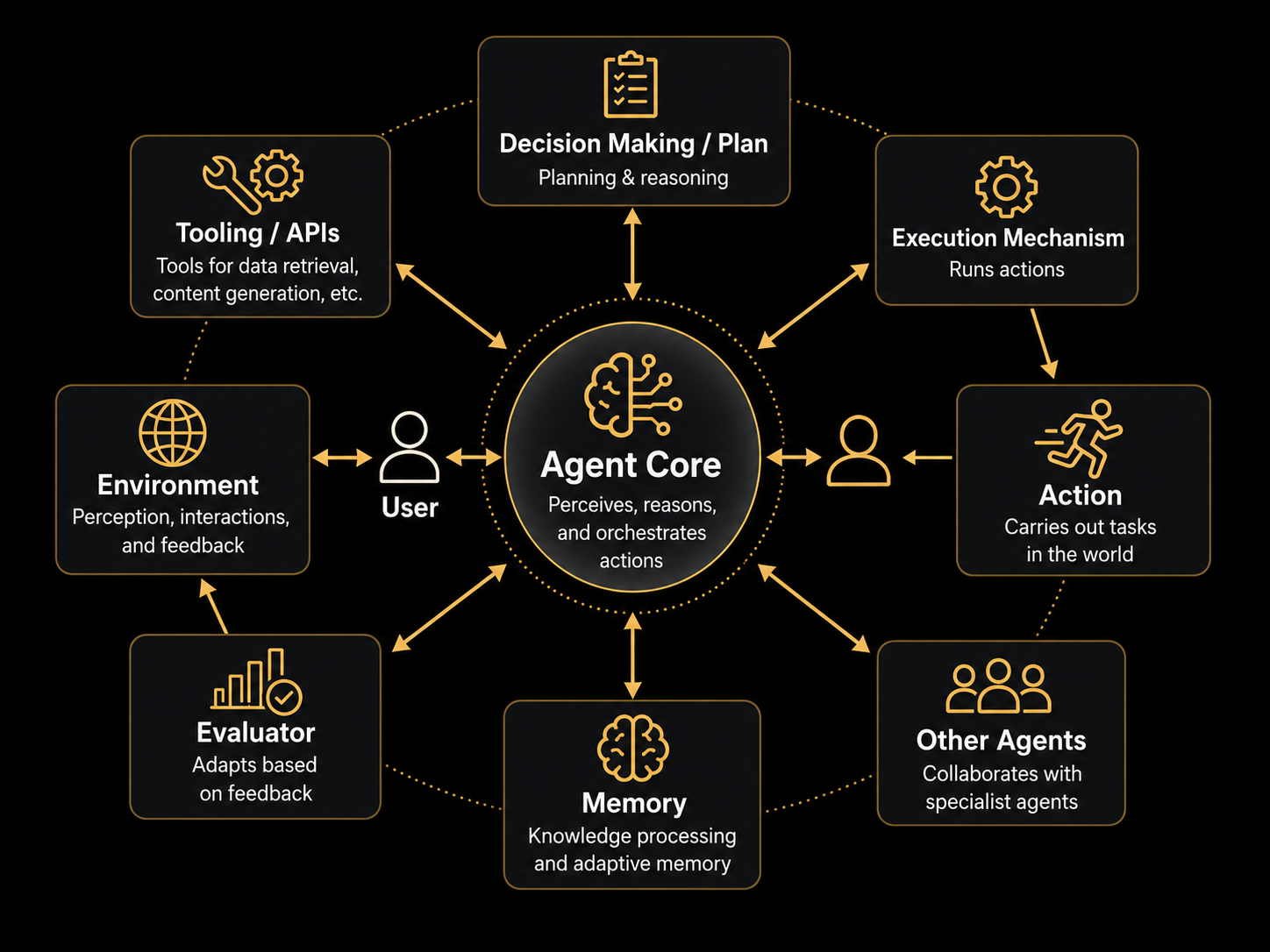
For an AI agent to work, the LLM needs to sit inside an operational layer that can manage context, retrieve relevant data, call tools, follow business rules, ask for approval when needed, and track what happened.
That is where agentic AI architecture comes in.
Unlocking the Future of Automation: A Step-by-Step Guide to How Agentic AI Works
Step 1: Agentic AI Architecture: Building the Operational Brain
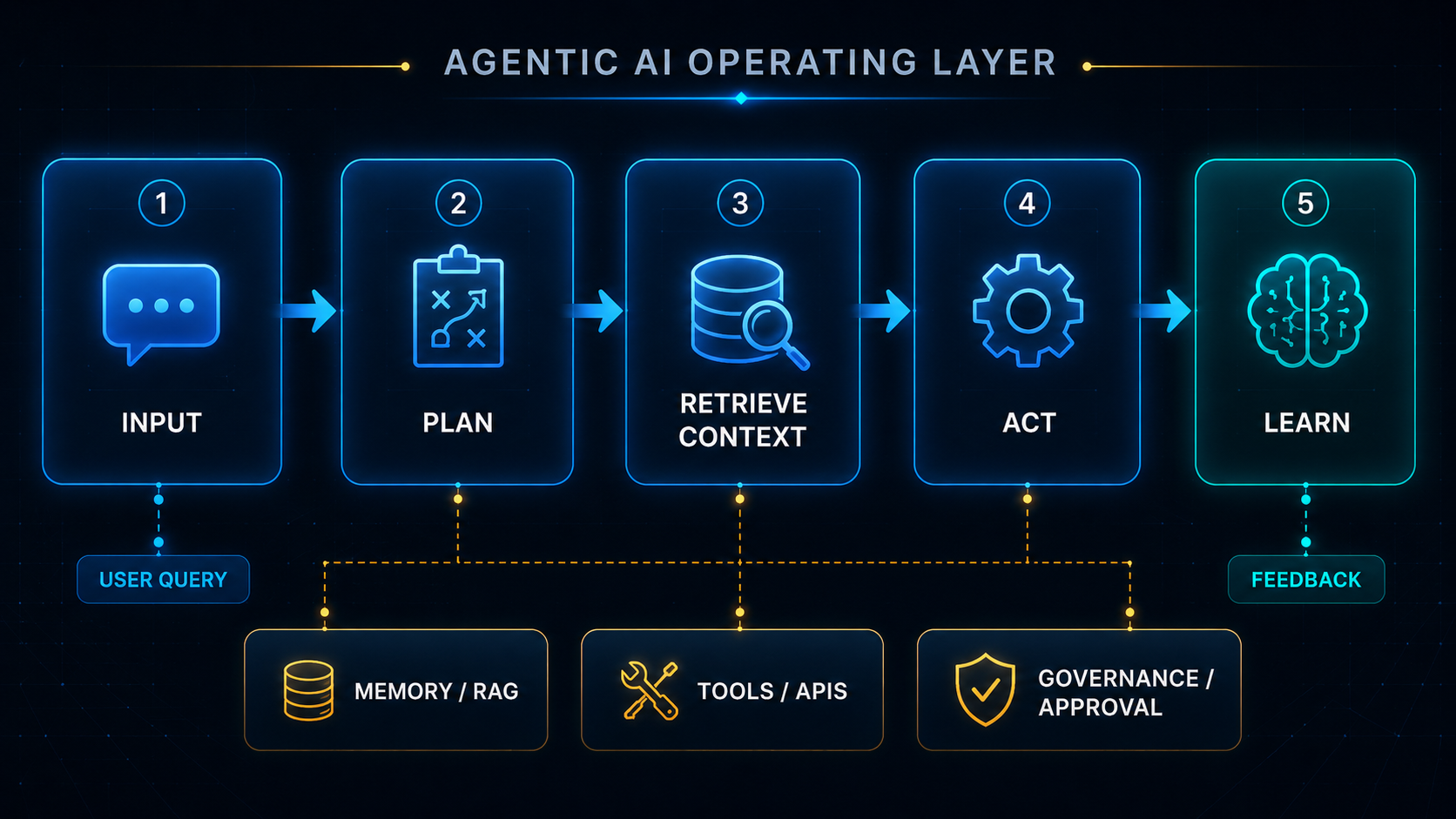
While an LLM acts as the reasoning engine, it cannot function autonomously on its own. To achieve true autonomy, it must be housed within a sophisticated agentic architecture built around a continuous "Perceive-Plan-Act-Learn" cycle.
This self-correcting loop allows the AI to ingest information, formulate a multi-step plan, execute actions, and adapt based on the feedback it receives,.
Production-grade agentic systems generally follow a comprehensive five-layered blueprint:
Engagement Layer
This is where the user or system interacts with the agent. It could be chat, voice, email, WhatsApp, a website, a mobile app, or an internal dashboard.Orchestration Layer
This layer decides what happens next. It routes tasks, manages workflows, coordinates tools, and decides whether a task can be completed automatically or needs human approval.Intelligence Layer
This is where LLMs and other AI models reason, classify intent, summarize information, generate responses, and make decisions.Context and Memory Layer
This layer stores short-term and long-term context. It helps the agent remember previous interactions, customer history, business rules, documents, and workflow state.Governance and Security Layer
This layer controls what the agent can access, what actions it can take, what needs approval, and how every decision is logged for auditability.
Depending on the complexity of the objective, developers deploy different agent structures. A Single-Agent Architecture is ideal for simple, contained tasks like document summarization. For highly complex enterprise operations, companies use a Hierarchical Architecture, where a "master" agent breaks down a mission and delegates tasks to specialized sub-agents.
The most advanced setup is Multi-Agent Collaboration, where specialized agents act as a committee, collaborating, sharing context, and even debating outcomes to solve cross-functional problems,.
Where Fluid AI Fits Into This Architecture?
For Fluid AI, architecture matters, enterprise AI can’t stop at a chatbot.
In regulated sectors (banking, insurance, telecom, financial services), agents must work across channels and systems without losing security, compliance, auditability, or human oversight.
The value isn’t just the model, it’s the operating layer around it.
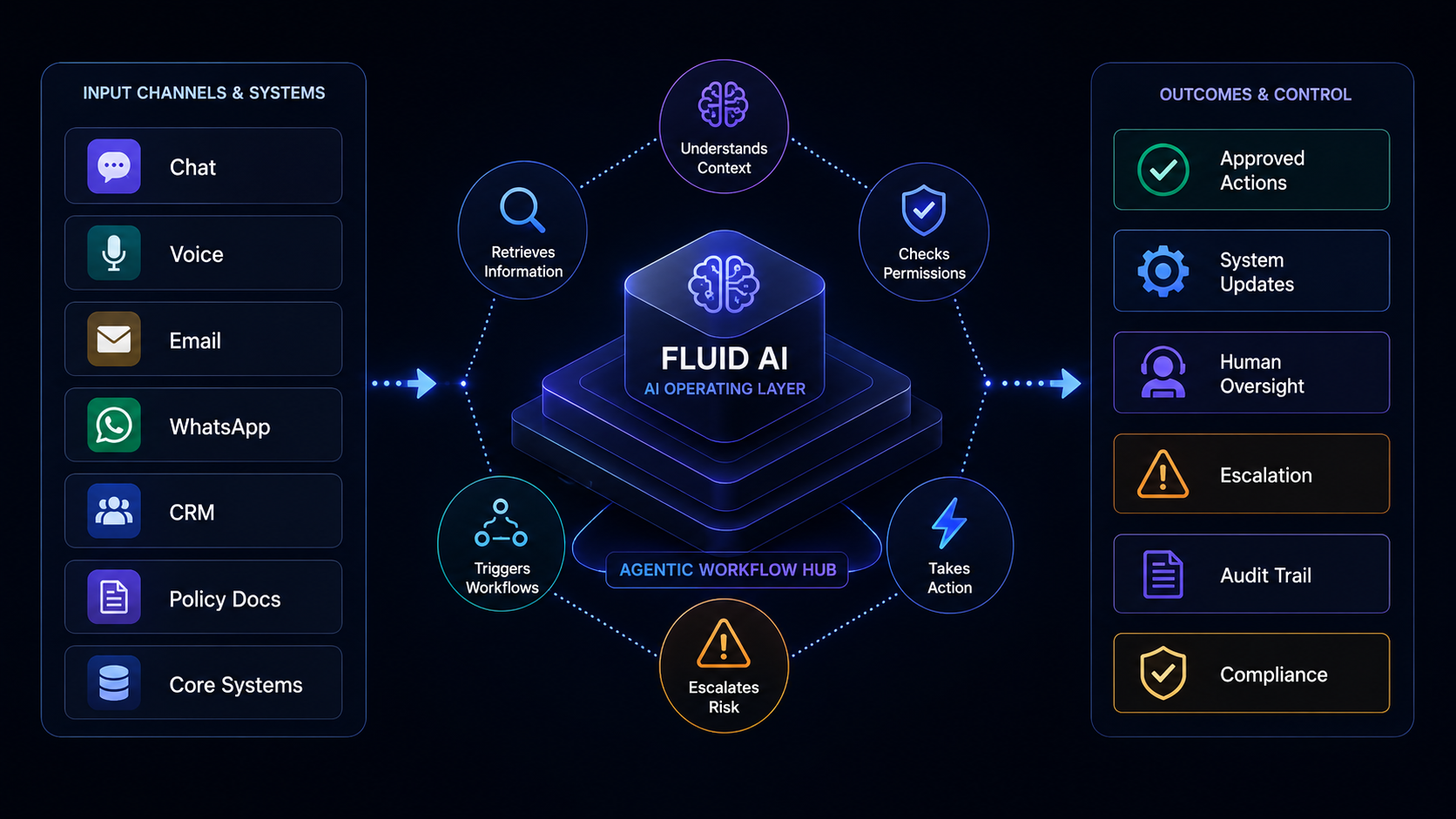
Fluid AI helps enterprises shift from disconnected tools to agentic workflows that understand context, retrieve the right info, take approved actions, escalate risks, and keep humans in control.
Example: a banking agent identifies the customer, understands the issue, retrieves context, checks permissions, triggers workflows, updates systems, and escalates when risk thresholds are crossed.
That’s what makes Agentic AI enterprise‑ready.
Step 2: RAG vs Agentic RAG: From Knowing to Deciding
To make intelligent decisions, AI needs access to the right data.
Standard Retrieval-Augmented Generation, or RAG, helps an AI model know more. It connects the model to external knowledge sources such as documents, FAQs, policies, manuals, PDFs, databases, and internal knowledge bases.
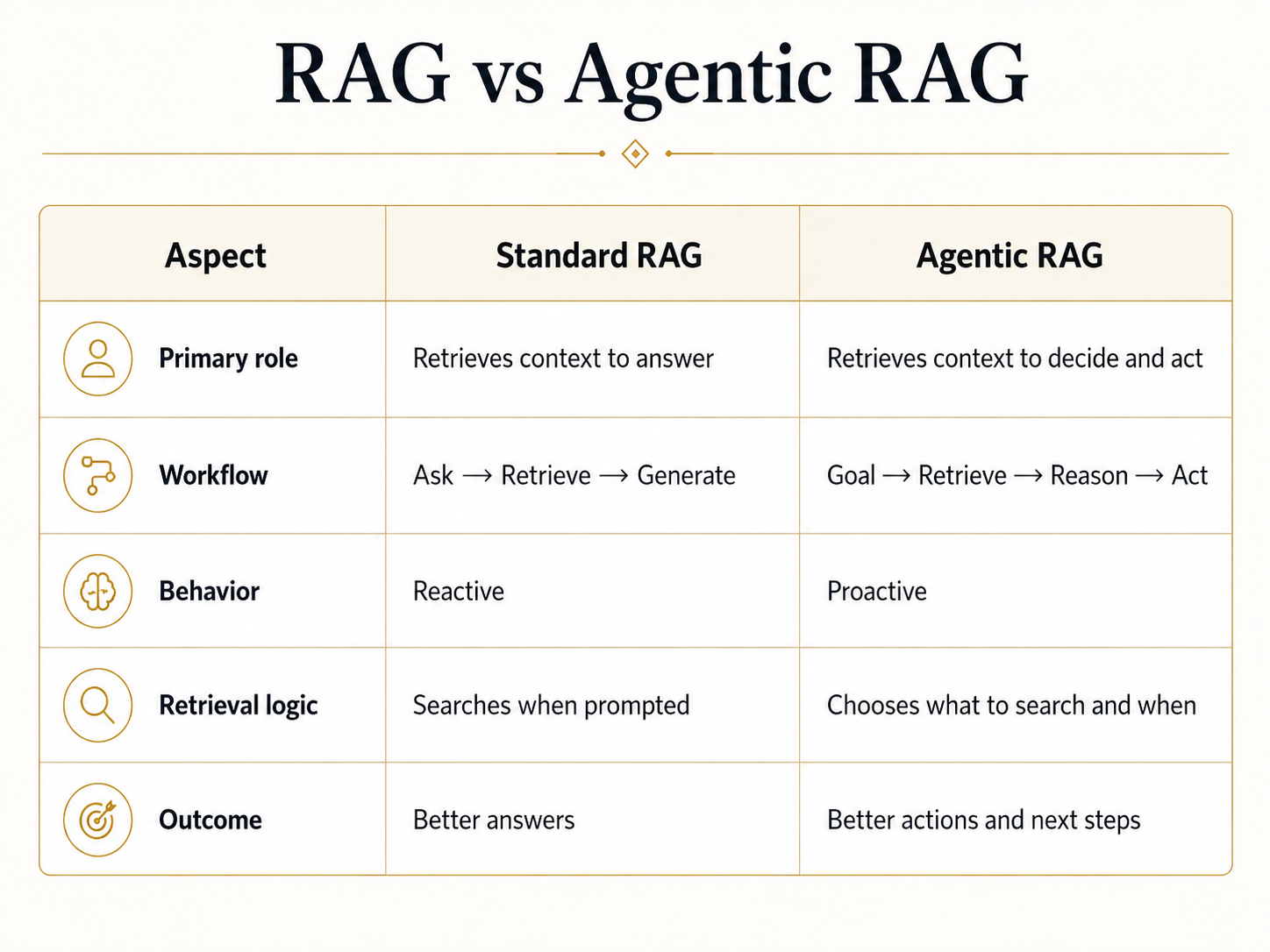
A standard RAG pipeline usually works like this:
Ask → Retrieve → Return → Augment → Generate
The user asks a question. The system retrieves relevant context. The model uses that context to generate an answer.
That is useful, but it is still mostly reactive.
Agentic RAG goes further:
Instead of only retrieving information when asked, an agentic RAG system can decide when it needs more context, what source it should search, how much information it needs, and what action to take after retrieval.
For example, if a customer asks about a failed payment, the agent may need to retrieve transaction history, check the customer’s account status, search the bank’s policy database, inspect previous support tickets, and then decide whether to respond, create a case, or escalate.
That is the shift from retrieval for answers to retrieval for action.
Step 3: Tool Calling and MCP: Connecting Agents to Enterprise Systems
If RAG helps an agent know more, tool calling helps it do more.
Tool calling allows an AI agent to interact with external systems, APIs, databases, applications, and enterprise platforms. This is how an agent moves from generating text to completing work.
For example, an agent may use tools to:
Check a CRM record
Create a support ticket
Search a policy database
Trigger a payment workflow
Send an email
Update a customer profile
Fetch transaction details
Book a meeting
Escalate a case to a human
Model Context Protocol, or MCP, helps standardize this connection between AI agents and tools.
Instead of building custom integration logic for every single system, MCP works as a standard connection layer between AI agents and enterprise systems. It allows the agent to discover available tools, understand the required inputs, call the right APIs, and use the results to continue the workflow.
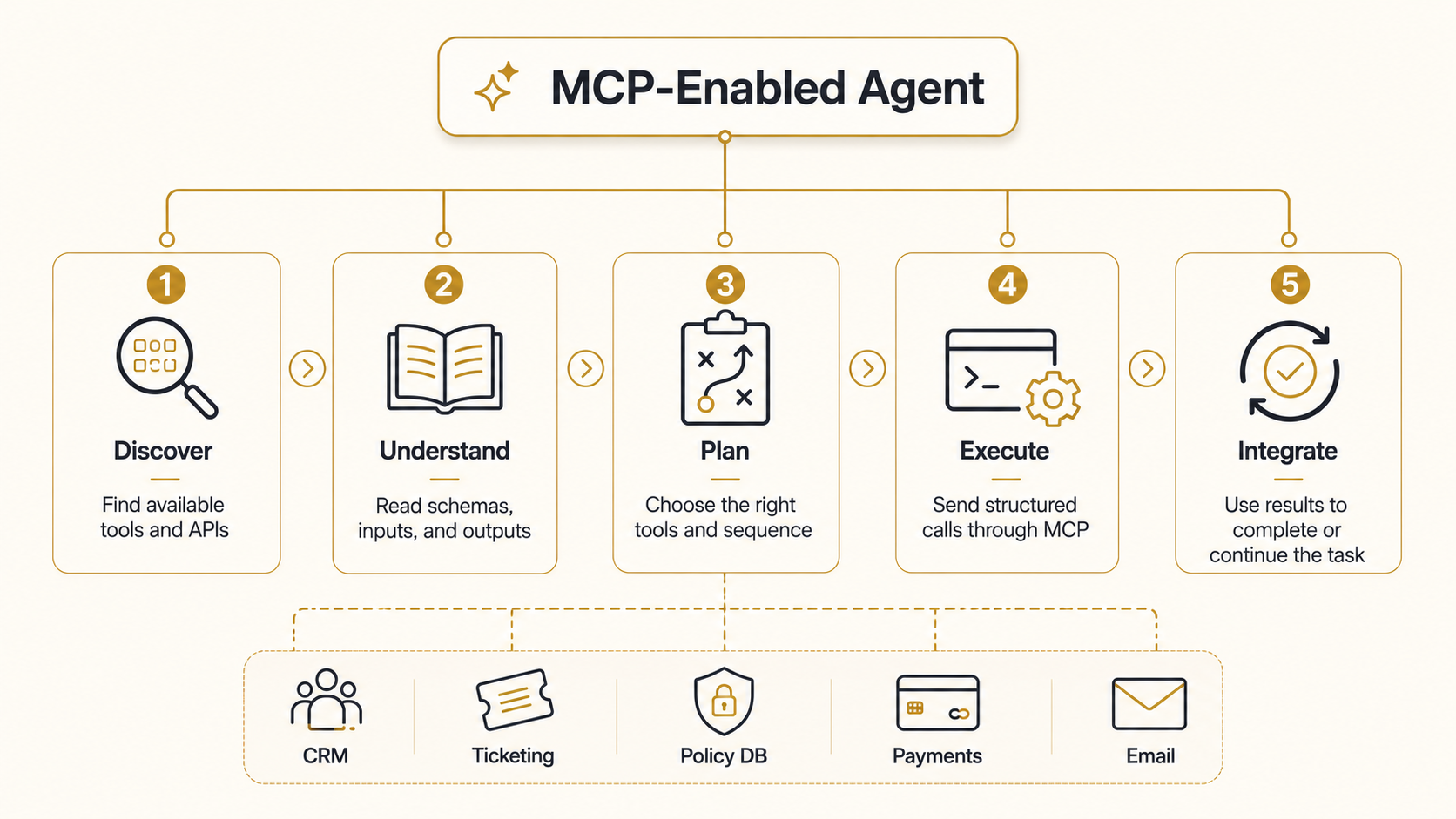
An MCP-enabled agent usually follows this flow:
Discover: The LLM connects to the MCP server to dynamically check what tools and APIs are available to use.
Understand: It reads the schema of each available tool to learn its required inputs and outputs.
Plan: The agent's reasoning engine decides exactly which tools to use and in what order to achieve the user's request.
Execute: It sends structured calls through the secure MCP runtime, triggering the tools to perform actions in the real world.
Integrate: The agent takes the results from the tools and uses them to either finalize the task or make subsequent tool calls.
For example, a support agent handling a failed payment could use MCP-connected tools to check transaction status, retrieve the customer profile, open the bank’s policy database, create a ticket, and send a response through an approved channel.
This is where agentic workflows become operational.
Step 4: Governance and AI Agent Security
Giving an AI system autonomy and connecting it to enterprise tools creates a new risk category.
A chatbot that gives a wrong answer is a problem. An AI agent that takes the wrong action inside a business system can become a much bigger problem.
That is why AI agent governance and AI agent security are critical.
The major risks include:
Prompt injection
Unauthorized tool usage
Data leakage
Poor access control
Memory poisoning
Incorrect workflow execution
Lack of audit trails
Over-automation of high-risk decisions
Unclear ownership when something goes wrong
To safely deploy agentic AI, organizations must implement strict governance and guardrails. Best practices include:
Human-in-the-Loop (HITL): For any irreversible actions, such as significant financial payments or mass data deletion—the system must pause and seek manual human approval before proceeding,.
Constitutional AI and Negative Limits: Developers must set strict "digital fences" that clearly define what the system is never allowed to do.
Starting Small: Enterprises should not automate entire end-to-end workflows from day one. It is crucial to start with well-defined, low-risk tasks, actively monitor the agent's performance, and build trust before scaling
The goal is not full autonomy everywhere. The goal is controlled autonomy.
Step 5: AgentOps: Monitoring AI Agents in Production
Once an AI agent goes live, the work is not over.
Enterprises need AgentOps: the monitoring, evaluation, logging, and improvement layer for production-ready AI agents.
AgentOps helps teams understand whether the agent is working safely, accurately, and efficiently after deployment.
This includes tracking:
Tool calls
Latency
Cost per workflow
Resolution rates
Failed actions
Escalations
Human approval rates
Hallucination patterns
User feedback
Policy violations
Workflow completion rates
Model performance over time
Without AgentOps, teams may know that an agent is running, but they may not know whether it is working correctly.
This is especially important for regulated industries, where AI agents need to be observable, auditable, and continuously evaluated.
A production-ready AI agent needs monitoring just like any other enterprise system.
What Production-Ready Agentic AI Looks Like?
A production-ready agentic system is not just a clever demo.
It has clear architecture, reliable integrations, permission controls, governance, monitoring, and human oversight.
It should be able to:
Understand user intent
Retrieve relevant context
Plan a workflow
Use tools safely
Follow business rules
Ask for approval when needed
Escalate edge cases
Log every action
Measure performance
Improve over time
The best enterprise AI systems are not the ones that remove humans completely. They are the ones that put humans at the right control points while letting AI handle the repetitive execution layer.
That is how Agentic AI moves from experiment to infrastructure.
Conclusion
Agentic AI challenges enterprises to rethink how work gets done.
The real shift is not from one model to another. It is from isolated AI tools to agentic workflows that can reason, retrieve, act, coordinate, and learn inside real business environments.
By combining agentic AI architecture, RAG, Agentic RAG, tool calling, MCP, governance, human approval, and AgentOps, enterprises can build AI systems that do more than answer questions.
They can build systems that complete work.
In the next phase of enterprise AI, humans will stay in control of strategy, judgment, and oversight while AI agents handle execution across systems, channels, and workflows.
Book your Free Strategic Call to Advance Your Business with Generative AI!
Fluid AI is an AI company based in Mumbai. We help organizations kickstart their AI journey. If you’re seeking a solution for your organization to enhance customer support, boost employee productivity and make the most of your organization’s data, look no further.
Take the first step on this exciting journey by booking a Free Discovery Call with us today and let us help you make your organization future-ready and unlock the full potential of AI for your organization.
_1790254083168-CB8e8KXC.png)