LLMs vs. SLMs Explained: The Differences in Large & Small Language Models

TL;DR
LLMs are versatile, large-scale generalists capable of complex, open-ended tasks but require massive computational resources and cloud infrastructure, while SLMs are efficient, specialized models optimized for speed, specific tasks, and smaller hardware footprints.
LLMs excel in broad applications with high variability like complex customer support and advanced research, whereas SLMs thrive in specialized, privacy-sensitive fields such as healthcare and finance where sensitive data cannot leave the device.
Choosing between LLMs and SLMs ultimately depends on your need for deep, versatile reasoning versus speed and data privacy, as well as your available budget, hardware resources, and specific use-case requirements
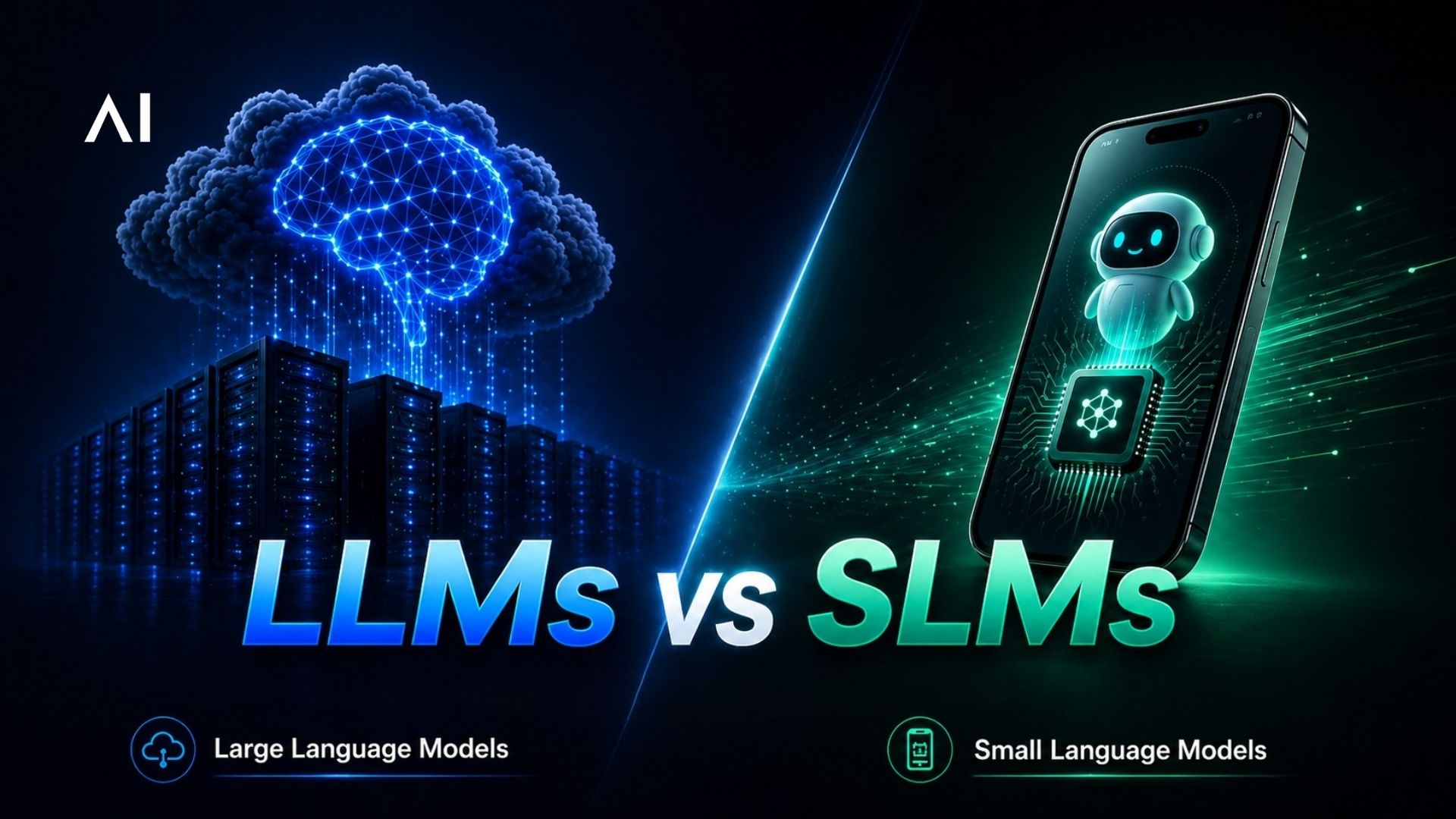
Have you ever wondered why some artificial intelligence tools can run instantly on your smartphone, while others require powerful, energy-hungry cloud servers just to function?
For years, the tech industry has been obsessed with scale, focusing heavily on Large Language Models (LLMs). Packed with billions or even trillions of parameters and trained on vast expanses of the internet, these massive models act as broad generalists. They offer deep contextual understanding and excel at complex, open-ended tasks like creative writing, deep data analysis, and sophisticated reasoning.
But as AI integrates deeper into our daily lives, a new challenge has emerged. What if you need an AI to work seamlessly in a remote area with flaky internet, process sensitive medical or financial data privately without ever leaving your device, or respond in under 100 milliseconds?

This is where Small Language Models (SLMs) step into the spotlight. Rather than trying to know everything, SLMs are designed as highly efficient specialists. They require a fraction of the computing power, are much cheaper to run, and are proving that AI competence does not always require massive size.
Here is a comprehensive breakdown of the core differences between large and small language models, and how to decide whether your project needs heavy-duty, general-purpose intelligence, or the fast, focused power of staying small.
What are Language Models?
Language models are artificial intelligence (AI) systems designed to understand, read, and write text that sounds like it came from a human. You can think of them as the "brains" behind AI tools that can answer your questions, write essays, or even write computer code.
They learn how to do this by reading massive amounts of data, and they store this knowledge using "parameters," which you can think of as the rules and weights the model learns to figure out how language works.
To make the different sizes of these models easier to understand, you can think of them using a food analogy:
Large Language Models (LLMs) are like a massive warehouse filled with food meant to serve everybody. They are packed with huge amounts of general knowledge and can handle very complex, open-ended tasks. Because they are so massive, they need powerful computer servers and massive memory to run.
Small Language Models (SLMs) are like a single, perfectly portioned meal made just for you. Instead of trying to know everything, they are "specialists" designed to do a few straightforward tasks extremely fast and well. Because they are much smaller, they can run right on your smartphone or smartwatch without needing an internet connection.
In short, they are computer programs that process human language, available in giant sizes when you need heavy-duty intelligence, and smaller sizes when you need quick, everyday efficiency.
The Differences between LLMs & SLMs
The core differences between Large Language Models (LLMs) and Small Language Models (SLMs) come down to their scale, purpose, and resource requirements.
Here is a deeper look at how they compare:
Size and Capabilities
LLMs are broad generalists built with tens of billions to over a trillion parameters. Because they are trained on massive, diverse datasets, they excel at deep reasoning, creative writing, complex coding, and handling highly nuanced, open-ended conversations.
SLMs are efficient specialists that typically have fewer than 13 billion parameters. Rather than trying to know everything, they are designed to perform specific, well-defined tasks, like document routing or straightforward summarization, extremely well.
Hardware, Cost, and Speed
LLMs require massive computing power, relying on hyperscale GPU clusters and cloud environments. This makes them expensive to operate, consumes exponential energy, and can lead to higher latency and slower response times due to their complexity.
SLMs are lightweight and fast, needing far less computational power. They can be deployed affordably on single GPUs, CPUs, or directly onto edge devices like smartphones and laptops. Because they perform fewer calculations per inference, they offer much faster response times, sometimes under 100 milliseconds.
Privacy and Deployment
LLMs usually run in the cloud, meaning sensitive information often has to leave your device to be processed.
SLMs can run completely offline or on-premise, making them the ideal choice when data privacy is non-negotiable. For example, if you need an AI to analyze personal bank statements or medical records, an SLM ensures your private data never leaves your device.
In short, LLMs bring broad intelligence at scale for complex problem-solving, while SLMs bring fast, cost-effective AI to everyday devices for focused, everyday tasks.
How do I choose between an LLM and an SLM?

Choosing between a Large Language Model (LLM) and a Small Language Model (SLM) ultimately comes down to matching the model's capabilities to your specific task. As a general rule, you should use an LLM when you need a "generalist" with broad knowledge, and an SLM when you need a highly efficient "specialist" for a focused job.
Here is a breakdown of how to decide:
Choose a Large Language Model (LLM) when:
You need broad knowledge and complex reasoning: LLMs are ideal for deep analysis, creative writing, complex coding, and navigating unfamiliar APIs.
Your task has high variability: If you are building a system like complex customer support, an LLM can synthesize data across multiple domains (like billing databases and technical configurations) and generalize to edge cases it hasn't explicitly seen before.
You need a massive context window: LLMs can process huge amounts of information at once, making them suitable for handling heavy documentation or cross-referencing extensive knowledge bases.
You are tackling open-ended discovery: Use cases like drug discovery, analyzing broad business strategies, or nuanced language translation are best suited for LLMs.
You have a large budget and infrastructure: LLMs require hyperscale GPU clusters and cloud environments to manage their high computational complexity.
Choose a Small Language Model (SLM) when:
Privacy and security are non-negotiable: SLMs can run on-premise or offline, meaning sensitive information, like medical records or personal bank statements, never has to leave your device.
You need speed and low latency: Because SLMs perform fewer calculations, they offer much faster inference. They are the best choice for real-time applications or tasks requiring latency under 100 milliseconds.
You have specific, well-defined tasks: SLMs often match or beat LLMs at straightforward jobs like document classification, routing, simple summarization, or predicting basic API calls.
You are deploying on edge devices: SLMs are lightweight enough to run on smartphones, laptops, offline robotics, and smartwatches, often without an internet connection.
Cost and resource efficiency are priorities: SLMs require a fraction of the GPU budget and can sometimes even run on a single CPU, making them highly cost-effective and eco-friendly.
Consider a Hybrid Approach
You don't always have to choose just one. In complex AI architectures (like agentic orchestration), you can use an LLM as the "boss" agent to understand the user's initial, complex instructions. The LLM can then distribute simpler, specific tasks out to multiple SLMs, allowing you to get the best of both worlds: deep intelligence combined with fast, cost-effective execution.
Final thought
The ultimate takeaway when navigating the world of language models is that the best AI model is simply the one that fits your specific use case.
It is not a competition where one type of model universally defeats the other. Instead, success comes down to matching a model's exact capabilities to your project's needs. If you need deep nuance, complex reasoning, and high-quality broad outputs, large models are the best choice. If speed, operational efficiency, cost, and privacy are your priorities, small models are the way to go.
As one of the experts summarized, a great strategy to keep in mind is to "go big but stay small".
Looking ahead, the future of AI development isn't just about choosing one or the other, it is about a smart combination of both. We will increasingly see hybrid approaches that combine the vast, scalable intelligence of LLMs with the fast, everyday efficiency of SLMs to unlock the absolute best performance for any given task.
Book your Free Strategic Call to Advance Your Business with Generative AI!
Fluid AI is an AI company based in Mumbai. We help organizations kickstart their AI journey. If you’re seeking a solution for your organization to enhance customer support, boost employee productivity and make the most of your organization’s data, look no further.
Take the first step on this exciting journey by booking a Free Discovery Call with us today and let us help you make your organization future-ready and unlock the full potential of AI for your organization.
_1790254083168-CB8e8KXC.png)