Small Language Models and Agentic AI: The Future of Secure, Sovereign Enterprise Intelligence

TL;DR
- Large cloud LLMs expose data and compliance risks for regulated sectors like banking, healthcare, and government.
- Small Language Models (SLMs) can run fully inside your infrastructure, keeping intelligence and data sovereign.
- When paired with Agentic AI layers — memory, reasoning, and action modules — SLMs evolve into private, autonomous systems.
- Fluid AI deploys sovereign Agentic AI systems that operate entirely within your firewall — your data, your intelligence, your rules.
The Shift from Smart Tools to Thinking Systems
For the last two years, the world has been fixated on large language models — ChatGPT, Claude, Gemini, you name it.
They wowed everyone with scale, but scale isn’t sovereignty.
Enterprises in banking, healthcare, and government quickly realized something: they can’t outsource their intelligence layer to a public API. Every query, every inference, every memory — it all sits outside their control.
That’s where the new wave begins: Private Intelligence.
Instead of shipping sensitive data to massive cloud models, organizations are bringing intelligence in-house — building AI systems that live, reason, and evolve entirely within their own infrastructure.
And the foundation of that revolution? Small Language Models — paired with Agentic AI reasoning.
For a deeper look into how executives are planning this transition, explore the CFO Playbook for Agentic Intelligence
What Small Language Models Really Unlock
Here’s the truth: the size of a model matters less than its context and control.
Small Language Models (SLMs) are compact, fine-tuned systems designed to run efficiently on local hardware — without sacrificing reasoning quality for the use case at hand.
Think of them as:
- Focused experts instead of generalist polymaths.
- Lightweight, fast, and deployable on on-prem GPU clusters.
- Trainable on your enterprise corpus — from transaction logs to medical records.
SLMs thrive when connected to real enterprise data.
They become exponentially more powerful when an Agentic layer wraps around them — giving them the ability to not just generate, but reason, remember, and act.
From LLMs to Agents: The Missing Evolution Step
A Large Language Model can give you a smart answer.
An Agentic AI system can use that answer to actually do something.
That’s the key difference.
Here’s how the stack evolves inside your enterprise:
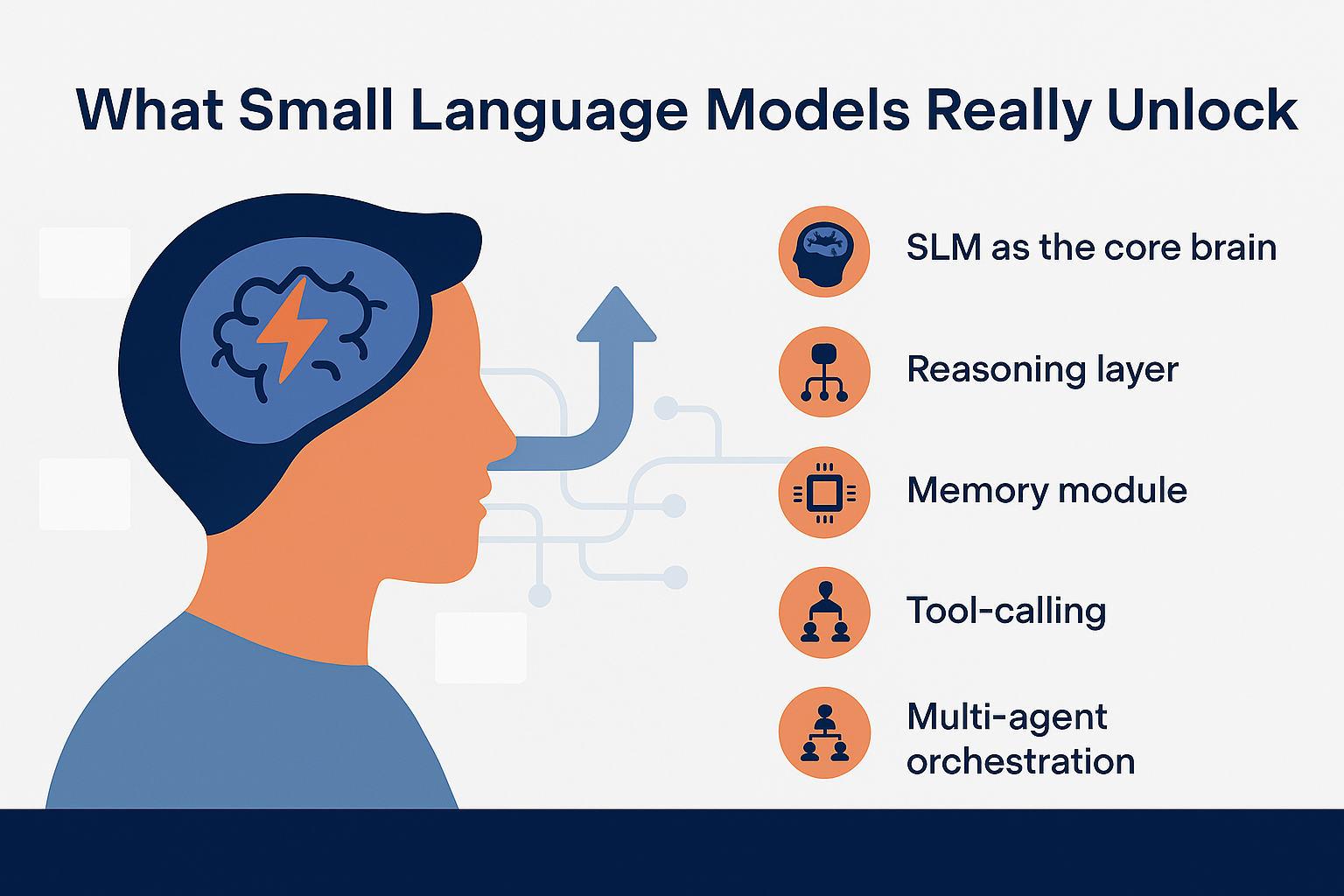
- SLM as the core brain — understanding language, data, and intent.
- Reasoning layer — planning multi-step goals (like resolving a customer complaint or reconciling data).
- Memory module — retaining context over time, learning from past interactions.
- Tool-calling — connecting to CRMs, ERPs, or knowledge bases to execute real-world actions.
- Multi-agent orchestration — multiple specialized agents (audit, support, compliance) collaborating automatically to achieve an outcome.
That’s not chatbot intelligence — that’s operational intelligence.
It’s AI that behaves like a team — not a text generator.
Want to measure success when adopting such systems? Read the KPI Blueprint for Agentic AI Success
Why Cloud-Hosted Intelligence No Longer Works
Most leaders already sense this tension:
You want intelligence everywhere — but you can’t afford it anywhere.
Cloud-hosted LLMs create undeniable exposure points:
- Data sovereignty: Every token that leaves your boundary is a compliance risk.
- Black-box reasoning: You can’t audit why a model made a decision.
- Integration gaps: Cloud APIs can’t securely connect to on-prem databases.
- Regulatory hurdles: Banking and healthcare regulators demand full control, traceability, and data locality.
When the model itself lives inside your infrastructure, all those barriers dissolve.
That’s why the most forward-thinking enterprises are pivoting to SLMs + Agentic AI — a stack that’s intelligent, auditable, and sovereign by design.
How Private Agentic Systems Actually Work
Let’s visualize it inside your firewall:
- Your SLM runs on local servers — fine-tuned on enterprise documents and logs.
- Retrieval-augmented generation (RAG) modules fetch precise context from internal systems.
- Agents act on behalf of departments — support, compliance, HR, operations — coordinating across systems through APIs.
- Memory graphs evolve over time, letting the AI “remember” past actions, learn from feedback, and improve decision accuracy.
- Governance controls ensure every action is logged, reversible, and explainable.
So when someone asks,
“What’s the risk exposure of our retail loan portfolio under new RBI guidelines?”
The system doesn’t just summarize PDFs — it connects to internal risk dashboards, applies the new circular logic, and produces a compliance-ready report — all locally, without a single byte leaving your environment.
That’s not automation. That’s Agentic cognition.
For architecture-level insights into how these systems are deployed, explore the Fluid AI Architecture.
Why Smaller Can Actually Mean Smarter

Most assume that only billion-parameter models can do meaningful work. Not anymore.
SLMs today, especially when powered by reasoning agents, outperform larger models in focused enterprise tasks because they:
- Operate with faster inference (no latency from external APIs).
- Are fine-tuned on structured and unstructured enterprise data.
- Maintain deterministic reasoning, meaning repeatable, auditable outputs.
- Run at a fraction of the cost of cloud inference.
Paired with Agentic reasoning, these smaller models become adaptive ecosystems — thinking entities that can handle complex workflows like loan restructuring, claim adjudication, or policy enforcement.
They’re not just smaller. They’re strategically local.
The Agentic Edge: Reasoning That Enterprises Can Trust
Agentic AI adds what’s been missing from corporate automation — intent, memory, and decision accountability.
- Intent understanding: Instead of interpreting every prompt literally, agents infer what the user wants to achieve.
- Memory and continuity: The system remembers context across sessions, departments, and timelines.
- Decision grounding: Every action can be traced back to the data, rule, or policy that triggered it.
That’s crucial for industries where a single wrong decision can cost millions — or violate regulations.
Agentic AI doesn’t just execute tasks — it understands processes.
It can explain its reasoning, flag anomalies, and collaborate with human operators as a digital colleague, not a black box.
Fluid AI’s Approach: Sovereign Agentic Intelligence
At Fluid AI, we’ve built our entire platform around this exact vision — sovereign intelligence for regulated enterprises.
Our systems combine:
- Small Language Models optimized for domain-specific data and secure on-prem deployment.
- A multi-agent orchestration layer that enables reasoning, planning, and cross-system execution.
- Private RAG pipelines that ensure no external dependency.
- Memory-driven intelligence that learns continuously without leaving the firewall.
- Enterprise governance controls — audit logs, RBAC, encryption, and explainable decision tracking.
The result?
A self-contained AI ecosystem that functions like ChatGPT for your organization — but one that doesn’t compromise your sovereignty, security, or compliance.
Why This Isn’t Optional Anymore
The move toward private intelligence isn’t just a tech trend — it’s a regulatory inevitability.
As data laws tighten and LLMs get embedded into decision systems, enterprises will have no choice but to own their AI stack.
And ownership means one thing: sovereignty.
SLMs with Agentic intelligence represent the middle ground — flexible, powerful, yet contained.
They let organizations build systems that don’t just react — they reason, decide, and evolve.
That’s the true future of enterprise AI: not another model subscription, but a thinking system you control.
To understand where on-prem vs. cloud AI fits into this shift, check out Edge vs. Cloud: Where Should Your Voice AI Be?.
Final Takeaway
We’re entering the age of Private Intelligence — where the smartest AI systems don’t live on the internet, but inside your enterprise.
They won’t just answer questions.
They’ll manage workflows, monitor compliance, and drive decisions — all autonomously, all securely, and all within your walls.
Because in this new world, intelligence isn’t rented.
It’s sovereign.
And that’s where Fluid AI leads — delivering Agentic AI sovereignty, powered by Small Language Models that never leave your firewall.
_1790254083168-CB8e8KXC.png)