Single-Agent vs Multi-Agent AI Systems: Understanding the Difference

TL;DR
Most teams pick between a single-agent and multi-agent AI system based on what sounds impressive, not what the problem actually needs. A single-agent system is one autonomous AI handling a workflow end-to-end: fast to build, easy to audit, ideal for deep, sequential tasks. A multi-agent system is a network of specialised agents collaborating in real time: more powerful, more resilient, built for complex, parallel, cross-functional workflows at scale.
Neither is universally better. The wrong choice creates systems that either break under complexity or overcomplicate problems that didn't need it.
This blog breaks down how both architectures work, where each one wins, and the decision framework that tells you which one your use case actually needs.
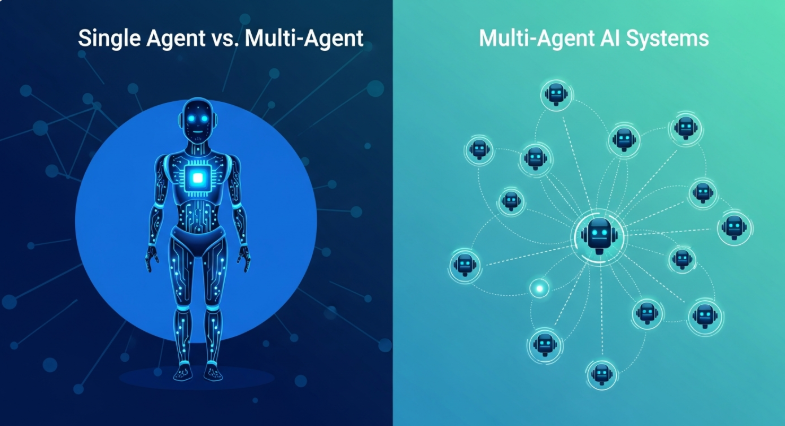
Single-Agent vs Multi-Agent AI Systems: Understanding the Difference
You've got a new project. Someone says "let's build an AI agent for it."
Cool. But then comes the question nobody has a clean answer to: one agent or multiple?
Most teams pick based on vibes. Or they copy what they saw in a demo. Or they default to whichever sounds more impressive in a slide deck (spoiler: it's always multi-agent).
That's how you end up with over-engineered systems that break in production, or under-powered ones that can't scale past week three.
This guide fixes that. By the end, you'll know exactly what agentic AI is, how single-agent and multi-agent systems differ in practice, and most importantly, which one your actual problem needs.
What Is Agentic AI?
The word "agentic" comes from agency, the capacity to act independently toward a goal.
An agentic AI system is one that doesn't just respond to prompts. It plans, decides, acts, and evaluates its own outputs in a loop, without needing a human to approve every step.
This is what separates agentic AI from everything that came before it:
A chatbot waits for you to give it the next instruction
A copilot suggests what you might want to do next
An agentic AI system receives a goal and figures out how to get there on its own
This is why agentic AI has gone from buzzword to boardroom priority in 2025–2026. Not because the models got smarter (though they did), but because the architecture around them, memory, tool use, planning loops, and evaluation layers finally matured enough to make autonomous execution reliable at enterprise scale.
Now, within agentic AI, there are two fundamental architectures. And which one you pick changes everything.
Single-Agent AI System

Picture your smartest hire. Brilliant, fast, can handle complexity, but still one person. One context, one focus, one throughput.
That's a single-agent AI system.
One autonomous AI agent receives a goal, plans the steps, calls the tools it needs, evaluates its own outputs, and delivers a result. No other agents involved. The entire workflow runs through one reasoning unit.
Benefits of Single-Agent AI
It's autonomous without being complicated. One agent, one decision loop. No coordination overhead, no communication latency between agents. For tasks where speed of execution matters more than breadth of reasoning, this is a feature.
It's traceable. Everything flows through one chain of reasoning. You can see exactly why every decision was made. In banking, insurance, or any regulated environment, this auditability is non-negotiable.
It's fast to build. Fewer moving parts means faster development, faster testing, faster iteration. If you need something working in weeks, not months, a well-designed single agent gets you there.
It specialises deeply. An agent built for one domain, contract review, invoice reconciliation, ticket classification, can be fine-tuned for that domain in a way a general-purpose multi-agent system rarely achieves out of the box.
Real-world Examples of Single-Agent AI
Banking fraud detection: A single agent monitors transactions continuously, flags anomalies against learned thresholds, and escalates. Deep, focused, sequential. Perfect single-agent territory, until fraud patterns diversify enough to require simultaneous cross-domain analysis, which is when multi-agent comes in.
Invoice processing: Extract → validate → match against PO → flag exceptions → post to ERP. Thousands of invoices, same workflow every time. One agent, optimised for this exact loop, handles it at scale without breaking a sweat.
IT helpdesk ticket routing: Reads ticket, classifies intent, routes to the right team. Works cleanly until tickets start requiring cross-system context from three different platforms simultaneously.
Resume screening: Scans at volume, applies consistent criteria, outputs ranked shortlists. Fast, cost-effective, audit-friendly. Hits its limit when evaluation requires nuanced cross-referencing across multiple HR systems in parallel.
Limitations of Single-Agent AI
One point of failure: It stalls, everything stalls.
Context window caps out: Long, complex tasks degrade its own output quality.
No self-checking: Errors go straight through, no second opinion.
Multi-Agent AI System

Now imagine instead of one brilliant hire, you build a team.
A researcher. A writer. A compliance checker. A project manager who coordinates them all. Each one expert in their lane. All of them sharing information in real time, catching each other's errors, building on each other's outputs.
That's a multi-agent AI system (MAS).
Multiple AI agents, each specialised, each autonomous, collaborating toward a shared goal. They communicate, pass outputs, cross-check results, and adapt based on what other agents produce. It's not just parallel processing. It's coordinated intelligence.
Benefits of Multi-Agent AI
Distributed task execution. Each agent handles its part of the problem. No single agent's context window gets overwhelmed. Accuracy stays high across the workflow because each agent focuses only on what it's built for.
Real-time collaboration. Agents share data and outputs continuously. When the research agent finishes, the synthesis agent doesn't wait for a human handoff; it picks up immediately.
Fault tolerance. If one agent fails, the others continue. In always-on environments, fraud monitoring, customer support, supply chain, a single point of failure is unacceptable. Multi-agent architecture eliminates it.
Parallel processing. Things that can happen simultaneously, do. Dramatically faster execution on complex workflows that would be bottlenecked in a sequential single-agent loop.
Modular scalability. Need to handle ten times the volume? Add agents. Need a new capability? Add a specialised agent without rearchitecting the whole system.
Real-world Examples of Multi-Agent System
Loan processing at a bank: Different agents handle each step, data intake, risk scoring, compliance checks, decisioning, and customer messaging. What once took days now runs in hours, with a human reviewing the final decision.
Supply chain disruption response: One agent detects a machinery fault. A second assesses which orders are affected and reschedules them. A third reallocates inventory across distribution centres. A fourth updates procurement. A fifth flags exceptions for human review. All triggered by one signal, all running simultaneously.
Enterprise customer support at scale: A classification agent reads the ticket. A retrieval agent pulls account history and knowledge base content. A drafting agent writes a personalised response. A quality agent checks tone, accuracy, and compliance. Output routes to send, or to human review if confidence is below threshold. Thousands of tickets a day. Consistent quality. No queue.
Automated candidate hiring pipeline: One agent screens applications against job criteria. A second coordinates scheduling with hiring managers. A third handles onboarding documentation once an offer is accepted. Three agents, three specialisations, one continuous workflow, with human decision-making inserted only at the offer stage.
Limitations of Multi-Agent AI
Complex to build and debug: More agents, more things that can go quietly wrong.
Errors compound fast: One bad output cascades through every agent that follows.
Higher compute cost: More agents running means more infrastructure, and more spend.
When to Choose a Single-Agent System?
✅ The task is focused and linear: one domain, clear inputs, clear outputs, many sequential steps but no parallel specialisation required
✅ Auditability is the highest priority: regulated workflows where you need to show exactly why every decision was made
✅ You need a fast prototype or lightweight solution: single agents are cheaper to build, test, and iterate
✅ The context window can hold everything: all the information the agent needs fits within one active memory without degradation
✅ Decisions don't depend on multiple specialised roles running simultaneously
When to Choose a Multi-Agent System?
✅ The task is genuinely multidisciplinary: different parts of the problem require fundamentally different types of reasoning that compete for context in a single agent
✅ Parallel processing changes the outcome: not just speed, but quality. Things that should happen simultaneously but can't in a sequential single-agent loop
✅ Fault tolerance is non-negotiable: always-on environments where one failure can't stop the workflow
✅ You're scaling volume and need modular control: update or replace individual agents without rearchitecting the whole system
✅ The process spans multiple tools, platforms, and teams: Slack, CRM, ERP, databases, calendars, all talking to each other through a coordinated agent network
✅ Output quality improves with specialisation and cross-checking: when one agent's output is another agent's input, errors get caught before they compound
Core Components of an Agentic AI Architecture

A production-grade AI agent has five components working together:
Brain (Large Language Model - LLM)
The large language model is what gives the agent reasoning capability. It interprets inputs, makes decisions, generates plans, and produces outputs. The LLM doesn't just generate text, in an agentic context, it decides what to do next at each step of the loop.
A Planning Module
This is what converts a high-level goal into a sequence of actions. Frameworks like ReAct (Reason + Act), Plan-and-Execute, and Chain-of-Thought are the underlying patterns that make this work. The planning module is why an agent can decompose "audit all vendor contracts" into fifty discrete steps it executes sequentially.
Memory (Short-term + Long-term)
Short-term memory is the active context window, what the agent holds in working memory right now. Long-term memory is an external store (typically a vector database) that the agent reads from and writes to across sessions and tasks. Without memory, an agent forgets what it did three steps ago. With it, the agent builds a coherent picture across thousands of actions.
Tools(External Integrations)
Agents aren't confined to text generation. They call external tools: web search, database APIs, code execution environments, file systems, CRM integrations, calendar systems, email, and other agents. Tool use is what makes an agent capable of doing things rather than just saying things.
Evaluation Layer (Self-Correction Loop)
A well-architected agent checks its own output after each action. Did this meet the criteria? If not, retry, adjust, or escalate. This self-correction loop is what makes agentic AI reliable at scale, rather than a single-point-of-failure system that breaks the moment something unexpected happens.
Agentic AI in 2026: Where This Is All Heading
The trajectory is clear: single-agent systems will handle more, and multi-agent systems will become the default architecture for enterprise-grade AI.
Not because multi-agent is always better, but because the problems enterprises are increasingly bringing to AI are the kind that require it. Complex, cross-functional, high-volume, fault-intolerant workflows that can't be compressed into a single reasoning unit.
In 2026, AI is speeding up high-volume work while humans step in only where judgment matters most.
The best agentic systems being built right now aren't the most autonomous. They're the ones that know exactly when to stop and ask.
The most autonomous system isn't always the best one. The most accurate one is.
Book your Free Strategic Call to Advance Your Business with Generative AI!
Fluid AI is an AI company based in Mumbai. We help organizations kickstart their AI journey. If you’re seeking a solution for your organization to enhance customer support, boost employee productivity and make the most of your organization’s data, look no further.
Take the first step on this exciting journey by booking a Free Discovery Call with us today and let us help you make your organization future-ready and unlock the full potential of AI for your organization.
Frequently Asked Questions
What defines a single-agent AI system?
A single-agent system consists of one reasoning unit that plans, executes, and evaluates a workflow end-to-end. It is highly traceable and specializes deeply in a single domain, making it ideal for linear tasks.
When should an enterprise choose a multi-agent system?
Multi-agent systems are better suited for multidisciplinary tasks where parallel processing and specialized roles are required. They offer higher fault tolerance and allow for modular scalability, meaning new agents can be added without rearchitecting the entire system.
What are the core components of a production-grade AI agent?
An agent requires a Large Language Model for reasoning, a planning module for sequence execution, and a memory system for context retention. Additionally, it uses external tools for specific actions and an evaluation layer to self-correct during the process.