Understanding AI Agent Types: Active vs Scheduled vs Triggered Agents

TL;DR
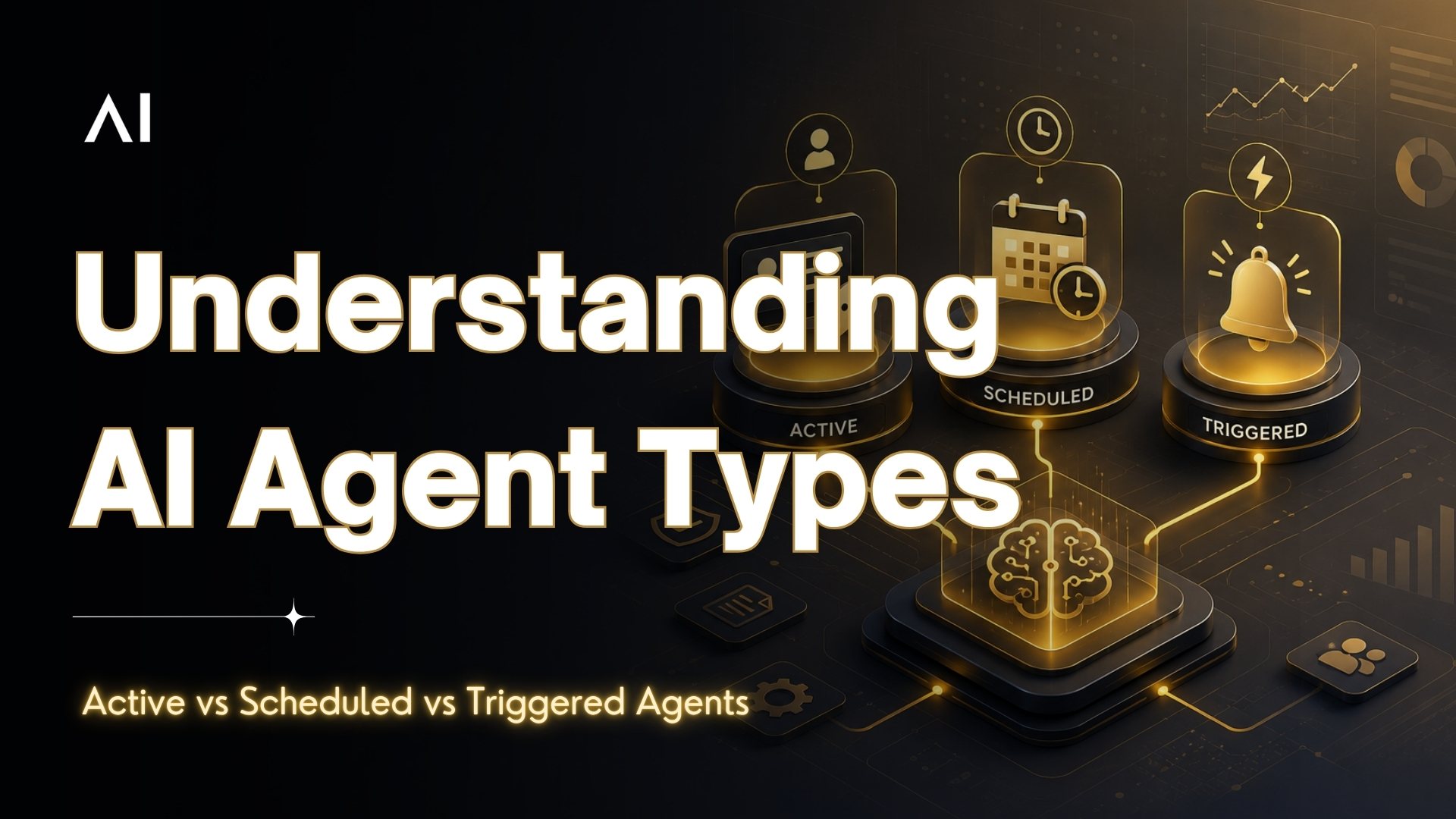
Enterprise AI platforms use three agent types. Active agents respond to live user inputs in real time. Scheduled agents run autonomously at set intervals without any human prompt. Triggered agents activate when a specific event or condition is met. Most mature deployments use all three in combination, and the ones that don't are leaving serious automation potential on the table.
Why Most Enterprise AI Conversations Miss This
Everyone talks about AI agents like they're one thing. You deploy an agent, it does stuff, done. But if you've actually built or bought an enterprise AI platform, you know it's never that simple.
The agents handling a customer query at 2pm work completely differently from the ones reconciling transaction data at midnight. And both of those are different from the agent that fires the moment a fraud signal crosses a threshold.
These aren't implementation details. They're architectural decisions. Get them wrong and your AI deployment is slower, leakier, and harder to scale than it needs to be.
There are three types of AI agents every enterprise platform should have. Here's what they are, where they break down, and why the combination of all three is what separates a real agentic AI platform from a glorified chatbot.
Type One: The Active Agent
An active agent is always listening. It sits in a ready state and responds the moment a user or system sends a request.
This is what most people picture when they think about AI. The customer support bot. The employee help desk assistant. The document Q&A tool your compliance team uses to pull policy answers in seconds.
In financial services, active agents handle:
★ Customer queries on balances, transactions, and account details
★ Employee requests for HR policy, IT support, or compliance guidance
★ Real-time document summarisation during client calls
★ Live KYC assistance during onboarding flows
★ Relationship manager co-pilots pulling customer history mid-call
The critical design consideration is latency. A response that takes eight seconds in a live conversation is a failed interaction. Users lose trust fast. Active agents need to be optimised for speed - retrieval architecture, model selection, and memory design all matter enormously.
The other trap is scope creep. Teams start with a focused use case and keep adding until the agent is doing everything poorly. Active agents need clear boundaries on what they answer, what they escalate, and what they hand off.
Type Two: The Scheduled Agent
A scheduled agent doesn't wait for anyone. It runs on a clock.
You define the cadence and the agent executes automatically without a human trigger. Nobody has to ask. Nobody has to remember. The work just happens.
Where enterprises deploy scheduled agents:
★ Nightly reconciliation across accounts and ledgers
★ Daily risk scoring updates across loan portfolios
★ Regulatory report generation at end of month
★ Customer churn risk scores refreshed nightly on latest behavioural data
★ SLA breach reports generated and distributed before the business day starts
A huge percentage of enterprise work isn't triggered by a human. It's triggered by time. Every organisation has tasks that need to happen on a cadence regardless of whether anyone asked. Before agentic AI those tasks needed a person or a brittle RPA script. Now they don't.
The biggest mistake enterprises make is under deploying scheduled agents. Most teams think of AI as reactive. They miss the entire category of work that was always time-based, not request-based.
Failure handling matters too. A scheduled agent runs at 2am when nobody's watching. If it fails silently you might not find out until a compliance report is missing or a risk score hasn't updated in days. Robust logging and alerting on failure aren't optional.
Type Three: The Triggered Agent
A triggered agent activates when something happens. Not when a user asks. Not on a schedule. When a specific event or data signal occurs in your system.
This is the most powerful agent type for risk, compliance, and exception handling. You're essentially encoding automated decision logic into your AI layer. When this happens, do this, without waiting to be asked.
Where triggered agents operate:
★ A transaction crossing a fraud threshold fires an agent that investigates and escalates with a full summary
★ Customer sentiment dropping mid-conversation routes the interaction with context already attached
★ A loan application reaching a pipeline stage triggers document collection and an underwriter summary
★ A compliance check failure triggers a remediation workflow and notifies the right team
★ A support ticket breaching SLA triggers escalation with full conversation history
Triggered agents are where agentic AI starts to look genuinely autonomous. They don't need to be asked. They're watching, and when something crosses a threshold, they act.
Trigger definition is where most teams struggle. Too broad and the agent fires constantly on noise. Too narrow and it misses the events it was built to catch. And in regulated industries the audit trail is non-negotiable. Why did it fire, what did it look at, what did it do. All of it needs to be logged and explainable.
How All Three Work Together
In a mature deployment you're not choosing between these three. You're running all of them in coordination.
A customer contacts their bank about an unrecognised transaction. An active agent handles the conversation, pulls account history, identifies the transaction, and resolves it in under two minutes.
Behind that interaction a triggered agent had already flagged the transaction twelve hours earlier. It cross-referenced merchant data, assigned a risk score, and added a note to the customer profile. The active agent had that context ready before the conversation even started.
That night a scheduled agent generates a consolidated report of every flagged transaction from the past 24 hours. The compliance team has it in their inbox before work starts.
One customer interaction. Three agent types. Each doing what it does best.
This is what an orchestrated agentic AI platform actually looks like. Not one agent trying to do everything but the right agent firing at the right moment, sharing context, and handing off cleanly.
What to Ask When Evaluating AI Platforms
Most platforms demo their active agent layer because it's the most visible. What you should also be asking:
★ Does the platform support scheduled execution natively or does it require external tooling?
★ How granular is the trigger system and how quickly does it respond to events?
★ Can all three agent types share memory and context or are they siloed?
★ What does the audit trail look like? Is it exportable for regulators?
★ How does the platform handle failures in scheduled and triggered agents?
If a platform can't answer those cleanly, you're looking at an active-agent-only product dressed up as agentic AI. Fine for some use cases. Not enough for enterprise.
The difference between an AI pilot and an enterprise-wide deployment almost always comes down to this architecture. One agent type is a proof of concept. All three working together is a platform.
Book your Free Strategic Call to Advance Your Business with Generative AI!
Fluid AI is an AI company based in Mumbai. We help organisations kickstart their AI journey. If you're seeking a solution for your organisation to enhance customer support, boost employee productivity and make the most of your organisation's data, look no further.
Take the first step on this exciting journey by booking a Free Discovery Call with us today and let us help you make your organisation future-ready and unlock the full potential of AI for your organisation.
Frequently Asked Questions (FAQ) :
1. What are the three types of AI agents?
Active agents respond in real time, scheduled agents run on a timer, and triggered agents activate when a specific event or condition is met.
2. What is an active AI agent?
An active agent responds to live inputs from a user or system in real time. Most customer-facing AI assistants are active agents.
3. What is a scheduled AI agent?
A scheduled agent runs automatically at defined intervals without any human trigger, handling recurring tasks like nightly reconciliation or monthly report generation.
4. What is a triggered AI agent?
A triggered agent activates when a specific event occurs in your system. It responds to data signals the moment they fire, without waiting for a user prompt.
5. Which type of AI agent is best for fraud detection?
Triggered agents. They activate the moment a transaction crosses a risk threshold, investigate automatically, and escalate with context before a human notices.
_1790254083168-CB8e8KXC.png)