The End of Ticket-Based Customer Service: How AI Agents Resolve Work Before It Becomes a Queue

TL;DR
Ticket-based customer service was built for a slower era of support. Customers had a problem, submitted a ticket, waited in a queue, repeated information, and hoped the issue moved to the right team.
That model is now breaking.
AI agents for customer service are changing support from a queue-based function into a resolution-first system. Instead of simply creating, tagging, and routing tickets, AI agents can understand customer intent, access business systems, complete approved actions, escalate complex cases, and close the loop across channels.
For enterprises, this shift is not just about reducing tickets. It is about reducing friction, lowering cost-to-serve, improving customer experience, and turning support from a reactive department into an intelligent operating layer.
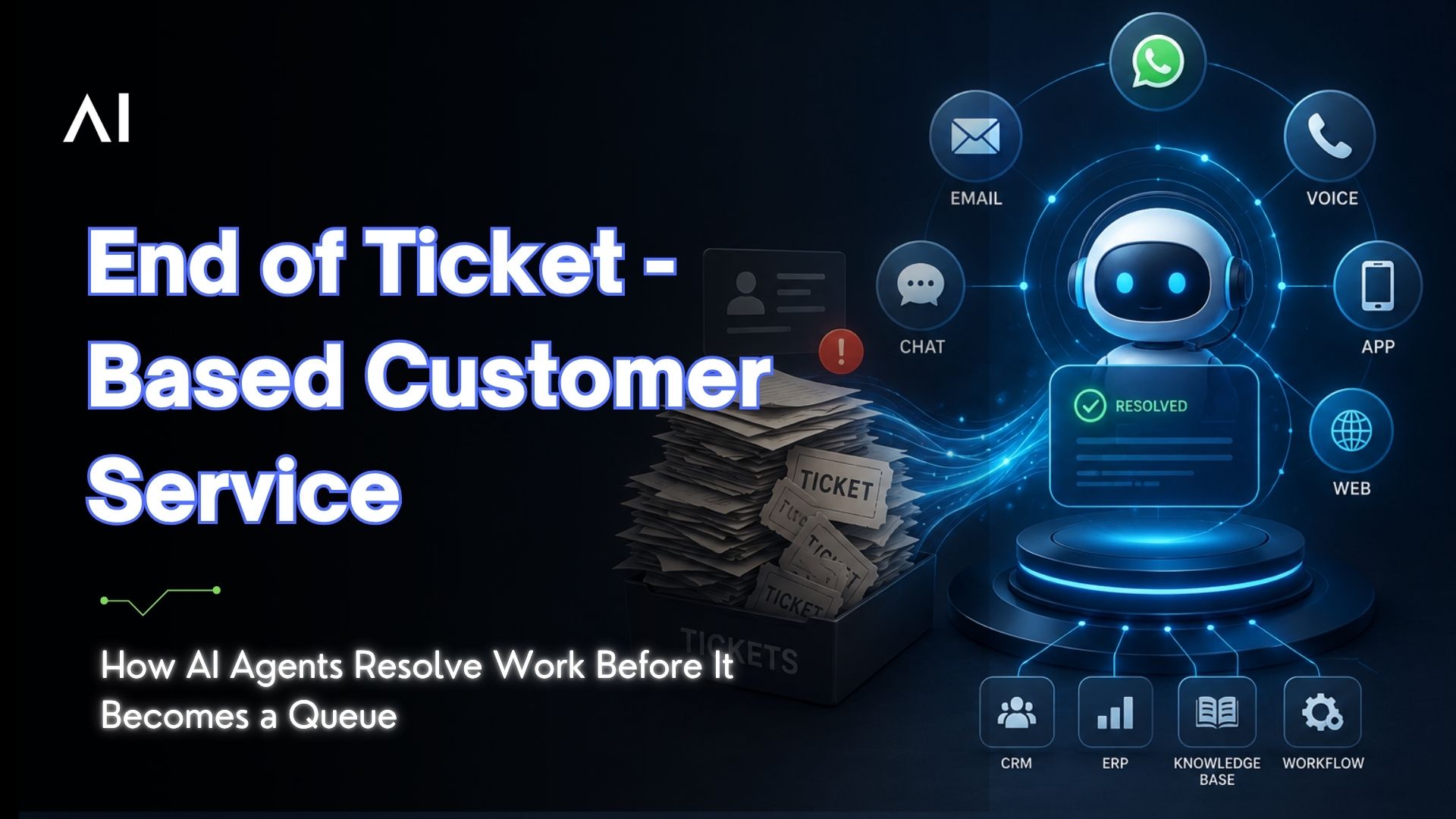
Why Ticket-Based Customer Service Is Reaching Its Limit?
AI agents for customer service do ticketing that helps enterprises manage customer issues at scale. But it was designed to process work after friction already entered the system.
Today’s customers expect resolution across voice, chat, email, WhatsApp, apps, and web without repeating themselves or waiting for internal handoffs.
That creates pressure on traditional support models:
Slower resolution cycles
Repeated customer effort
More internal handoffs
Higher cost-to-serve
Overloaded support teams
Fragmented channel visibility
For modern enterprises, the question is no longer “How fast can we close tickets?”
It is “How many issues can we resolve before they become tickets?”
What Are AI Agents for Customer Service?
AI agents for Customer Service move customer service from ticket handling to issue resolution.
They can understand intent, use business context, connect with approved systems, and trigger the next best action without forcing every request into a queue.
That means routine work can be resolved faster:
Status checks
Account updates
Document collection
Simple refunds
Escalation summaries
Proactive customer updates
Human teams still matter. But instead of spending time on repetitive queues, they can focus on complex, sensitive, and high-value customer moments.
That is the shift: fewer tickets, faster outcomes, and a more intelligent service model.
From Ticket Management to Resolution Management
Most customer service platforms were built around ticket management.
They help teams organize work, assign ownership, track status, and measure closure. That is useful, but it is not the same as solving the customer’s problem quickly. The future of support is resolution management.
Resolution management starts with a different question.
Instead of asking, “How do we route this ticket?”
It asks, “How do we resolve this issue as close to the customer’s first interaction as possible?”
That shift changes everything.
A ticket-based system treats the ticket as the unit of work.
An AI-agent system treats the customer outcome as the unit of work.
This is a major transformation, the value of customer service is no longer measured only by how many tickets a team can process. It is measured by how many customer issues can be resolved without unnecessary delay, repetition, or escalation.
AI agents for customer service make this possible by working across conversations, systems, and workflows.
How AI Agents Resolve Work Before It Becomes a Queue?
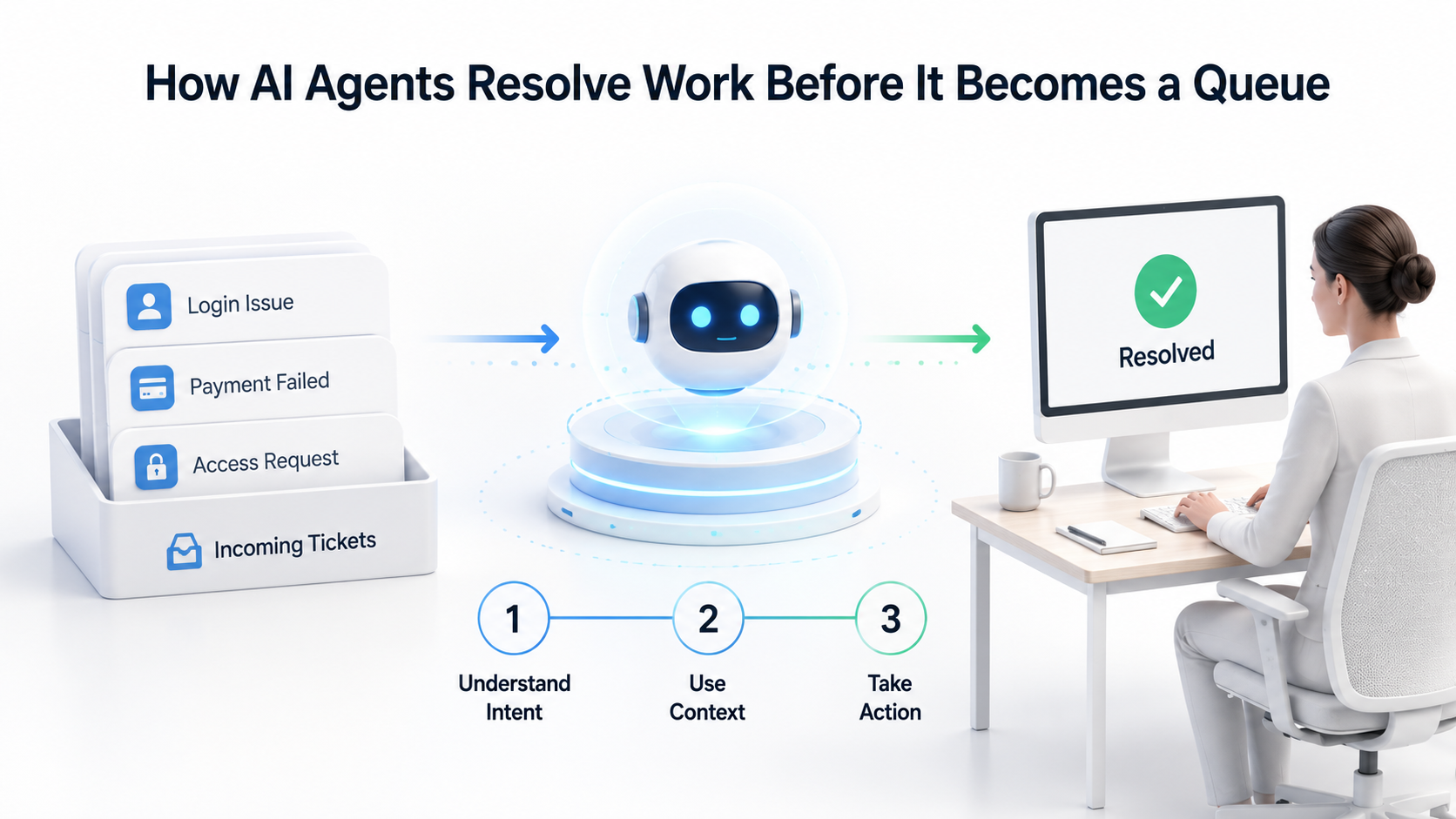
AI agents reduce support queues by acting earlier in the customer journey.
Instead of waiting for a ticket to be created, they identify the request, gather context, check approved systems, and complete routine steps in real time.
A mature AI-agent workflow can support:
Intent recognition
Context retrieval
Identity or account checks
Approved system actions
Escalation routing
Interaction logging
Customer confirmation
This is where customer service automation becomes more powerful than simple routing.
For example, a delayed refund does not always need to become a ticket. If the system can verify the customer, check refund status, identify the delay, and provide the next step, the issue can be resolved before it enters a queue.
That is the practical value of automated resolution.
Why Enterprises Need More Than Ticket Deflection?
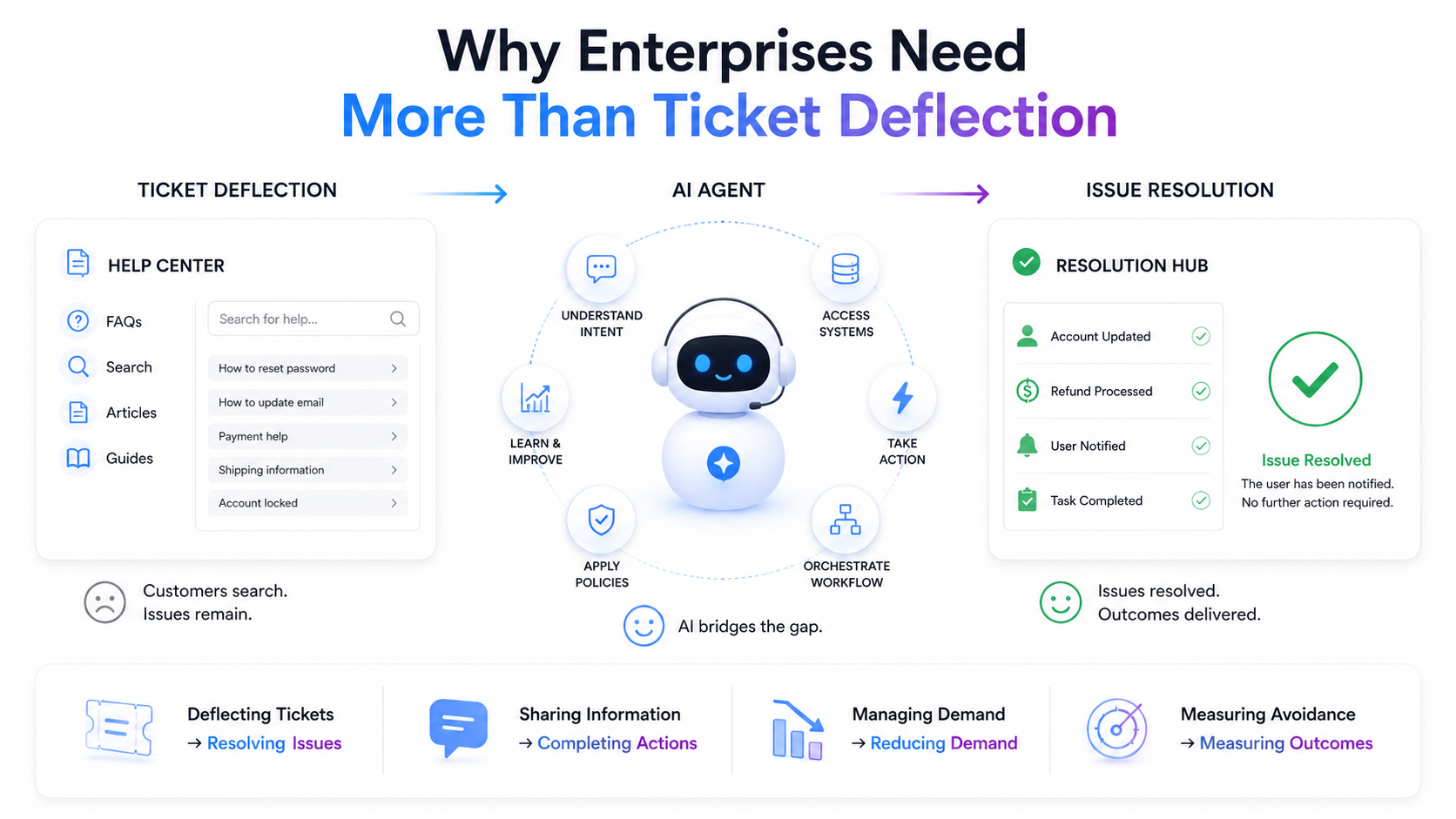
Ticket deflection has been a common support goal for years. It reduces ticket volume by pushing customers toward help centers, FAQs, or self-service flows.
But deflection is not the same as resolution.
Many deflection strategies still make the customer do the work. AI agents move beyond that model.
They help enterprises shift from:
Deflecting tickets to resolving issues
Sharing information to completing actions
Managing demand to reducing demand
Measuring avoidance to measuring outcomes
This matters because customers do not want to be deflected. They want to be helped.
The next generation of AI-powered customer experience will not be built around avoiding tickets. It will be built around completing work.
The Business Case for Ending Ticket-Based Support
For CEOs and enterprise leaders, the case for AI agents is not just operational. It is financial and strategic.
Ticket-based support is expensive because every ticket creates work. Even simple requests require routing, review, response, and follow-up. As customer volume grows, businesses often need more agents, more supervisors, more tools, and more process layers.
AI agents for customer service can change the economics.
They help reduce repetitive work, improve service speed, and allow human agents to focus on complex, high-value interactions.
The business impact can show up in several areas.
1. Lower Cost-to-Serve
When AI agents resolve routine issues automatically, fewer cases require human handling. This reduces the cost of serving each customer without reducing service availability.
2. Faster Resolution
AI agents can work instantly across multiple conversations and channels. Customers get answers and actions faster, especially for repetitive or process-driven requests.
3. Better Customer Experience
Customers do not want to wait, repeat themselves, or chase updates. AI agents can maintain context and provide faster continuity across channels.
4. Higher Human Agent Productivity
Human agents can spend less time on repetitive tickets and more time on escalations, relationship-building, complex troubleshooting, and high-value customer conversations.
5. Stronger Operational Visibility
AI agents can capture patterns across customer requests. This helps enterprises identify recurring problems, product issues, policy confusion, and process bottlenecks.
The result is a more intelligent support operation.
What AI Agents Need to Resolve Customer Issues End to End?
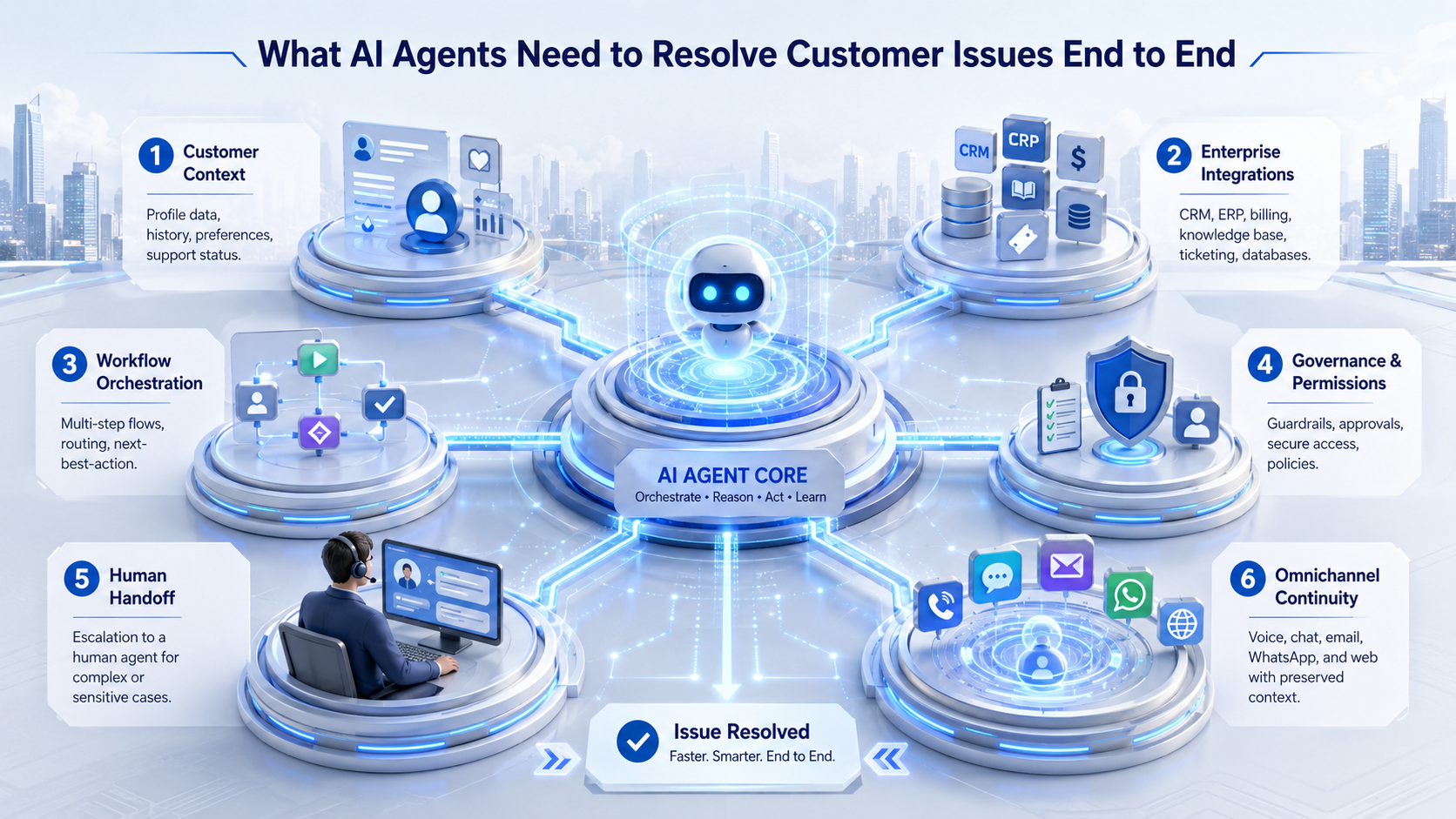
Not every AI tool can deliver autonomous customer service. To resolve issues before they become tickets, AI agents need the right foundation.
1. Customer Context
AI agents need access to relevant customer information, conversation history, previous requests, account details, preferences, and support status.
Without context, AI can only provide generic responses.
2. Enterprise System Integrations
To take action, AI agents must connect with systems such as CRM, ERP, order management, billing platforms, ticketing tools, knowledge bases, and internal databases.
This is what allows them to move from answering to resolving.
3. Workflow Orchestration
Many customer issues require more than one step. AI agents need orchestration to decide what should happen next, which system to use, which rule applies, and when to escalate.
4. Governance and Permissions
Enterprises cannot allow AI agents to act without boundaries. Every agent needs clear permissions around data access, task execution, approval flows, and escalation rules.
5. Human Handoff
The best AI customer service systems do not remove humans completely. They bring humans in when the issue is sensitive, complex, high-risk, or emotionally important.
6. Omnichannel Continuity
Customers may move across voice, chat, email, WhatsApp, and web. AI agents should preserve context across these channels so customers do not have to start over.
This is where http://Fluid.ai ’s approach becomes highly relevant: enterprises need AI agents that can operate across multiple channels while staying connected to business systems and governance requirements.
Where AI Agents Can Replace Ticket Queues First
Enterprises do not need to automate every support workflow at once. The strongest starting point is high-volume, repeatable, low-risk work.
These are the areas where AI support agents can create fast impact:
Order and transaction status
Refund updates
Appointment changes
Account updates
Document collection
Billing questions
Delivery tracking
Policy information
Support triage
Escalation summaries
These workflows are ideal because they are frequent, measurable, and often process-driven.
Once these areas are optimized, enterprises can expand into more advanced workflows such as claims, complaints, renewals, onboarding, and regulated customer operations.
That is how agentic customer service scales responsibly.
Why Customer Service Still Needs Omnichannel AI and Human Trust?
Omnichannel AI Agents Keep Journeys Connected
Customers move across WhatsApp, email, chat, voice, apps, and web. Omnichannel AI agents preserve context so every interaction feels like one continuous journey.
Human Teams Protect Trust
AI agents handle repeatable work. Human teams step in for complex, sensitive, or high-value moments where judgment and empathy matter.
The Future of Customer Service Is Queue-Free
Ticket queues will not disappear completely. Complex cases will still need ownership, structure, and human review. But the role of the ticket will change.
In the future, tickets will become the exception, not the default. Routine issues will be resolved before they become backlog. Human teams will focus on higher-value interactions. Support leaders will manage resolution systems, not just case queues.
This is the future of autonomous customer service.
AI agents for customer service make that shift possible by connecting intent, context, systems, workflows, and human oversight into one operating model.
Conclusion
Ticket-based customer service was built to organize support work. But modern enterprises need more than organized work. They need resolved work.
AI agents for customer service help businesses move from reactive support to proactive resolution. They reduce unnecessary queues, improve service speed, support omnichannel experiences, and allow human teams to focus on the moments that matter most.
For http://Fluid.ai , this is the future of enterprise customer service: fewer tickets, faster outcomes, smarter automation, and customer experiences built around resolution instead of waiting.
Book your Free Strategic Call to Advance Your Business with Generative AI!
Fluid AI is an AI company based in Mumbai. We help organizations kickstart their AI journey. If you’re seeking a solution for your organization to enhance customer support, boost employee productivity and make the most of your organization’s data, look no further.
Take the first step on this exciting journey by booking a Free Discovery Call with us today and let us help you make your organization future-ready and unlock the full potential of AI for your organization.
_1790254083168-CB8e8KXC.png)