Invisible but Inevitable: Why AI Agents Are the New Digital Colleagues

TL;DR
AI agents are already embedded in daily workflows, silently optimizing your apps, inbox, and finances.
They don’t just follow commands—they self-learn, anticipate, and act across tools.
Enterprises are experimenting with Agentic OS platforms where invisible agents orchestrate entire operations.
Everyday life is shifting too: from Spotify’s DJ to agents that cancel subscriptions you forgot about.
The winners of tomorrow will be enterprises that embrace agentic tooling, self learning agents, and AI agent platforms as core infrastructure.
From Apps to Agents: The Big Shift
When software first went mainstream, it was all about apps. Each app did one thing well: messaging, music, calendars. But apps depend on you to open them and give instructions.
AI agents flip that model. They’re not waiting for input—they’re running in the background, making micro-decisions constantly. You didn’t tell Gmail which emails were important, but it figured it out. You didn’t ask Netflix to save you from watching a bad series, but its recommendation agent quietly pushed you elsewhere.
This silent orchestration is the hallmark of the invisible workforce.
We recently shared some of the most jaw-dropping examples of this shift—check out The 6 Most Impressive AI Workflows of 2025.
What Exactly Is an AI Agent?
At its simplest: an AI agent is software that can sense, decide, and act without step-by-step programming. Unlike static apps, agents:
Monitor environments (your inbox, transactions, server logs).
Decide what action makes sense (flag spam, escalate a ticket, approve a payment).
Act automatically or bring results back for your review.
That loop—sense, decide, act—means they’re less like tools and more like digital colleagues.
Want to go deeper into the architecture powering these agents? Read our breakdown of The Agentic AI Operating System
The Layers of Invisible Agents
Not all agents are created equal. Think of them in layers:
Single-Task Agents
Example: a spam filter. It learns what you ignore and routes accordingly.
Invisible? Completely.
Multi-Modal Agents
Example: a fraud detection bot at a bank. It looks at location, device ID, transaction history, and customer behavior—across systems—to stop fraud before you even notice.
Self Learning Agents
Example: customer service bots that learn from historical tickets to improve resolution speed. They don’t just follow scripts; they adapt.
Orchestrators (Agentic OS)
These don’t just work in silos. They coordinate multiple smaller agents to deliver results. Imagine booking a trip: one agent compares flights, another handles visas, a third manages expense filing, all under an agentic OS umbrella.
For a glimpse of where this is heading, see why we believe every customer will soon have their own AI agent.
When these orchestrating agents are turned inward on the workforce, they become digital employee experience software. Instead of an employee juggling separate HR, IT, and finance portals, a layer of coordinated agents handles the whole request end to end, resetting access, answering a payroll question, or booking leave, without the person ever leaving their flow of work.
That is exactly the shift digital employee experience software is chasing: moving from a tool an employee has to operate to an invisible colleague that simply gets the task done. One agent checks the policy, another executes the action, a third confirms it, all behind a single point of contact.
Everyday Examples You’ve Already Met
You might not call them “agents,” but you’ve been using them daily:
Email triage: Gmail’s “Important” folder is a constant AI agent decision.
Shopping: Amazon’s recommendation engine works like a silent personal shopper.
Subscriptions: New startups deploy agents that watch your bank account for recurring charges and cancel under-used services.
Content feeds: TikTok’s algorithm is essentially a personal entertainment agent, customizing your stream every second.
The difference now is that these agents are evolving from consumer quirks into enterprise infrastructure.
Invisible Agents at Work in Enterprises
Behind the polished dashboards executives love to show, invisible agents are already doing heavy lifting:
Compliance: Bots crawl financial transactions against regulatory frameworks (GDPR, DPDP, SOC2) and auto-flag anomalies.
Cybersecurity: AI agents patch vulnerabilities, simulate attacks, and enforce Zero Trust policies in real time.
Finance Ops: Agents reconcile invoices, detect duplicate payments, and even negotiate payment terms with suppliers.
Customer Support: Instead of waiting in IVR hell, you get routed by a silent decision agent that predicts intent and routes you to the right resolution path.
For most enterprises, this is the new invisible workforce—quiet, cheap, scalable.
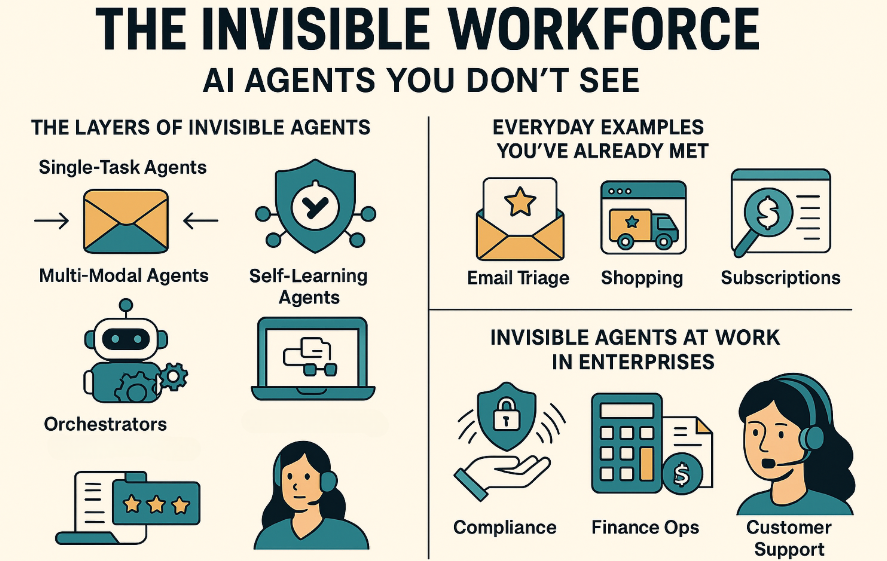
The hidden AI workforce quietly powering your inbox, shopping, finances, and enterprise operations.
Why Agents Are More Than Just Automation
It’s tempting to dismiss agents as “just automation.” But here’s the difference:
Automation follows hard rules.
Agents self-learn, adapt, and operate across messy, unstructured environments.
That means when environments change—new regulation, customer behavior shift, supply chain delays—agents adjust without requiring armies of developers to rewrite rules.
Think of RPA (Robotic Process Automation) as static robots. AI agents are dynamic colleagues who learn the ropes on their own.
The Rise of the Agentic OS
The concept of an Agentic OS is one of the hottest undercurrents in enterprise AI. Instead of siloed apps, imagine an operating system where invisible agents run as background services:
HR agent: tracks attrition patterns, predicts resignations, and nudges managers with retention playbooks.
Finance agent: auto-generates quarterly forecasts from live ERP data.
IT agent: detects bottlenecks in CI/CD pipelines and re-routes workflows.
This isn’t theory—companies like Fluid AI are already prototyping these architectures. It’s where Fluid GPT, AI agent platforms, and agentic tooling converge.
The Consumer Future: Subscription-Free Living
For individuals, the most relatable impact will be subscription management. Invisible agents are moving toward:
Canceling free trials before they convert (without you remembering the date).
Negotiating renewals (“Can you give me 20% off to keep me as a customer?”).
Switching providers if they find a cheaper or better plan.
Your financial health could be quietly optimized while you sleep.
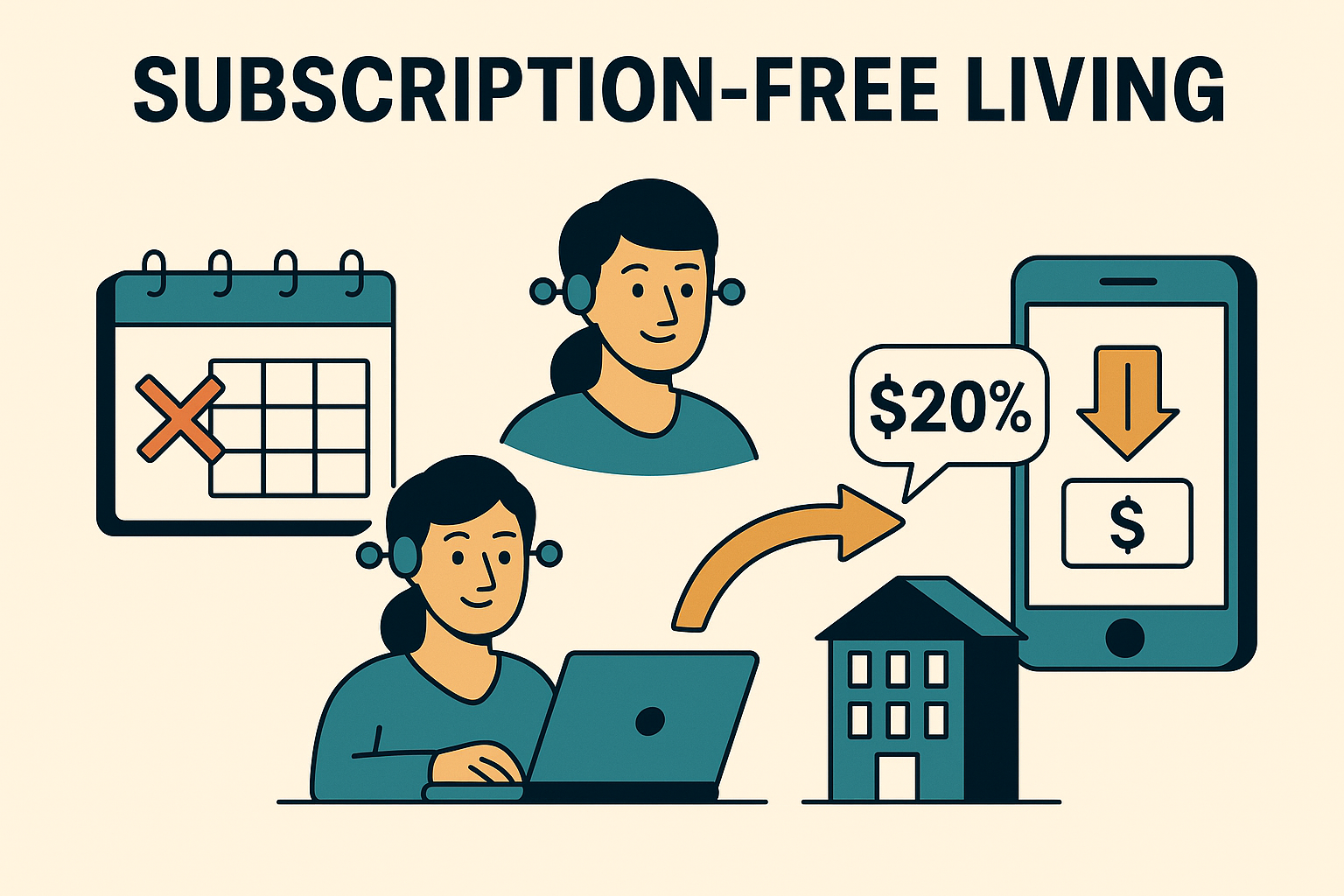
AI agents quietly cutting costs and managing your subscriptions for you.
The Economic Impact of an Invisible Workforce
Enterprises adopting agents at scale are already reporting:
Significant reduction in manual back-office tasks.
Faster cycle times—weeks to minutes in contract approvals.
Lower compliance penalties by catching issues early.
And because these agents don’t need benefits, training, or holidays, they’re reshaping what “workforce planning” means.
From Chatbots to Omnichannel Colleagues
The leap from basic chatbots to invisible agents is huge. Where chatbots were tied to one channel—say, a website widget—today’s agents are omnichannel colleagues. They move across voice, chat, email, and enterprise apps without breaking the flow.
Voice: A customer calls and speaks with an AI voice agent. While the conversation feels natural, the agent is also pulling CRM data, updating tickets, and triggering backend workflows.
Chat: On WhatsApp or a web chat, the same agent continues the conversation, keeping context intact across platforms.
Email: Agents quietly draft responses, detect urgency, and route issues into the right workflows—often faster than a human support team could.
Apps: Whether it’s banking, HR, or supply chain, these agents sit in the background, stitching together data so users experience one consistent journey.
This shift means enterprises no longer have “chatbots” that live in silos. They have colleagues—omnichannel agents that work invisibly across every customer touchpoint, driving efficiency and consistency at scale.
Explore how enterprises are already putting this into action with our Autonomous AI Voice & Calling Agents solution.
Where Do Influencers Fit?
Interestingly, the buzz around AI influencers—digital personas with millions of followers—represents the visible side of AI. They capture attention, drive brand engagement, and act as marketing assets.
But behind every polished AI influencer is a team of invisible agents: content scheduling bots, analytics engines, SEO crawlers, and recommendation agents deciding what you see.
The influencers are the face. The invisible agents are the muscle.
If you’re curious about the visible side of AI too, here’s our list of Top 10 AI Influencers You Can’t Ignore in 2025
What This Means for Enterprises
The lesson is simple: if you’re still thinking about AI as “chatbots” or “tools,” you’re already behind.
Enterprises need to ask:
Which invisible agents are already running inside my systems?
How do I unify them into an agentic OS?
Do I trust them enough to escalate decision-making power?
Because in a few years, businesses won’t be judged by how many employees they have—but by how many invisible agents are quietly working for them.
We also dive into how Agentic AI is reshaping marketing—check out our AI-powered marketing solutions.
Final Word: The Workforce You Don’t See
The AI hype often focuses on the visible—chatbots, avatars, famous AI influencers. But the real shift is invisible. Agents are becoming the digital equivalent of electricity: you don’t notice it, but it powers everything.
The smartest move today? Stop obsessing about shiny apps. Start mapping out your invisible workforce strategy. Because whether you like it or not, they’re already here—and they’re not asking for permission.
Frequently Asked Questions
How are AI agents different from traditional software apps?
While apps rely on users to open them and provide specific instructions, AI agents run in the background to sense, decide, and act autonomously. This loop makes them function more like digital colleagues rather than static tools.
What is an Agentic OS in the context of invisible agents?
An Agentic OS is an operating system where multiple agents act as background services to coordinate complex operations. Instead of working in silos, these agents orchestrate different tasks, such as HR tracking or finance forecasting, under one umbrella.
What impact do invisible agents have on enterprise operations?
Enterprises report significant reductions in manual back-office tasks and faster cycle times for processes like contract approvals. These agents improve compliance by automatically flagging anomalies and help manage cyber threats in real time.
_1790254083168-CB8e8KXC.png)