The Invisible AI Workforce: How Enterprises Are Moving From Automation Tools to Autonomous Operations

TL;DR
The line between automation and autonomous operations is not technical sophistication. It is whether the system owns the outcome or just executes a step.
"Invisible" is the maturity marker. When users stop seeing the AI and only see the work done, the workforce is operating, not piloting.
Three shifts separate enterprises with autonomous operations from those running automation theater: from scripts to goals, from supervision to delegation, and from interfaces to outcomes.
Most stalled programs are stuck on operating model, not on model quality. Agents are being deployed into the same human-in-every-loop processes that automation lived in.
The next 18 months will widen the gap between enterprises that re-architected their operations and those that bolted agents onto legacy workflows.
Introduction
The shift everyone is talking about in enterprise AI is not from humans to bots. It is from automation tools that execute tasks to an autonomous workforce that owns outcomes. The distinction sounds semantic. It is not. An automation script needs to be triggered, monitored, and explained when it breaks. An autonomous agent takes a goal, decides how to pursue it, recovers from failure, and reports the result. One is a tool. The other is a colleague.
If your enterprise has scaled the first and is wondering why the second still feels out of reach, this piece is for the operators, CIOs, and transformation leads asking that exact question.
What "invisible AI workforce" actually means
The phrase is doing more work than it gets credit for.
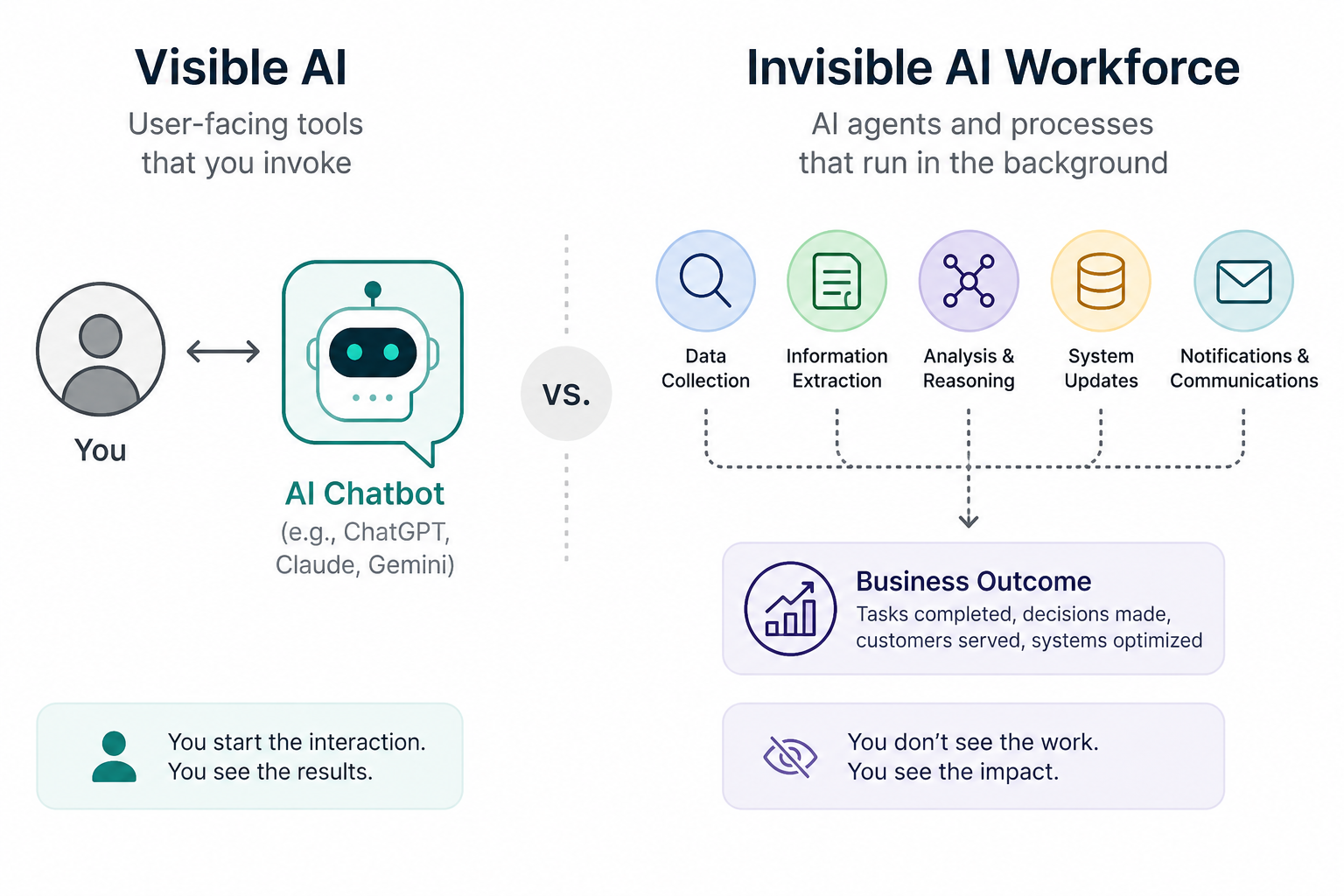
Most enterprises already have AI in production. But it tends to be visible AI: a chatbot on the support page, a copilot inside the CRM, a recommendation panel in the e-commerce flow.
Visible AI is something a user invokes. They open it, type into it, accept or reject its output. An invisible AI workforce is different. It runs in the background of operations the user never sees.
It is the layer that reconciles a payment exception at 3 a.m. without a human ever touching it.
It is the agent that closes a claim file by gathering the documents, cross-checking the policy, and routing the result to the adjuster, who reviews instead of executes.
It is the procurement assistant that negotiates within a band of pre-approved terms and surfaces only the deals that fall outside it.
The user does not interact with the workforce. The user sees the outcome.
Most enterprise work has been invisible to end customers for decades. Settlement, reconciliation, KYC, compliance review, document processing, internal ticketing.
The new question is not whether AI can be invisible. It is whether AI can hold those invisible jobs end to end.
Automation tools vs autonomous operations: the real distinction
The two categories get conflated because the vendor language overlaps.
The difference is in five dimensions. Any one of them missing pushes the system back into the automation category.
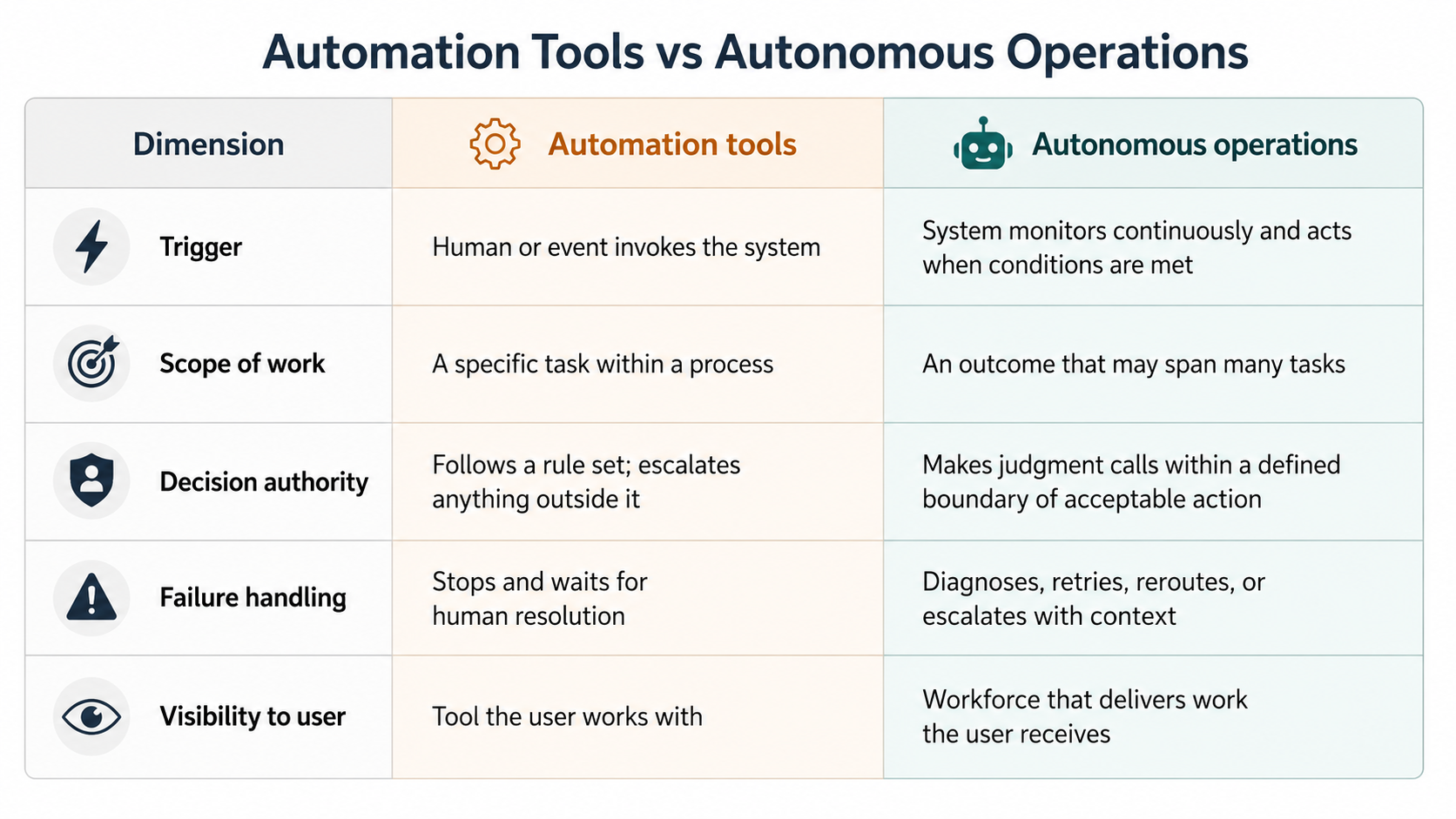
A bot that processes invoices when a file lands in a folder, follows a fixed extraction template, and stops if a field is missing is an automation tool. The model behind it does not matter.
An agent that monitors the invoice queue, handles standard processing, escalates only the anomalies that genuinely require human judgment, and learns which patterns recur is an autonomous operation.
The model inside both might be the same. The difference is what the system is allowed to own.
Why "invisible" is the maturity marker
When teams pilot AI, they instinctively put a UI on it. The UI is reassuring. It tells the team they are still in control.
Mature autonomous operations move past this. The UI shrinks until it disappears.
The team is not approving every action. They are reviewing exceptions, monitoring drift, and adjusting the goals the workforce is pursuing.
This is the inflection point most programs do not reach.
Not because the technology is missing. Because the operating model never gets redesigned.
The agents are dropped into the same workflow the humans used. Same approval gates. Same handoffs. Same dashboards.
The result is faster automation, not an autonomous workforce. The work still moves at the speed of the slowest human review.
Invisible is uncomfortable. It is also where the value lives.
An AI workforce that needs a human in every loop costs the same as the human, plus the AI.
An AI workforce that owns the loop, and surfaces only what genuinely needs judgment, changes the unit economics of the whole operation.
The three shifts that separate autonomous operations from automation theater.
Enterprises that have made the transition share three operational changes:
1. From scripts to goals.
Automation is told what to do. Autonomous systems are told what outcome to deliver, and given the means to figure out the steps.
This sounds abstract until you try to write the requirements document. Specifying a script is engineering. Specifying a goal is management.
The teams that thrive at this rebuild their internal documentation to describe outcomes, constraints, and acceptable trade-offs. Not procedures.
2. From supervision to delegation.
A supervised system has someone watching every action. A delegated system has someone watching the boundary conditions.
The delegation requires three things: the boundary is well defined, the agent reports up when it gets near the edge, and the humans have meaningful escalation criteria. Most failed pilots fail here.
The agent is delegated work, but the humans were never given a new job description. So they keep doing the old one. And the agent's autonomy stays theoretical.
3. From interfaces to outcomes.
This is the cultural shift. Teams measure interface productivity (tickets closed, calls handled, forms processed) because they have always been able to.
Autonomous operations push the measurement up a level. To the outcome the work was supposed to produce.
Did the customer issue actually resolve? Was the claim correctly settled? Did the procurement deliver value? When the measurement moves to outcomes, the workforce can be redesigned around them.
Where most enterprises get stuck: Automation theater?
The most common failure pattern is what could be called automation theater.
The buying motion looks like agentic AI. The architecture diagram has agents in it. The vendor pitch promised autonomy. In production, every agent action still routes to a human who clicks approve.
This happens for understandable reasons.
Risk teams want oversight. Legal wants audit trails. Operations wants to be able to explain every decision. The compromise is human-in-every-loop. Which preserves the appearance of autonomy and eliminates the economic benefit.
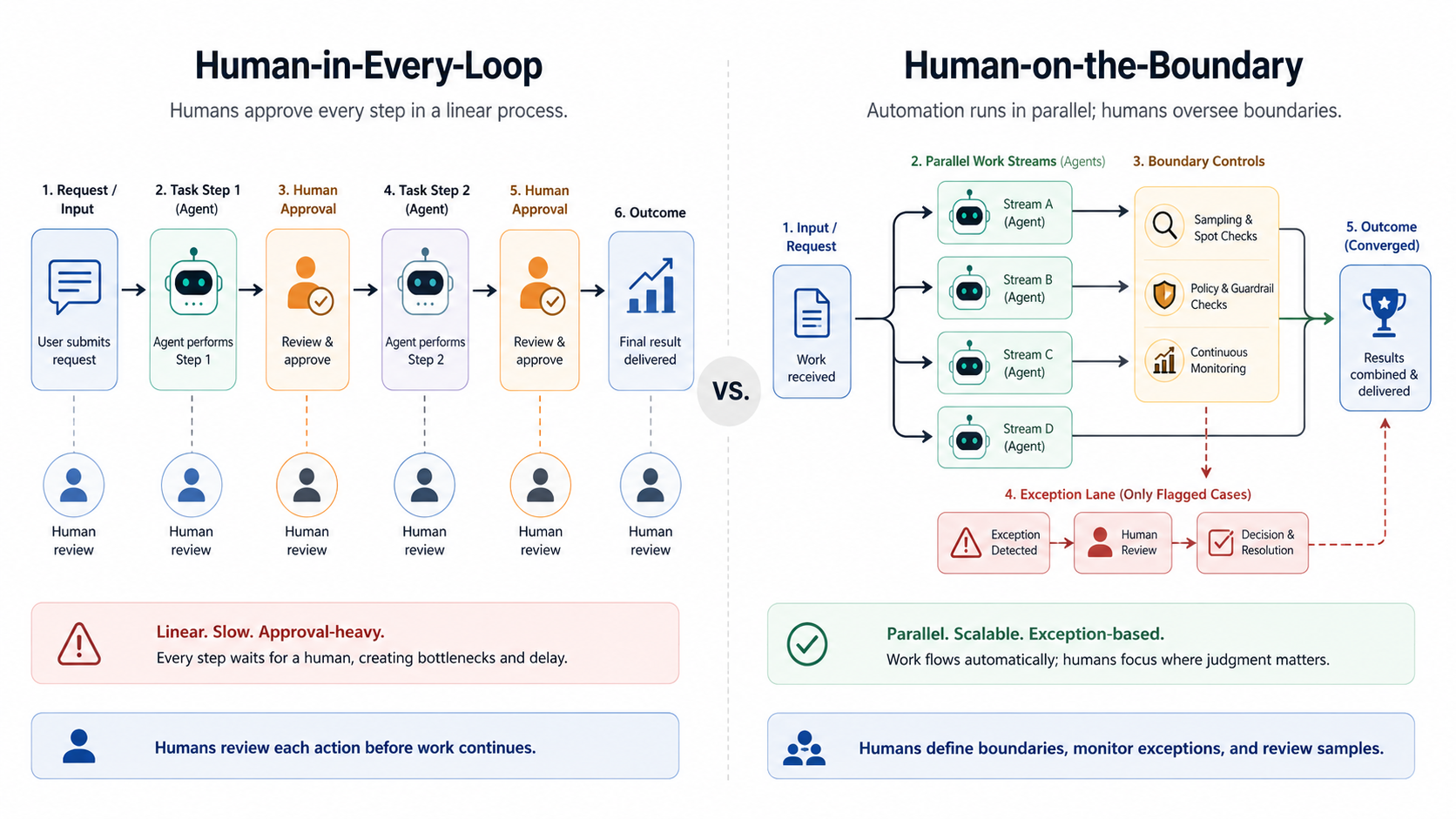
The fix is not to remove oversight. It is to redesign it.
Oversight at the decision level is paralyzing. Oversight at the boundary level (sampling, drift monitoring, exception review, periodic audits) is what allows the workforce to operate at scale while remaining accountable.
This is how human workforces have always been governed.
Managers do not approve every action their team takes. They set objectives. They monitor results. They review outliers. The same operating principles apply when the workforce is software.
What this looks like in production?
In banking, where Fluid AI has worked with institutions including Bank of America, Barclays, and Mastercard, the highest-leverage deployments tend to live in operations that were never customer-facing.
Settlement. Reconciliation. Exception handling in payments. Compliance triage. These are jobs where the work is high-volume, high-precision, and largely invisible.
They are also jobs where the cost of every additional human reviewer compounds. Which makes the economics of autonomous handling compelling.
In manufacturing and logistics, the equivalent pattern shows up in maintenance scheduling, fleet routing, and anomaly response.
The work involves continuous monitoring, decisions under uncertainty, and recovery from disruptions.
These are conditions automation tools were never designed for. And conditions autonomous operations handle as their default mode.
The common thread: the highest-value autonomous deployments tend to be the least visible ones.
The teams running them are not winning awards for customer-facing AI. They are quietly removing the operational overhead that automation could never touch.
What to do this quarter?
Three actions are worth taking now, regardless of where a program currently sits.
First, audit one operational process end to end:
Identify which steps require human judgment and which only have a human because that is how it has always been done. The gap between those two is where autonomous operations will live.
Second, rewrite the requirements for one in-flight pilot in terms of outcomes rather than steps:
If the team cannot articulate the outcome, the pilot is not ready to be autonomous. Another round of automation will not change that.
Third, give the humans currently in the loop a new job description:
Boundary monitor. Exception reviewer. Escalation handler. If the new job is meaningfully different from the old one, the autonomy is real. If it is the same job with extra steps, the agent is automation in a different shirt.
Curious what this looks like inside a Tier-1 bank's operations stack? See how Fluid AI's agentic platform handles end-to-end exception resolution in regulated environments.
The next 18 months:
The gap between enterprises that re-architected their operations around autonomous agents and those that bolted agents onto legacy workflows is going to widen.
The technology is now cheap enough and good enough that the differentiator is no longer model quality. It is operating model.
The enterprises that will pull ahead are not the ones with the most agents in production.
They are the ones whose users have stopped noticing.
Book your Free Strategic Call to Advance Your Business with Generative AI!
Fluid AI is an AI company based in Mumbai. We help organizations kickstart their AI journey. If you’re seeking a solution for your organization to enhance customer support, boost employee productivity and make the most of your organization’s data, look no further.
Take the first step on this exciting journey by booking a Free Discovery Call with us today and let us help you make your organization future-ready and unlock the full potential of AI for your organization.