Agentic AI vs RPA: Difference Between Agentic AI and Robotic Process Automation

TL;DR
Robotic Process Automation, or RPA, follows fixed scripts. Agentic AI follows goals.
That difference matters.
RPA is useful for repetitive, rule-based tasks where the process never changes. But it breaks when documents are messy, systems change, exceptions appear, or judgment is needed.
Agentic AI can read, reason, decide, use tools, handle exceptions, and move workflows forward across systems.
For enterprises, the mistake is calling both “automation.” One automates tasks. The other owns outcomes.
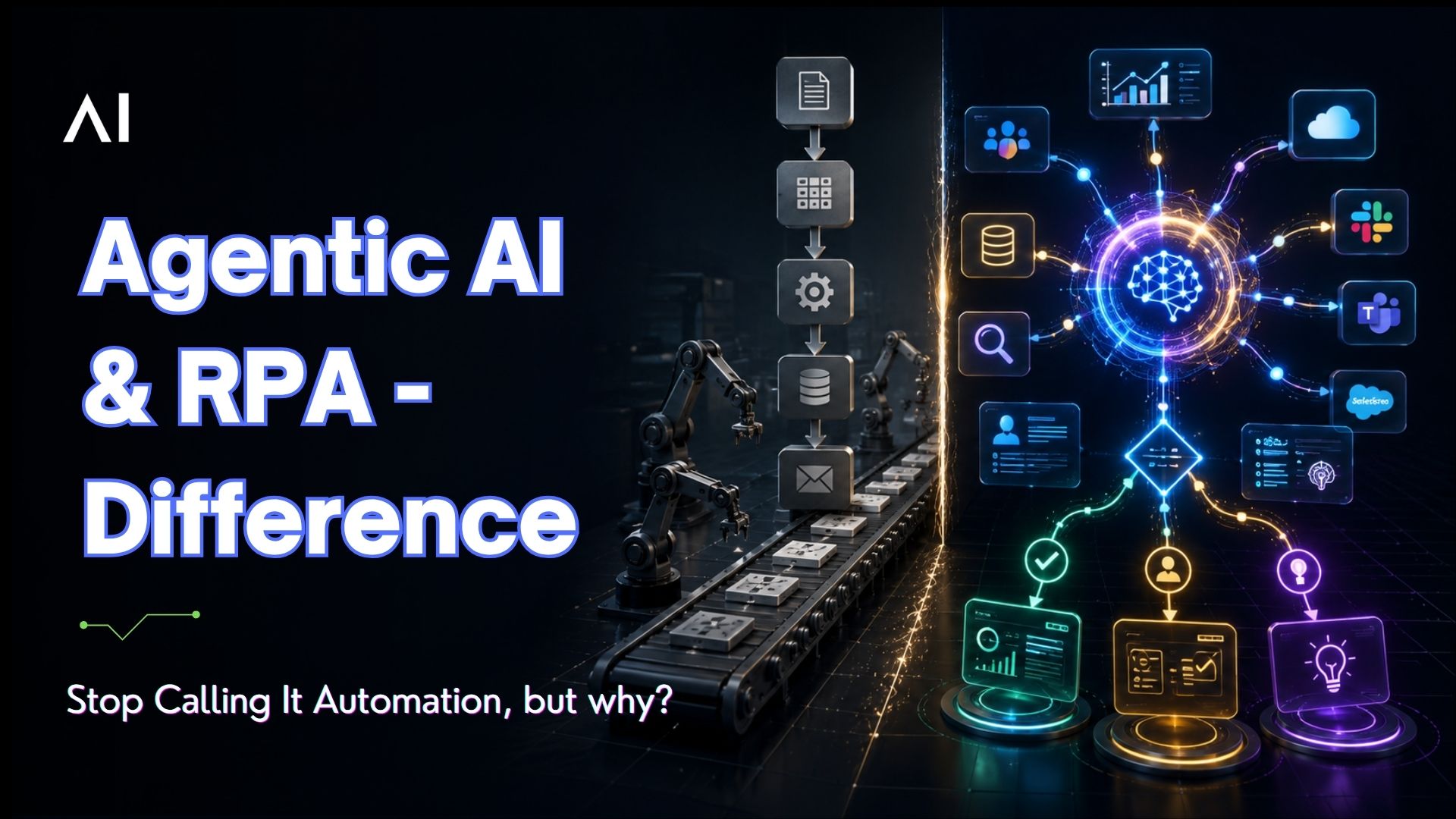
Stop Calling It Automation: Why Agentic AI and Robotic Process Automation Are Not the Same Thing
When your vendor says "automation," they do not all mean the same thing. Sometimes it is a bot that clicks through screens in a fixed order. Sometimes it is an AI that reads a messy PDF, makes a call, and updates three different systems while you are still on your second coffee.
Same word. Completely different technology. Completely different outcomes.
The problem is that nobody is saying this out loud. So enterprises keep signing contracts for one thing thinking they are getting the other. Pilots fail. Budgets get wasted. And everyone sits in a room wondering what went wrong.
Most people leave this conversation with a vague sense that they are different.
What RPA Actually Is?
RPA stands for Robotic Process Automation. Which, honestly, sounds a lot more impressive than what it actually does. At its core it watches a human complete a task and then copies that task on repeat. Same clicks, same sequence, same outcome every time. No variation. No interpretation. Just repetition at scale.
And for a long time, that was enough. A decade ago, banks and insurers were drowning in manual back office work. Data entry, report generation, account reconciliation. Repetitive, high volume, low variation tasks that humans were doing by hand. RPA came in and automated all of it. Thousands of hours saved. Real money recovered.
The catch showed up later.
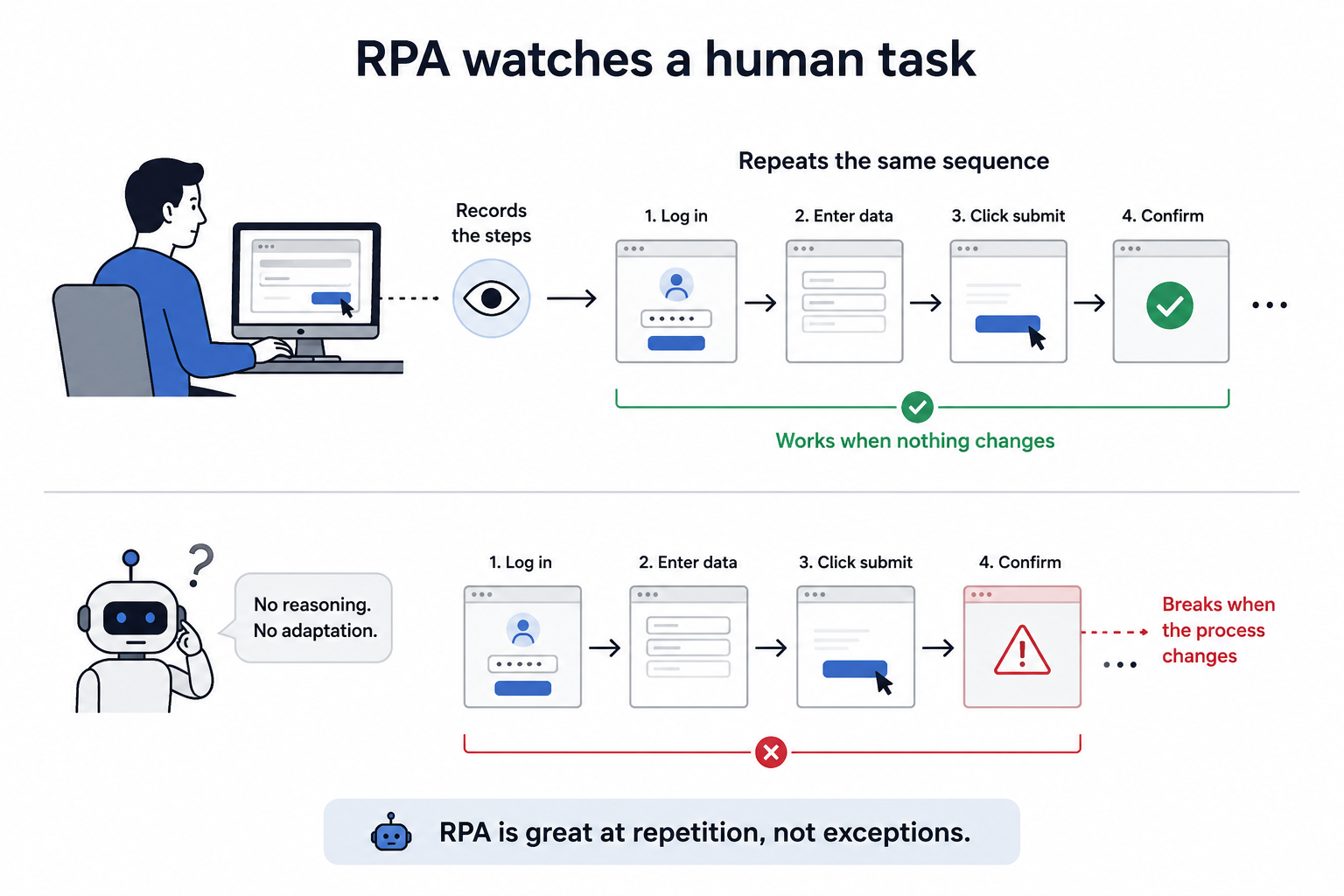
Because RPA only works when everything stays exactly the same. Move a button on a screen. Rename a field. Change the layout of a form. The bot does not adapt. It breaks. And while it is broken, whatever process it was running stops completely until a developer goes in and fixes the script.
There is no reading happening. No reasoning. No handling of anything unexpected. The moment a situation falls outside what the bot was originally programmed for, it has nothing to offer.
The honest way to think about RPA is this. It is your most dependable intern. Shows up every day, never complains, follows the checklist perfectly. But hand it something that is not on the checklist and it will just stand there.
What Agentic AI Actually Is?
Here is what nobody tells you when they are selling you both in the same breath. RPA and Agentic AI do not belong in the same category. They are not cousins. They are not even distant relatives. One follows a path someone else built. The other figures out the path while it is walking.
When you give an AI agent a goal, process this application, sort out this complaint, check this transaction, it does not wait for instructions on how. It reads what is there, works out what matters, and moves. The whole thing happens in real time based on what is actually in front of it, not what someone anticipated last quarter when they built the workflow.
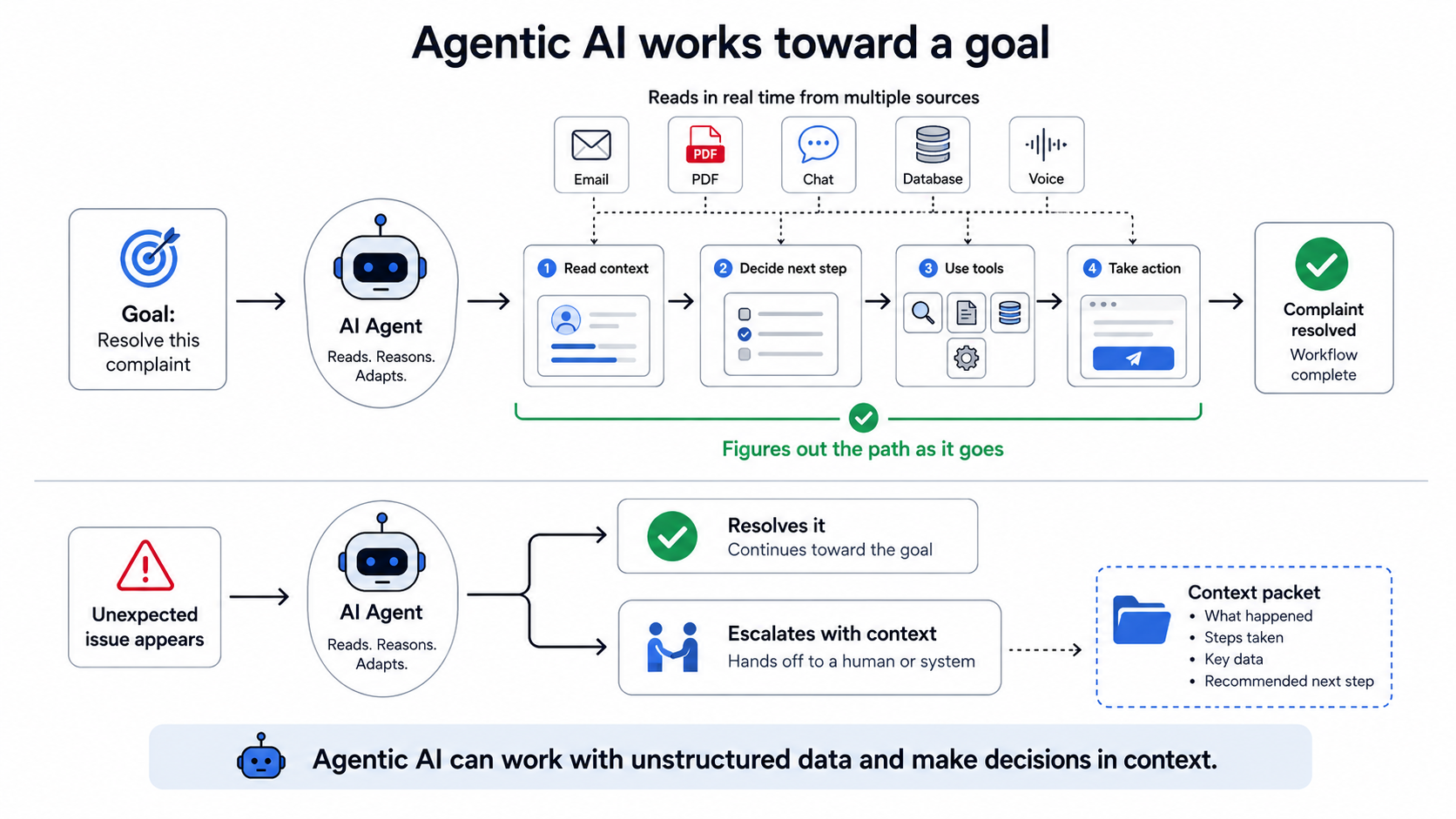
That is genuinely different from anything RPA does. And when something unexpected shows up midway, which in any real enterprise workflow it will, the agent does not stall. It reads it, decides, and either resolves it or hands it off with everything the next person needs already attached. Nobody is piecing the context together from scratch.
The other thing worth saying clearly is that RPA simply cannot work with unstructured data. Emails. PDFs. Scanned documents. Voice recordings. Chat transcripts. A huge portion of the information flowing through a bank or insurance company lives in these formats. RPA cannot touch any of it.
That is not a configuration problem. That is a fundamental limitation of what the technology was built to do.
RPA follows a script. Agentic AI follows a goal.
If that one sentence landed, the rest is just detail. But here it is anyway.
RPA needs every step written out before it can do anything. Open this system. Go to this field. Copy this value. Paste it here. Click submit. If anything on that path looks different from what the bot expects, it stops.
Agentic AI gets a destination and finds its own way there. Give it a loan application and it will read the documents, check eligibility, pull credit data, flag what needs flagging, and either approve or escalate with a clear explanation of why. No pre-built map required.
RPA cannot read. Agentic AI reads, reasons, and decides.
RPA cannot handle exceptions. Agentic AI was built for them.
RPA breaks when something changes. Agentic AI adapts.
RPA works on structured data. Forms, fields, databases with clean inputs. Agentic AI works on everything. The messy, unstructured, inconsistent stuff too.
RPA is fast at repetition. Agentic AI is capable of judgment.
And the one that most enterprises are still not fully sitting with. RPA automates a task. Agentic AI owns an outcome.
That last line is not just a reframe. It is the whole business case. And it is why buying RPA and telling your board you have AI is not just a terminology mistake. It is a strategy mistake.
What Happens When You Confuse the Two?
This is where the vocabulary problem becomes an expensive one.
Picture a mid-sized bank modernising loan processing. The vendor demo looks clean: the bot moves fast, fields fill themselves, numbers appear, and everyone feels like progress just happened.
Six months later, the team is on its fourth escalation call. A routine UI update in the core banking system keeps breaking the bot. Every exception in the lending queue still needs a human. The STP rate rose by 11 percent. The target was 60.
Why RPA failed: the bank bought a rule-follower and gave it work that required judgment.
Why change management is not the fix: no amount of training or adoption work can make a scripted bot read, reason, or handle exceptions.
The hidden costs: wasted budget, teams losing confidence in AI, and competitors moving faster because they chose the right technology early.
The real warning: saying “we already have automation” is dangerous if that automation is RPA. There is an entire category of work it cannot touch, and someone else’s AI agent already is.
What To Ask Your Vendor Before You Sign Anything
The next time someone presents you with "intelligent automation" or "AI-powered workflows" or "end-to-end process automation," ask these three questions before the demo wraps up.
One. What happens when the process changes?
If the answer involves a developer, a redeployment, or any kind of timeline to get back up and running, that is RPA. An AI agent does not need to be reprogrammed when your core system gets an update. It reads what is in front of it and continues.
Two. Can it handle a document it has never seen before?
RPA needs the document to look exactly like the ones it was built for. Change the font, shift a column, use a slightly different template and it falls over. An AI agent does not care. It reads the thing, pulls out what it needs, and keeps going. Messy formatting, inconsistent structure, a form it has genuinely never seen before. None of that stops it. If your vendor cannot say the same about their product, that pause before they answer is all the information you need.
Three. What happens when it hits an exception?
RPA hits an exception and either stops or fails quietly, which is somehow worse. An AI agent hits the same exception and actually does something about it. It reads what happened, figures out if it can handle it, and if it cannot, escalates with everything already packaged up so the person picking it up can act immediately rather than spend twenty minutes reconstructing what went wrong. If your vendor describes exception handling as "it flags it for review" and leaves it there, that is worth pushing on. A lot harder.
The Era of "Just Automate It" Is Over
RPA still has a role. High volume, low variation, fully structured processes that never change. It does that job well and it always will.
But the work that actually determines whether a bank or insurer pulls ahead. Loan processing, claims assessment, fraud detection, customer resolution, compliance monitoring. That work has always involved judgment calls, unstructured inputs, and situations nobody planned for.
A bot that follows a script was never going to be enough for that. It was always going to need something that could read the room.
So the next time someone in a meeting says "we are automating that," ask which kind. The answer will tell you more about where that organisation is actually headed than any strategy deck will.
At Fluid AI, this is the kind of AI we build - agents that read, reason, decide, and act across the most complex workflows in banking, insurance, and fintech.
Book your Free Strategic Call to Advance Your Business with Generative AI!
Fluid AI is an AI company based in Mumbai. We help organisations kickstart their AI journey. If you're seeking a solution for your organisation to enhance customer support, boost employee productivity and make the most of your organisation's data, look no further.
Take the first step on this exciting journey by booking a Free Discovery Call with us today and let us help you make your organisation future-ready and unlock the full potential of AI for your organisation.