Improving Customer Retention Through Faster Loan Turnaround Times with Agentic AI

TL;DR
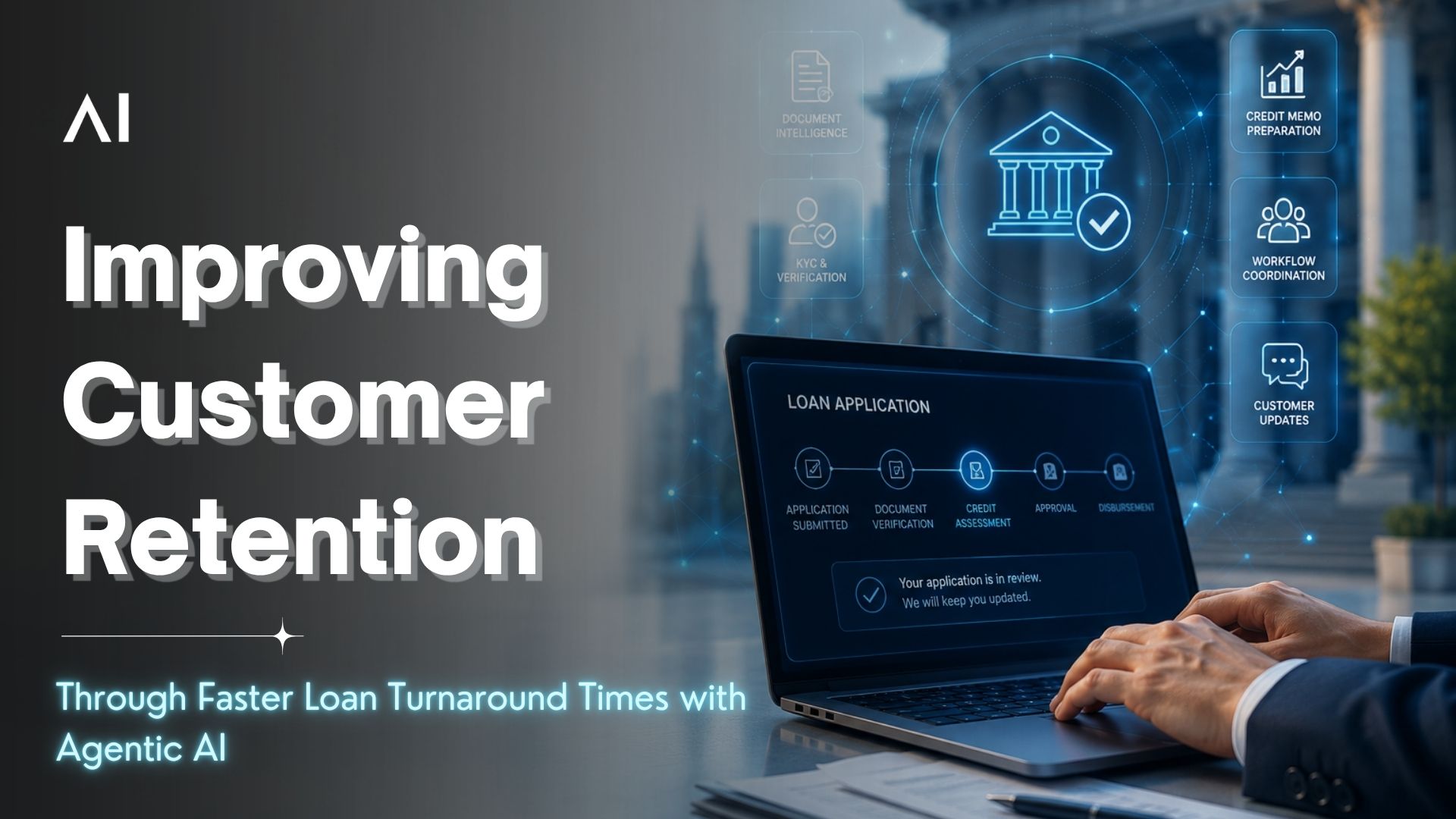
A 30-day loan TAT isn’t just an operations issue; it drives churn. Customers leave not only for better rates but because the process is slow, updates are unclear, documents bounce back and forth, no one explains status, and another lender moves faster. Agentic AI compresses the slowest steps, document checks, KYC validation, credit memo prep, follow-ups, handoffs, exception handling, and approval tracking, so lending becomes faster, clearer, and more controlled.
Why a 30-Day Loan TAT Is Costing Your Bank Customers?
In modern lending, a 30-day loan turnaround time (TAT) is no longer just an internal operational metric, it is a customer retention crisis. When an applicant seeks a loan to buy a home, expand a business, or close a cash flow gap, they aren’t just looking for competitive interest rates; they are looking for speed and certainty.
Unfortunately, while customers expect approvals in minutes, traditional banks often operate in hours or days, bogged down by manual handoffs and legacy systems. During these long delays, the customer doesn't assume the bank is carefully managing risk; instead, they wonder if they should apply elsewhere.
The solution to this churn crisis isn’t just a sleeker digital front-end, but a fundamental transformation of the back-office using Agentic AI
The True Cost of Silence and Bottlenecks
A lengthy loan TAT rarely stems from the credit judgment itself, which rightfully should take time. Instead, the friction lies in the manual drag surrounding the decision: collecting missing documents, checking completeness, extracting data, calculating ratios, and routing approvals.
One of the largest hidden delays is the credit memo. Preparing this critical document can take analysts hours, or even days for complex SME or corporate loans, as they manually read financial statements, calculate Debt-Service Coverage Ratios (DSCR), and draft risk commentary. Until this memo is prepared, the loan file is stuck, and the customer is left in the dark.
When the bank goes silent, trust erodes. Customers are left wondering if their application was received, if anything is missing, or why it is delayed. Once a borrower starts experiencing uncertainty and comparing timelines with a competitor, the bank has already lost control of the relationship
Enter Agentic AI: Moving Work, Not Just Answering Questions
Many banks assume they have digitized their lending process because they have an online application portal or SMS alerts. But digitization without intelligence still leaves human analysts to manually process PDFs, emails, and spreadsheets.
Agentic AI is fundamentally different from traditional chatbots or Robotic Process Automation (RPA). While a chatbot answers questions and RPA follows rigid rules that break when inputs deviate, an AI agent executes complex, multi-step workflows across connected systems. In a lending environment, a stack of specialized agents takes over the heavy lifting:
Data Agents: Parse complex documents (like PDFs, IDs, and bank statements), extract critical entities, and detect missing or tampered pages in seconds rather than minutes.
Verification Agents: Autonomously run KYC checks, cross-reference income patterns, validate IDs, and screen against anti-money laundering (AML) databases.
Decisioning Agents: Prepare the credit memo's structured first draft by analyzing cash flow trends, calculating ratios, and flagging anomalies, saving analysts from starting with a blank page.
Coordination Agents: Manage system dependencies, escalate risky files to human reviewers, maintain full audit logs, and trigger real-time updates to the customer
Reclaiming Customer Trust with Speed and Transparency
Agentic AI doesn't remove human underwriters from the process; it equips them with ready-to-review files, effectively removing the manual grind and the waiting period. By integrating Agentic AI, banks can fundamentally alter the customer experience:
Massive TAT Reductions Recent industry implementations show that Agentic AI frameworks can reduce loan processing times by an astonishing 75% to 96%, while other deployments report cutting TAT from hours down to minutes and reducing manual workloads by up to 60%.
Proactive, Contextual Communication A visible process feels like a trustworthy process. Agentic AI acts as the connective tissue between the back office and the customer, sending automated, hyper-contextual updates (e.g., "One document is missing," or "Your file has moved to credit"). This reduces customer anxiety and slashes the volume of inbound support calls.
Higher Accuracy and Compliance Agents produce consistent, uniform logs for every action and decision, eliminating interpretive errors caused by human fatigue. This provides institutions with regulatory-grade, audit-ready compliance built inherently into the loan flow
Where Fluid AI Fits?
Fluid AI fits into banking not as a simple chatbot, but as an operating layer embedded directly inside lending workflows. It functions as a lending assistant that connects across various platforms, such as Loan Origination Systems (LOS), CRMs, and KYC systems, to handle:
Document intelligence and credit memo preparation.
Customer follow-ups and automated status updates.
Risk flagging, workflow routing, and human escalation.
Ultimately, it acts as the connective tissue that accelerates the manual steps of the loan process while ensuring the process remains fully auditable and under human control
How Banks Can Start?
Banks should not begin their transformation by attempting to automate the entire lending process, as this broad approach often causes initiatives to stall. Instead, institutions can successfully deploy Agentic AI by following a targeted, step-by-step playbook:
Audit Existing Workflows: Identify bottlenecks, manual handoffs, and compliance-heavy tasks.
Target a Single Journey: Start with one high-friction area (like SME, retail, or working capital loans) instead of trying to automate the entire lending process at once.
Fix the Slowest Steps First: Focus on high-impact manual tasks such as document intelligence, drafting the first version of credit memos, and exception routing.
Map Roles and Integrate: Assign specific responsibilities to different AI agents and integrate them into existing Loan Origination Systems (LOS) and CRMs using standard APIs.
Set Compliance Guardrails: Define strict rule boundaries, ensure human oversight for escalations, and maintain immutable audit logs for every AI action.
Automate Customer Updates: Send proactive status updates to borrowers to reduce anxiety and inbound support calls.
Measure the "First Win": Track metrics like turnaround time (TAT) reduction and workload decreases to prove the specific loan journey now moves faster with better visibility
The Bottom Line
A 30-day loan TAT is not just a delay.
It is the bank telling the customer:
Wait.
Chase.
Repeat.
Hope.
That is not how modern lending should feel.
Winning the battle for customer retention in 2026 isn't about entirely automating the credit decision. The most successful banks will be those that use AI to remove the drag, silence, and repetition surrounding lending.
By deploying Agentic AI, financial institutions can eliminate the manual bottlenecks that cause a 30-day TAT, delivering faster, clearer, and more controlled loan processing that keeps customers engaged, informed, and loyal.
The winning banks will not be the ones that remove humans from credit.
They will be the ones that remove the drag around them.
Book your Free Strategic Call to Advance Your Business with Generative AI!
Fluid AI is an AI company based in Mumbai. We help organizations kickstart their AI journey. If you’re seeking a solution for your organization to enhance customer support, boost employee productivity and make the most of your organization’s data, look no further.
Take the first step on this exciting journey by booking a Free Discovery Call with us today and let us help you make your organization future-ready and unlock the full potential of AI for your organization.
_1790254083168-CB8e8KXC.png)