AI Voice for Collections: Transforming Outbound Calls for Banks and Lenders

TL;DR
AI voice for collections is becoming a core operating layer for banks, NBFCs, lenders, and financial institutions that run high-volume outbound calling. The strongest use cases are not generic reminder calls. They are trigger-based conversations where the AI agent verifies the customer, understands repayment intent, captures promise-to-pay, handles objections, escalates exceptions, and updates the collections system in real time.
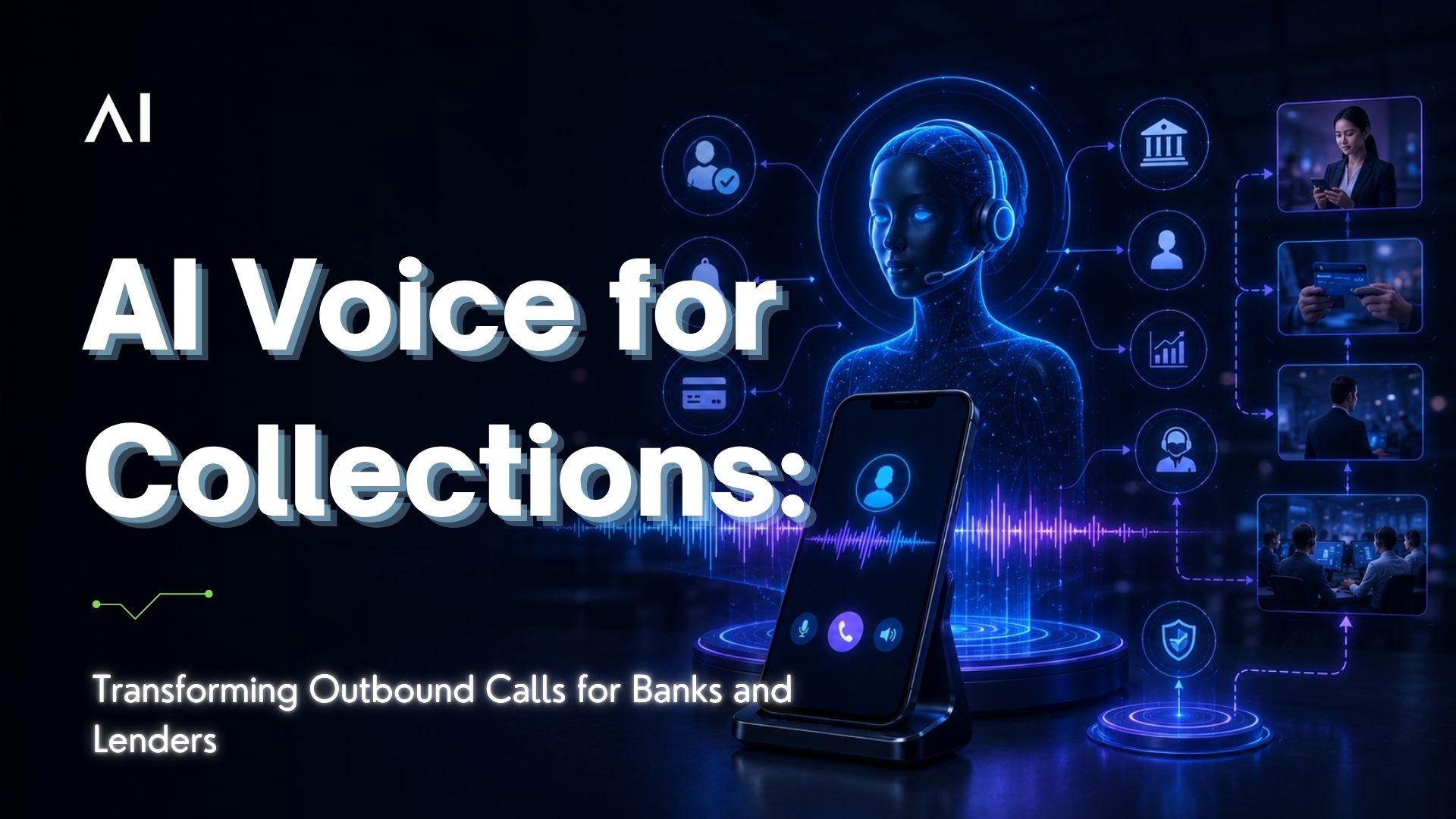
Collections has always been one of the most operationally intense functions inside lending. The work is repetitive at the surface, but sensitive underneath. A missed EMI, a delayed credit card payment, a broken promise-to-pay, or an early delinquency account all require timely outreach, but they do not all require the same conversation.
That is where most traditional outbound calling models break. They treat collections as a calling capacity problem when it is actually a decisioning, timing, and conversation quality problem.
More dialers do not solve that. More agents do not always solve that. More SMS reminders definitely do not solve that.
AI voice for collections changes the model by turning outbound calls into structured, intelligent workflows. The agent does not just call and remind. It verifies the customer, understands the reason for delay, captures repayment intent, logs the outcome, triggers follow-ups, and escalates cases that need human judgment.
For banks and lenders, that is the difference between running a call campaign and running an AI-powered collections operation.
What AI Voice for Collections Actually Means
AI voice for collections refers to conversational AI agents that make outbound calls to customers for overdue payments, upcoming EMIs, missed promise-to-pay commitments, repayment reminders, and early delinquency follow-ups.
The value is not that the AI can speak. The value is that it can complete the operational loop.
A serious AI collections voice agent should be able to:
trigger calls based on delinquency stage, risk bucket, missed payment, or business rule
authenticate the customer before discussing account-specific information
explain the overdue amount, due date, or repayment status clearly
understand whether the customer intends to pay, dispute, delay, or escalate
capture promise-to-pay details with date, amount, and payment mode
send payment links or reminders through SMS, WhatsApp, or email
update the collections system, CRM, or loan management platform
escalate sensitive, disputed, or high-risk cases to a human collector with full context
That is why AI voice for collections should not be compared to IVR or recorded reminder calls. Those systems deliver messages. AI voice agents conduct conversations and move workflows forward.
Why Banks and Lenders Are Looking at This Now
The pressure on collections teams has changed. Delinquency volumes can move quickly, customer expectations are higher, and regulators are paying closer attention to conduct, consent, tone, and documentation.
At the same time, human collections teams are spending too much time on calls that are necessary but not always judgment-heavy. Early-stage reminders, payment confirmation, missed PTP follow-ups, and standard repayment conversations consume enormous calling capacity.
AI voice agents are useful because they absorb this first layer of outbound engagement while keeping human collectors focused on accounts where judgment matters.
That includes:
disputed balances
financial hardship
repeat broken promises
high-value overdue accounts
settlement conversations
legal-risk cases
vulnerable customer handling
complaints and escalation scenarios
This is the right division of labour. AI handles scale, consistency, and follow-through. Humans handle negotiation, empathy, exception judgment, and complex resolution.
The Outbound Voice Playbook
The best AI voice collections deployments follow a simple pattern.
1. Start with the trigger
The call should not happen because a list was uploaded manually. It should happen because a system event created a reason to call.
That trigger could be a missed EMI, an upcoming due date, a broken promise-to-pay, a failed auto-debit, a risk score change, or a collections bucket movement. In non-banking use cases, it could also be an IoT event, such as an overspeeding alert for a commercial vehicle driver that requires immediate acknowledgement.
The pattern is the same across industries: a system detects the event, the AI agent makes the call, the customer or user responds, and the workflow updates.
2. Verify before discussing details
Collections calls involve sensitive financial information. The AI agent must verify the customer before sharing overdue amounts, account status, repayment details, or next steps.
Authentication can be configured through bank-defined rules such as registered mobile validation, OTP, date of birth, account identifiers, or other approved verification checks.
Without verification, outbound voice AI becomes a compliance risk.
3. Understand repayment intent
The core outcome of a collections call is not just contact. It is intent.
Did the customer agree to pay?
Are they disputing the amount?
Do they need more time?
Did they already pay?
Are they under financial stress?
Should the case be escalated?
A good AI collections agent captures this clearly and converts the conversation into structured data that the collections team can actually use.
4. Capture promise-to-pay accurately
Promise-to-pay is one of the most important outcomes in collections, but it is also one of the easiest to lose through poor note-taking or inconsistent logging.
An AI voice agent should capture the promised date, amount, payment mode, reason for delay, and follow-up requirement. It should then update the collections platform automatically and trigger reminders before the promised date.
The value here is not just automation. It is discipline.
5. Escalate the right cases
Collections should never be fully automated blindly. The agent needs clear escalation logic for disputes, hardship signals, abusive calls, regulatory triggers, low-confidence understanding, fraud suspicion, and customer requests for a human.
The escalation should not be a cold transfer. It should carry the full conversation summary, customer response, account context, and reason for escalation so the human collector does not start from zero.
Why This Applies Beyond Banking
The same outbound voice AI pattern applies across industries.
In collections, the trigger is a missed payment. In wealth or member services, it may be a follow-up action. In commercial vehicles, the trigger may come from IoT, such as overspeeding or unsafe driving behaviour. In utilities, it may be an overdue bill or service alert.
The underlying workflow is identical.
A trigger happens.
AI calls the right person.
The person responds in natural language.
The system captures intent.
The workflow updates automatically.
That is why AI voice for collections is part of a much larger shift: enterprises are moving from passive notifications to active, conversational operations.
What Banks Should Demand From an AI Voice Collections Platform
A collections voice AI system needs to be evaluated differently from a generic voice bot.
Banks and lenders should look for:
Collections system integration: The agent should connect to loan management systems, CRM, payment platforms, dialers, and collections dashboards.
Policy-controlled conversations: The tone, language, disclosures, and escalation logic should follow approved collections policy.
Multilingual capability: Customers should be able to speak naturally in the language they use, especially in markets like India, the Middle East, Southeast Asia, and the Caribbean.
Promise-to-pay tracking: PTP capture should be structured, searchable, and connected to follow-up workflows.
Human escalation: Sensitive and high-risk cases should move to human collectors with complete context.
Auditability: Every call should be traceable, including what was said, what data was accessed, what outcome was captured, and what action was triggered.
Deployment control: For regulated institutions, the platform should support private cloud, on-premise, or sovereign deployment models where required.
Where Fluid AI Fits
Fluid AI builds AI voice agents for banks, lenders, and enterprises that need outbound conversations to connect directly into operational workflows.
For collections, that means the AI agent can support the full loop: trigger-based calling, customer verification, overdue payment reminders, promise-to-pay capture, objection handling, payment link follow-up, multilingual conversation, human escalation, system updates, and audit trails.
The point is not to replace every collector. The point is to stop using human collections capacity on repetitive conversations that can be handled consistently by AI, while giving human teams better context for the cases that actually need them.
This is especially important for banks and lenders operating at scale. A collections team does not only need more calls. It needs better prioritisation, cleaner intent capture, faster follow-up, and stronger compliance control.
That is what AI voice for collections is built to deliver.
The Future of Collections Is Smarter Outbound Engagement
The next phase of collections will not be defined by who can call the most customers. It will be defined by who can call the right customers, at the right time, with the right conversation, and trigger the right next action automatically.
AI voice makes that possible.
It gives banks and lenders a way to move from manual calling campaigns to intelligent outbound workflows. The customer gets a clearer conversation. The collections team gets cleaner data. The institution gets more control over cost, compliance, and follow-up quality.
When AI calls your customers, the question is not whether it can sound human.
The question is whether it can understand intent, act inside policy, update the system, and know when to bring in a human.
That is the real outbound calling playbook.
Book your Free Strategic Call to Advance Your Business with Generative AI!
Fluid AI is an AI company based in Mumbai. We help organisations kickstart their AI journey. If you're seeking a solution for your organisation to enhance customer support, boost employee productivity and make the most of your organisation's data, look no further.
Take the first step on this exciting journey by booking a Free Discovery Call with us today and let us help you make your organisation future-ready and unlock the full potential of AI for your organisation.
Frequently Asked Questions
What is AI voice for collections?
AI voice for collections uses conversational AI agents to make outbound repayment calls, verify customers, capture promise-to-pay, handle objections, and update collections systems automatically.
How does AI voice help banks with collections?
It helps banks reduce repetitive calling, improve early-stage outreach, capture repayment intent consistently, lower collections cost, and allow human collectors to focus on complex or high-risk accounts.
Can AI voice agents capture promise-to-pay?
Yes. A well-built AI voice agent can capture the promised payment date, amount, payment mode, reason for delay, and follow-up requirement, then update the collections platform in real time.
Is AI voice for collections compliant?
It can be compliant when designed with authentication, consent handling, approved scripts, audit logs, policy guardrails, and human escalation. For banks, auditability and governance are non-negotiable.
Is AI voice only useful for banking collections?
No. The same outbound voice AI model works across lending, insurance, telecom, fleet management, utilities, and any enterprise workflow where a trigger requires a timely human-like conversation.
_1790254083168-CB8e8KXC.png)