The Future of Insurance Claims AI: Moving Beyond the 60% Straight-Through Processing Plateau

TL;DR
Insurance Claims AI is helping insurers reduce claim delays, automate document checks, improve fraud detection, and deliver better customer updates.
But straight-through processing often plateaus because real claims are messy, document-heavy, emotional, regulated, and full of exceptions.
The next phase is not just more automation. It is intelligent claims orchestration: AI systems that can read documents, retrieve policy context, detect risk, trigger workflows, communicate with customers, and keep humans in control.

The promise of Insurance Claims AI
Insurance claims have always been one of the most expensive and sensitive parts of the insurance business.
For the customer, a claim is not just a transaction. It usually comes after an accident, illness, loss, damage, delay, or disruption. For the insurer, it is where customer trust, fraud control, operational efficiency, financial exposure, and compliance all meet.
That is why Insurance Claims AI has become such a major priority.
Insurers want faster AI claims processing, lower operating costs, better fraud detection, cleaner documentation, and a smoother customer experience. Straight-through processing, or STP, became the obvious goal: receive a claim, validate it, assess it, approve it, and settle it with little or no manual intervention.
This is why AI claims processing, automated insurance claims processing, and AI powered claims automation have become central to modern insurance transformation programs.
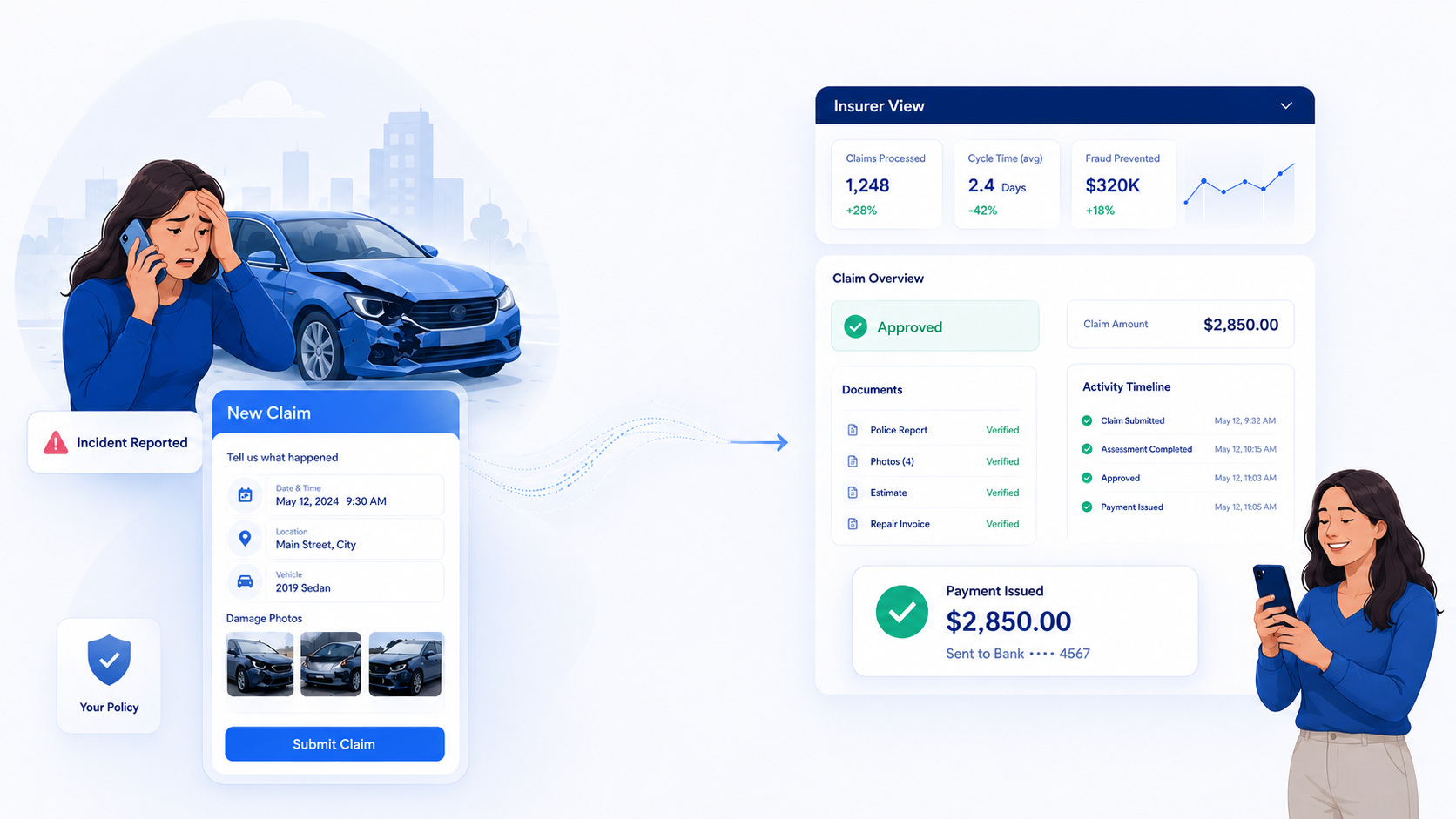
The AI insurance claims market is moving from simple automation toward connected claims intelligence.
On paper, it sounds perfect.
In reality, most insurers quickly discover the same problem: automated insurance claims processing works beautifully for simple claims, then starts to plateau.
The question is why.
What is straight-through processing in insurance claims?
Straight-through processing in insurance claims refers to an automated claims workflow where a claim moves from submission to decision without manual intervention.
In simple terms, the system receives the claim, checks the required data, validates rules, assesses eligibility, and moves it toward settlement or rejection.
STP works best for claims that are:
Simple
Low value
Low risk
Well documented
Policy-rule friendly
Supported by structured data
Not suspected of fraud
A small travel delay claim with all documents attached may be a strong STP candidate. A simple motor glass repair claim may also be easy to automate. A routine outpatient reimbursement claim with clean documents and a valid policy may move through quickly.
Auto insurance claims AI can also support damage photo review, repair estimate checks, liability triage, fraud detection, and customer status updates.
But the moment the claim becomes complex, the automation layer starts to struggle.
This is where the 60% problem begins.
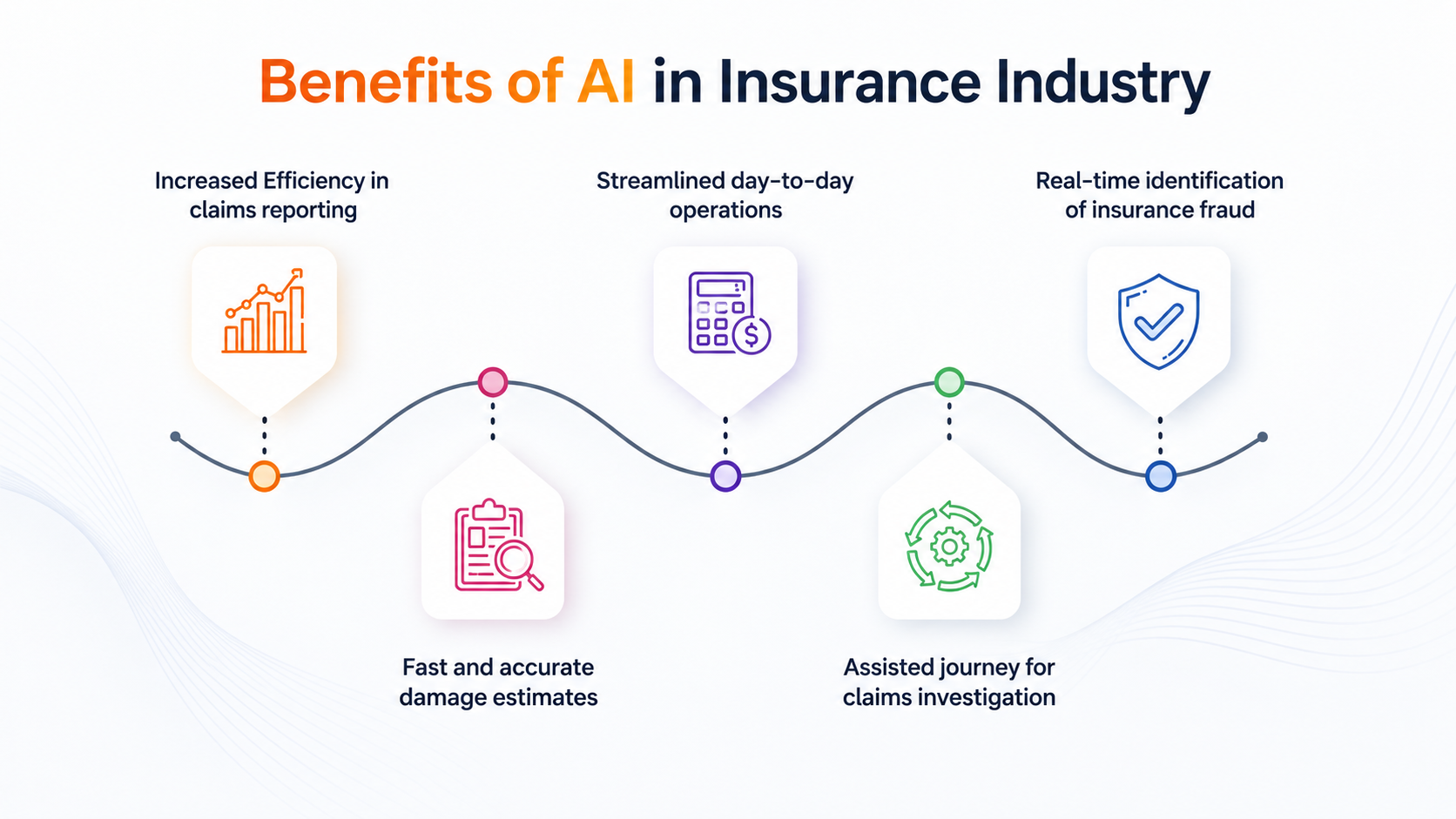
Why straight-through processing plateaus
The 60% plateau does not mean every insurer gets stuck at exactly 60%. It is better understood as the ceiling many claims automation programs start to feel after they automate the obvious, rules-based, low-risk portion of claims.
The first wave of claims automation is usually easier. These are the claims where forms are complete, rules are clear, documents are readable, and risk is low.
The next layer is much harder.
That is because real claims are not just data entries. They involve judgment, exceptions, missing context, customer emotion, regulatory exposure, fraud risk, and operational handoffs.
That is the core reason STP plateaus. The easy cases go through. The messy ones do not.
This is where insurance claims management AI becomes important. A modern AI claims management system cannot simply push claims through a rules engine. It needs to support intelligent claims management across documents, policies, risk checks, customer communication, and human review.
1. Claims data is still messy
Claims automation depends on clean data. But claims data is rarely clean.
A single claim may involve:
Claim forms
Policy documents
Medical bills
Police reports
Photos
Repair estimates
Hospital records
Invoices
Customer emails
Agent notes
Call transcripts
Third-party documents
Some data is structured. Most of it is not.
Even when insurers use OCR for insurance claims or document AI, extraction is only one part of the problem. The harder task is understanding what the document means, whether the information matches the policy, whether something is missing, and whether the claim should move forward.
This is where AI document processing insurance claims becomes critical.
The goal is not just to read documents. It is to turn claim documents into structured decisions, next steps, and workflows.
That is why insurance claims document automation and claims document extraction AI are becoming core parts of modern claims operations.
In health insurance claims AI, this is especially useful for discharge summaries, medical bills, treatment dates, diagnosis checks, and policy coverage validation.
That is where many STP systems slow down.
2. Rules-based automation breaks at the edge cases
Traditional STP is often built around rules.
If document A is present, move forward.
If claim amount is below X, approve.
If policy is active, continue.
If required field is missing, reject or route to human.
Rules work well when claims are predictable. But claims are full of edge cases.
A customer may submit the wrong document but still have a valid claim. A hospital bill may have a mismatch because of formatting. A policy condition may require interpretation. A motor claim may look simple until repair cost, liability, previous claims, and customer history are considered together.
Rule-based STP hits a ceiling: it automates routine steps but fails on judgment-heavy workflows.
That matters: STP works with predetermined criteria but struggles when a claim needs context, interpretation, or judgment.
This is also where claims automation software needs to evolve from simple rule execution to AI-led claims orchestration.
3. Fraud risk forces human review
Claims fraud is one of the biggest reasons STP cannot run unchecked.
The more automation insurers introduce, the more important fraud controls become. A claim that looks simple at first may still need investigation if it has unusual timing, repeated behavior, inconsistent documents, suspicious patterns, or links to known fraud indicators.
Insurance fraud detection AI can identify these signals faster, but it does not remove the need for governance. In fact, better fraud detection often increases the need for smarter triage.
AI fraud detection in insurance, claims fraud detection software, and predictive analytics insurance claims fraud all help insurers identify suspicious claims earlier, prioritize investigations, and reduce leakage.
Some claims should be auto-approved.
Some should be auto-rejected.
Some should be sent for investigation.
Some should be escalated to a senior claims handler.
This is not a simple yes-or-no automation problem. It is a decisioning problem.
The best Insurance Claims AI systems do not blindly maximize STP. They maximize the right kind of automation while protecting the insurer from leakage and risk.
That is the future of insurance fraud detection AI: not replacing experts, but helping them focus on the claims that need attention.
4. Customer communication creates friction
Claims processing is not only about settlement. It is also about communication.
Many STP programs focus on the back office but fail to automate the communication layer properly.
That creates a strange experience. The claim may be moving through a digital workflow, but the customer still has to call support, email repeatedly, or wait for unclear updates.
This is where AI claims customer experience matters.
An AI claims assistant, insurance claims chatbot, voice AI agent, and claims status automation can explain claim status, ask for missing documents, answer policy questions, and route complex issues to humans.
But again, this requires more than a static bot.
The AI must connect to the claims system, policy database, document repository, CRM, payment status, and escalation workflow.
Without that integration, the customer experience remains broken.
5. Human approval is still required for sensitive claims
The goal of Insurance Claims AI should not be to remove humans from every claim.
High-value claims, legal disputes, suspected fraud, medical complexity, liability questions, and regulatory exposure often require human judgment.
The mistake many insurers make is thinking that human involvement means automation failure.
It does not.
The better model is human-in-the-loop claims AI.
In this model, AI does the heavy lifting:
Reads documents
Summarizes the claim
Checks policy coverage
Flags missing information
Identifies fraud signals
Recommends next actions
Drafts customer communication
Prepares the claim file for review
Then the human decides where judgment matters.
That is how insurers move beyond the STP plateau. Not by chasing 100% automation everywhere, but by making human review faster, smarter, and more focused.
6. Legacy systems make claims automation harder
Claims do not live in one system.
Most insurers have multiple systems across policy administration, claims management, CRM, document management, fraud detection, payments, contact centers, and compliance.
This creates a major challenge for AI claims automation and digital claims management.
A claim may require data from one system, documents from another, customer history from another, and approval from another. If these systems do not talk to each other properly, automation gets stuck.
That is why many insurers can automate individual tasks but struggle with end-to-end claims automation.
This is also why modern Insurance Claims AI is moving toward agentic workflows.
Instead of one static automation script, agentic claims AI can coordinate multiple steps across systems.
It can retrieve policy details, read documents, check claim history, call APIs, update records, request missing information, trigger approvals, and escalate complex cases.
This is the difference between task automation and claims orchestration.
Why Insurance Claims AI needs to move beyond STP
Straight-through processing is still valuable. It should absolutely remain part of the claims automation roadmap.
But STP is not enough.
The next phase of Insurance Claims AI is not just about pushing more claims through automation. It is about building intelligent claims management where AI can decide what should be automated, what should be reviewed, what should be investigated, and what should be escalated.
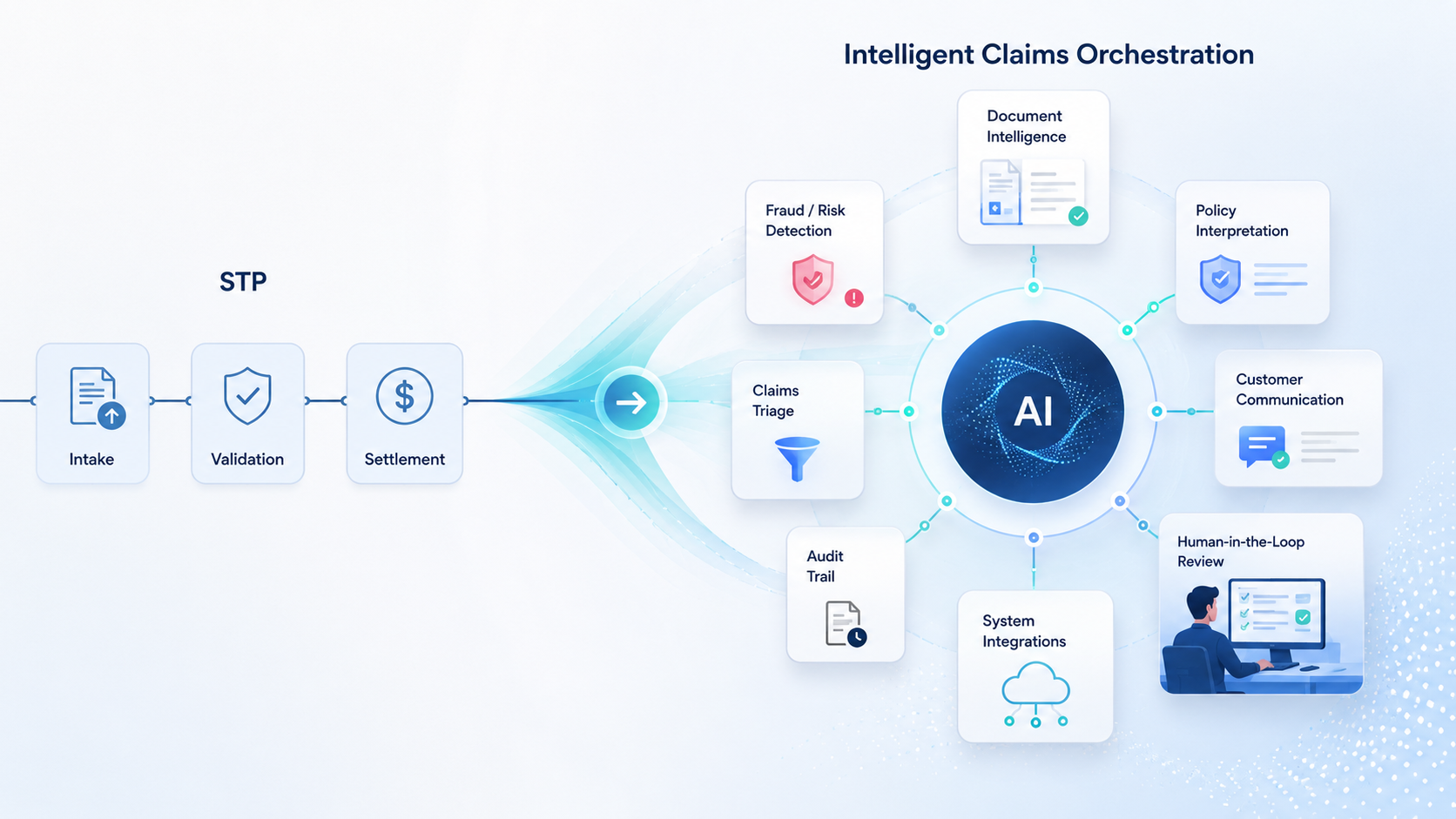
That requires:
AI document processing
Fraud detection
Policy interpretation
Customer communication
Claims triage
Workflow orchestration
Human-in-the-loop approvals
Audit trails
System integrations
Continuous monitoring
This is where agentic AI becomes relevant.
There is also a natural connection between claims AI and AI underwriting. Underwriting AI helps insurers assess risk before a policy is issued, while Insurance Claims AI helps evaluate what happens after a loss occurs. When both systems share data, insurers can improve pricing, risk selection, fraud detection, and claims decisioning across the full policy lifecycle.
The rise of Agentic AI in insurance claims
Agentic AI is different from traditional automation because it does not just follow static rules. It can work toward a goal.
In claims, that goal may be:
Resolve this claim
Validate these documents
Check whether this policy covers the claim
Detect whether this claim is suspicious
Ask the customer for missing information
Prepare this claim for human review
Trigger payment after approval
An agentic claims AI system can break the goal into steps, retrieve context, call tools, check policies, and decide the next action.
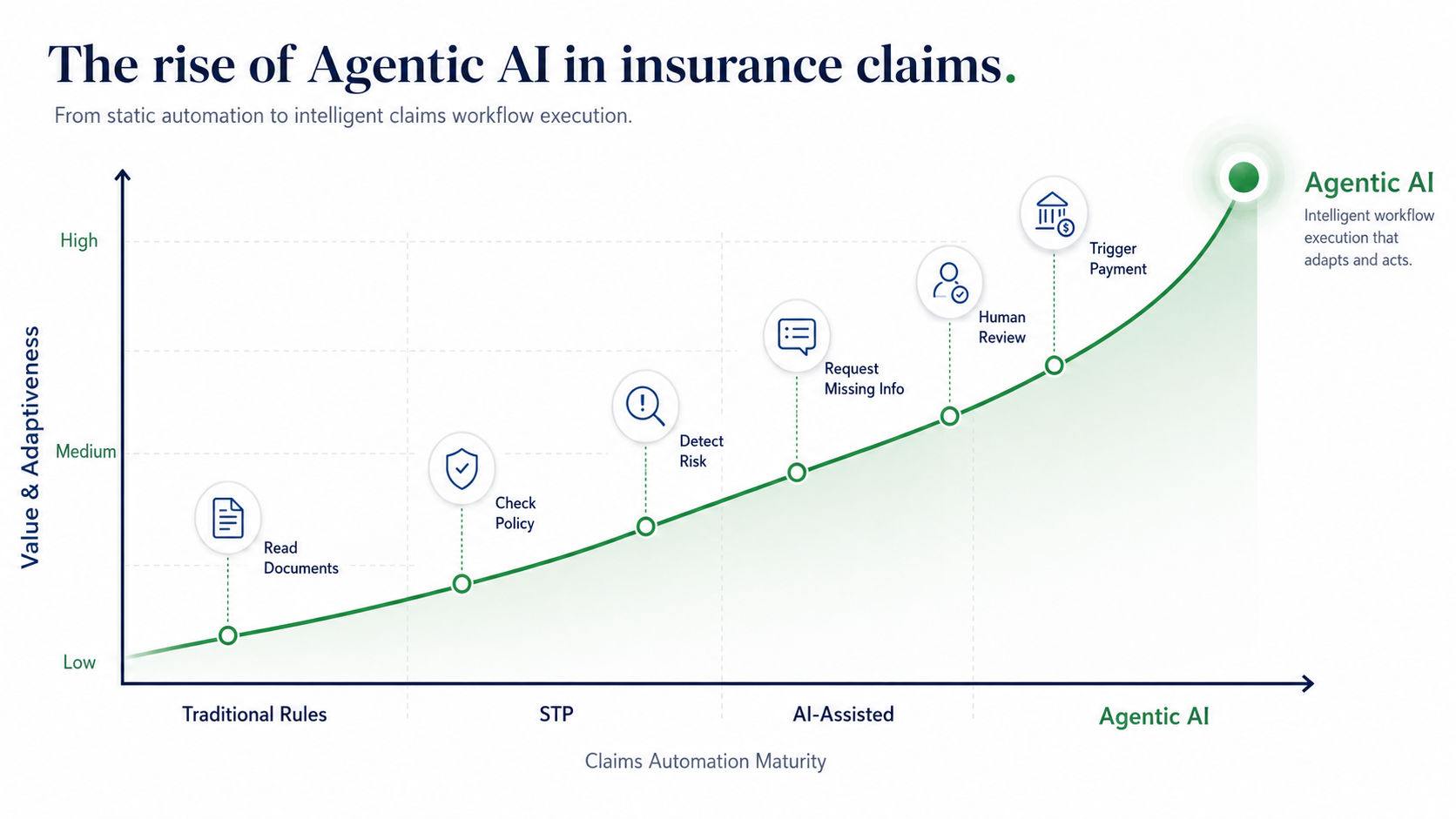
This is why agentic AI insurance claims is becoming a practical next step for insurers that want to move beyond basic automation and build more adaptive claims operations.
An insurance claims AI agent can move through the claim journey step by step, from reading documents to checking policy rules, asking for missing information, and escalating risky cases.
For example, if a health insurance customer submits a claim with missing discharge documentation, the AI agent can:
Read the submitted documents
Identify the missing discharge summary
Check policy requirements
Notify the customer through email or WhatsApp
Update the claim status
Set a reminder
Escalate if the document is not received
This is not just STP. This is intelligent claims workflow execution.
Where Fluid AI fits naturally
For Fluid AI, the opportunity in insurance claims is not to build another basic claims chatbot.
The bigger opportunity is to help insurers build an AI-powered claims operating layer.
That means connecting AI agents across the channels and systems where claims actually happen: chat, voice, email, WhatsApp, CRMs, policy documents, claims systems, document repositories, and approval workflows.
A Fluid AI-style claims assistant can help insurers move from disconnected automation to connected claims intelligence. It can retrieve customer and policy context, understand claim intent, extract and validate documents, trigger backend workflows, escalate high-risk claims, and keep humans in control where approval is needed.
This is especially important in regulated insurance environments, where speed alone is not enough. Claims AI must also be explainable, auditable, secure, and compliant.
What insurers should automate first
The best way to avoid the STP plateau is not to automate everything at once.
Start with the workflows where AI can create measurable value without adding unacceptable risk.
Strong starting points include:
Claim intake and FNOL
Document classification
Missing document detection
Claim status updates
Policy FAQ support
Low-value claim triage
Repair estimate review
Medical bill extraction
Fraud signal detection
Customer communication drafts
Human review summaries
These workflows reduce manual effort without forcing the insurer to give up control.
Once these foundations are stable, insurers can move toward more advanced automation, such as automated settlement recommendations, complex claims routing, and multi-agent claims orchestration.
These are also some of the most practical AI claims use cases insurers should prioritize first because they reduce friction without creating unnecessary risk.
What a production-ready Insurance Claims AI system needs
A real Insurance Claims AI system needs more than a model.
It needs architecture.
The most important capabilities include:
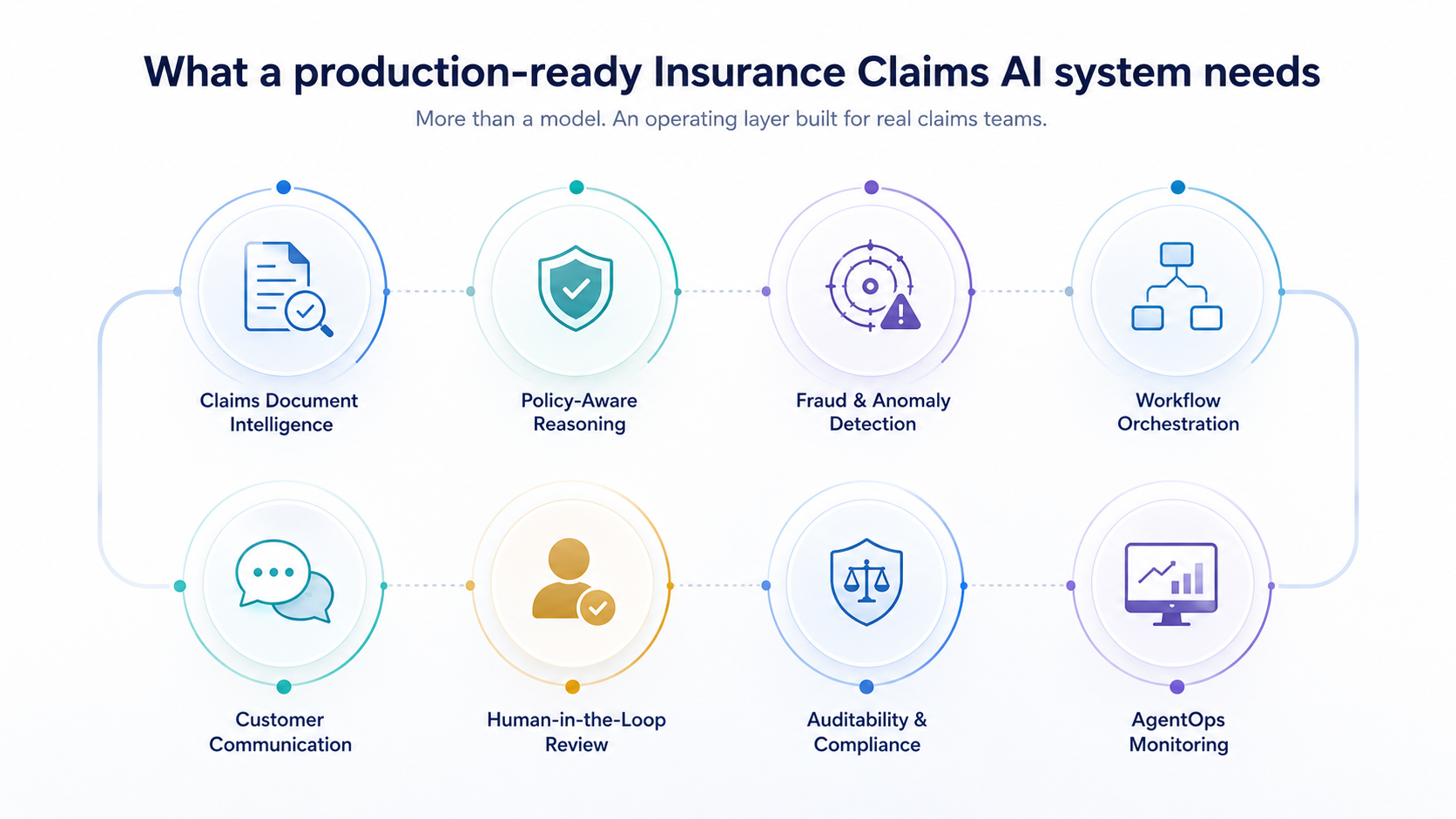
Claims document intelligence:
The system should classify, extract, validate, and summarize documents from multiple formats.Policy-aware reasoning:
The AI should understand policy terms, exclusions, limits, deductibles, and claim eligibility rules.Fraud and anomaly detection:
The system should flag suspicious claims for review instead of blindly processing them.Workflow orchestration:
The AI should trigger next steps across systems, not just generate text.Customer communication:
The system should keep customers informed across channels.Human-in-the-loop review:
Sensitive or high-risk actions should require approval.Auditability and compliance:
Every decision, recommendation, document check, and workflow action should be traceable.AgentOps monitoring:
Insurers should track accuracy, escalation rates, cycle time, cost per claim, failed actions, and customer satisfaction.
This is what separates a claims AI demo from a claims AI system that can run in production.
For insurers comparing AI in insurance claims solutions, these capabilities matter more than a flashy demo. The real question is whether the system can support real claims teams, real policy logic, real documents, and real customer communication at scale.
The best insurance claims AI software should not only automate intake. It should support document intelligence, fraud detection, workflow orchestration, human review, customer communication, and auditability.
Where generative AI helps in insurance claims
Generative AI in insurance claims can be useful, but it works best when used carefully.
It can summarize claim files, draft customer updates, explain policy language, prepare review notes, and help claims handlers understand complex information faster.
But GenAI alone is not enough. It needs policy context, document intelligence, fraud signals, workflow integration, governance, and human approval to become reliable in claims operations.
That is why the strongest claims systems combine generative AI, document AI, fraud detection, workflow automation, and agentic orchestration.
The future of claims is not 100% automation
Here is the thing: the best insurers will not be the ones that blindly chase 100% straight-through processing.
The best insurers will be the ones that know which claims should go straight through, which need AI-assisted review, and which require human judgment.
That is the real future of Insurance Claims AI.
The most successful insurance companies using AI for claims are not just automating approvals. They are redesigning the full claims journey around data, risk, communication, and human oversight.
The goal is not to remove claims teams. The goal is to remove unnecessary manual work, reduce delays, improve accuracy, detect risk earlier, and help claims professionals focus on the cases that truly need expertise.
Straight-through processing plateaus because claims are not always straight lines.
The next leap is intelligent claims orchestration.
Conclusion
Insurance Claims AI is entering a new phase.
The first phase was digitization.
The second phase was straight-through processing.
The third phase is agentic claims intelligence.
STP will continue to matter, but it will not solve the full claims problem on its own. Claims are too complex, too regulated, and too human for simple automation to handle everything.
To move beyond the 60% plateau, insurers need AI systems that can read documents, retrieve context, check policies, call tools, detect risk, communicate with customers, escalate intelligently, and support human decision-making.
That is where Insurance Claims AI becomes more than automation.
It becomes the operating layer for modern claims.
Book your Free Strategic Call to Advance Your Business with Generative AI!
Fluid AI is an AI company based in Mumbai. We help organizations kickstart their AI journey. If you’re seeking a solution for your organization to enhance customer support, boost employee productivity and make the most of your organization’s data, look no further.
Take the first step on this exciting journey by booking a Free Discovery Call with us today and let us help you make your organization future-ready and unlock the full potential of AI for your organization.
_1790254083168-CB8e8KXC.png)