16 Agentic AI Use Cases Transforming the Oil & Gas Sector: From CapEx Estimation to Pipeline Security

TL;DR
Every energy company has tried AI in oil and gas by now. Most of it died in a proof of concept. Not because the models were bad, but because the deployment was impossible: the data couldn't leave the building, the systems were decades-old SAP, and no cloud demo survived contact with a refinery's compliance team.
That's the real filter in this industry. A use case only counts if it runs where the data lives, talks to the systems you already have, and can be shown to an auditor.
The 16 below clear that bar. They span everything from oil and gas automation to predictive maintenance, grouped by domain so you can find the ones that map to your operation, whether you sit in a control room, a procurement office, or an HR function.
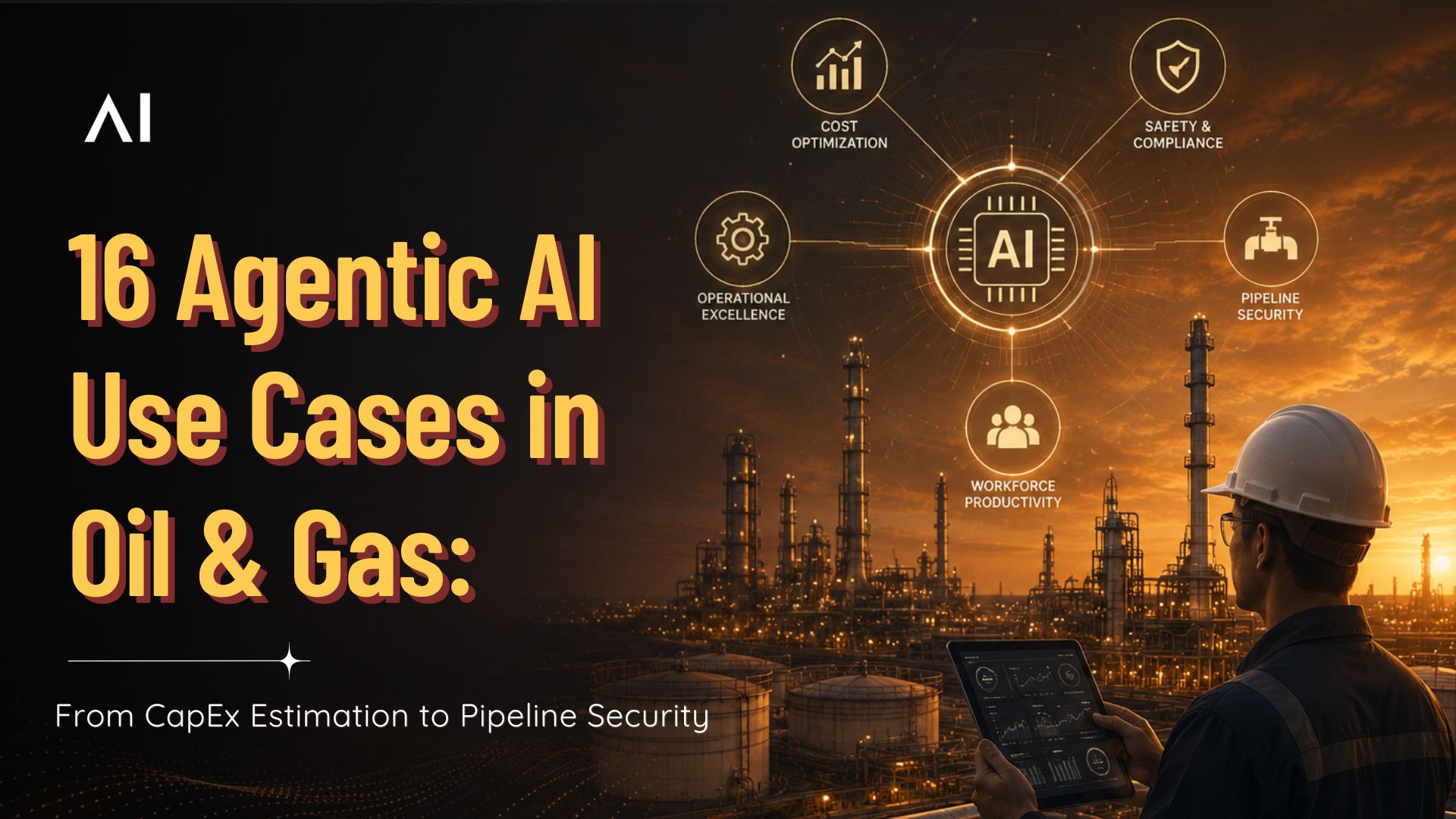
Every oil & gas company is in the same journey. Typically, it's on this way:
It begins with digital transformation within the oil and gas industry, digitizing records from paper to systems.
Next, automation in the oil and gas industry, whereby software takes over repetitive tasks.
Next is AI in oil and gas, predicting, detecting and analysing with models.
Now, however, the frontier is agentic AI, in which the software doesn't just analyse, but also acts, performing entire tasks without human intervention.
The majority of businesses are in the middle of that funnel. They have digitised and automated, but their AI hasn't yet done the work, it's just answering questions. The space between “AI that tells you something” and “AI that does something” is where the value is.
And that's the real reason most IT in the oil and gas world doesn't make that leap: Data doesn't get to leave the building, the systems are decades-old SAP systems, and no cloud demo withstands a compliance audit. Only use cases that pass all three (on-premise, connected to SAP, and never leaving the firewall) make it onto production.
Here are 16 of them, organized by location in your operation. These aren't chatbots. Both of them really do something in a real system.
Operations and refinery
Smart Refinery
A refinery operates based on knowledge stored in thousands of SOPs and technical documents, and engineers spend hours of their working day searching. A smart refinery agent allows them to ask a question in a natural language and receive the exact procedure back in seconds.CapEx Estimation
Get three engineers to estimate the same project, and you'll get three numbers. The logic behind the CapEx estimation is standardised by AI, resulting in consistent, quick, and defendable estimates when finance asks, “How did you do that?”Pipeline Security AI
Pipelines run for hundreds of kilometres across unmonitored areas. This keeps eyes on the infrastructure continuously, detects the anomalies in real-time, and alerts to threats before they grow to be failures – a perfect natural habitat for predictive maintenance.
Safety and logistics
Transport Monitor
If a tanker driver causes a safety exception, time is of the essence. This agent monitors vehicle tracking live, and notifies the driver automatically when there's a problem, rather than waiting hours to find it in a log. The paper trail turns into a real-time intervention.LPG Safety Check
Hand checking for consistency is a daunting task, particularly when dealing with large numbers of inspections. It applies computer vision to scan images of the site to identify gas safety risks and compliance issues that could be missed by a rushed manual scan and does it the same way each and every time.Inventory Smart Agent
There's no one to watch everything at all times, and there's no way to avoid overstocks or stock-outs. An autonomous agent does just that – monitors stock levels and predicts demand so that shortfalls are identified before they become an issue.Permit-to-Work AI
Permit to Work is where safety on site comes from and from and it's all in paperwork. Signing off on a permit is just as good as having it checked and recorded when the workflow is digitised and AI verified. Compliance turns into something you can demonstrate.
Supply Chain & Procurement
Material Management
Imagine a SAP system with lakhs of material records and search function that works pitifully. Getting the right part is a daily burden on all. This agent enables the entire material master to be searched using plain language and brings up the SAP compliance information with it.Sourcing AI
Consistency in pricing is the key to obtaining a source for a capital project. This takes care of the smart sourcing and vendor benchmarking so two similar projects don't present wildly different costs. Procurement receives price it can support.Vendor Communication
The manual effort involved in raising RFQs and chasing vendors is just tedious. This eliminates the tedious follow-ups with vendors and the generation of RFQs, allowing the team to concentrate on decisions, rather than writing emails.Stock Reconciliation
A monthly batch of reconciliation is looking at a "snapshot" of the inventory. This agent will discover the discrepancy and will automatically balance the stocks, so the number on your screen is the number that's true.
Sales and customer
Negotiation Training AI
It's impossible to send all field salespeople to a negotiation course. This can. It delivers voice-based role play, so your entire sales team practises real negotiations and learns by doing instead of reading a training deck.Sales Data Agent
Sales people are sitting on data that requires a report and days to request. This instantly provides sales and competitor answers in plain language, on any device, as the deal is still live.Customer Conversational AI
Customer enquiries in the energy sector are also large and mainly repetitive. This treats them end to end, and does not deflect the request but actually resolves it, meaning that the user will only contact a human when they really need to.
HR and IT
Employee Assistant (HR GPT)
If hundreds or thousands of employees ask the same basic HR questions, the HR department becomes a line. Solves policy questions and fetches real-time employee data, around the clock. HR's time is saved, and employees receive immediate answers.IT Helpdesk AI
The same tickets are seen again and again by the IT helpdesk: access, logins, software problems. This troubleshoots and resolves them automatically whenever they come up, even in the middle of the night, so that the queue actually gets smaller, not larger.
Is it real or hype?
It's real, and that's the important part. Every use case above is the kind already running in live production across the oil and gas value chain, not sitting in a slide deck. The largest industrial AI deployments in this sector go from kickoff to first production in around three months, fully on-premise, with zero cloud dependency.
Two things separate the AI that survives from the AI that stalls:
It acts, it doesn't just chat. Each of these does real work inside a real system: SAP, a control room, a vehicle tracker, a permit workflow.
It runs on your terms. Everything works on-premise, connected to SAP, with data staying inside your firewall. In a regulated industry, that's the only version of AI that ever makes it to production.
Where to start?
The companies getting value from this didn't switch on all 16 at once. The pattern that works is simple:
Pick the one problem costing you the most time, money, or risk today.
Prove it in production, not in a pilot that never ends.
Then expand across the rest of the value chain.
Start narrow, prove it works, and scale from there.
Book your Free Strategic Call to Advance Your Business with Generative AI!
Fluid AI is an AI company based in Mumbai. We help organisations kickstart their AI journey. If you're seeking a solution for your organisation to enhance customer support, boost employee productivity and make the most of your organisation's data, look no further.
Take the first step on this exciting journey by booking a Free Discovery Call with us today and let us help you make your organisation future-ready and unlock the full potential of AI for your organisation.
Frequently asked questions (FAQs)
1. What are the main uses of AI in oil and gas?
The biggest ones are refinery document search, CapEx estimation, pipeline monitoring, safety and permit compliance, SAP-based supply chain and procurement, and HR and IT self-service. The common thread is AI that takes action inside your systems, not standalone chatbots.
2. Is AI in oil and gas actually in production or still in pilots?
It's in production. Real deployments run live across refinery, safety, supply chain, sales, and HR functions, often reaching first production in about three months.
3. Why does oil and gas AI need to run on-premise?
Refinery records, SAP data, and operational information are sensitive and often bound by data rules. Running on-premise keeps that data inside the company firewall while still fully connecting to SAP and keeping a complete audit trail.
4. Can AI work with old SAP systems?
Yes. Production deployments connect through standard, approved SAP methods and use live data, not manual file exports.
5. How do you start with AI in oil and gas?
Pick your single highest-pain use case, prove it in production, then expand. Starting narrow and scaling beats trying to deploy everything at once.
_1790254083168-CB8e8KXC.png)