Copilot vs. Agent: The AI Terminology Banks Keep Getting Wrong

TL;DR
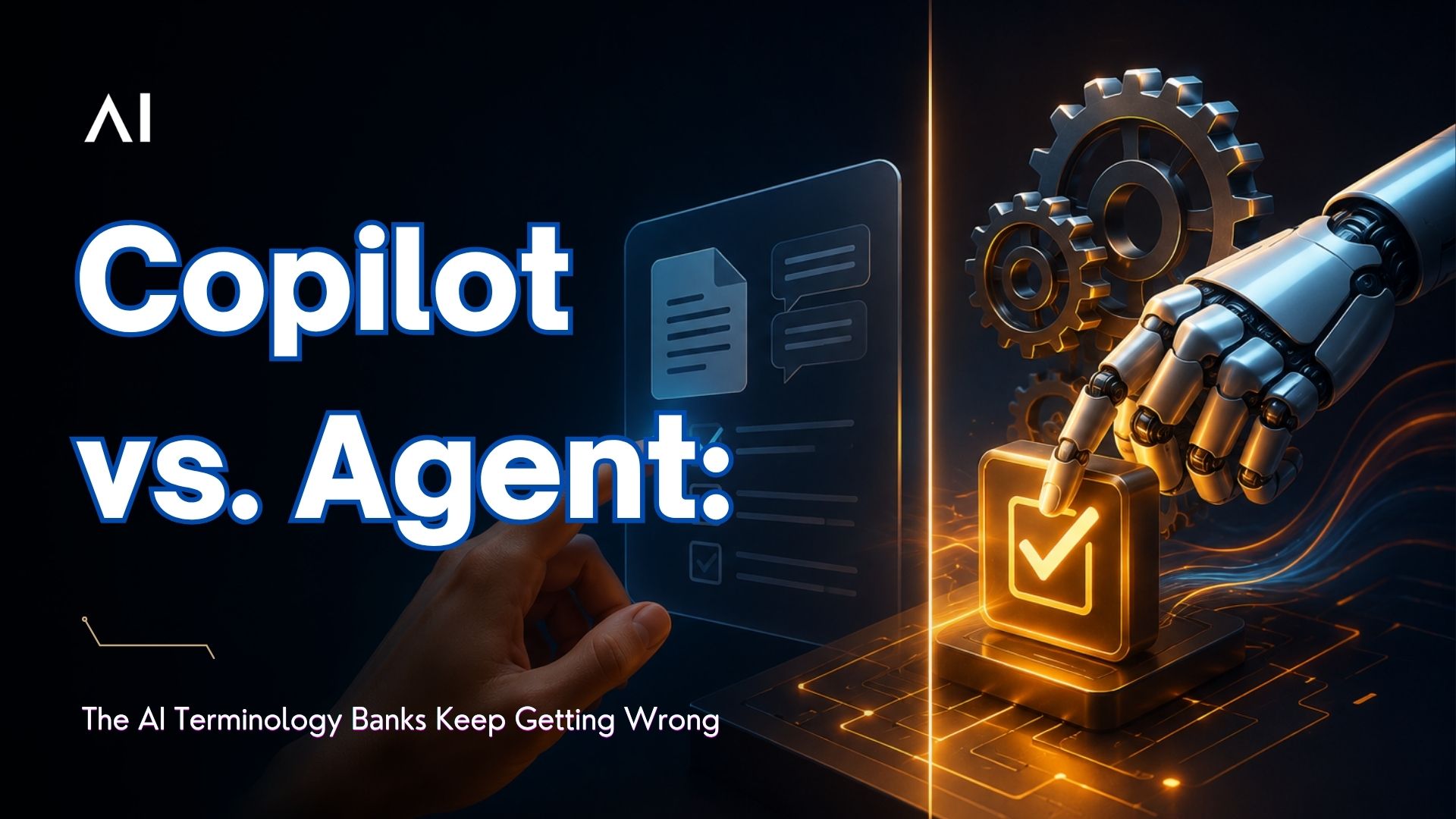
Microsoft Copilot is an assistant that drafts, summarizes, and suggests inside tools like Microsoft 365, but a human still has to read it and hit send. An AI agent works differently. It pulls data, makes a decision, and completes the task on its own, things like approving a KYC file or drafting a full credit memo without waiting for someone to prompt it at every step. Banks that treat these as the same category end up buying assistants when what they actually needed was automation.
Everyone's calling everything "AI" now
Walk into any bank's tech vendor pitch this year and you'll hear the word agent thrown around like it means the same thing it meant three years ago. It doesn't. Copilots exploded first, Microsoft's own Copilot inside Word, Outlook, and Teams put the word in front of a few hundred million office workers. Then agent became the new must have term on every RFP. Somewhere in between, the two got mashed together in procurement decks that promise autonomous everything and deliver a slightly smarter autocomplete.
This isn't just semantics. It's a buying decision that costs banks real money when the label doesn't match what the tool actually does.
What a Copilot actually does
A Copilot, in the Microsoft sense, sits inside an app you already use and helps you go faster at the thing you were already doing. Ask it to summarize a thread in Outlook and it gives you a summary. Ask it to draft a memo in Word and it gives you a draft. It's genuinely useful. It just isn't the one doing the work. You still read it, edit it, and hit send. The action, the actual completion of the task, stays with the human.
That's fine for a lot of office work. It's a real problem when the "task" is something like verifying a customer's identity documents or checking a loan application against forty compliance rules, because a summary of what needs to happen isn't the same as it happening.
What an AI agent actually does
An agent doesn't wait for you to act on its output. It takes the output and runs with it. Active, scheduled, and triggered agents each kick off differently, but the shared trait is that once they start, they finish the job themselves. Pull the data, check it against a rule, make a call, move to the next step. No human has to sit in the loop reading a draft and deciding whether to click approve.
That distinction is exactly what separates a chatbot with a nice interface from something an enterprise agentic AI platform is actually built to do. The non negotiables aren't about how smart the model sounds. They're about whether it can complete a multi step workflow without a person babysitting every step.
Why banks keep mixing the two up
Three reasons, mostly.
First, vendors have every incentive to blur the line. "Agentic" sells better than "assistant," so a lot of Copilot style tools get relabeled as agents in the marketing copy even when the underlying behavior hasn't changed.
Second, procurement teams are moving fast and the RFP language hasn't caught up. When an eligibility criterion says "AI agent capability," half the vendors responding are describing a chatbot with a good UI, and half are describing something that actually executes.
Third, and this one's on the banks themselves, a lot of AI budgets get approved based on demos, and demos are where Copilots shine. Watching a tool draft a beautiful email is impressive in a fifteen minute pitch. Watching an agent quietly clear four hundred KYC files overnight isn't as flashy, even though it's the one moving the metric that actually matters.
The real test: who's doing the work
Forget the label on the slide. Ask one question about any tool being pitched to you: if this thing produces an output, does a human still have to act on it, or is the task already done?
A few concrete banking examples make the split obvious.
→ KYC onboarding: a Copilot might summarize a customer's uploaded documents for a compliance officer to review. An agent extracts the data, runs the fraud and compliance checks, and approves the account, no officer required unless something actually flags as risky.
→ Credit memo generation: a Copilot drafts a memo template based on a prompt. An agent pulls the financials, spreads the statements, checks covenants, flags risk, and hands the underwriter a completed memo ready for sign off, not a blank page with better formatting.
→ Collections calls: a Copilot could write talking points for an agent to use on a call. An actual AI agent makes the call, captures the promise to pay, and logs it, with zero human dialing.
Same underlying models in a lot of cases. Completely different amount of human effort left over.
What this means for your AI strategy
→ Don't buy on vocabulary. Ask for a live workflow demo, not a scripted one, and watch what happens after the AI produces an answer.
→ Match the tool to the task. Drafting and summarising genuinely benefit from a Copilot style assistant. High volume, rules heavy processes like onboarding or credit checks need something that finishes the job.
→ Check for data sovereignty and deployment options before you commit either way. A Copilot embedded in someone else's cloud stack raises different questions than an agent your compliance team can audit end to end.
→ Watch your RFP language. If "AI agent" isn't defined with an actual completion criterion, you'll get bids from both categories and won't be able to compare them fairly.
Getting it right
The terminology fight isn't going away soon, and honestly it doesn't need to. Copilots and agents solve different problems and most banks will end up running both somewhere in their stack. The mistake isn't using a Copilot. It's assuming a Copilot is doing agent level work when it's actually still waiting on a human to finish the job.
Book your Free Strategic Call to Advance Your Business with Generative AI!
Fluid AI is an AI company based in Mumbai. We help organisations kickstart their AI journey. If you're seeking a solution for your organisation to enhance customer support, boost employee productivity and make the most of your organisation's data, look no further.
Take the first step on this exciting journey by booking a Free Discovery Call with us today and let us help you make your organisation future-ready and unlock the full potential of AI for your organisation.
Frequently Asked Questions (FAQ) :
What's the difference between Microsoft Copilot and an AI agent?
Copilot drafts, summarizes, and suggests inside apps like Word, Outlook, and Teams, but a human still reviews and acts on it. An AI agent completes the task itself without waiting for a human to finish the last step.Is Microsoft Copilot an AI agent?
Not in the way banks usually need. Copilot is an assistant built into Microsoft 365 that helps humans work faster. It doesn't independently execute multi step workflows like KYC approval or credit underwriting the way an AI agent does.Can a bank use both Copilot and AI agents together?
Yes, and most eventually will. Copilot style tools fit drafting and internal productivity work well. Agents fit high volume, rules based processes like onboarding, collections, and credit memos.Why do vendors call Copilot style tools "agents"?
Because "agentic" sells better in a pitch than "assistant." The underlying tool often hasn't changed, just the label on the slide.What should banks ask vendors to tell the two apart?
Ask what happens after the tool produces an output. If a human still has to review, edit, and complete the task, it's a Copilot. If the task is already done, it's an agent.
_1790254083168-CB8e8KXC.png)