AI Agent Guardrails: What Happens When an AI Agent Hits Its Limit

TL;DR
Every AI agent eventually reaches a limit. The real test is not whether it can handle the easy queries, but what it does when it faces an edge case, low confidence, or a decision it was not trained for. A production-ready agent should know when to stop, escalate with full context, and improve from every handoff.
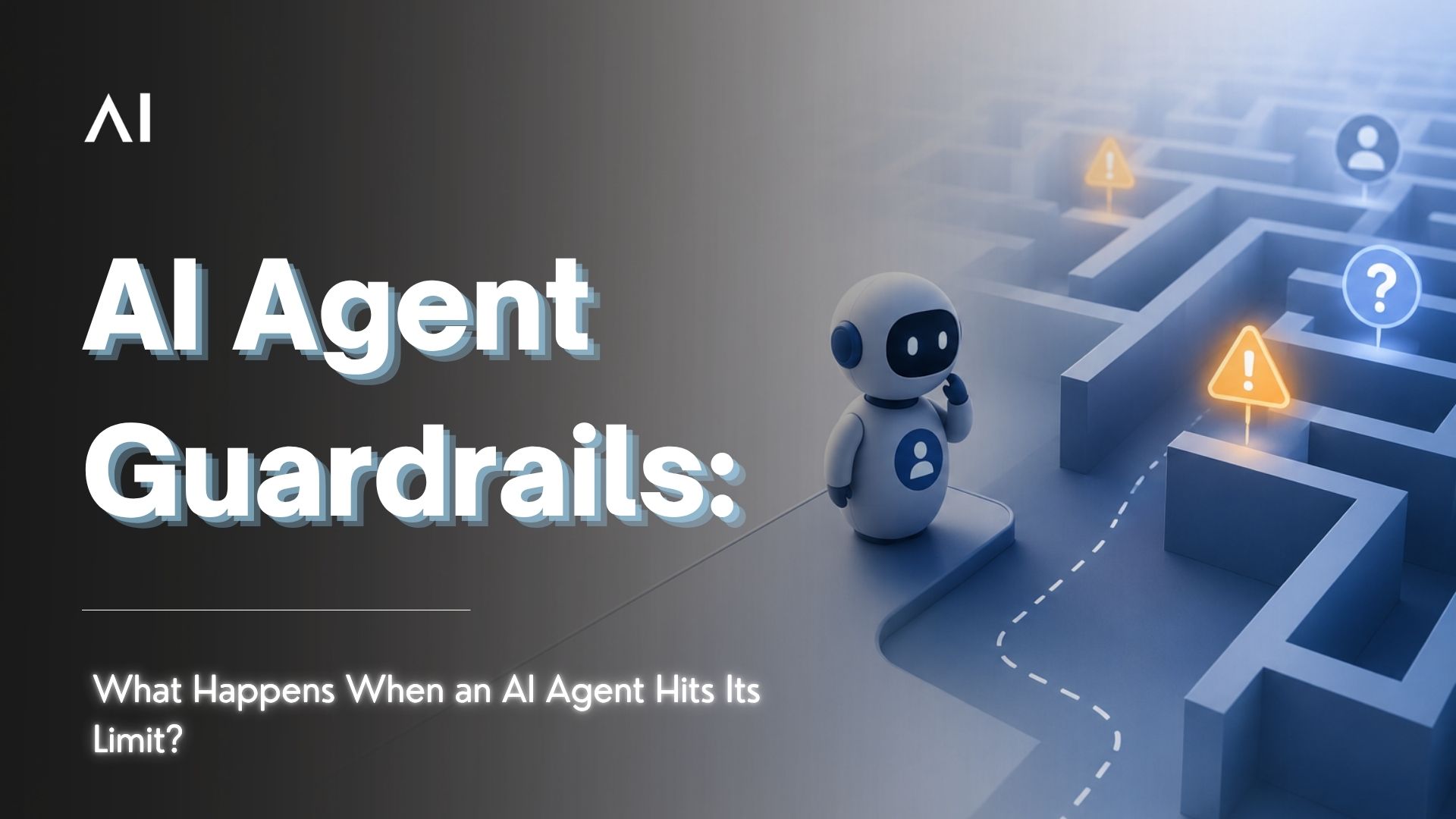
Every AI agent has a boundary. Most vendors will not tell you where it is. Some of them do not know.
What happens at that boundary is not something you see in a demo. The data is too clean, the scenarios too controlled, the questions too predictable. But in a live deployment it shows up fast. Usually within the first few weeks. And when it does, it tells you more about how the system was actually built than anything you saw in the evaluation room.
Most enterprise AI does not fail on the obvious stuff. It fails at the edge. And the edge is where nobody thought to look.
The Types of Edge Cases That Break Most AI Agents
Edge cases in enterprise AI are not rare. They are a daily reality.
In banking especially, the volume and variety of what comes through a customer-facing AI agent is wider than any training set fully anticipates. A customer whose account has been frozen for a reason that spans two different departments. A loan application that meets some criteria but not others in a way the system was not designed to handle. A complaint that starts as a balance enquiry and turns into a fraud report three messages in. A query in a regional language mixed with technical financial terminology that the model has seen separately but never together.
None of these are exotic. They are Tuesday.
Then there is a different kind of edge case entirely. Not unusual queries but unusual weight. A customer describing a transaction pattern that, if you read it carefully, suggests someone else might be managing their account without their full understanding. A request that sits within scope on paper but something about the context makes a straight answer feel inadequate. A moment where following the process correctly would still leave the person on the other end worse off than before they called.
Volume was never the hard part. This is the hard part.
How a Poorly Built AI Agent Handles It
Most AI agents that have not been built for the edge respond in one of three ways, and none of them are good.
The confident wrong answer: The system does not register that it is out of its depth. It pulls together something that sounds reasonable, delivers it confidently, and the customer walks away with information that is wrong.
The hard stop: The agent hits something outside its scope and either goes silent, returns an error, or loops the customer back to the beginning with no explanation.
The generic fallback: “I am sorry, I am unable to help with that. Please contact our support team.” It sounds polite, but it gives the customer no answer and gives the support team zero context.
What all three have in common is simple: the agent was built to handle the expected. When the unexpected arrived, there was no plan.
How a Well Built Agent Handles It
A well built agent knows what it does not know. That sounds simple, but it is one of the harder things to get right in enterprise AI.
The difference comes down to how the system is designed to handle its own limits.
A production-ready AI agent needs:
Clear guardrails: It should know what is in scope, what is out of scope, and where human judgment is required.
Confidence thresholds: It should detect when the signal is weak instead of pushing through and generating a confident wrong answer.
Graceful escalation: When uncertainty hits, it should not stop, loop, or throw a generic fallback. It should transition to a human with context.
Context handoff: The human agent should receive the full conversation history, the query that triggered escalation, the data already retrieved, and the reason the AI agent decided to escalate.
Learning from the edge: Every escalation, out-of-scope query, and low-confidence moment should be logged and reviewed so the system improves over time.
The point is not to build an AI agent that never reaches its limit. That agent does not exist.
The point is to build one that knows its limit, handles it gracefully, and gets better every time it reaches the edge.
How Fluid AI Approaches Edge Case Handling
Edge case handling is not a feature Fluid AI adds at the end of a deployment. It is something that gets designed into the system from the first conversation about architecture.
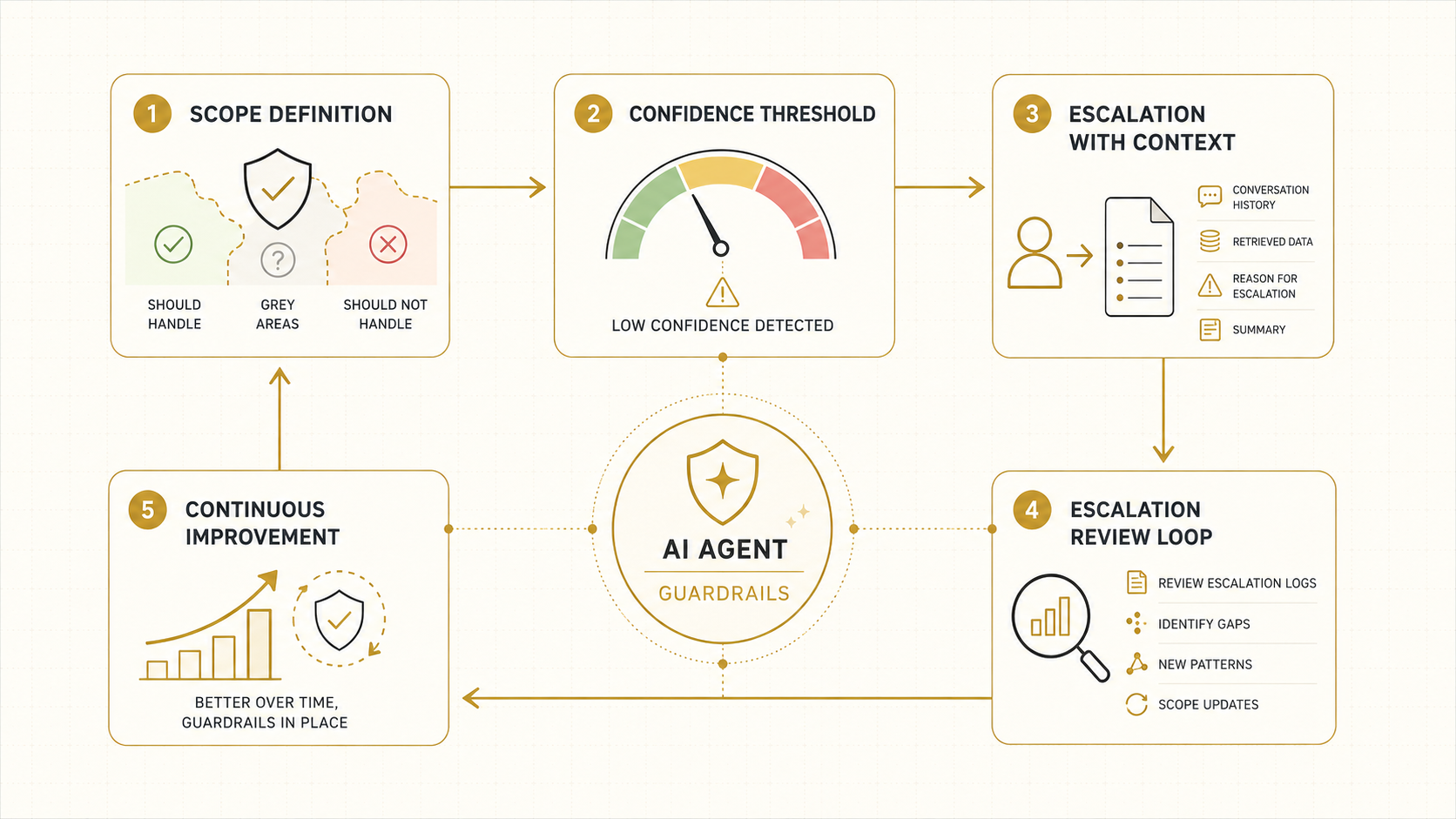
Scope definition comes first.
Before any agent goes live, the boundaries of what it should and should not handle get mapped out explicitly. Not just the obvious ones. The grey areas too. Query types that sit at the edge of scope, decisions that need a human, situations where the technically correct answer is not the appropriate one. All of it documented, tested, and built into the guardrail layer before a single real customer interaction happens.Then comes the confidence threshold layer.
Every response the agent generates carries an internal confidence signal. When that signal drops below a defined level the agent does not push through. It recognises it is outside its reliable range and moves into escalation mode. The customer does not experience a failure. They experience a transition to someone who can actually help.The escalation carries everything with it.
When a query moves from the agent to a human, the full conversation moves too. The data retrieved, the reason for escalation, a summary of what was already attempted. The person picking it up does not start from scratch. They start from where the agent left off.And the work does not stop after go-live.
Fluid AI runs regular reviews of escalation logs in production. Every handoff gets examined. Some lead to expanding the agent's scope. Some confirm the guardrail did exactly what it was supposed to. Some surface gaps nobody anticipated during the build. That loop is what keeps the system honest and what stops month one edge cases from still being edge cases in month six.
The goal is not an agent that never hits its limit. That agent does not exist. The goal is an agent that knows its limit, handles it gracefully, and gets better at it over time.
The Most Important Question You Are Probably Not Asking Your AI Vendor
Most vendor evaluations follow the same pattern. You see a demo of the happy path. The query is clean, the answer is right, the response is fast. Everyone is impressed. The procurement process moves forward.
Nobody asks what happens when it goes wrong.
Not because the question is not important. Because the demo is designed so the question never comes up. The scenarios are controlled, the data is clean, and the edge cases that will show up on day thirty of a live deployment are nowhere near the room.
So here is the question worth asking before you sign anything.
What does your agent do when it hits something it was not built for?
Push past the first answer. "It escalates to a human" is not enough. Ask what the escalation looks like. Ask what context gets passed. Ask whether the customer has to repeat themselves. Ask how the system knows it has hit an edge case rather than just generating a confident wrong answer. Ask how the logs from those moments get used to improve the system over time.
The answers to those questions will tell you more about the maturity of what you are buying than any benchmark or accuracy metric will.
An agent that performs well on expected queries and falls apart at the edges is not a production-ready system. It is a pilot that was never stress-tested.
The organisations that figure this out before go-live build something that holds up. The ones that figure it out after are the ones calling their vendor at month two wondering why the contact centre load went up instead of down.
This Is the Part That Separates AI That Works From AI That Lasts
Every enterprise AI deployment will eventually meet its edge. A query it was not designed for. A decision that sits outside its confidence range. A situation where the right answer is not the obvious one.
The organisations that build for that moment from the start are the ones that end up with AI systems that actually hold up in production. Not just in the first month when everything is running on carefully prepared data and controlled scenarios. In month six, month twelve, and beyond when the real variety of customer needs has had time to show up.
The ones that do not build for it find out the hard way. Usually through a combination of customer complaints, unexpected contact centre load, and an escalation log that nobody has been reading.
Fluid AI builds enterprise agentic AI for banking, insurance, telecom, manufacturing and fintech with edge case handling, confidence thresholds, escalation design, and continuous improvement loops built in from day one. Not as an afterthought. As part of what it means to build something production-ready.
Because an AI agent that only works when everything goes according to plan is not really ready for the real world. And the real world is where your customers live.
Book your Free Strategic Call to Advance Your Business with Generative AI!
Fluid AI is an AI company based in Mumbai. We help organisations kickstart their AI journey. If you're seeking a solution for your organisation to enhance customer support, boost employee productivity and make the most of your organisation's data, look no further.
Take the first step on this exciting journey by booking a Free Discovery Call with us today and let us help you make your organisation future-ready and unlock the full potential of AI for your organisation.
_1790254083168-CB8e8KXC.png)