Agentic AI in Manufacturing: How AI Replaces Operator Button-Clicks on Legacy DCS and MES Systems

TL;DR
Agentic AI can operate legacy DCS and MES systems autonomously by reading operator interfaces directly and taking actions the same way a human would. It acknowledges alarms, logs batch events, adjusts setpoints, and escalates anomalies, all without requiring API access, system replacement, or infrastructure upgrades.
Plants running decade-old SCADA and DCS systems are deploying agentic AI on top of existing infrastructure in weeks, not months, by starting with a single high-frequency workflow like alarm management and expanding from there.
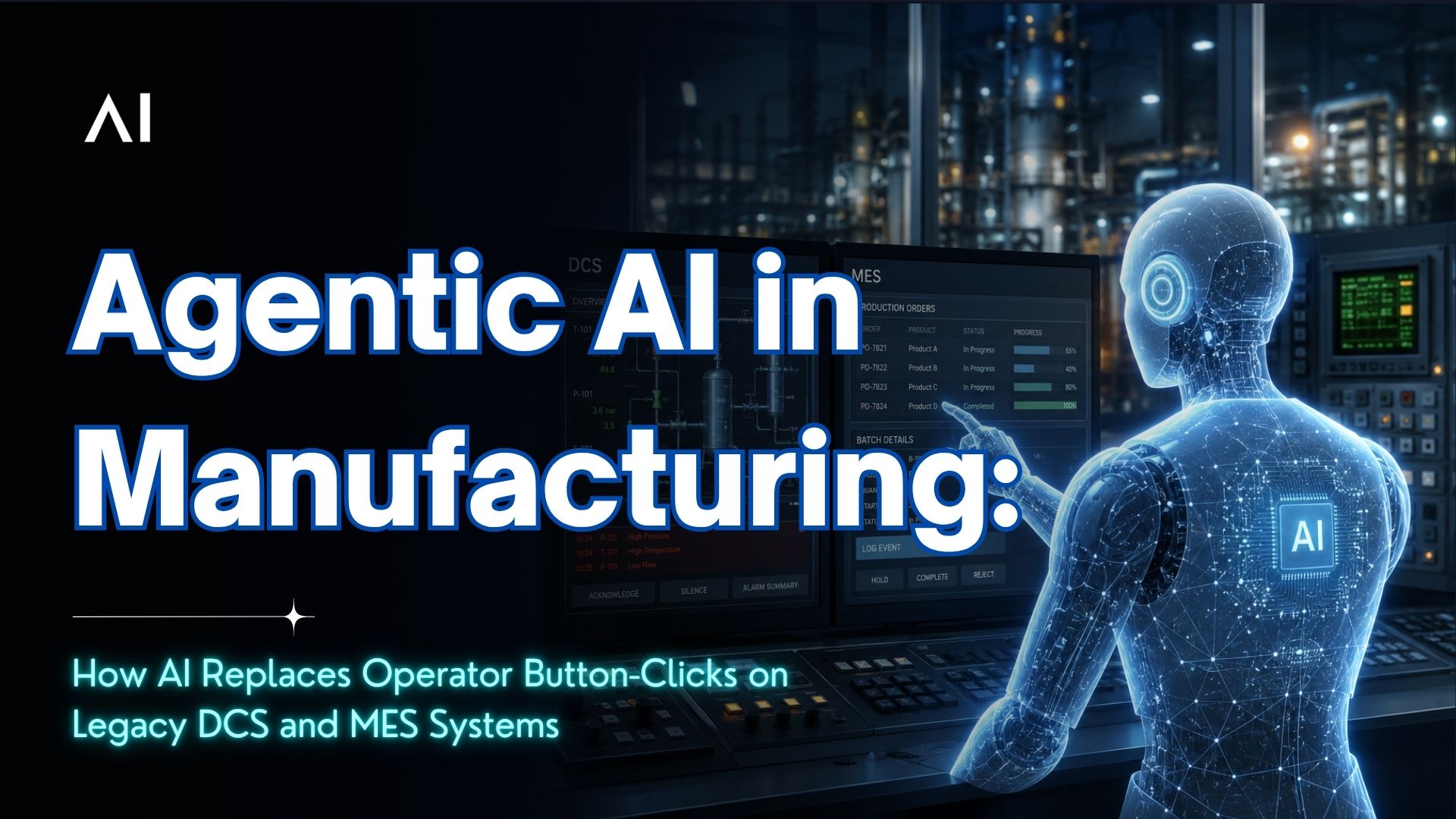
There's a version of "AI in manufacturing" that sounds great in a conference deck. Predictive maintenance. Digital twins. Real-time yield optimisation. All of it running on a clean, modern, API-first architecture.
Then there's what most plant managers are actually working with.
A SCADA system from 2008. A DCS that the original vendor barely supports anymore. An MES that requires a specific version of Internet Explorer to render correctly. Operators who've built institutional memory around quirks in the interface that nobody ever documented. And an IT department that'll tell you, plainly, that integrating anything new with this stack is a six-figure project with an eighteen-month timeline, minimum.
This is the real manufacturing AI problem. Not the algorithms. The plumbing.
What DCS and MES Systems Actually Do
Most plants have two systems doing the heavy lifting, and they operate at completely different speeds.
The DCS is the one closest to the metal. It's reading sensors, holding set points, managing alarms, and making sure physical processes stay inside safe boundaries.
→ Temperature in a reactor
→ Pressure in a line
→ Flow rate through a mixer
When something drifts, the DCS catches it. That's the only reason most facilities haven't had a serious incident in years.
The MES works at a different pace. It's not watching millisecond-level sensor data. It's tracking what got made, which batch it came from, how much material went in, whether the output met spec, and who signed off on what. A plant manager running a morning production review is looking at MES data. A QA auditor pulling batch records is in the MES.
Both of them throw off huge volumes of data. And both of them need operators to keep responding to that data, all shift long:
→ Acknowledge this alarm
→ Log this event
→ Adjust that set point
→ Escalate this anomaly
→ Sign this record
The work itself isn't complicated. It just never stops.
The Operator Workload Nobody Talks About
A control room operator on a 12-hour shift might interact with their DCS or MES interface hundreds of times. Most of those interactions are reactive and formulaic. Alarm comes in, operator checks the context, acknowledges it if it's known, escalates it if it isn't. Batch reaches a milestone, operator logs the transition. A set point drifts past a threshold, operator makes a correction.
This isn't skilled work in the traditional sense. It's pattern recognition applied to a cluttered interface, hour after hour, with the constant low-level pressure that any missed action could become a quality event or a safety incident.
Experienced operators handle it because they've internalized the patterns:
→ They know which alarms are noise and which ones matter
→ They know which setpoint corrections are routine and which ones need a supervisor
→ They know the system's quirks
But that knowledge walks out the door when operators retire. And the manufacturing sector is in the middle of a retirement wave that isn't slowing down.
So the real question isn't whether AI can optimise a plant. It's whether AI can take over the repetitive operational decisions that currently depend on individual human memory and attention.
Why Traditional Automation Didn't Solve This
Plants have been automating for decades. The playbook is familiar: define your conditions, write your rules, wire them to your outputs. If pressure hits X, trigger Y. If alarm Z fires and the line is running, do this. If it fires during a changeover, do that.
It works. Until it doesn't.
The rules get written for the conditions that exist when someone sits down to write them. Six months later, a new product line changes how the equipment behaves. A vendor swap shifts the baseline readings. An operator figures out a workaround that becomes standard practice but never gets documented. The rule engine doesn't know any of that happened. It just keeps firing on logic that no longer matches reality, and it fails quietly enough that nobody catches it until something goes wrong.
There's also no way to ask a rule engine why it did something. It matched a condition and executed. That's the whole explanation. For a regulator who wants to understand a batch deviation, or a shift supervisor trying to figure out why an alarm got suppressed, that answer isn't useful.
Context is the thing rules can't hold. An operator reading alarm X at 6am after a difficult night shift knows whether that alarm is routine noise or the start of something real, because they know what happened on the previous shift, what the product is, and what the equipment has been doing all week. A rule engine knows none of that. It just sees the trigger.
What Agentic AI Actually Does in This Context
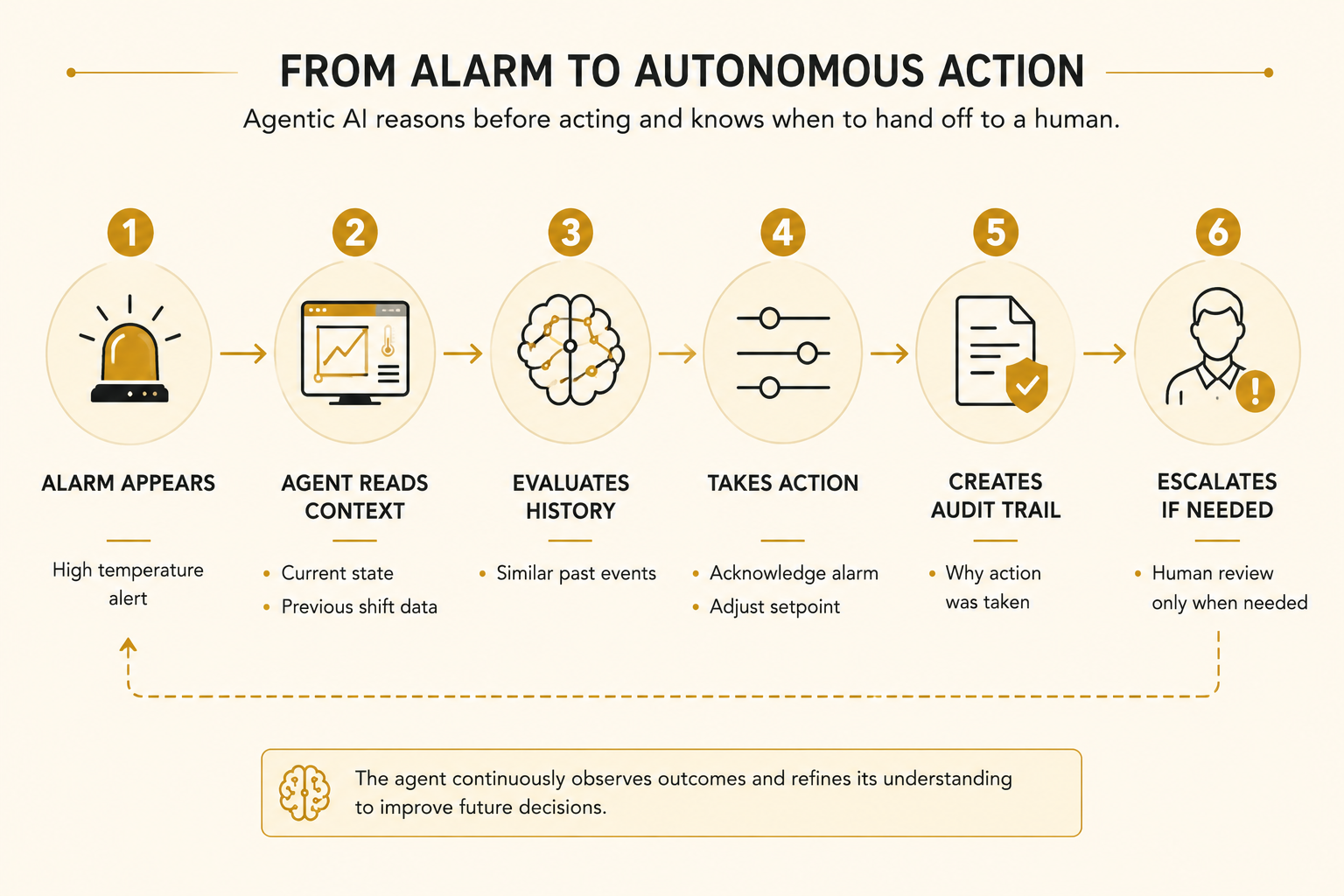
The core difference between agentic AI and every automation approach that came before it is that the agent reasons before it acts.
It's not matching conditions to outputs. It's looking at a situation the way an operator would: what's the current state, what's the history, what does this pattern usually mean, and what's the right move given all of that. Then it acts. Then it checks whether the action had the expected effect. That loop is what makes it fundamentally different from a rule engine.
In practice, for a DCS or MES environment, that looks like this:
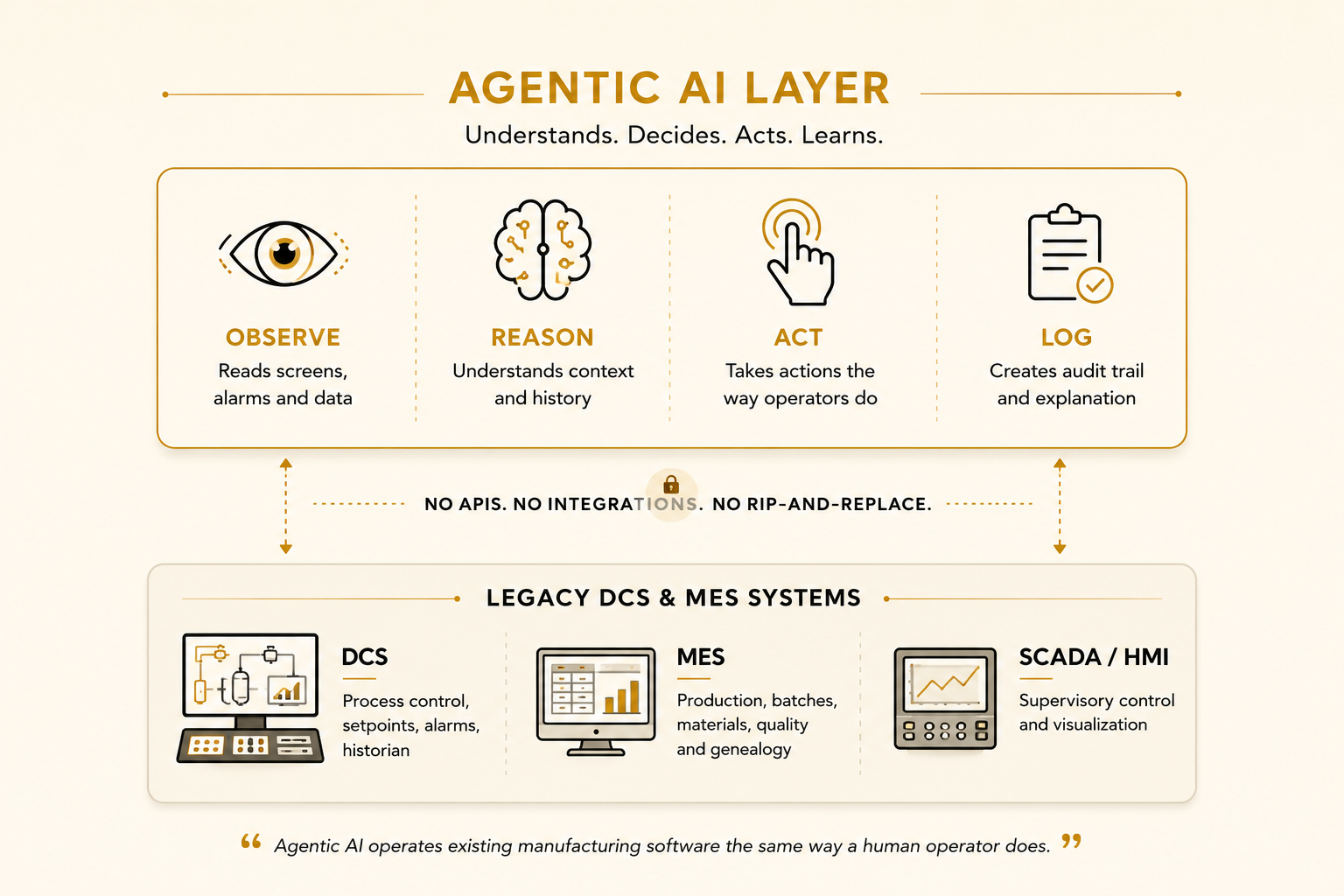
→ The agent reads the interface directly
No API required. Agentic frameworks can observe a screen, parse what's on it, and interpret it the same way a trained operator would. Alarm lists, batch status panels, setpoint dashboards: the agent sees them and understands what they mean.
→ It takes action the way an operator would
Acknowledging alarms. Adjusting setpoints within safe limits the plant defines. Logging batch transitions. Triggering work orders. Every action gets logged with the reasoning behind it, not just a timestamp.
→ It knows when to stop and hand off
When a situation falls outside what it can handle confidently, it doesn't guess. It flags the issue to a human with enough context that the person can make a fast call without having to reconstruct what happened from scratch.
The Integration Reality: No Rip-and-Replace
Here's what makes this genuinely different from every other "AI for manufacturing" pitch.
→ You don't touch the DCS
→ You don't touch the MES
→ You don't run an integration project
→ You don't wait for the legacy vendor to release an API
The agent layer sits on top of what already exists. It observes through the same interface a human would use. It acts through the same interface a human would use. From the DCS's perspective, someone is clicking the button. It just isn't a person.
That framing shift matters more than it sounds. "Modernise the stack" is a board-level budget conversation with an 18-month delivery timeline and a real chance of scope creep. "Layer intelligence on top of what we have" is an ops conversation that can start next quarter. Same outcome, completely different path to get there.
The workforce angle is the other thing plants get wrong. Operators hear "AI is taking over decisions" and they picture their job disappearing. What actually happens with a well-deployed agentic system is closer to the opposite: the AI handles the stuff nobody wanted to do anyway.
→ The alarms that fire 40 times a shift and mean nothing
→ The batch logs that are copy-paste from the last run
→ The set point nudges that experienced operators do on autopilot
That creates space for operators to actually think. And it tends to land well once people see it in action. What doesn't land is promising full autonomy before the workforce has had any chance to watch the system work and build trust in it.
Where This Is Already Working
Fluid AI's core deployments are in banking, and the problems there rhyme closely with manufacturing. You've got legacy infrastructure that generates more events than any human team can triage carefully. You've got decisions that are repeatable most of the time but genuinely consequential when they're not. You've got regulators who want an audit trail for everything.
In banking, agents are handling:
→ Alert triage that used to sit in a human queue for hours
→ Compliance checks that required someone to stop and manually verify
→ Workflow handoffs that fell through the cracks between shifts
What "Audit-Ready" Means in Practice
One concern that comes up immediately in regulated manufacturing environments is auditability. If an AI agent is clicking buttons and making operational decisions, how do you prove to a regulator what happened and why?
This is actually an area where agentic AI has an advantage over human-only operations.
When an agent takes an action, it logs:
→ What it saw on the interface at that moment
→ What it concluded from the current and historical state
→ What action it took and why
→ Whether the action produced the expected result
Not a system code. Not a timestamp. An actual account of the reasoning. If it acknowledged an alarm, the record shows what state the system was in, what pattern matched, and why it didn't escalate. If it did escalate, you can see exactly where its confidence ran out and what it handed to the human.
That's a materially different audit record than what you get from human-only operations. Shift handover notes written at 6am aren't reliable documentation. Institutional knowledge isn't documentation at all.
Agentic systems don't just make operations faster. They make operations more legible, which is something pharma, food and beverage, and chemical manufacturers care about deeply.
The Skills Gap Makes This More Urgent
Manufacturing is losing experienced operators faster than it's replacing them. The average age of a control room operator in heavy industry is rising. Plants that built their operational culture around people who've been there for 20 years are starting to feel what happens when those people leave.
Training a new operator to handle a complex DCS takes years. Getting them to the point where they can manage edge cases with confidence takes even longer. And a lot of what they learn isn't documented anywhere because it never needed to be: it was just what experienced people knew.
Agentic AI is part of how you stop that knowledge from disappearing:
→ Patterns get encoded, not just practiced
→ Decisions get logged, not just made
→ Institutional knowledge survives the retirement, not just the shift
Not by replacing operators, but by building a system that can carry what they know forward.
Getting Started Without a Big Project
The right first move isn't deploying an agent across your entire plant. It's picking one narrow, high-frequency workflow and proving the model.
Alarm management is often the easiest starting point. Every plant has a class of alarms that experienced operators recognise immediately as nuisance alarms and acknowledge without escalating. An agent can learn that pattern, handle those alarms autonomously, and create a clean audit trail in the process.
→ The win is measurable
→ The risk is contained
→ Operators can verify in real time that the agent is making the right calls
From there, you expand. Batch event logging. Set point correction within safe limits. Work order triggering. Shift reporting. The scope grows as trust is established, not the other way around.
This is the pattern that actually works in industrial environments. Prove value narrowly, build trust deliberately, then scale.
The Bottom Line
Replacing a DCS or MES isn't a real option for most plants. The cost is too high, the risk is too high, and the timelines involved would outlast most of the people making the decision.
But that's never been the actual blocker for AI. The blocker was that AI required clean APIs, modern infrastructure, and integration projects nobody had budget for. Agentic AI sidesteps all of that:
→ It uses the interface operators already use
→ It works within guardrails the plant defines
→ It starts returning value before anyone's filed a capital expenditure request
The plants that move on this now will be the ones that have figured out institutional knowledge retention before the next wave of retirements hits. The ones that wait will be rebuilding from scratch.
Book your Free Strategic Call to Advance Your Business with Generative AI!
Fluid AI is an AI company based in Mumbai. We help organisations kickstart their AI journey. If you're seeking a solution for your organisation to enhance customer support, boost employee productivity and make the most of your organisation's data, look no further.
Take the first step on this exciting journey by booking a Free Discovery Call with us today and let us help you make your organisation future-ready and unlock the full potential of AI for your organisation.
Frequently Asked Questions (FAQ)
1. Can AI work with old factory systems?
Yes. Agentic AI sits on top of whatever you already have. No upgrades, no integration project, no new infrastructure.
2. Will AI replace my operators?
No. It takes over the repetitive stuff, alarm acknowledgements, routine logs, minor setpoint fixes, so operators can focus on decisions that actually need a human.
3. How is this different from the automation we already have?
Your current automation follows fixed rules. Agentic AI reads context, adapts when conditions change, and explains every decision it makes. Rule engines don't do any of that.
4. What if our DCS or MES has no API?
Doesn't matter. The agent reads the screen and acts through it the same way an operator would. No API needed.
5. How do we prove to auditors that AI made the right call?
Every action is logged with full reasoning in plain language. What it saw, what it decided, why. Better documentation than most shift handover notes.
_1790254083168-CB8e8KXC.png)