Agentic AI in Enterprise: Architecture, Use Cases, Implementation & Deployment

TL;DR
Agentic AI in enterprise environments goes beyond generating text or answering questions. AI agents can understand intent, reason over enterprise data, plan multi-step tasks, use tools, interact with business systems, and execute workflows. But production deployment requires more than an LLM: enterprises need reliable integrations, governed access, security, observability, human oversight, and a clear path from pilot to production.
Introduction
Most enterprise AI started with a simple promise: ask a question, get an answer.
That was useful. But it left the hardest part untouched.
Someone still had to do the work.
An employee could ask an AI assistant to identify overdue invoices, but someone still had to open the ERP. A customer could ask about a delayed payment, but an employee still had to check the core system and resolve the issue. A procurement team could ask AI to summarize vendor information, but the actual workflow still lived across emails, spreadsheets, SAP, approval systems, and databases.
Agentic AI changes this model.
Instead of stopping at an answer, an AI agent can understand a goal, break it into steps, retrieve the required information, use enterprise tools, make decisions within defined policies, execute actions, and escalate when human intervention is required.
That distinction is becoming increasingly important as enterprises move from AI experimentation toward production deployment.
BCG describes this shift as a transformation of enterprise platforms, with AI agents increasingly interacting with workflows, enterprise data, and business systems rather than operating as standalone assistants.
For enterprises, however, the question is no longer simply "What can an AI agent do?"
The better question is:
How do you make an AI agent capable of doing real enterprise work safely, reliably, and at scale?
This guide explains the architecture, use cases, implementation challenges, security requirements, and deployment strategy behind enterprise agentic AI.
What Is Agentic AI in Enterprise?
Agentic AI in enterprise refers to AI systems that can understand goals, reason through tasks, plan actions, use tools and enterprise systems, and execute multi-step workflows with varying levels of autonomy.
Traditional generative AI primarily produces an output.
An agentic system can produce an outcome.
Consider a customer asking:
"My card was blocked. Can you check why and help me fix it?"
A conventional AI assistant might explain possible reasons.
An enterprise AI agent can potentially:
Identify the customer's intent.
Authenticate the customer.
Retrieve account information.
Check the card status.
Review relevant transaction information.
Determine whether the issue can be resolved automatically.
Trigger an approved action.
Update the relevant system.
Inform the customer.
Escalate the case if policy requires human intervention.
The difference is execution.
Fluid AI describes this model as agents that can plan, reason, and execute multi-step workflows across enterprise systems while remaining governed by enterprise policies and compliance requirements.
This makes enterprise agentic AI fundamentally different from a chatbot sitting outside the organization's operational systems.
Agentic AI vs Generative AI vs Copilots vs RPA
These technologies often get grouped together, but they solve different problems.
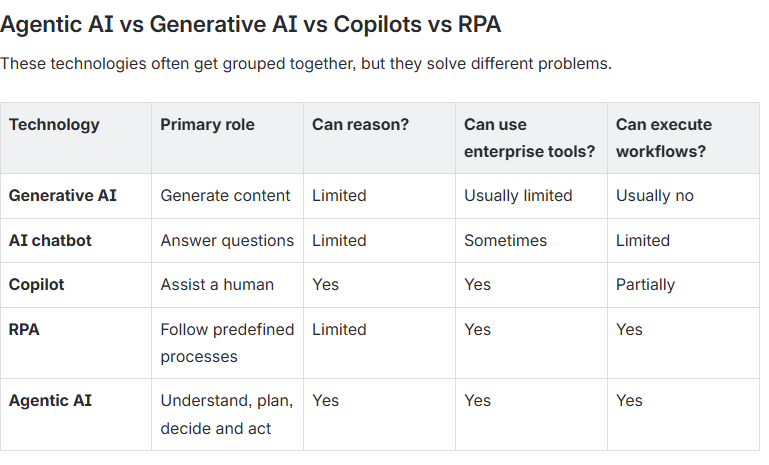
RPA remains useful for deterministic processes. Copilots remain useful when humans need assistance.
Agentic AI becomes particularly valuable when a process involves context, decisions, multiple systems, exceptions, and actions.
The goal isn't necessarily to replace every existing automation technology.
It is to create an intelligent layer that can coordinate them.
How Does Agentic AI Work in an Enterprise?
A production enterprise agent is not simply an LLM connected to an API.
It is a system made up of several layers.
A simplified architecture looks like this:
User or Business Event
↓
Agent / Orchestrator
↓
Reasoning + Planning
↓
Enterprise Knowledge + RAG
↓
Tools, APIs + MCP
↓
CRM / ERP / Core Systems / Databases
↓
Action
↓
Validation + Approval
↓
Audit + Monitoring
Each layer has a specific role.
1. Interaction Layer
Agents can receive requests through multiple channels:
Voice
Chat
Email
WhatsApp
Web applications
Internal enterprise applications
System-generated events
This matters because enterprise workflows don't begin in one place.
A customer may call.
An employee may send an email.
A machine may generate an alert.
A transaction may trigger an event.
The agent should be able to respond to the business event regardless of its source.
Fluid AI supports voice, chat, email, and WhatsApp as interaction channels while retaining context across them.
2. Reasoning Layer
The reasoning layer interprets intent and determines what needs to happen next.
For example:
"Find all delayed purchase orders and identify which ones are likely to affect this month's production schedule."
That isn't a single database query.
The agent may need to:
identify relevant purchase orders,
retrieve supplier information,
compare expected and actual delivery dates,
check inventory,
understand production requirements,
identify dependencies,
prioritize risks,
produce a recommendation.
This is where agentic systems differ from simple prompt-response applications.
3. Planning Layer
The agent converts a goal into a sequence of tasks.
For example:
Goal: Resolve an insurance claim.
Possible plan:
Retrieve policy.
Validate coverage.
Retrieve claim documents.
Check missing information.
Analyze submitted evidence.
Calculate applicable coverage.
Apply business rules.
Approve, reject, or escalate.
Update the policy system.
Notify the customer.
The plan may change when new information appears.
That adaptability is one of the defining characteristics of agentic systems.
4. Knowledge and RAG Layer
Enterprise agents need context.
That context may come from:
SOPs
policy documents
manuals
contracts
knowledge bases
databases
internal documentation
customer records
transaction history
Retrieval-augmented generation, or RAG, allows agents to retrieve relevant information before reasoning over a task.
But enterprise RAG shouldn't be treated as simply "chat with your documents."
The retrieved information must be connected to the workflow the agent is trying to execute.
5. Tool and Action Layer
This is where an agent moves from reasoning to execution.
Tools can include:
APIs
SQL queries
enterprise applications
CRM actions
ERP actions
search
document processing
email
messaging
workflow engines
business functions
external services
Protocols such as MCP can provide standardized ways for AI systems to discover and interact with tools.
Fluid AI's agent platform includes tool use, MCP connectivity, planning, memory, and multi-agent orchestration as components of its agent architecture.
6. Orchestration Layer
Complex enterprise processes rarely belong to one agent.
A loan application, for example, could involve:
a document agent,
a verification agent,
a risk agent,
a compliance agent,
a communication agent,
an approval agent.
An orchestrator coordinates these specialized agents.
Tasks can be executed sequentially or in parallel, with handoffs and escalation rules determining what happens next.
7. Governance Layer
Autonomy without controls is not enterprise readiness.
The system needs to know:
what the agent can access,
what it can change,
which actions require approval,
when it must stop,
when it must escalate,
what information it can expose,
how every action is recorded.
This is particularly important in regulated environments.
Enterprise Agentic AI Architecture
A production architecture typically needs more than an LLM and a vector database.
The key components are:
Foundation models: LLMs provide reasoning and language capabilities. Enterprises may use one model or multiple models depending on cost, latency, privacy, performance, and task requirements.
Agent runtime: The runtime manages agent execution, state, planning, memory, retries, and tool calls.
Orchestration: Orchestration coordinates multiple agents, workflows, handoffs, and parallel tasks.
Enterprise knowledge: RAG, databases, documents, APIs, and other sources provide the context required for decisions.
Tool layer: Agents need controlled access to enterprise functions.
Integration layer: The system connects to existing infrastructure instead of requiring enterprises to replace it.
That can include:
SAP
Oracle
Salesforce
Core banking platforms
SCADA
databases
ticketing systems
legacy applications
APIs
Governance and security
Identity, permissions, policies, approvals, audit trails, and monitoring sit across the entire architecture.
Observability
Enterprises need visibility into:
what the agent received,
what it retrieved,
what it decided,
which tools it used,
which actions it took,
where it failed,
when a human intervened.
This becomes especially important when AI agents are allowed to take real-world actions.
Agentic AI Use Cases in Enterprise
Agentic AI becomes most valuable when it is connected to high-volume, multi-step workflows.
1. Banking and Financial Services
Financial institutions have thousands of processes that involve documents, rules, systems, and decisions.
Loan Origination
An AI agent can:
collect applicant information,
retrieve documents,
extract financial data,
verify information,
assess eligibility,
prepare a credit memo,
identify missing information,
route exceptions,
update the lending system.
Instead of simply helping a loan officer read documents, the agent can participate in the entire workflow.
KYC and Customer Onboarding
Agents can coordinate:
document collection,
identity verification,
screening,
data validation,
risk checks,
case creation,
customer communication.
Collections
An agent can prioritize accounts, retrieve customer history, initiate conversations, determine the appropriate next step, record outcomes, and escalate sensitive cases.
Fraud Operations
Agents can gather information across transaction systems, customer profiles, previous cases, and rules engines to support investigators and automate appropriate actions.
2. Insurance
Insurance processes are heavily document-driven and involve multiple decisions.
Claims Processing
An agent can:
Receive a claim.
Extract information from documents.
Validate policy coverage.
Identify missing information.
Retrieve relevant records.
Assess the claim against defined rules.
Recommend an outcome.
Trigger downstream workflows.
Escalate exceptions.
Underwriting
Agents can gather information from multiple sources, summarize risk factors, compare them against underwriting policies, and prepare recommendations for underwriters.
Policy Servicing
Agents can handle requests involving:
policy changes,
renewals,
document generation,
customer questions,
eligibility checks,
follow-up communication.
3. Manufacturing
Manufacturing environments contain complex operational workflows, large knowledge bases, and legacy systems.
Plant Operations
An agent can connect plant manuals, SOPs, maintenance records, production information, and operational systems to help teams diagnose and resolve issues.
Procurement
Agents can:
search material catalogs,
compare suppliers,
retrieve purchase order information,
communicate with vendors,
identify delays,
recommend actions,
update procurement systems.
Inventory Management
An agent can monitor inventory, identify discrepancies, investigate transactions, check material availability, and initiate appropriate actions.
Maintenance
Instead of simply displaying a maintenance manual, an agent can combine machine history, sensor information, maintenance records, and SOPs to guide technicians through the appropriate workflow.
4. Oil and Gas
Oil and gas operations combine physical assets, safety requirements, field information, documents, and enterprise systems.
Agentic AI can support:
asset management,
procurement,
inventory,
maintenance,
safety compliance,
field operations,
incident management,
document search,
operational intelligence.
The value comes from connecting operational knowledge to systems where actions actually happen.
5. Government and Public Sector
Government organizations manage enormous amounts of structured and unstructured information.
Agents can support:
citizen services,
document processing,
case management,
employee support,
regulatory workflows,
grievance management,
internal knowledge access,
public-service operations.
For government environments, deployment architecture becomes particularly important because data sovereignty, security, auditability, and policy controls can be non-negotiable.
How Enterprises Integrate AI Agents With Existing Systems
One of the biggest misconceptions about enterprise agentic AI is that organizations need to replace their existing software.
They don't.
The challenge is making AI work with the systems that already run the business.
A production agent may need access to:
ERP → CRM → Core Banking → Database → Email → Ticketing → Documents → APIs
An agent that can only read information is limited.
An agent that can securely interact with those systems can become part of the workflow.
For example:
"Find all customers whose payments are overdue by more than 30 days and start the approved collection workflow."
The agent might:
Query the relevant database.
Retrieve customer information.
Check account status.
Apply collection policies.
Generate the appropriate communication.
Send it through the approved channel.
Record the interaction.
Schedule the next action.
Escalate exceptions.
Fluid AI positions its platform as an orchestration layer connecting enterprise agents to systems including core banking platforms, SAP, Oracle, Salesforce, SCADA, legacy mainframes, APIs, and other enterprise infrastructure.
This system connectivity is one of the most important differences between an enterprise agent and a standalone AI assistant.
Agentic AI Security and Governance
The more autonomy an AI system receives, the more important governance becomes.
An agent that can read a document is one thing.
An agent that can modify a customer account, approve a transaction, create a purchase order, or send an external communication is very different.
Enterprise agentic AI should therefore be designed around controlled autonomy.
Role-Based Access
Agents should only access the systems and information required for their role.
Permission Controls
Not every action should be available to every agent.
For example:
Read customer record: allowed
Update customer address: allowed
Issue refund above threshold: requires approval
Delete financial record: prohibited
Human-in-the-Loop
Human approval should be available where the business process requires it.
This doesn't mean putting a human in front of every AI action.
It means defining where human judgment is necessary.
Audit Trails
Every important action should be traceable.
Enterprises should be able to answer:
What did the agent do?
Why did it do it?
Which information did it use?
Which system did it access?
What changed?
Who approved it?
Escalation
Agents need clear boundaries.
When confidence is low, information is missing, a policy is violated, or an unusual situation appears, the correct action may be to stop and escalate.
BCG similarly highlights governance, controls, human oversight, and the challenges of integrating agentic AI into enterprise environments.
Challenges of Implementing Agentic AI in Enterprise
Enterprise deployment is not as simple as connecting an LLM to a workflow.
Several challenges need to be solved.
1. Data Quality
Agents are only as reliable as the information they can access.
Incomplete, outdated, duplicated, or inconsistent enterprise data can lead to poor decisions.
2. Legacy Systems
Many enterprises still operate on systems that were never designed for AI agents.
Connecting modern AI to legacy infrastructure requires APIs, connectors, middleware, or other integration approaches.
3. Security
Agents may need access to sensitive financial, customer, operational, or employee information.
Access must therefore be tightly controlled.
4. Hallucinations
A generated answer can be inconveniently wrong.
An incorrect action inside an enterprise workflow can be much more serious.
Agents need grounding, validation, constrained tools, and appropriate approval mechanisms.
5. Reliability
Production systems need predictable behavior.
The system should handle:
failures,
retries,
timeouts,
unavailable APIs,
incomplete information,
unexpected user inputs,
conflicting data.
6. Cost and Latency
Complex agent workflows can require multiple model calls, retrieval operations, and tool calls.
Enterprises need to balance intelligence with:
latency,
throughput,
infrastructure cost,
model selection.
7. Governance
As agents become more autonomous, organizations need clear ownership and policies around what agents can and cannot do.
How to Implement Agentic AI in Enterprise
The best enterprise deployments usually begin with the workflow, not the model.
Step 1: Identify the Right Workflow
Look for processes that are:
high volume,
repetitive,
time-consuming,
rules-driven,
dependent on multiple systems,
expensive to execute manually,
measurable.
Don't start with:
"Where can we use AI?"
Start with:
"Which business process is worth making autonomous?"
Step 2: Map the Existing Process
Document:
inputs,
decisions,
systems,
people,
exceptions,
approvals,
outputs.
This identifies where the agent actually needs to operate.
Step 3: Identify Data and Tools
Determine what the agent needs to:
read,
retrieve,
calculate,
decide,
update,
communicate.
Step 4: Define the Agent's Boundaries
Decide:
what it can do autonomously,
what requires approval,
what is prohibited,
when it must escalate.
Step 5: Connect Enterprise Systems
Integrate the required:
APIs,
databases,
CRMs,
ERPs,
knowledge bases,
workflow systems,
communication channels.
Step 6: Build and Test the Agent
Test against real scenarios, including failure cases.
A production test should not only ask:
"Did the agent give the correct answer?"
It should also ask:
"Did the agent take the correct action?"
Step 7: Add Monitoring and Governance
Track:
accuracy,
completion rate,
failures,
intervention rate,
latency,
cost,
policy violations,
escalation.
Step 8: Move to Production
Once the workflow is reliable, deploy it into the actual operating environment with appropriate security and controls.
Step 9: Measure Business Outcomes
The ultimate measure isn't how impressive the demo looks.
It's whether the process improved.
How to Measure Agentic AI ROI
Enterprise AI should be measured using business outcomes, not just model performance.
Useful metrics include:
Productivity
hours saved
tasks automated
cases handled per employee
Operational efficiency
processing time
resolution time
throughput
SLA adherence
Quality
error rate
rework
escalation rate
exception rate
Automation
percentage of workflow completed autonomously
human intervention rate
straight-through processing rate
Financial impact
cost per transaction
operational savings
incremental revenue
avoided costs
ROI
For example, instead of saying:
"Our AI agent is 40% more efficient."
A stronger enterprise metric would be:
"The agent reduced average claim processing time from X hours to Y minutes while maintaining the required approval controls."
The closer the metric is to the business process, the more useful it becomes.
Cloud, On-Premise, Hybrid, or Sovereign AI?
Enterprise AI deployment is not one-size-fits-all.
Some organizations can use public cloud infrastructure.
Others need private cloud or customer-controlled infrastructure.
Regulated industries may require on-premise or sovereign deployments because of:
data residency,
privacy,
regulatory requirements,
security policies,
infrastructure control,
intellectual property concerns.
Fluid AI supports customer cloud, on-premise, hybrid, and private deployment models, including environments where data remains within the customer's infrastructure.
The right deployment model depends on the organization's risk profile and operational requirements.
The important question isn't:
"Which cloud should we use?"
It is:
"Where should the data, models, agents, and controls operate for this workflow?"
What Should an Enterprise Agentic AI Platform Include?
Organizations evaluating an enterprise agentic AI platform should look beyond the model.
A production-ready platform should provide:
Agent Development
agent builder
reusable agents
configurable roles
memory
planning
tool use
Orchestration
multi-agent coordination
sequential workflows
parallel execution
handoffs
retries
escalation
Enterprise Knowledge
RAG
document processing
structured data
databases
enterprise search
Integrations
APIs
MCP
ERP
CRM
core systems
legacy systems
communication platforms
Governance
role-based access
policy controls
human approval
audit trails
monitoring
security
Deployment
cloud
private cloud
on-premise
hybrid
air-gapped environments where required
Channels
voice
chat
email
messaging
Fluid AI positions its platform around this broader execution layer, combining autonomous agents, multi-agent orchestration, enterprise integrations, governance, and multiple deployment models.
Agentic AI for Regulated Enterprises
For regulated organizations, "autonomous" does not mean "uncontrolled."
The most useful enterprise agents are often policy-bound agents.
They can act independently within clearly defined boundaries while escalating decisions outside those boundaries.
This model is particularly relevant to:
banking,
insurance,
government,
healthcare,
oil and gas,
large industrial organizations.
For these enterprises, a successful AI deployment must answer both:
"Can the agent do this?"
and
"Can the organization safely allow the agent to do this?"
That is why governance, auditability, deployment control, identity, permissions, and system integration need to be designed into the architecture rather than added later.
Agentic AI Is Moving From Answers to Actions
The first wave of enterprise AI focused on making information easier to access.
The next wave is about making work easier to complete.
That means the enterprise AI stack is expanding:
LLMs → RAG → AI assistants → AI agents → multi-agent workflows → autonomous enterprise execution
But the winning systems won't necessarily be the ones with the most autonomy.
They will be the ones that can combine autonomy with control.
An enterprise agent needs to understand the business context, access the right information, use the right tools, follow the right policies, execute the right actions, and know when to involve a human.
That is what turns agentic AI from an impressive demo into an operational system.
Frequently Asked Questions About Agentic AI in Enterprise
1. What is agentic AI in enterprise?
Agentic AI in enterprise refers to AI systems that can understand goals, reason through tasks, plan actions, use enterprise tools and systems, and execute multi-step business workflows with defined levels of autonomy.
2. What are the main enterprise use cases for agentic AI?
Common use cases include customer service, loan origination, KYC, collections, claims processing, underwriting, procurement, inventory management, IT helpdesk, employee support, document processing, maintenance, compliance, and operational workflows.
3. How is agentic AI different from generative AI?
Generative AI primarily creates content such as text, images, summaries, or code. Agentic AI can use generative AI as part of a larger system that plans tasks, interacts with tools, makes decisions, and executes workflows.
4. How is agentic AI different from RPA?
RPA generally follows predefined rules and workflows. Agentic AI can interpret context, reason about tasks, adapt its plan, and work with less structured inputs. The two technologies can also work together.
5. Is agentic AI secure for enterprises?
It can be, provided the architecture includes appropriate identity controls, permissions, data protection, governance, auditability, monitoring, human approval, and escalation mechanisms.
6. What is an enterprise agentic AI platform?
An enterprise agentic AI platform provides the infrastructure required to build, deploy, orchestrate, integrate, govern, and monitor AI agents across business workflows.
7. Do enterprises need to replace their existing software?
No. In many cases, the goal is to connect AI agents to existing systems rather than replace them. This allows organizations to add an intelligent execution layer across their current technology stack.
Conclusion
Enterprise agentic AI isn't about giving a chatbot more intelligence.
It's about giving AI the context, tools, system access, and permissions to actually complete work.
The technology becomes valuable when an agent can move from:
Understand → Retrieve → Reason → Plan → Act → Verify → Resolve
while remaining secure, auditable, and governed.
For enterprises, that is the real transition from AI experimentation to AI execution.
And as organizations connect agents to the systems that already run their businesses, the biggest opportunity is no longer simply asking what AI can generate.
It's asking what work AI can safely finish.
Explore Fluid AI's Enterprise Agentic AI Platform
Book your Free Strategic Call to Advance Your Business with Generative AI!
Fluid AI is an AI company based in Mumbai. We help organisations kickstart their AI journey. If you're seeking a solution for your organisation to enhance customer support, boost employee productivity and make the most of your organisation's data, look no further.
Take the first step on this exciting journey by booking a Free Discovery Call with us today and let us help you make your organisation future-ready and unlock the full potential of AI for your organisation.
_1790254083168-CB8e8KXC.png)