The Hidden Cost of Token Sprawl in Enterprise AI Deployments

TL;DR
Token sprawl is the hidden cost of enterprise AI. It happens when prompts, documents, chat history, and responses keep getting bigger without adding real value. At pilot scale, it looks harmless. At enterprise scale, it quietly increases cost, slows performance, weakens response quality, and creates governance risk before anyone notices the bill.
There is a cost in every enterprise AI deployment that almost never shows up in the original business case.
It is not the model licensing fee. It is not the infrastructure. It is not even the implementation. It is the quiet, compounding expense of sending more tokens than you need to a model that charges you for every single one.
Token sprawl is what happens when nobody is watching what goes in and out of the language model. Prompts that are longer than they need to be. Context windows stuffed with information the model never uses. Responses generated at a length that serves nobody. All of it billed per token, all of it adding up, and almost none of it showing up in a line item that anyone reviews.
For a single use case in a pilot, the numbers look fine. Spread that across an enterprise deployment running thousands of calls a day and the bill starts telling a very different story.
How Tokens Work and Why They Cost Money?
Before getting into where it goes wrong it helps to understand what is actually being counted.
A token is not a word. It is a chunk of text, roughly three to four characters on average, that the model processes as a single unit. Every time you send something to a language model and every time it responds, both sides of that exchange get counted and billed.
So when an enterprise system sends a prompt to a model it is not just sending the user's question. It is typically sending a system prompt that sets the context, relevant documents retrieved from a database, conversation history, instructions for how to format the response, and then the question itself. All of that goes in as input tokens. Whatever comes back is output tokens. Output tends to cost more.
In isolation none of this sounds alarming. A few thousand tokens per call at a fraction of a cent adds up slowly at low volume. At enterprise scale, with hundreds of thousands of calls running daily across multiple use cases, the math changes fast.
What Token Sprawl Actually Looks Like?
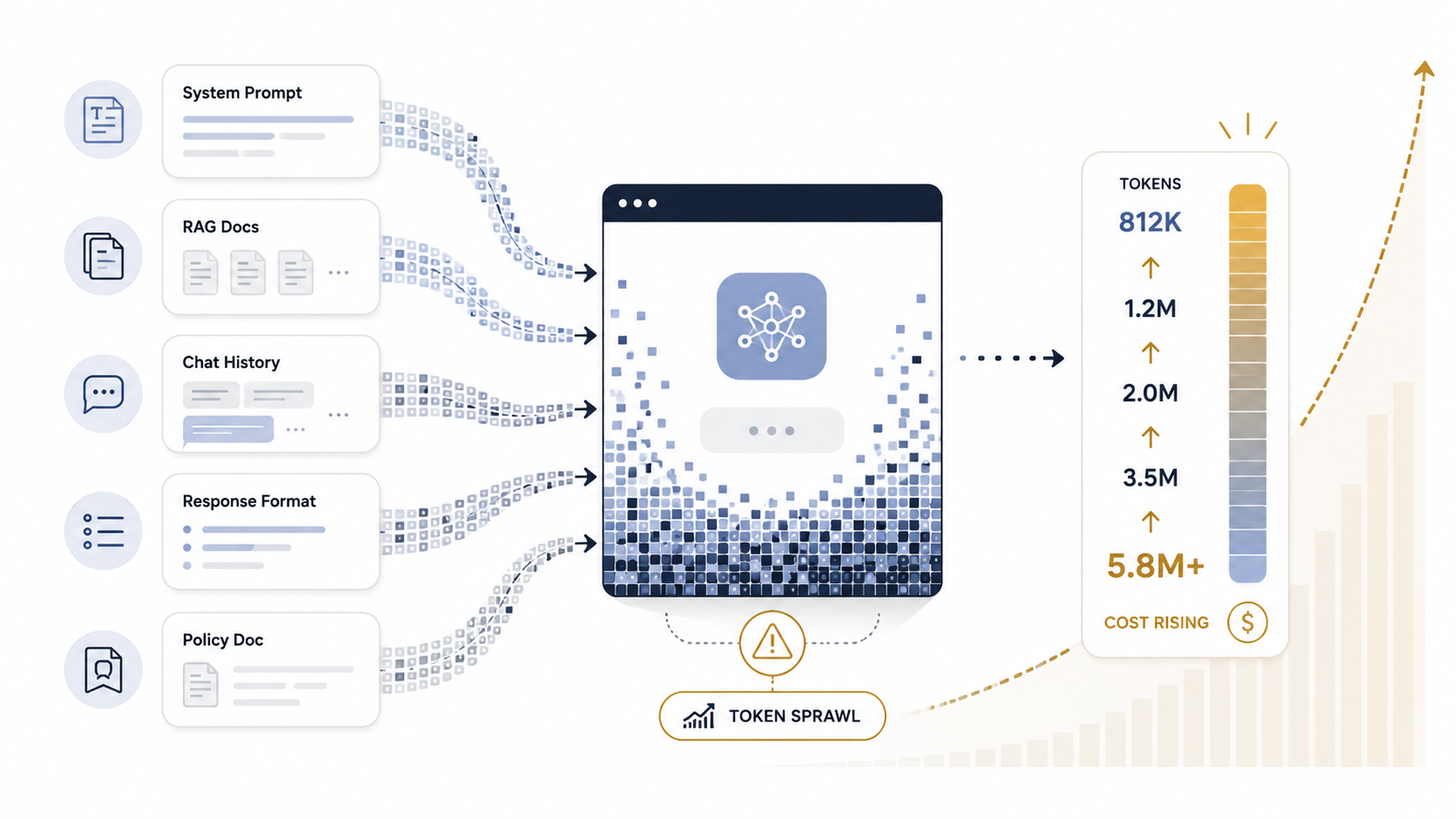
Token sprawl is rarely one big problem. It is usually five or six small ones running at the same time that nobody has connected to each other.
The system prompt that was written during the pilot and never trimmed down after go-live. The RAG pipeline that retrieves the top ten documents for every query even when two would have been enough. The conversation history that gets passed in full every single turn even when only the last three exchanges are relevant. The response format instruction that asks the model to explain its reasoning every time even for queries that do not need it. The fallback that sends the entire policy document when a paragraph would have answered the question.
None of these feel like expensive decisions in the moment. Each one made sense when someone made it. But running together, across a deployment at scale, they are the difference between an AI programme that looks sustainable on paper and one that quietly becomes the most expensive line in the technology budget.
The other thing about token sprawl is that it does not stay still. Every time a new use case gets added, every time the system prompt gets updated, every time a new document set gets pulled into the retrieval layer, the token count creeps up. Without active monitoring it compounds in the background while everyone is focused on accuracy and latency.
The Hidden Costs Beyond the API Bill
The API bill is the obvious one. But token sprawl creates problems that do not show up in the invoice at all.
The first is latency. More tokens in means more time to process. More tokens out means more time to generate. In a customer-facing application where response time is part of the experience, a bloated prompt is not just a cost problem. It is a quality problem.
The second is context pollution. A context window that is filled with irrelevant information does not just cost more. It actively makes the model worse. When the model has to reason across a large volume of context, the signal gets diluted. The answer it produces is less precise, less grounded, and more likely to drift from what was actually asked.
The third is governance. Every token that goes into a model is a token that could contain sensitive information. In banking and financial services where customer data is involved, an undisciplined approach to what gets sent to the model is not just inefficient. It is a compliance risk that most organisations have not fully mapped.
Token sprawl is not a billing problem with some performance side effects. It is a system design problem that shows up in the bill, the response quality, and the risk posture all at once.
How to Know If You Have a Token Sprawl Problem?
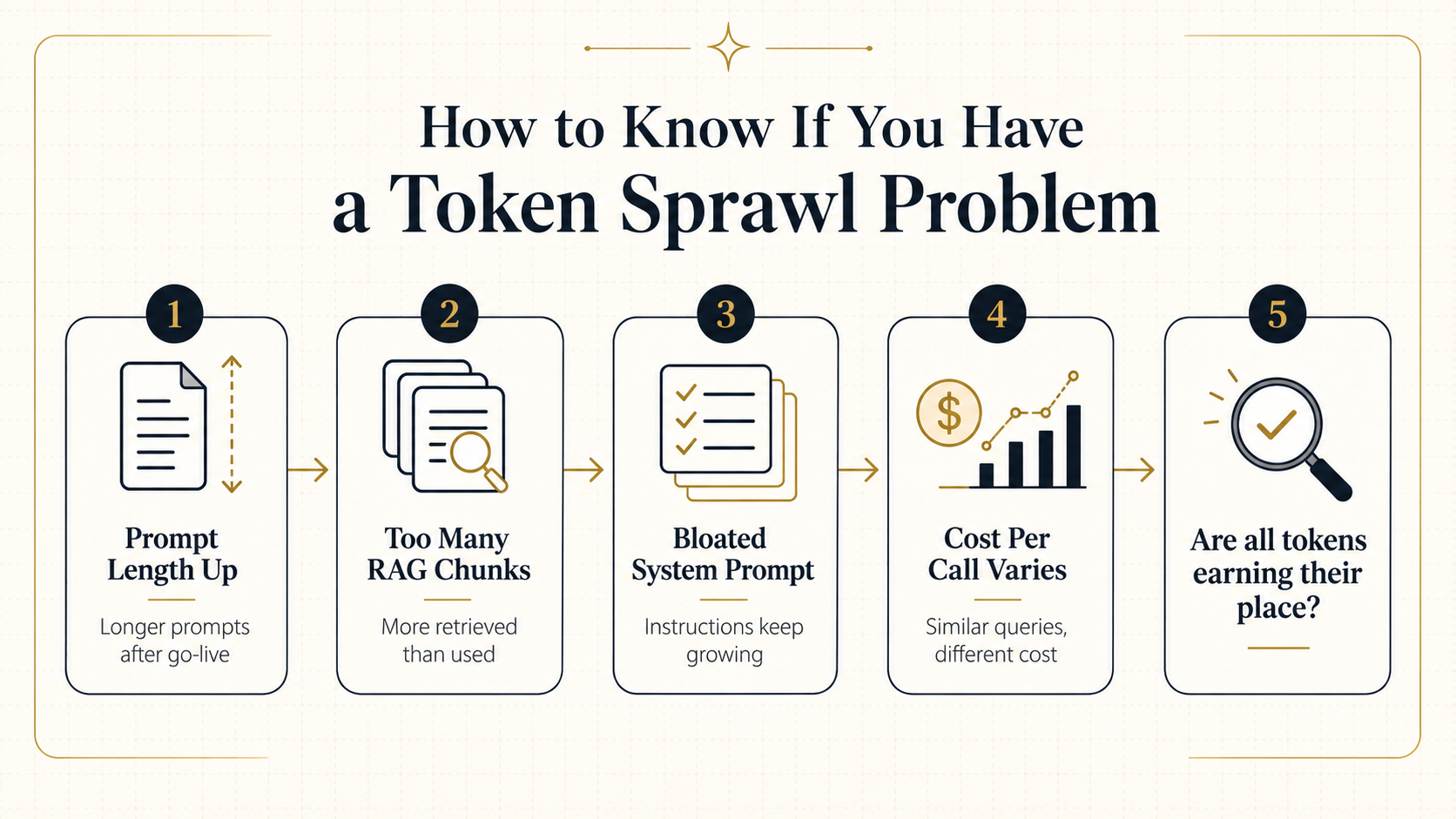
Most organisations find out the hard way. The bill comes in and someone does the maths on cost per call and realises it does not match what was projected during the pilot.
But there are earlier signals.
If your average prompt length has grown significantly since go-live without a corresponding improvement in output quality, that is a signal. If your RAG pipeline is consistently retrieving more chunks than the model actually references in its response, that is a signal. If your system prompt has been added to multiple times by multiple people and nobody has reviewed the whole thing recently, that is a signal. If your cost per call varies significantly across similar queries without a clear reason, that is a signal.
The underlying question is whether every token being sent is earning its place. Most enterprise deployments, if they are honest about it, cannot answer that question with confidence.
How Fluid AI Approaches It?
Token efficiency is not an afterthought in how Fluid AI builds enterprise AI systems. It is built into the architecture from the start.
The RAG layer is designed to retrieve what is actually needed for a given query rather than defaulting to a fixed number of chunks regardless of relevance. Prompts are structured to carry context without carrying noise. Response formats are calibrated to the use case so the model is not generating five paragraphs when one sentence would do.
Beyond the initial build, Fluid AI monitors token usage across deployments in production. Not just the total cost but the breakdown by component, by use case, and by query type. When something starts creeping up, it gets caught early rather than at the end of a billing cycle.
The goal is an AI system that performs well and costs what it should cost. Not what it costs when nobody is watching.
The Conversation Most Teams Are Not Having
Enterprise AI budgets are getting bigger. The scrutiny on those budgets is getting bigger too. And the organisations that will defend those budgets most effectively are the ones that can point to exactly where every rupee is going and why.
Token sprawl is the part of that conversation that most teams are not having yet. Not because it is not important but because it is invisible until it is not.
The time to build the discipline around it is before the deployment scales, not after the bill arrives.
Book your Free Strategic Call to Advance Your Business with Generative AI!
Fluid AI is an AI company based in Mumbai. We help organisations kickstart their AI journey. If you're seeking a solution for your organisation to enhance customer support, boost employee productivity and make the most of your organisation's data, look no further.
Take the first step on this exciting journey by booking a Free Discovery Call with us today and let us help you make your organisation future-ready and unlock the full potential of AI for your organisation.
_1790254083168-CB8e8KXC.png)