System Ticketing: Understanding Ticketing Systems and FluidAI's Role in Resolution Management

TL;DR
System ticketing involves the process of recording all requests and problems as a recordable ticket, and then routing, prioritizing, and resolving requests in a single location. It is run by software called a ticketing system. There are 3 main types of IT tickets: IT Ticketing, Help Desk, and Enterprise Service Desk. AI and agentic systems take the organization of the queue a step further, resolving common tickets automatically and reducing the time needed for resolution. The biggest change in ticketing today is the move from the old "deflect and resolve" mentality to managing tickets.
System ticketing is a way for an organization to convert all those bits and pieces of requests, emails, chats, phone calls and forms into a structured ticket that can be tracked, assigned and closed without missing or losing anything. This is what a ticketing system does.
When you're considering one, the question is not so much “Which tool is best for organizing tickets?” as it is “How many tickets can I avoid creating in the first place?” This guide provides an overview of the concept of system ticketing, the primary types, key features, and the transformative role of AI within the framework.
What is a ticketing system?
A ticketing system is a platform that captures all incoming requests as tickets, and then manages the ticket from its inception to completion and closure. The request details, who raised the request, the priority, the status of the request and a complete history of what happened is stored in each ticket.
System ticketing is easy, it's about providing one place, one owner, and one audit trail for every request. Requests for support are not lost in inboxes and chat threads but are seen, measurable work.
How system ticketing works
Most ticketing systems go through the following lifecycle:
Capture: Request is received via email, portal, chat or phone and turns into a ticket.
Categorize and prioritize: The ticket will be labeled with the type and urgency.
Route and assign: It is sent to the correct team or agent via manual or rules.
Resolve: The agent handles the ticket, and may interact with the requester.
Close and review: The ticket is closed and the data feeds are reporting on volume, resolution time and satisfaction.
The quality of a ticketing system is typically assessed by a number of metrics such as resolution time, first response time, and the number of tickets in the backlog.
Types of ticketing systems
There are various names for system ticketing designed for various purposes:
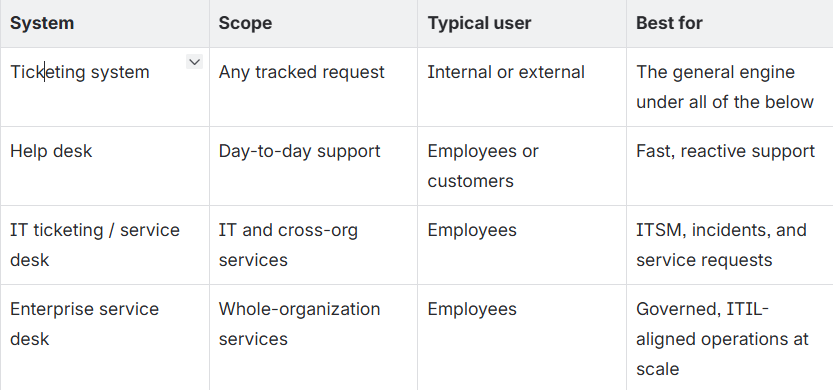
IT ticketing system: manages technical issues and IT requests, including access, hardware and software problems. Commonly included in an ITSM platform.
Help desk: receives and processes common and routine support requests, often involving direct interactions with customers or for routine internal support.
Enterprise service desk: A more comprehensive system that is aligned to ITIL and that covers incidents, service requests and changes throughout the organization, not just the IT organization.
Customer support ticketing: handles external customer tickets through channels.
The basics of the game remain the same. But it's in the scope, in who is raising the tickets and in the amount of process and governance that sits around them.
Key features of a ticketing system
Typically, robust system ticketing will contain:
Multichannel capture: All email, chat, portal, and voice requests are converted into tickets.
Automated routing and prioritization: to ensure tickets are to the right owner, quickly.
A knowledge base: for agents and users to access without having to open a ticket.
SLA tracking: to keep resolution and response times to a standard.
Reporting and analytics: of volume, resolution time and satisfaction.
Self-service: allows users to solve simple requests themselves.
It's the final feature that's undergoing the most change in the model.
AI ticketing: from managing tickets to resolving them
Traditional system ticketing is designed to manage a queue. It makes the assumption that there is a human behind each ticket. The issue is that many tickets are repetitive – such as password resets, access requests, status enquiries, and how-to questions that are asked thousands of times.
AI ticketing changes the target. An AI system solves the ticket and not passes it on to a human for faster resolution. It's done in two ways:
Deflection: the user gets an instant, accurate answer from an AI assistant, so no ticket is ever created.
Auto-resolution: for tickets that are created, an AI agent completes the action end to end, such as resetting access or pulling a status, without a human touching it.
This is a step from a passive ticket queue to an active system which helps to minimize the ticket queue. It is also the place where IT process automation and AIOps use cases collide with the service desk: routine work is automated, and the ones that require complex, high-judgment work are the ones that need human involvement.
Ticketing system vs help desk vs service desk
Ticketing system vs help desk vs service desk
How Fluid AI enhances traditional ticketing systems
Fluid AI is not just a ticketing system. An enterprise agentic AI platform that integrates with your ticketing, CRM, ERP and business systems to prevent, automate and even eliminate tickets before they reach a queue. It is not a replacement for platforms such as ServiceNow, Zendesk, Freshdesk, Jira or Salesforce Service Cloud; it's meant to complement them.
It brings a transformation from ticket management to resolution management. Rather than asking "how fast can we close tickets", the question is "how many issues can we solve before they are tickets?".
Here's how it works in real life. A request is received, the AI decodes the intent, accesses the appropriate company data, reviews customer/employee records, links to such systems as SAP, Oracle, Salesforce, or a banking core, and completes the desired task and resolves the request. Only generates or escalates tickets when a human is truly necessary, and even then, the AI provides the complete context.
What that lets Fluid AI do on top of your ticketing stack:
Take care of common requests without needing to create a ticket, like resetting a password, updating an account, checking a status, collecting documents, and answering frequently asked questions.
Operate in all channels: voice, chat, email, WhatsApp and web – for a unified experience. Take action, not just respond: Update records, gather documents, escalate cases, route to the appropriate team – and more – with full context.
Support human agents on complex cases by summarizing the conversation, giving context and suggesting further actions.
Remain enterprise-safe, role-based access control, verify actions before they take place, complete audit trails, SOC 2 Type II and ISO 27001 certified, on-premise, hybrid, private cloud or user-provisioned cloud.
In regulated industries such as banking, insurance and government, 1000+ integrations mean that you can solve tickets instead of simply routing them, by connecting it to systems that you already use.
To see how this maps to your environment, look at Fluid AI's AI customer support automation, the agentic AI platform features, and the deeper take in the end of ticket-based customer service.
Where Fluid AI fits
Fluid AI is an enterprise agentic AI platform built for exactly this kind of work: autonomous agents that connect to your core systems, act across voice, chat, email, and WhatsApp, and complete multi-step tasks rather than just answering questions.
It is designed for regulated, high-security environments, runs on-premise or in your private cloud, is SOC 2 and ISO 27001 certified, and supports 150+ languages, which matters for cross-border supply chains.
Book your Free Strategic Call to Advance Your Business with Generative AI!
Fluid AI is an AI company based in Mumbai. We help organisations kickstart their AI journey. If you're seeking a solution for your organisation to enhance customer support, boost employee productivity and make the most of your organisation's data, look no further.
Take the first step on this exciting journey by booking a Free Discovery Call with us today and let us help you make your organisation future-ready and unlock the full potential of AI for your organisation.
Frequently asked questions
1. What is system ticketing?
It involves taking all requests or problems and assigning a ticket to them, after which they are given priority and addressed in a single location without them getting lost.
2. What is the difference between a ticketing system and a help desk?
A ticketing system is the software that keeps track of requests as tickets. A help desk is one application of that engine that is used to support the day to day problems. All help desks use ticketing; not all ticketing is a help desk.
3. What is an IT ticketing system?
A system used to submit tickets that are typically intended for technical problems and IT service requests, often integrated into an ITSM or service desk solution.
4. How does AI improve system ticketing?
Deflects repetitive requests with a quick response and resolves common tickets end to end, reducing ticket volume and resolution time, and giving agents more time to work on complex tickets.
5. What features should a ticketing system have?
Multichannel capture, automated routing, knowledge base, SLA tracking, reporting and self-service, and more, and more AI resolution is now being demanded.
6. Does Fluid AI replace my ticketing system?
No. Fluid AI operates on top of your current ticketing, CRM and ERP systems and solves or deflects issues before they turn into tickets. It's not a replacement for other platforms, such as ServiceNow, Zendesk, or Salesforce, although it can work alongside them.
_1790254083168-CB8e8KXC.png)