Snowflake Vector DB: Why Enterprise RAG Is Moving Closer to the Data in 2026

TL;DR
Enterprise RAG is moving out of standalone vector DBs and into the data warehouse itself.
Snowflake's native vector data type, Cortex Search, and in-database embeddings remove the need to copy data anywhere.
Governance, lineage, and access control come for free - they're already there.
Standalone vector DBs solved an early problem; data gravity is solving the next one.
Enterprises that adopt this pattern in 2026 stop paying twice for the same data.
The Shift: From Standalone Vector DBs → External RAG Pipelines → In-Warehouse Vector Search
Let's be honest: most enterprise RAG architectures today look like this.
Your data lives in Snowflake. You ETL it into a vector DB. You chunk it, embed it, store it. You sync it back every few hours, hoping nothing drifts. You manage two access policies, two security models, two audit trails.
And every time the source data changes, the entire pipeline holds its breath.
This isn't because anyone wanted it this way. It's because vector DBs arrived as standalone tools, Pinecone, Weaviate, Chroma, Milvus, and warehouses didn't have native vector support yet.
That's changed.
Snowflake's VECTOR data type, similarity functions, Cortex Search, and embedding functions now sit natively where your data already lives. The retrieval layer no longer needs to be somewhere else.
And once you remove the need to move data, most of the reasons people built external RAG pipelines simply disappear.
What Snowflake Vector DB Actually Is
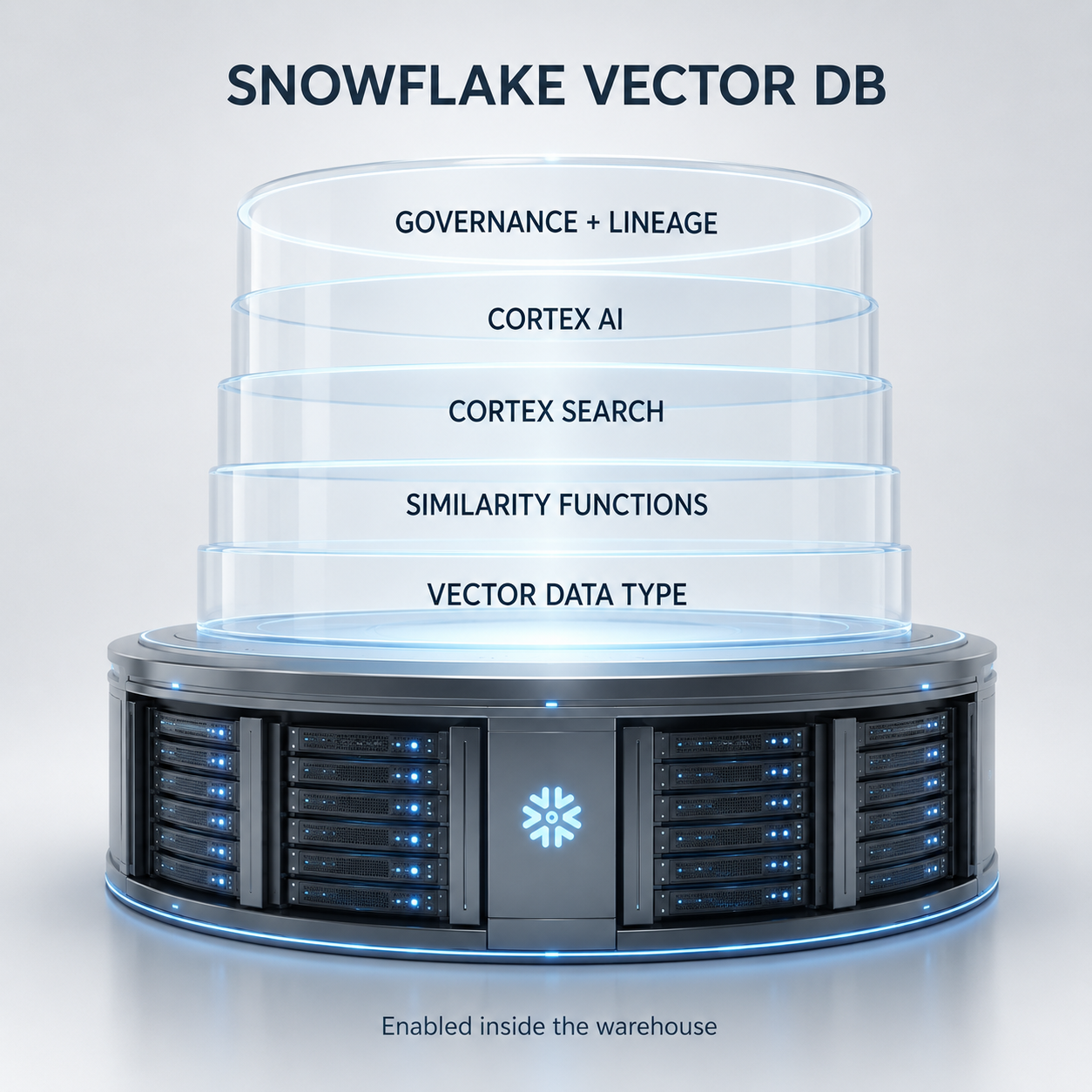
It's not a separate product. It's a set of capabilities Snowflake has folded into the warehouse itself:
A native VECTOR data type that stores embeddings inside your existing tables
Built-in similarity functions, cosine, L2, inner product, that run on your warehouse compute
Cortex Search, a managed retrieval service that handles chunking, embedding, and ranking
Cortex AI functions that let you run embeddings and inference without leaving SQL
Governance, masking, and lineage that you've already configured for the underlying data
You don't deploy it. You enable it.
Which means your vector index isn't a separate system, it's a column on a table you already own.
If you want to understand the broader pattern behind this, the closest parallel is how enterprise systems begin working together through a shared AI layer.
What Makes Snowflake Vector DB Different
1. No ETL between source and retrieval
The biggest hidden cost in enterprise RAG isn't compute. It's keeping your vector store in sync with your source.
Documents update. Policies change. Customer records get amended. In an external setup, every change needs a re-embed, a re-index, and a sync job.
In Snowflake, the embedding lives next to the row that produced it.
When the row changes, the embedding can change in the same transaction. No drift, no stale retrieval, no 3 a.m. sync failures.
2. Governance inherited from your existing data layer
Vector DBs ship with their own access control models, which is a polite way of saying you now have two sets of permissions to manage.
Snowflake vectors inherit row-level security, column masking, role-based access, and data lineage from the table they sit on.
If a finance analyst can't see a row, they can't retrieve its embedding either. If a region's data is geo-fenced, the vector is geo-fenced.
This is the boring win that compliance teams actually care about, and it's the same principle behind the multi-LLM enterprise architecture Fluid AI uses for regulated deployments.
3. Compute that scales with your warehouse, not against it
External vector DBs come with their own scaling story. More documents, bigger cluster. Faster queries, more nodes. Paid for separately, monitored separately, tuned separately.
Snowflake's vector queries run on the same warehouses your analysts already use.
Scale up for a heavy embedding job, scale back down when the job ends. No second infrastructure to keep alive.
Why Enterprises “Need This Now”
1. Data gravity is finally winning
The whole "move data to where the AI is" assumption is breaking.
Petabytes don't move easily. Sensitive data shouldn't move at all if it can be avoided.
Bringing the AI to the data is cheaper, faster, and dramatically easier to govern.
2. Security teams are saying no to copies
The single most common reason enterprise AI pilots stall isn't model quality. It's the security review around data going somewhere new.
When your vector store is a column on a table that's already been approved, the review is mostly already done.
3. Standalone vector DBs become hard to justify
Two years ago, you needed an external vector DB because warehouses didn't do vectors. That's no longer true.
Most enterprises now ask the harder question: why are we paying for, and securing, a second data system to do something the first one can do natively?
What Snowflake Vector DB Actually Does (With Real Examples)
These patterns are already live across enterprise deployments.
1. Internal Knowledge Search Across Enterprise Documents
The retrieval layer:
Ingests policies, contracts, SOPs, manuals, internal decks
Embeds them inside the same database that already holds your other knowledge
Surfaces results filtered by role, region, and clearance
Updates as the underlying documents change
No separate search system. No syncing. Just retrieval that respects the access model the rest of your business already uses, the foundation of Agentic RAG.
2. Customer Support RAG Grounded in CRM Data
Tickets, accounts, transaction history, prior interactions, all of it lives in your warehouse already.
An agent built on Snowflake Vector DB:
Reads the customer's full context from the same tables your support team queries
Retrieves similar past cases via vector search
Drafts a response grounded in actual customer data, not a separate knowledge silo
The result is RAG that knows the customer, not just the FAQ.
3. Compliance and Policy Retrieval at the Speed of the Question
Compliance teams ask the same kinds of questions repeatedly: which policy applies, which rule changed last quarter, what was the exception process for this scenario.
In-warehouse vector search lets them get answers grounded in the live policy table, not a stale export.
When the policy updates, the retrieval updates with it.
4. Financial Document Analysis Without Data Movement
Filings, statements, transaction narratives, regulatory submissions, sensitive enough that most institutions refuse to send them to an external service.
Embedding and retrieval inside the warehouse means the documents never leave. The analysis happens where the data already lives.
For regulated industries, this is the unlock.
5. Semantic Search on Operational Data
Beyond documents, vector search is now being used on structured operational data: log messages, error patterns, customer feedback, support transcripts.
Anywhere a "find me things like this" query is more useful than a "find me things matching this filter" query, vector search in the warehouse becomes the default.
The Architecture Behind In-Warehouse RAG
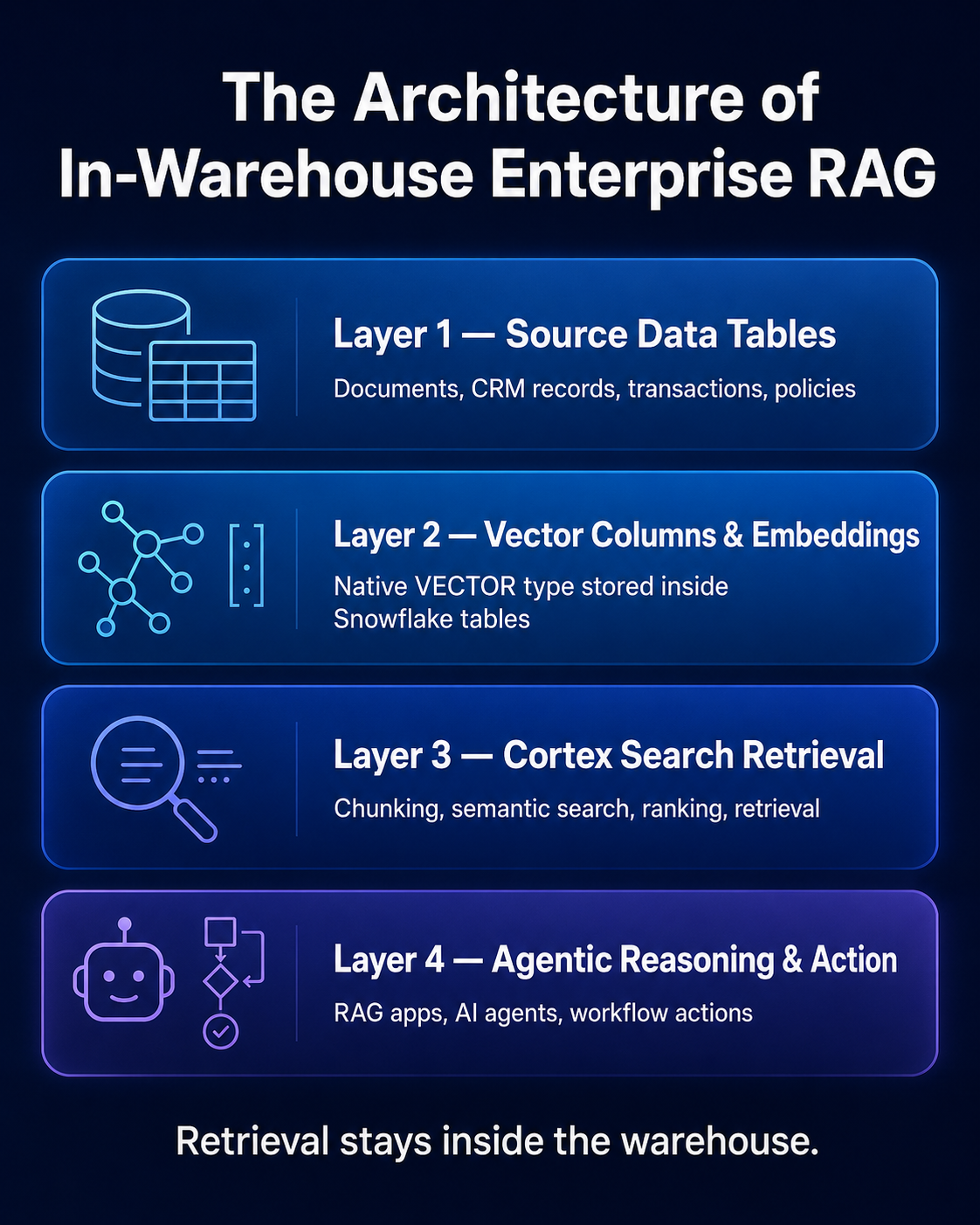
Why 2026 Is the Breakout Year
Three things are converging:
Native vector support has matured across the major data platforms, Snowflake, Databricks, BigQuery, making in-warehouse RAG a real option, not a beta one
Embedding model quality has crossed the threshold where retrieval grounded in enterprise data outperforms general-purpose semantic search
Procurement and security teams are pushing back hard on "another data system" requests, which is closing the door on standalone vector DB sprawl
Put them together, and the default architecture for enterprise RAG shifts from "external vector DB plus sync pipeline" to "vectors live where the data lives."
How Enterprises Can Start - Without Re-Architecting Everything
1. Pick one high-value retrieval use case
Customer support knowledge, policy lookup, internal docs - choose something with clear value and bounded scope.
2. Stay inside Snowflake
Use the native vector data type and Cortex Search. Don't introduce a second system unless you've proven you need one.
3. Layer the agentic workflow on top
Retrieval is only half the work. The rest is reasoning, action, and handoff, which is where an agentic orchestration layer earns its place.
4. Govern the embeddings like you govern the data
Same access control. Same lineage. Same audit trail. If you're treating them differently, you're rebuilding the problem you set out to solve.
5. Expand only when the first use case is real
Resist the temptation to roll out everywhere at once. Prove value in one workflow, then extend.
If you want a clear maturity roadmap, this aligns cleanly with our enterprise agentic AI playbook.
What This Means for Leadership
If you're a CIO, CTO, CDO - this is where your data strategy and your AI strategy stop being separate things.
The enterprises that win the next phase will be the ones that:
Treat the warehouse as the substrate for retrieval, not just analytics
Stop building parallel data systems for AI
Make their AI architecture inherit the governance their data architecture already has
This isn't a vector DB decision. It's a data architecture decision.
Final Thought
Enterprise RAG didn't fail because the models weren't ready.
It got harder than it needed to be because the retrieval lived in the wrong place.
The moment retrieval moves into the warehouse, RAG becomes another query - governed, audited, fast, and grounded in the data your enterprise already trusts.
That's the unlock for 2026.
Book your Free Strategic Call to Advance Your Business with Generative AI!
Fluid AI is an AI company based in Mumbai. We help organizations kickstart their AI journey. If you’re seeking a solution for your organization to enhance customer support, boost employee productivity and make the most of your organization’s data, look no further.
Take the first step on this exciting journey by booking a Free Discovery Call with us today and let us help you make your organization future-ready and unlock the full potential of AI for your organization.