How AI Agents Compress Insurance Claims Processing from Weeks to Hours

TL;DR
Insurance claims often take days or weeks because teams must review documents, check policy terms, verify details, and investigate possible fraud. AI agents can automate much of this work by handling claim intake, extracting information from documents, checking for fraud signals, and preparing settlement recommendations. Fluid AI brings these steps together in one connected workflow, helping insurers reduce manual work, speed up claim processing, and maintain a clear audit trail while keeping human experts involved where needed.

Why Insurance Claims Still Take So Long
Insurance claims should be straightforward: report the incident, submit documents, verify coverage, and receive payment. In practice, missing paperwork, system updates, coverage checks, and fraud reviews often slow each claim down.
Motor claims may need FIRs, photos, estimates, and surveyor reports; health claims may need bills, discharge summaries, prescriptions, and hospital records. At high volumes, this manual work quickly creates backlogs.
The core issue is the manual effort required to move each claim from one stage to the next.
This is where AI agents can help.
What Is Agentic AI in Insurance Claims Processing?
Traditional automation follows fixed rules. It works well when information arrives in a predictable format, but insurance claims rarely do.
Documents come in different formats. Customers describe incidents in their own words. Policy conditions vary, and some claims need additional investigation.
Agentic AI can handle these changing situations by using AI agents to complete specific tasks, work with enterprise systems, and pass information between stages of a workflow.
Instead of asking one AI model to handle everything, insurers can use specialised agents for different parts of the claims process.
For example, one agent collects claim details, another reads documents, another checks for possible fraud, and a fourth prepares a settlement assessment.
Together, these agents help reduce manual handoffs and keep claims moving.
How AI Agents Automate the Insurance Claims Lifecycle
Fluid AI's Claims Automation Engine brings key claims activities into a connected workflow, from the First Notice of Loss (FNOL) to the settlement assessment.
1. Claims Intake AI: Capture the Claim from the Start
The claims process begins when a customer reports an incident. This is known as the First Notice of Loss, or FNOL.
Traditionally, an employee may need to speak with the customer, fill out forms, enter details into a claims system, and send the case to the right team.
A Claims Intake AI agent can collect this information through channels such as WhatsApp, voice, mobile apps, and web portals.
It can capture important details, including:
The type of incident and when it occurred
The policy and claimant details
Vehicle or patient information, where relevant
Contact details and supporting information
The agent can then pass the collected details to the next stage of the workflow. Where an inspection is needed, the process can also help initiate the surveyor or inspection request.
This reduces the time spent on initial data entry and helps claims teams start processing cases sooner.
2. Document Extraction AI: Turn Documents into Usable Information
Insurance claims depend on documents. But those documents do not always arrive in a format that is easy to process.
A customer may upload a photograph of a repair bill. A hospital may provide a long discharge summary. A police report may contain handwritten information.
Employees often have to open each file, find the relevant details, and enter them into the claims system.
Document Extraction AI helps automate this work. It reads supported documents and extracts important information into a structured format that downstream systems can use.
Depending on the claim, this may include:
FIRs and incident reports
Medical bills and discharge summaries
Repair estimates and invoices
Photographs and supporting forms
Policy and claimant details
Multilingual document processing can also help insurers handle documents in English, Hindi, and other supported regional languages.
The extracted information can then be checked against the claim details and passed to the next stage.
The benefit is simple: less manual data entry, faster document review, and fewer delays caused by moving information between systems.
3. Fraud Detection AI: Identify Claims That Need a Closer Look
Not every claim is straightforward. Some contain inconsistent information, suspicious documents, or patterns that require further investigation.
Traditional fraud detection systems often depend on predefined rules. These rules are useful, but they may not identify every unusual pattern.
A Fraud Detection AI agent can review available claim information and assess potential fraud indicators before settlement.
Depending on the data and checks available, this can include:
Differences between documents and claim details
Unusual claim patterns or repeated submissions
Inconsistencies in bills, amounts, or supporting evidence
Connections between claimants, service providers, or previous claims, where relevant data is available
Fluid AI's claims use case highlights the assessment of more than 40 fraud indicators and reports up to 70% fewer false-positive fraud flags compared with traditional rule-based systems.
This matters because false positives create extra work. When a genuine claim is flagged unnecessarily, employees must spend time reviewing it before it can move forward.
AI-assisted fraud screening can help teams focus their attention on cases that need closer investigation. A risk signal is not proof of fraud, so suspicious cases should be reviewed using the appropriate checks and approval process.
4. Assessment Draft AI: Match the Claim Against the Policy
Once the relevant information is collected, the insurer needs to determine what the policy covers and what settlement may be appropriate.
This step can involve checking coverage limits, deductibles, exclusions, and other policy conditions. The claims team must also confirm that the evidence supports the assessment.
An Assessment Draft AI agent can bring these details together.
It can compare extracted claim information with the relevant policy terms, identify possible exceptions, and prepare a draft assessment with supporting policy references.
The assessment can include:
A summary of the incident and submitted documents
Relevant policy terms and coverage conditions
Missing information or inconsistencies
A proposed payout calculation, where the required information is available
Reasons supporting the recommendation
Instead of starting the assessment from scratch, the claims adjuster receives a prepared view of the case and can focus on checking the evidence and resolving exceptions.
AI prepares the assessment. The insurer's authorised team retains the appropriate decision-making and approval controls.
For eligible, straightforward claims, greater automation may reduce the need for manual intervention. Complex, high-value, or suspicious claims can be routed for additional review.
How the Four Agents Work Together
AI agents create value by linking tasks across the claims journey, rather than automating each step in isolation.
In a motor claim, the intake agent records the incident, the document agent extracts details from evidence, the fraud agent checks for unusual patterns, and the assessment agent reviews the policy to prepare a recommendation.
If the system finds missing documents or conflicting information, the claim can be sent for further checks. If the claim is straightforward and meets the insurer's rules, it can move through a more automated path.
Claim Intake → Document Extraction → Policy Verification → Fraud Screening → Assessment Draft → Approval or Further Review
Traditional Claims Processing vs. AI-Powered Claims Processing
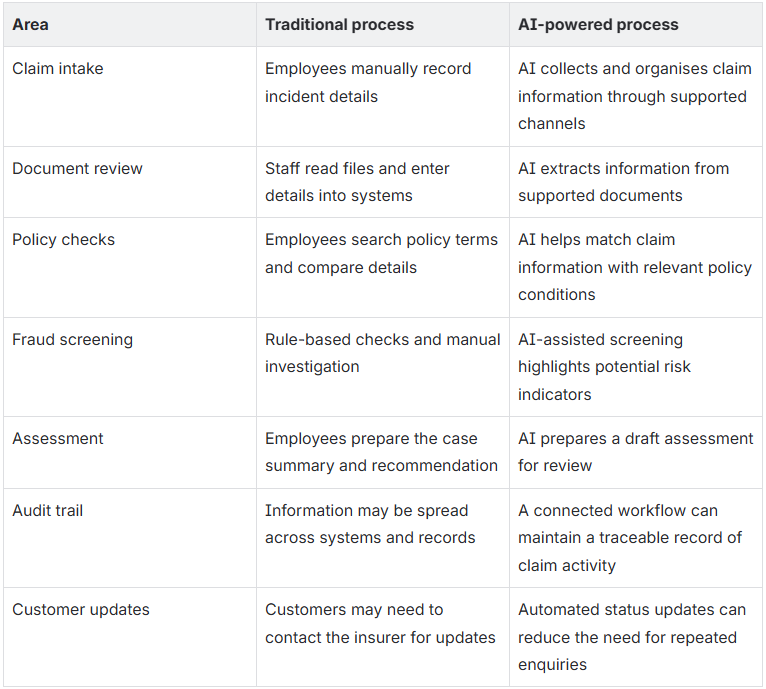
AI does not remove the need for good claims controls. Its role is to reduce repetitive work and help employees make informed decisions faster.
What Results Can Insurers Expect?
The impact of claims automation depends on claim type, document quality, existing systems, and how much of the process can be automated.
Fluid AI's claims use case reports the following outcomes:
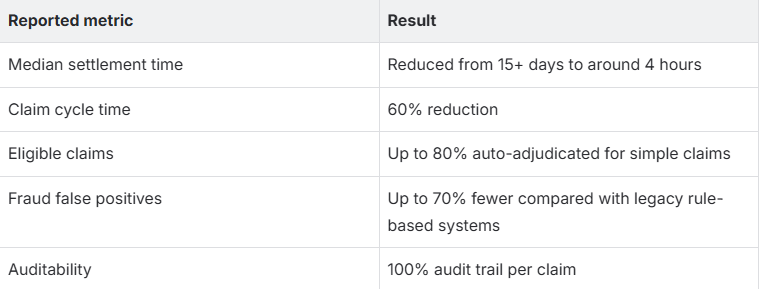
These are reported use-case figures, not guaranteed results for every insurer. Actual outcomes depend on the implementation, the insurer's workflow, and the types of claims being processed.
The broader benefit is that claims teams can spend less time on repetitive administrative tasks and more time handling exceptions, complex cases, and customer needs.
Integrating AI Agents with Existing Insurance Systems
Insurers rely on core claims, policy, document, payment, and surveyor systems, so automation must integrate with existing technology rather than replace it.
Fluid AI connects with enterprise platforms such as Guidewire, Duck Creek, and Majesco, as well as document storage, surveyor networks, and payment services.
Clear integration rules define how data moves, how missing information is handled, and when claims go to human review, ensuring automation supports teams without creating another disconnected system.
Security, Compliance, and Human Oversight
Protect sensitive claims data, including personal, financial, medical, and vehicle information.
Use on-premises or private-cloud deployment to keep data within the insurer’s chosen environment.
Define access permissions, data-handling rules, logs, approvals, and compliance checks, including applicable IRDAI requirements.
Maintain audit trails so teams can trace inputs, checks, recommendations, and actions.
Keep human oversight for exceptions and higher-risk claims while automating straightforward cases.
The Future of Insurance Claims Processing
Insurance claims processing involves many connected tasks, from collecting incident details to checking documents, verifying coverage, and preparing a settlement recommendation.
When these tasks are handled through separate systems and manual handoffs, even a simple claim can take longer than necessary.
AI agents help connect these stages into a more coordinated workflow. They can collect information, process documents, highlight potential risks, and prepare assessments so that claims teams spend less time on repetitive work.
Fluid AI applies this approach to insurance claims automation, with the goal of helping insurers move from slow, manual processing to faster and more transparent claim journeys.
The goal is not just to process claims faster. It is to help insurers resolve claims with less manual effort, better visibility, and the right controls at every stage.
Learn more about Fluid AI's Insurance Claims Automation Engine.
Book your Free Strategic Call to Advance Your Business with Generative AI!
Fluid AI is an AI company based in Mumbai. We help organisations kickstart their AI journey. If you're seeking a solution for your organisation to enhance customer support, boost employee productivity and make the most of your organisation's data, look no further.
Take the first step on this exciting journey by booking a Free Discovery Call with us today and let us help you make your organisation future-ready and unlock the full potential of AI for your organisation.
_1790254083168-CB8e8KXC.png)