What Good Human-AI Collaboration Looks Like in Bank Customer Support?

TL;DR
The real question for AI in bank customer support isn't "how many agents can we cut", it's where the line between AI and humans should sit.
Split by strength: AI handles scale, speed, and repetition; people handle judgment, empathy, and exceptions.
Draw the line by risk: automate low-risk, high-volume queries fully; AI assists and humans decide on medium-risk; humans lead on fraud, hardship, and high-value cases.
The handoff makes or breaks it, when AI escalates, it must pass full context so the customer never repeats themselves.
Done right, AI doesn't replace the support team; it frees them for the work only people can do, inside the access controls and audit trails banking demands.
The debate around AI in bank customer support is usually framed as a replacement question: how many agents can we cut? That's the wrong question, and banks that lead with it tend to end up with frustrated customers and a support team that's lost trust in the tools.
The better question is a collaboration question: what should AI do, what should people do, and where exactly is the line? Get that division right and you get faster resolutions, lower cost, and happier customers and staff. Get it wrong and you get a bot that annoys people until they mash "0" for a human anyway.
Here's what a good human-AI collaboration model actually looks like in a bank.
What Is Human-AI Collaboration in Bank Customer Support?
Human-AI collaboration means AI and human agents working as one system, each doing what it's best at, rather than AI simply replacing people. AI handles the high-volume, routine side of support. Humans handle judgment, empathy, and the cases that carry real consequence. And critically, they support each other: AI escalates to humans when needed, and assists humans while they work.
It's not automation versus people. It's a deliberate division of labour, with a clear boundary between the two.
AI vs Humans in Banking Support: Who Should Handle What?
The whole model rests on one honest split.
AI is good at scale, speed, and repetition. It can answer thousands of queries at once, at any hour, pull a balance or transaction history instantly, and handle the same routine question the ten-thousandth time as patiently as the first.
People are good at judgment, empathy, and exceptions. A distressed customer whose card was frozen abroad, a complex dispute, a vulnerable client, a decision with real financial consequence, these need a human who can read the situation and be accountable for the call.
A good model plays to both. AI takes the volume so humans have the time and headspace for the moments that actually need them.
How to Draw the Line by Risk?
The practical question is where AI stops and a human takes over. The cleanest way to draw that line is by risk and consequence.
Low-risk, high-volume: automate fully. Balance checks, transaction history, branch hours, card activation, statement requests. High volume, low downside, let AI run it end to end.
Medium-risk: AI assists, human decides. A loan query, a fee waiver, a limit change. The AI gathers the context and proposes; a human approves.
High-risk or sensitive: human-led, AI supports. Fraud, hardship, complaints, anything touching a vulnerable customer or a significant sum. The human leads; the AI just hands them the full picture.
This is the difference between autonomy that's useful and autonomy that's reckless. The bank sets the boundaries deliberately, rather than hoping the bot knows its limits.
Why the AI-to-Human Handoff Makes or Breaks Support
Most bad AI support experiences aren't bad because the AI was dumb. They're bad because the handoff to a human was broken, the customer explains everything to the bot, gets transferred, and has to explain it all again from scratch.
A good collaboration model treats the handoff as a first-class feature. When AI escalates, it passes the human the full context: who the customer is, what they asked, what's already been tried, and why it's escalating. The customer never repeats themselves, and the human starts the conversation already up to speed. That single detail does more for customer satisfaction than almost anything else.
How AI Makes Human Support Agents More Effective
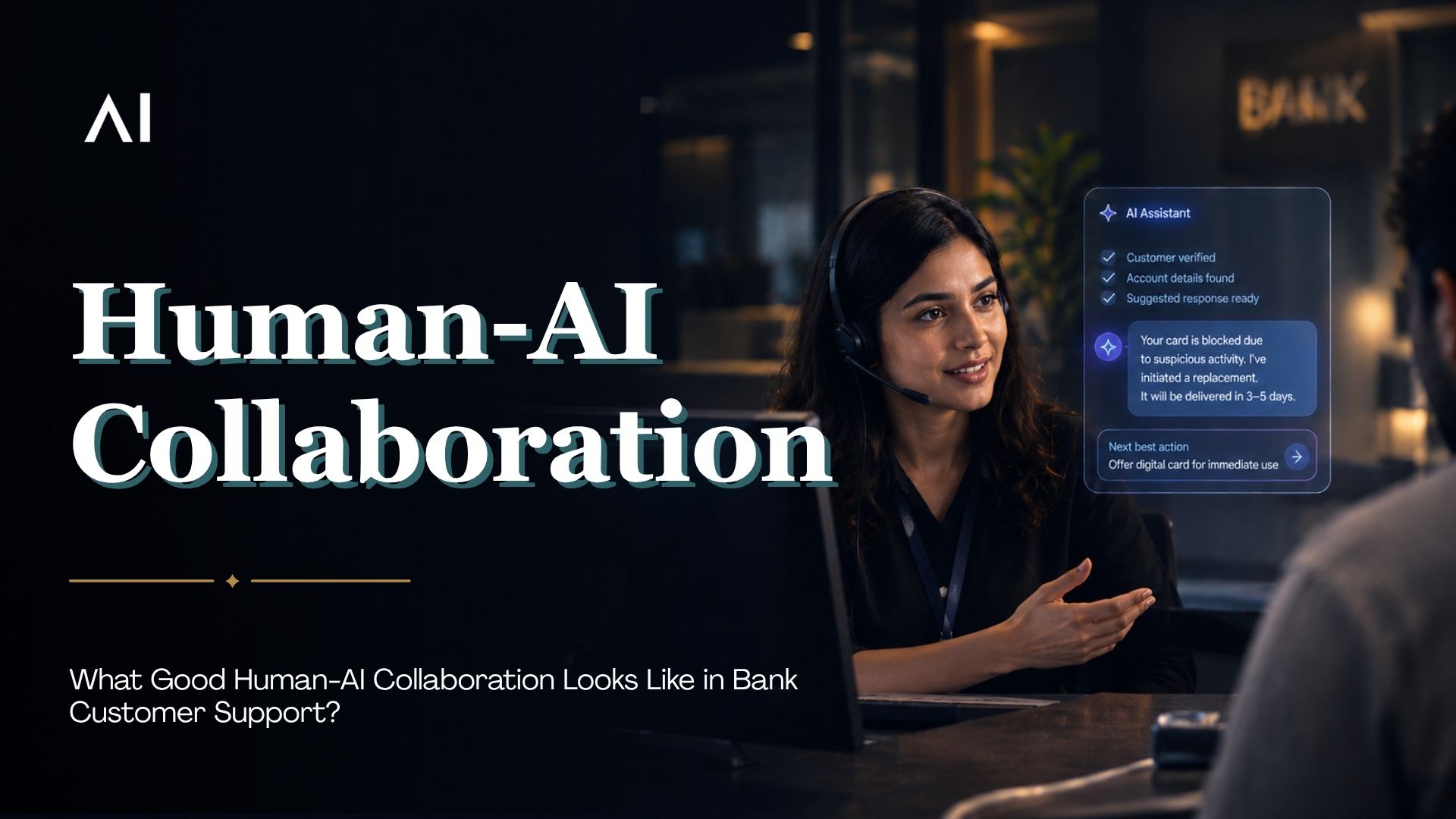
The best models don't only route work away from agents, they make the agents who remain more effective. While a human handles a complex case, AI works alongside them: surfacing the relevant policy, summarising the customer's history, drafting a suggested response, pulling the account detail they'd otherwise dig for.
The result is a support agent who spends their time on judgment and the customer, not on hunting through five systems. That's the quiet win of good human-AI collaboration: it doesn't just deflect tickets, it upgrades the people doing the work.
Why Human-AI Collaboration Matters More in Banking
Banking raises the stakes on all of this. Customer data is sensitive and regulated, so the AI has to operate inside strict access controls and keep an audit trail of every action. Decisions carry real financial and compliance weight, so the human-in-the-loop boundaries aren't optional niceties, they're how the bank stays defensible. And trust is the product; a support experience that feels careless erodes the relationship in a way it wouldn't for a retail app.
That's why, in banking especially, the answer is never full automation or pure human effort. It's a deliberate collaboration model, with AI carrying scale inside clear boundaries, humans owning judgment and accountability, and clean handoffs connecting the two.
The takeaway
Good human-AI collaboration in bank customer support isn't about how much you can automate. It's about drawing the line in the right place: AI for scale, speed, and repetition; humans for judgment, empathy, and exceptions; risk-based boundaries deciding who handles what; and handoffs clean enough that the customer never feels the seam. Done that way, AI doesn't replace your support team. It gives them back the time to be good at the parts only people can do.
Book your Free Strategic Call to Advance Your Business with Generative AI!
Fluid AI is an AI company based in Mumbai. We help organisations kickstart their AI journey. If you're seeking a solution for your organisation to enhance customer support, boost employee productivity and make the most of your organisation's data, look no further.
Take the first step on this exciting journey by booking a Free Discovery Call with us today and let us help you make your organisation future-ready and unlock the full potential of AI for your organisation.
Frequently asked questions
1. What is human-AI collaboration in customer support?
A model where AI handles high-volume, routine queries while human agents handle judgment, empathy, and complex or sensitive cases, with AI also assisting humans by surfacing context and drafting responses.
2. Should banks fully automate customer support?
No. The strongest approach draws a risk-based line: automate low-risk, high-volume queries, keep humans in control of high-risk, sensitive, or high-value decisions, and have AI assist in between.
3. What makes AI customer support fail in banking?
Usually a broken handoff, forcing customers to repeat themselves when transferred to a human, plus rigid bots that can't handle exceptions and weak controls over sensitive data.
4. How does AI make human support agents better?
By working alongside them, summarising customer history, surfacing relevant policy, pulling account details, and drafting responses, so agents spend time on judgment and the customer instead of searching systems.
_1790254083168-CB8e8KXC.png)